
International SEO: How to Rank in Markets You Don't Speak
There is a particular kind of nervousness that arrives the first time a company decides to take its content into a country it does not operate in, written in a language nobody on the team speaks. The instinct is to treat it as a translation project — feed the existing blog into a translation tool, publish the output under a new folder, and wait for traffic from a new market to appear. It almost never does. International SEO is not your domestic SEO with the words swapped out. It is a different discipline, and the teams that succeed at it treat it that way from the first decision.
This is a working guide to ranking in markets you do not personally speak. It will not pretend the language barrier is trivial — it is real, and ignoring it is the most common way these projects fail. But the language barrier is also not the hardest part. The hardest part is the structural and strategic decisions you make before a single word is translated, and those decisions are entirely within your control regardless of which languages you read.
Start with a market, not a language
The first mistake international SEO programs make is choosing languages instead of markets. "Let's do Spanish" is a language decision. "Let's enter Mexico" is a market decision, and only the second one is actionable.
The distinction matters because a language is not a market. Spanish is spoken across Spain, Mexico, Colombia, Argentina, and a dozen other countries, and the search behaviour, competition, vocabulary, and commercial conditions differ sharply between them. The word for a common product or feature can vary by country. The dominant competitors are local, not shared. The price sensitivity, the buying process, the seasonality — all of it is market-specific. A single "Spanish" page that tries to serve all Spanish-speaking countries at once serves none of them well, because it cannot speak to any of their specifics.
So the first deliverable of an international SEO program is not a translation. It is a shortlist of target markets, ranked. Rank them by three things: the size of the search demand for your subject in that market, the level of competition you would face there, and how well your product actually fits that market's needs and ability to buy. A market with large demand, beatable competition, and genuine product fit is worth entering. A market with one or two of those — and many will have only one or two — is worth waiting on. Enter markets deliberately, one or a few at a time, rather than declaring "we now support twelve languages" and supporting none of them properly.
Choose your URL structure before you publish anything
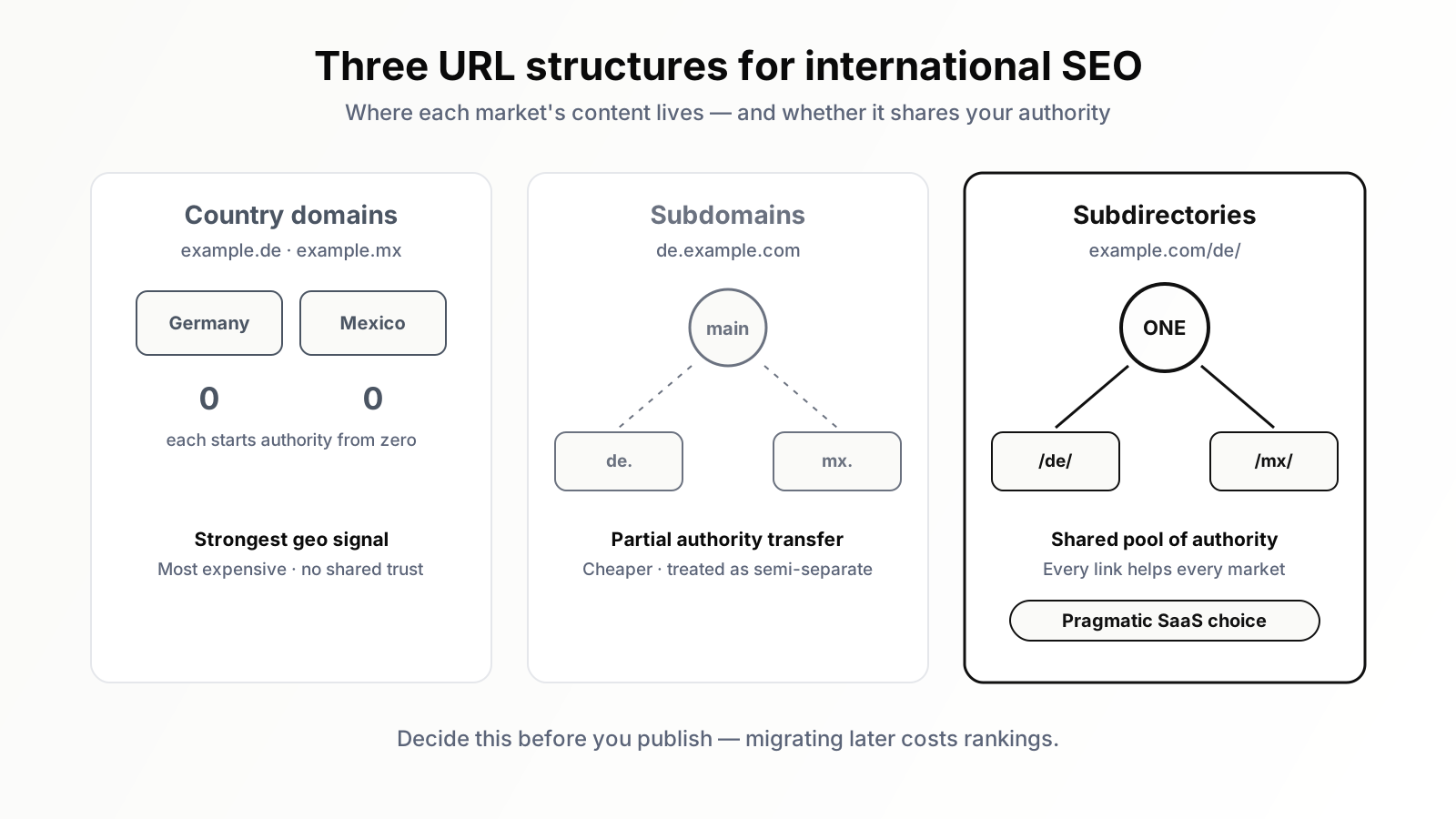
Once you know your markets, the next decision is structural and it is close to irreversible, so it deserves real thought before you commit. How will the different-market versions of your site be organised in your URLs? There are three standard options.
The first is a country-code top-level domain — a separate domain per country, such as example.mx or example.de. This sends the strongest possible geo-targeting signal to search engines, because the domain itself declares the target country. But it is the most expensive to acquire and maintain, and each domain builds its authority from zero, so a new country domain inherits nothing from your main site's reputation.
The second is a subdomain — mx.example.com, de.example.com. This is cheaper and easier to set up, but search engines treat subdomains as somewhat separate from the main domain, so authority transfer between them is partial and unreliable.
The third is a subdirectory — example.com/mx/, example.com/de/. The market versions live as folders within your single main domain. This is the option most SaaS companies should choose, for one decisive reason: the entire site shares one pool of domain authority. Every backlink your main site has ever earned helps the new market folders rank, instead of forcing each market to start its authority climb from nothing. For a company without a vast budget, that shared authority is the difference between a new market ranking within months and never ranking at all.
There is no universally correct answer — a large enterprise with country-specific legal entities may genuinely need separate domains. But for most companies expanding a content program into new markets, subdirectories are the pragmatic, authority-preserving choice. Decide this before you publish, because migrating URL structures later is painful and costs rankings while it settles.
hreflang: telling search engines who each page is for
Once you have multiple versions of a page — one for each market and language — search engines face a question: which version should they show to which searcher? The answer is a piece of markup called hreflang, and it is the technical backbone of international SEO.
An hreflang annotation is a signal on each page that says, in effect, "this page is the right version for people searching in this language, in this region." When the same content exists in English for the United States, English for the United Kingdom, and Spanish for Mexico, hreflang lets each version tell search engines exactly which audience it serves. The payoff is twofold. It points each searcher to the version meant for them — a Mexican searcher sees the Mexican-Spanish page, not the page meant for Spain. And it tells search engines that these pages are deliberate market variants of each other, not duplicate content competing for the same rankings.
hreflang has a deserved reputation for being fiddly. The annotations must be reciprocal — if page A points to page B as its Spanish version, page B must point back to page A as its English version, or search engines ignore the signal. The language and region codes follow a specific standard and a single typo can void an entry. And every market version of a page must be accounted for, including a default fallback for searchers who match none of them. The detail is real, but the concept is simple, and getting it right is not optional — without functioning hreflang, your market versions compete against each other instead of cooperating.
Translation is the floor, not the ceiling
Here is where the "I don't speak the language" anxiety becomes legitimate — and where it must be handled honestly.
Machine translation has improved enormously, and for getting the literal meaning of a page across, it is now genuinely good. But ranking in a market requires more than literal meaning. It requires that your content uses the words that market's searchers actually type into a search engine — and those words are frequently not the textbook translation of your domestic keywords.
A direct translation of your English keyword may be grammatically perfect and commercially useless, because real searchers in that market use a different word, a regional variant, a borrowed English term, or a shorter colloquial phrase. No translation tool fixes this, because it is not a translation problem. It is a keyword research problem that has to be done natively, in the target market, in the target language. You cannot rank for the search terms of a market until you know what those terms are, and you cannot know that by translating your existing list.
The practical implication: budget for native-language keyword research in every market you enter, and budget for a native speaker — a translator with subject knowledge, an in-market reviewer, or a local contractor — to review the content before it publishes. They are not just checking grammar. They are checking that the content reads as though it was written for that market, uses that market's vocabulary, and does not contain the small errors of register and idiom that quietly signal "this was translated by a foreigner" to local readers and, increasingly, to search engines assessing quality. Translation gets you to the floor. Native review gets you off it.
Localise the substance, not only the words
Beyond vocabulary, genuine localisation means adapting the substance of the content to the market. Examples should reference the local market. Currency, units, and date formats should match local convention. Regulatory and compliance references should reflect local law, not your home country's. Case studies and social proof should ideally come from the target region, because a reader in a new market trusts evidence from companies like theirs more than evidence from a country they have never operated in.
This is also where you decide, article by article, whether to translate or to rewrite — a decision worth its own deliberate process rather than a blanket policy. Some content translates cleanly: a technical explanation of how a feature works is largely market-neutral. Other content needs rewriting, because its premise, examples, or framing are specific to your home market and would land wrong elsewhere. Treating every page as a translation is the lazy default; treating every page as a question — translate or rewrite? — is the professional one.
Build authority in each market, locally
A subdirectory structure means your new market folders inherit your domain's existing authority, which is a powerful head start. But it is a head start, not a finish line. To compete with local players in a market, your content in that market eventually needs signals of local relevance and local trust.
That means earning links from sites in the target market and target language, not only from your home market. It means getting mentioned in the local-language publications and communities your buyers there pay attention to. It means, over time, building a presence that a search engine reads as genuinely relevant to that market rather than as a foreign site that happens to have a translated folder. This is slower than the technical work, and it is the part most international programs underinvest in — but it is what separates a market entry that plateaus from one that keeps climbing.
Measure each market on its own terms
Finally, report each market separately. A combined traffic number across all markets hides everything you need to know. One market may be growing strongly while another stalls, and an aggregate number averages the two into a misleading "steady." Segment your search performance data by country and by language version. Watch each market's trajectory on its own. Be willing to conclude that a market you entered is not working — that the competition is too entrenched or the product fit too weak — and to redirect that effort to a market where it pays off. Entering markets deliberately also means being willing to exit them deliberately.
International SEO rewards patience and structure over speed. The markets you can realistically win are the ones you choose carefully, build on a sound URL structure, annotate correctly with hreflang, and fill with content that is researched and reviewed natively rather than merely translated. None of that requires you personally to speak the language. It requires you to respect the language enough to bring in people who do, and to treat each market as the distinct place it is.
Where an AI agent fits
International SEO multiplies your workload by the number of markets you enter. Native keyword research, intent classification, content adaptation, hreflang management, and per-market reporting — done once per market, in parallel, indefinitely. It is the kind of structured, repetitive, multi-language work that overwhelms a small team fast, which is why so many international programs stall after the first market.
This is exactly the load an SEO AI agent is built to carry. Orova works natively across multiple languages — it can run keyword research directly in a target market's language rather than translating a domestic list, classify search intent per market, draft and adapt content for each locale, help keep hreflang annotations consistent across versions, and report each market's performance separately so you see which entries are working. It does not replace the native reviewer who checks that the content reads right — that human judgment stays essential. It removes the structured, repetitive volume that stops most teams from entering more than one market at a time. For a deeper look at how an agent differs from a stack of single-purpose tools, see our explainer on what an SEO AI agent is. Choose your markets with care, get the structure right, and let the agent carry the volume across every language you have decided to compete in.
Run your business with AI Agents
Orova is the always-on Biz AI Agent — it plans, runs, and optimizes the work for you. Save time, unlock productivity.
Try it free