
Meta Ad Fatigue: How AI Detects Frequency Burnout and Refreshes Creative
Pull up any Meta ad set that has been running for more than three weeks and watch the frequency column. There is a moment, usually somewhere between an average frequency of 2.5 and 4.0 inside a seven-day window, when the numbers quietly turn against you. The cost per thousand impressions starts to climb because the auction is showing the same ad to the same people who have already decided not to click. Click-through rate sags a few basis points at a time, so slowly that no single day looks alarming. Then cost per acquisition creeps up, and the ad that built your quarter becomes the line item your finance team asks about. That slow collapse has a name: Meta ad fatigue. It is one of the most predictable failure modes in paid social, and it is also one of the most ignored, because it never arrives as a crash. It arrives as a drift.
The reason fatigue is dangerous is precisely that it is gradual. A campaign that dies overnight gets attention. A campaign that loses two percent of its efficiency every day for a month loses roughly forty-five percent of its performance while every individual report still looks "basically fine." By the time the trend is obvious in a monthly rollup, you have already overspent against your best-performing asset. This article is about catching that drift while it is still cheap to fix: what fatigue actually is, the cluster of signals that announce it, why it happens at the auction level, the refresh mechanics that reverse it, and how an always-on system can watch the curve so you do not have to squint at spreadsheets every morning.
What ad fatigue actually is
Ad fatigue is the decline in an ad's performance caused by repeated exposure of the same creative to the same audience. It is not a penalty Meta imposes on you, and it is not a sign that your creative was bad. It is a natural consequence of how the delivery system works combined with how human attention works. Every audience has a finite number of people who are receptive to a given message at a given moment. The first time someone sees your ad, it is novel and it competes for attention on equal footing with everything else in the feed. The fifth time they see the same image and the same headline, their brain has already filed it under "seen it, skipped it." The creative has not changed, but its effective novelty has decayed to near zero for that person.
The important distinction is between fatigue and a simply weak ad. A weak ad performs poorly from day one and never recovers. A fatigued ad performed well, often very well, and then declined from its own peak. The diagnosis matters because the treatments are opposite. A weak ad needs to be killed and replaced with a fundamentally different concept. A fatigued ad needs the same concept delivered to fresh eyes, or a fresh variation of the concept delivered to the same eyes. Confuse the two and you will either keep a loser alive out of nostalgia or throw away a winner that just needed a second wind.
Why "frequency" is the load-bearing word
Frequency is the average number of times each person in your reach has seen your ad over a defined window. Meta reports it, but the reported number is deceptively simple because it is an average. An average frequency of 3.0 can mean everyone saw the ad exactly three times, or it can mean half your audience saw it once and the other half saw it five times. The second distribution is far more fatiguing than the first, because that heavily exposed half is being burned out while the lightly exposed half is barely reached. This is why frequency on its own is a starting signal, not a verdict. You need to read it alongside the metrics that show how people are actually reacting to that repeated exposure.
The fatigue signature: reading four signals together
No single metric proves fatigue. The mistake most advertisers make is watching one number, usually CPA, and reacting only when it spikes, by which point the damage is weeks old. Fatigue has a signature, a coordinated movement across four metrics that together tell a story no one of them tells alone. Learn to read the pattern and you can intervene days or weeks before the cost line breaks.
Rising frequency
This is the cause, and it is the leading indicator. When frequency inside a seven-day window starts climbing past your category's comfortable range, you are spending budget to reach people you have already reached. For most direct-response campaigns, weekly frequency above roughly 2.5 to 3.5 is where attention starts to thin, though the exact threshold depends on creative quality, audience size, and how memorable the offer is. A small retargeting pool will hit high frequency fast and tolerate it better; a broad prospecting audience hitting frequency 4 is a louder alarm. The key behavior is not the absolute number but the slope: frequency that is steadily accelerating means your effective audience is shrinking relative to your spend.
Falling click-through rate
CTR is the audience's vote, and in fatigue it is a vote of growing indifference. As people see the ad again and again, fewer of them click, because the curious ones already clicked and the rest have learned to scroll past. A declining link CTR, especially when it falls in step with rising frequency, is the cleanest behavioral confirmation that novelty has worn off. Watch the trend, not the snapshot. A CTR of 1.2% is meaningless in isolation; a CTR that has fallen from 1.8% to 1.2% over two weeks while frequency rose from 2.0 to 3.6 is a textbook fatigue curve.
Rising CPM
This one surprises people, because they assume cost per thousand impressions is set by competition and seasonality, not by their own creative. But Meta's auction rewards engagement. When your ad's engagement signals drop, your effective auction competitiveness drops, and the system charges you more to keep delivering it. So a fatiguing ad gets a double penalty: it earns fewer clicks per impression, and each impression costs more. Rising CPM that is not explained by a known seasonal event or a competitor's campaign launch is often the auction telling you your creative has gone stale.
Creeping CPA
Cost per acquisition is the lagging indicator, the symptom that finally shows up on the invoice. By the time CPA has visibly crept up, the three upstream signals have usually been flashing for a while. CPA is the metric your CFO cares about, but it is the worst one to manage by, because it confirms fatigue only after you have already paid for it. The whole point of reading the signature is to act on the leading signals so the lagging one never gets the chance to spike.
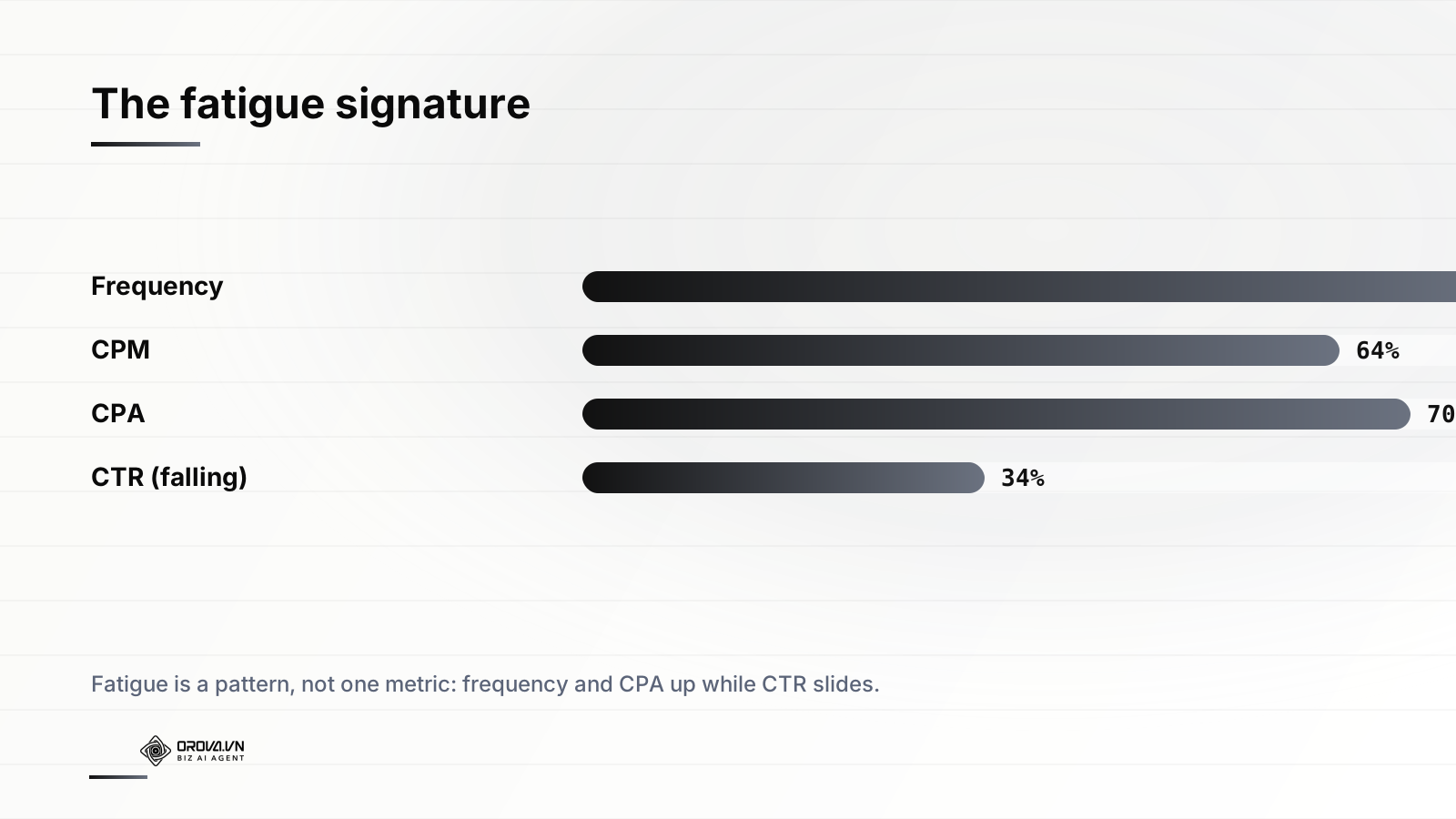
Put the four together and the diagnosis becomes confident. Frequency up, CTR down, CPM up, CPA up: that is fatigue, full stop. If frequency is flat but CPA rose, look elsewhere, perhaps a landing page change, a tracking problem, or a competitor undercutting you. If CTR is fine but conversions dropped, the problem is probably downstream of the ad. The signature only fires when the metrics move together, and that coordination is what separates true creative burnout from the dozen other things that can dent a campaign.
Why fatigue happens, mechanically
Understanding the mechanism makes the fixes obvious rather than superstitious. Three forces combine to produce the fatigue curve.
The first is audience saturation. Every audience, whether a custom list of past visitors or a broad interest-based prospecting pool, contains a finite number of people who can be reached and a smaller subset who are genuinely in-market. As your campaign runs, it exhausts the responsive portion first, because Meta's optimization deliberately front-loads delivery to the people most likely to convert. Once those people have converted or declined, continued spend pushes impressions onto progressively less responsive people, and frequency on the already-reached responsive group climbs. You are paying to nag the unconvinced.
The second is creative wear-out, which is the human attention side. Repetition reduces the salience of any stimulus. The neuroscience term is habituation, and it applies ruthlessly to feed-based advertising where the same thumbnail appears in the same context day after day. The brain optimizes for novelty and demotes the familiar. Your ad does not have to be bad to wear out; it only has to be the same.
The third is the auction feedback loop described earlier. Because Meta prices delivery partly on predicted engagement, declining engagement raises your costs, which compresses your reach for a fixed budget, which concentrates impressions on a smaller group, which raises frequency faster, which deepens fatigue. It is a reinforcing spiral. Left alone, a fatiguing ad does not plateau at a slightly worse level; it tends to decay faster the longer you ignore it.
The role of audience size and budget pressure
Two structural factors set how fast fatigue arrives. A small audience saturates quickly, so a tight retargeting pool of, say, thirty thousand people will fatigue in days at a meaningful budget, while a multi-million-person prospecting audience can run for weeks. Budget pressure compounds this: pushing a large daily budget into a small audience forces frequency up immediately, because the system has to show the ad more times per person to spend the money. If you are scaling spend faster than your audience can absorb it, you are manufacturing fatigue on purpose. Recognizing this relationship is half the cure, because it tells you whether the fix is new creative, a bigger audience, or simply a more honest budget.
The refresh response: how to reverse fatigue
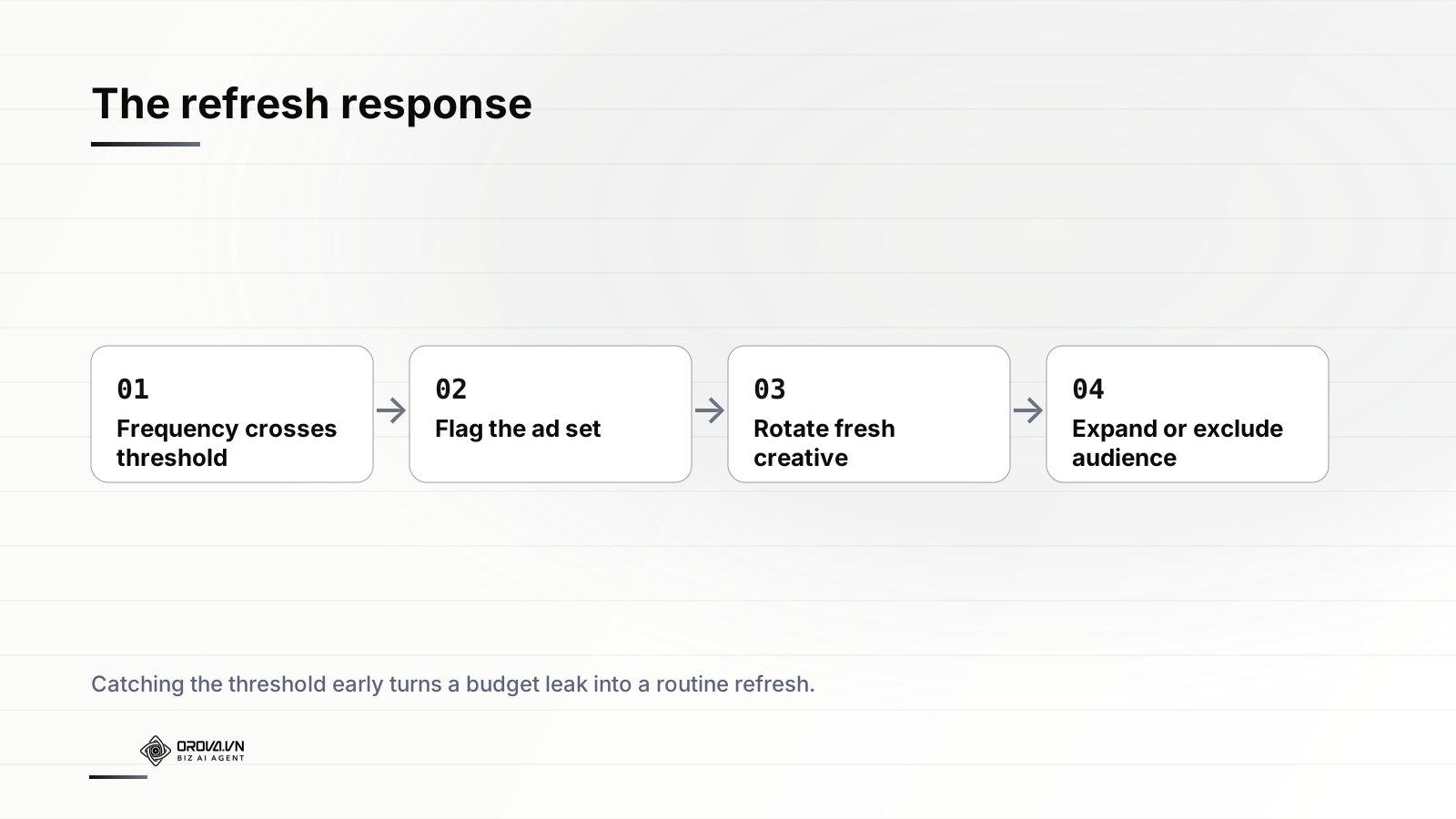
Once you can read the signature, the toolkit for reversing it is well understood. The art is in sequencing and timing, not in any single tactic. There are three primary levers, and the best operators use them in combination rather than reaching for only one.
Rotate fresh creative
The most direct fix for creative wear-out is new creative. But "new" is a spectrum, and matching the degree of change to the degree of fatigue saves money. Early, mild fatigue often responds to a light refresh: a new headline, a different opening frame on a video, a recolored background, a reframed value proposition saying the same thing a different way. These small variations restore novelty cheaply and reuse the underlying concept you already know works. Deeper fatigue, or fatigue that recurs quickly after light refreshes, calls for a genuinely different concept, a new angle, a different format, a testimonial instead of a product shot. The discipline that pays off is maintaining a creative pipeline so that fresh assets are ready before the current ones fatigue, rather than scrambling to produce replacements after the curve has already broken. A standing rule of having two or three untested variants queued at all times turns refresh from a fire drill into a routine swap.
Expand or exclude the audience
If the problem is saturation rather than the creative itself, the answer is to change who sees the ad. Expanding the audience, by broadening interests, raising the age range, adding lookalike segments, or simply letting Meta's broad targeting find new people, gives a winning creative fresh eyes without touching the asset. On the other side, excluding audiences is just as important and more often neglected. Excluding recent converters, recent purchasers, and people who have already engaged heavily prevents you from paying to re-reach people who are done with you. A well-built exclusion list is one of the quietest, most reliable defenses against frequency creep, because it keeps your spend pointed at people who have not yet been exhausted.
Manage frequency capping and pacing
Sometimes the cleanest move is to slow down. If a small audience is being hit too hard because the budget is too aggressive for its size, reducing the budget or capping frequency lets the same creative breathe. Pacing spend to the natural absorption rate of an audience prevents the self-inflicted fatigue described earlier. This is the lever advertisers reach for last, because it feels like retreating, but for high-value, narrow retargeting pools it is frequently the right call: a slightly smaller spend at a sustainable frequency outperforms a larger spend that burns the audience out in a week.
Refresh cadence: how often, and triggered by what
The natural question is how often to refresh. There are two schools of thought, and the right answer borrows from both. The calendar school sets a fixed cadence, swapping creative every two or three weeks regardless of performance, on the theory that prevention beats cure. This is simple and prevents deep fatigue, but it wastes good creative that still has life and it does not adapt to audiences that fatigue at different rates. The trigger school refreshes only when the signature fires, which is efficient but requires constant monitoring and risks acting late if no one is watching closely.
The pragmatic approach is trigger-based monitoring with a calendar backstop. Define thresholds for the leading signals, frequency crossing a chosen ceiling, CTR falling a chosen percentage from its own peak, CPM rising beyond normal variance, and let those triggers drive refreshes when they fire. Keep a maximum age as a safety net so that even an ad that somehow avoids the triggers gets refreshed before it can quietly rot. Crucially, set your thresholds per audience, not globally, because a retargeting pool and a broad prospecting campaign live on completely different fatigue clocks. The retargeting pool might fatigue at frequency 4 in a week; the prospecting pool might happily run at frequency 2 for a month.
The cheapest refresh is the one you make while the creative is still winning. By the time the cost line breaks, you have already paid the tuition.
Why this is hard to do by hand
Everything above is knowable. None of it is secret. So why do so many accounts still bleed budget into fatigued ads? Because doing it well by hand is a daily grind that does not scale. Reading the four-signal signature correctly means looking at trends, not snapshots, across every active ad set, every day, for every audience, each with its own thresholds. A solo advertiser managing a handful of ad sets can stay on top of it through discipline and habit. An agency or in-house team running dozens of campaigns across multiple accounts cannot, not reliably, not every single morning, not without the occasional ad slipping through the cracks for a week and quietly overspending.
The failure mode is human, not analytical. People are good at spotting dramatic changes and bad at noticing slow drifts. We anchor on yesterday and miss the two-week slope. We get busy and skip the frequency check on a Tuesday, and that is the Tuesday a winning ad tips into fatigue. We hesitate to kill an ad that "was doing so well," and the sunk-cost feeling keeps a fatigued asset alive. The whole pattern of fatigue, gradual, multi-metric, audience-specific, recurring, is almost perfectly designed to slip past human attention.
What an AI agent watches that you might miss
This is exactly the kind of work that benefits from an automated system that never gets bored and never skips a day. An AI agent watching the fatigue curve does a few things consistently that humans do inconsistently. It reads every ad set's metrics on a daily cadence and evaluates them against per-audience thresholds rather than gut feel. It looks at the coordinated movement of frequency, CTR, CPM, and CPA together, so it fires on the true signature and stays quiet on the false alarms that come from a single metric wobbling. It catches the slope early, flagging an ad set when frequency crosses its threshold and CTR has started sliding, before CPA has had a chance to spike. And because it is doing this across the entire account at once, it does not matter whether you are running three ad sets or three hundred; the attention is the same on the last one as on the first.
The deeper value is in closing the loop from detection to action. Spotting fatigue is only half the job; the other half is responding, and responding promptly. There is a meaningful difference between a tool that emails you a fatigue alert and a system that can actually carry out the refresh once a human approves it. We have written before about why moving from recommendation to execution is where most of the value in ad automation actually lives, because an alert that sits unread in an inbox until Thursday is barely better than no alert at all. The agent that detects the threshold, proposes the refresh, and then, with your sign-off, rotates the creative, adjusts the audience, or reallocates the budget is the one that turns fatigue from a recurring budget leak into a routine, handled event.
A practical checklist for staying ahead of fatigue
If you take nothing else from this, take a working routine. Whether a person or a system runs it, the steps are the same.
- Track the signature, not the symptom. Monitor frequency, link CTR, CPM, and CPA together, and watch their seven-day trends rather than daily snapshots. Fatigue is the coordinated movement, not any one number.
- Set thresholds per audience. Give your retargeting pools and prospecting audiences different frequency ceilings and CTR-decline triggers, because they fatigue on entirely different clocks.
- Keep a creative bench. Always have two or three untested variants ready to swap in, so a refresh is a swap and not a scramble.
- Match the fix to the cause. Light creative refresh for early wear-out, new concept for deep or recurring fatigue, audience expansion for saturation, exclusions and pacing for self-inflicted frequency.
- Exclude the exhausted. Maintain exclusion lists for recent converters and heavy engagers so you stop paying to re-reach people who are finished with you.
- Use a calendar backstop. Even with triggers, cap the maximum age of any creative so nothing rots unnoticed.
- Close the loop fast. The value of detecting fatigue early evaporates if the response takes a week. Shorten the distance between "flagged" and "refreshed."
Done consistently, this routine changes the economics of paid social in a quiet but compounding way. Instead of riding each ad up to its peak and then unknowingly down the far side of the curve, you ride the up-slope, refresh near the top, and start a new up-slope. Over a quarter, the difference between a managed fatigue curve and an ignored one is not a rounding error; it is a large fraction of your media efficiency. The advertisers who win on Meta over the long run are rarely the ones with a single brilliant creative. They are the ones with a reliable system for noticing when the brilliant creative has stopped being brilliant, and a fast, disciplined way of replacing it before the budget feels the difference.
If watching every fatigue curve across every audience every single day sounds like more attention than your team can spare, that is exactly the problem Orova Ads was built to solve. It is an AI agent that manages your paid campaigns across Google, Meta, and TikTok, reading the data daily, spotting fatigue and other signals before they hit your cost line, and executing the fixes, budget shifts, bid changes, on-off decisions, audience adjustments, with your approval and a full audit log of everything it does. You stay in control of the strategy; the agent handles the daily vigilance that fatigue demands. See how Orova Ads keeps your creative fresh and your spend honest.
Run your business with AI Agents
Orova is the always-on Biz AI Agent — it plans, runs, and optimizes the work for you. Save time, unlock productivity.
Try it free