
From Recommendation to Execution: How AI Actually Changes Your Campaigns
A media buyer I worked with kept a spreadsheet open on a second monitor all day. It pulled performance from three ad accounts every fifteen minutes and flagged anything that drifted: a campaign whose cost per acquisition crept above target, an ad set that had burned through 80% of its budget by noon, a keyword quietly bleeding spend with zero conversions. The spreadsheet was genuinely smart. It color-coded problems, ranked them by wasted dollars, even suggested what to do. And every single one of those suggestions still had to be carried out by a human being clicking through Google Ads, Meta Ads Manager, and TikTok Ads Manager — three separate interfaces, three separate logins, three separate confirmation dialogs — before anything changed in the real world.
That gap, between knowing what to do and the change actually landing in the account, is the entire subject of this article. It is also where almost every tool that calls itself "AI" gives up. A recommendation is cheap. Software has been generating recommendations for fifteen years. The hard, valuable, expensive-to-build part is execution: safely writing a new budget, a new bid, or a new on/off state to a live advertising platform through its API, with the right approvals, the right guardrails, and a record of exactly what happened so you can undo it. This piece walks through how that pipeline actually works, why so few tools cross the line into execution, and what changes the day they do.
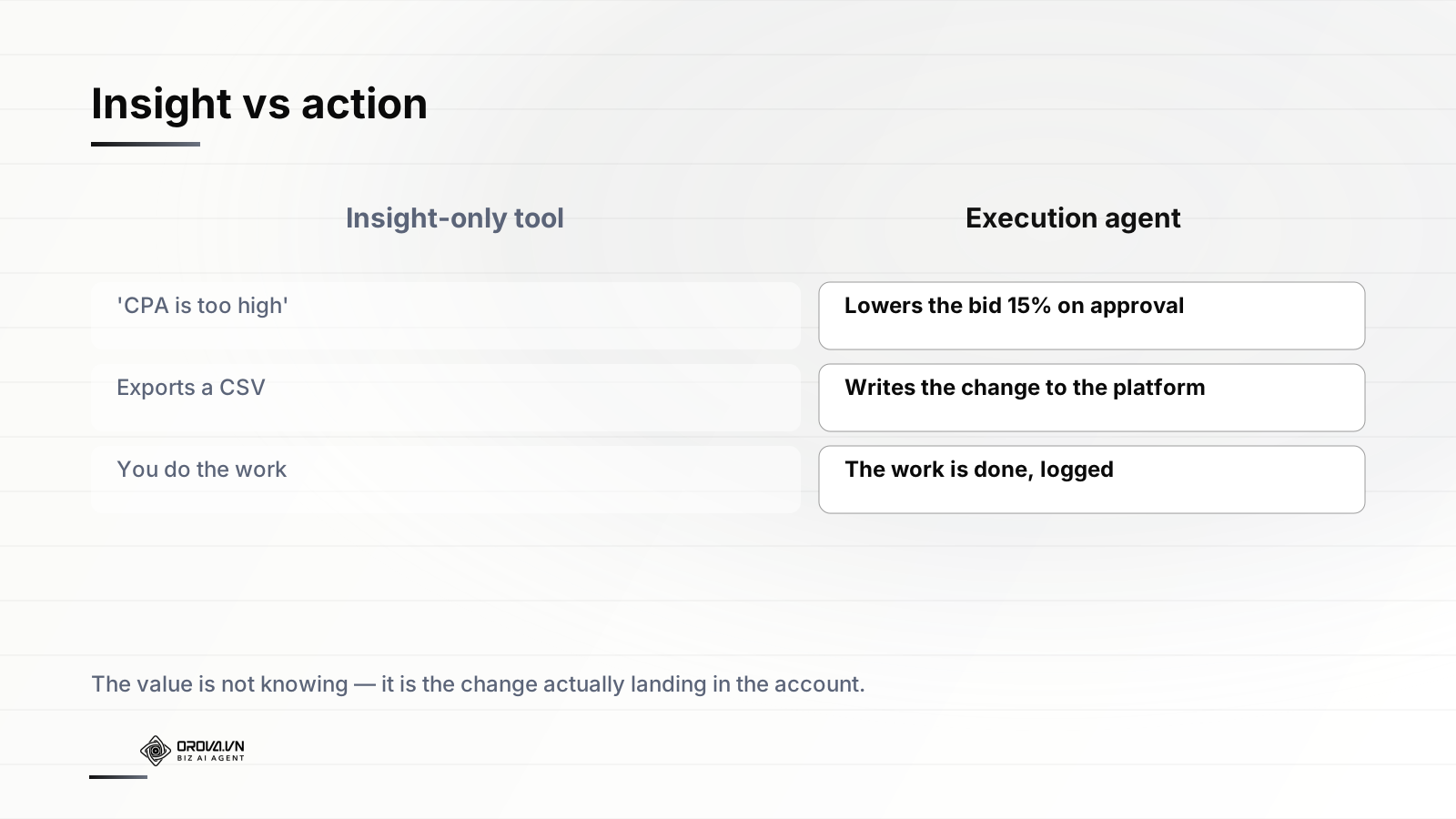
Insight is not action: the difference that costs you money
Let's be precise about the distinction, because the marketing around "AI optimization" deliberately blurs it. An insight is a statement about the state of the world. "Your cost per acquisition on the prospecting campaign rose 34% week over week." "This ad set has a frequency of 7.2 and the click-through rate is collapsing." "Three of your top-spending keywords have a Quality Score of 3." These are true, useful, and — on their own — completely inert. Nothing in your account is different because the tool said them.
An action is a change to the system. The bid drops 15%. The exhausted ad set pauses. The budget shifts from the campaign converting at $80 per sale to the one converting at $42. Actions cost money or save money. Insights only describe.
The reason this matters is that the work of converting insight into action is enormous and it never stops. Consider a modest account: three platforms, twenty campaigns, maybe eighty ad sets or ad groups underneath them. If you want to manage that account properly — checking it daily, reallocating budget, adjusting bids, pausing the losers, scaling the winners — you are looking at dozens of individual changes per week, each requiring you to find the right entity in the right interface, calculate the right new value, make the edit, and confirm it. Most teams simply cannot keep up. So the account drifts. Budgets sit at last month's allocation. Bids stay where they were set during the last "optimization sprint." The insights pile up in dashboards nobody has time to act on.
This is the dirty secret of the analytics-heavy ad-tech category: more visibility does not automatically produce better outcomes. A team drowning in dashboards is still a team that has to do every change by hand. The constraint was never knowing — most experienced buyers can look at a campaign for ten seconds and tell you what's wrong. The constraint is the labor of acting, multiplied across hundreds of entities, every day, forever. If you want a fuller treatment of what an autonomous agent is and where it sits relative to traditional tools, the companion piece on what an AI ads agent actually is covers the conceptual ground; here we are going one level deeper into the mechanics of the change itself.
The execution layer: writing changes through platform APIs
To execute, software has to do what a human does when they log into an ad platform — except through code instead of a browser. Every major ad platform exposes a programmatic interface for exactly this: the Google Ads API, the Meta Marketing API, and the TikTok Business API. These are the same pipes that the platforms' own interfaces use under the hood, and the same pipes that connect your account to a third party that has been granted access. An execution agent reads through them and, critically, writes through them too.
What a "change" actually is at the API level
When you drag a budget slider in Meta Ads Manager from $50 to $75, the interface is constructing an API request behind the scenes — roughly, "update ad set 1203847; set daily_budget to 7500" (budgets are typically expressed in the account's minor currency unit, so $75 becomes 7500 cents). An execution agent constructs that exact same request. There is no magic and no back door; it is the documented, supported, public way to modify a campaign. The four levers that matter most, and that a well-built agent operates, are:
- Budget — daily or lifetime budget at the campaign or ad set / ad group level. Raising it on a winner, lowering it on a marginal performer, or reallocating across entities.
- Bids and bid strategy — target CPA, target ROAS, manual CPC caps, or bid adjustments by device, location, time of day, and audience. This is the most consequential and most error-prone lever, which is why it gets the strictest guardrails.
- Status (on/off) — pausing an ad set that has hit frequency fatigue, switching off a keyword with spend and no conversions, or re-enabling something that was paused prematurely.
- Audiences and targeting — adding a high-performing lookalike, excluding a converter list to stop paying for people who already bought, narrowing a placement that is wasting impressions.
None of these is exotic. They are the everyday vocabulary of a media buyer. The difference is that the agent can perform them in seconds, across all three platforms, at any hour, and — this is the part that takes real engineering — only after passing through a chain of checks designed to make sure the change is the right one and that you stay in control.
Why so few tools cross this line
Building a read-only dashboard is a weekend project relative to building an execution agent. Reading data is forgiving: if your code misreads a number, you show a slightly wrong chart and fix it later. Writing is unforgiving. A bug that doubles a budget instead of halving it spends real money in real time. A status change applied to the wrong entity pauses your best campaign during peak season. Each platform's write API has its own rate limits, its own validation rules, its own asynchronous quirks where a change is accepted but takes minutes to propagate, and its own ways of failing partway through a batch. Handling all of that safely — across three platforms that disagree on almost every detail — is genuinely hard, and it is the reason most vendors stop at the CSV export and let you do the dangerous part by hand.
The pipeline: from spotting an opportunity to a logged, reversible change
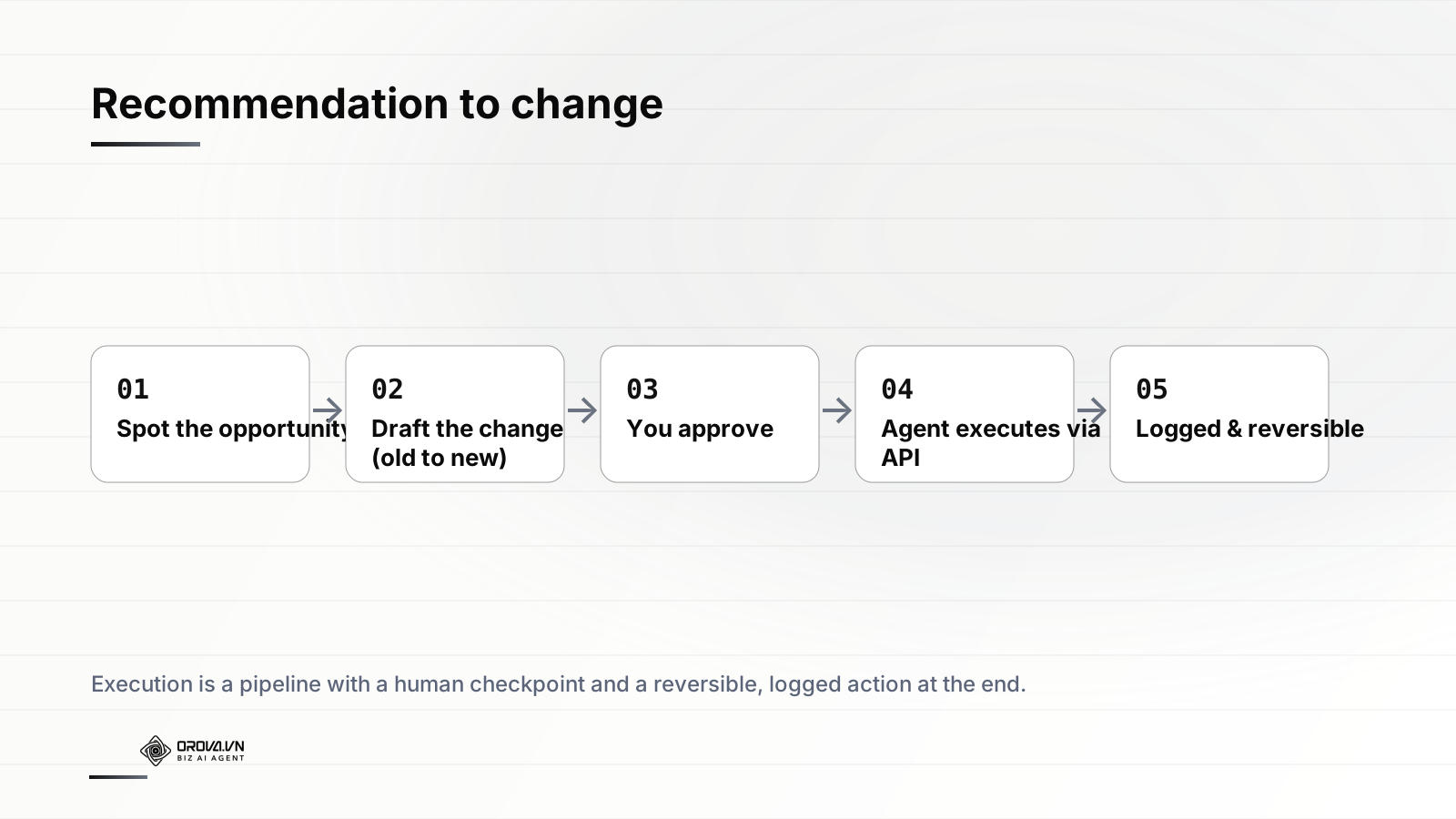
A trustworthy execution flow is not one big leap from "AI thinks" to "account changes." It is a pipeline with discrete stages, each of which can be inspected and, if needed, stopped. Here is what each stage does.
1. Spot the opportunity
The agent reads the account daily — performance by campaign, ad set, ad, keyword, audience, placement, and time window — and compares it against your goals and against its own history of what has worked. "Spotting" is not just threshold alerting. A good agent weighs statistical confidence (is this drop real or just a low-volume day?), recency (a three-day trend matters more than a single spike), and context (CPA rising during a known seasonal surge is different from CPA rising for no reason). The output of this stage is a candidate: a specific entity and a specific problem or opportunity.
2. Draft the change — old value to new value
This is the stage that separates an execution agent from a suggestion engine. Instead of producing prose ("consider lowering your bid"), it drafts a concrete, machine-executable change with both the current and proposed value spelled out: "Ad group Branded — Exact, target CPA: $45.00 → $38.25 (−15%), because the trailing 14-day actual CPA is $36 and the group is volume-constrained." The old-to-new framing is not cosmetic. It is what makes the change auditable before it happens, reversible after it happens, and comprehensible to a human who has ten seconds to decide. You should never see a change you can't immediately understand.
3. You approve (or the mode you chose approves for you)
Every drafted change passes through whatever approval mode you've set for that scope of activity. This is the human checkpoint, and it's important enough that it gets its own section below. The key point is that approval is a deliberate, configurable gate — not an afterthought, and not all-or-nothing.
4. The agent executes via the platform API
Once approved, the agent constructs the API request, validates it against the platform's rules, submits it, and confirms the platform accepted it. If the platform rejects the change (a budget below the minimum, a bid outside an allowed range, a transient rate-limit error), the agent handles the failure cleanly rather than leaving the account in a half-changed state — it retries transient errors, surfaces hard rejections to you, and never silently moves on.
5. Logged and reversible
The moment a change lands, it is written to an immutable audit log: what changed, on which entity, from what value to what value, who or what initiated it, under which approval mode, and at exactly what time. Because the log captures the old value, every change is reversible — one click puts the bid, budget, or status back where it was. An execution layer without a rollback path is a liability; with one, a mistake is an inconvenience you fix in seconds rather than a crisis.
Approval modes: choosing how much control to hand over
The single biggest objection to autonomous execution — "I'm not letting software touch my budgets unsupervised" — is entirely reasonable, and the answer to it is that you decide, per scope, how much autonomy to grant. There is no honest reason to force an all-or-nothing choice. Mature agents offer a spectrum, and you can set different points on it for different accounts, campaigns, or change types.
Advisory mode
The agent watches, drafts changes, and shows them to you — but executes nothing. This is the natural starting point. You get the full benefit of the spotting and drafting stages, you see exactly what the agent would do, and you keep your existing workflow of making the edits yourself. Many teams run advisory mode for a few weeks purely to build trust: they watch the agent's drafts, notice that its proposed changes match what they would have done (or are better), and only then loosen the reins. It's the equivalent of a test drive where you never take your hands off the wheel.
Approve-each mode
The agent drafts a change and waits for your explicit yes or no before executing. Each proposal arrives as a clear old-to-new statement with a one-line rationale; you tap approve, the agent does the work; you tap reject, it's discarded and the agent learns your preference. This is the mode most experienced buyers settle into. It removes the labor of finding the entity, calculating the value, and clicking through three interfaces, while keeping a human finger on every trigger. The agent does the tedious 90% — the analysis and the execution — and you keep the 10% that is pure judgment: the yes/no.
Auto mode
For change types you trust, within limits you set, the agent executes without asking and reports afterward. Crucially, "auto" is never a blank check. You scope it: maybe you let the agent automatically pause keywords with more than $50 spend and zero conversions, or automatically shift budget between ad sets within a single campaign, but never raise total account spend or change a bid strategy without approval. Auto mode is where the round-the-clock advantage shows up — the agent can pause a runaway ad set at 2 a.m. instead of letting it burn until you wake up — but it lives inside guardrails you define and can change at any time.
The right mental model is a junior buyer you're training. On day one they propose and you approve everything. As they prove themselves on routine tasks, you let them handle those alone while still bringing you the big decisions. You never hand over the whole account; you delegate by category of risk.
Guardrails, rollback, and the audit log: making execution safe
Autonomy without constraints is recklessness. The reason execution agents can be trusted with live budgets is that the execution layer is wrapped in protections that make damage hard to do and easy to undo. These are not optional extras; they are the load-bearing parts of the whole proposition.
Guardrails: limits the agent cannot cross
Guardrails are rules that bound what any change can be, no matter who or what proposes it. Sensible ones include:
- Magnitude caps. No single budget change exceeds a set percentage — say 25% — in one move. This prevents both fat-finger errors and an agent over-reacting to a noisy day. Big shifts happen as a series of smaller, observed steps.
- Floors and ceilings. Hard minimum and maximum budgets and bids per entity. The agent can optimize within the band you set but never spend beyond a number that would hurt to lose.
- Total-spend protection. The agent may reallocate freely but cannot raise aggregate account spend above your ceiling without explicit approval. Reshuffling the pie is low-risk; growing the pie is a decision you reserve.
- Frequency and cooldowns. A limit on how often the same entity can be changed, so the agent doesn't thrash a bid up and down chasing daily noise and starving the platform's own learning phase.
- Protected entities. Specific campaigns you mark as off-limits — a brand campaign, a legal-sensitive promotion — that the agent will analyze and advise on but never touch.
Rollback: every change is reversible
Because each logged change records the previous value, undoing it is mechanical: the agent simply writes the old value back through the same API. This changes the emotional calculus of automation entirely. The fear of "what if it does something wrong" assumes mistakes are permanent and costly to discover and fix. When every change is captured old-to-new and reversible in one action, a wrong move becomes a thirty-second correction. You can let the agent be useful precisely because you can always take it back.
The audit log: a complete, queryable history
The audit log is the record that makes the whole system accountable. For every action it captures the entity, the platform, the old and new values, the rationale, the approval mode in force, the initiator, and the timestamp. This does several jobs at once. It lets you answer "why did our CPA improve last month?" with specifics instead of guesses. It gives you a defensible trail when a client or a finance team asks what changed and why. And it creates a feedback loop: by reviewing which changes helped and which didn't, both you and the agent get better at choosing the next one. A platform that executes but doesn't log is asking for blind trust; one that logs everything is inviting scrutiny, which is exactly what you want from anything touching your money.
Why execution is where the value lives
It's worth stating plainly why all this engineering effort is justified, because the answer reframes how you should evaluate any "AI" ad tool. The value of optimization is not in the realization that something should change. It's in the change happening — promptly, correctly, and at a scale and frequency no human team can match by hand.
The compounding cost of the gap
Think about the lag between insight and action in a manual workflow. A problem appears Monday morning. The dashboard flags it. The buyer is in meetings until Wednesday. They finally make the edit Thursday. That's three days of an exhausted ad set burning budget, or a winning campaign starved of the budget it could have spent profitably. Multiply that lag across every entity in the account and across every week of the year, and the cumulative waste dwarfs the cost of the tool many times over. Execution collapses the lag to near zero: the problem is spotted, drafted, approved, and fixed in minutes, not days.
Scale that a human can't reach
A skilled buyer can deeply manage perhaps a few dozen entities. Beyond that, attention thins and changes get skipped — the long tail of small ad sets and keywords, each individually minor but collectively a large slice of spend, simply doesn't get touched. An execution agent treats the hundredth entity with the same diligence as the first. It doesn't get tired, doesn't deprioritize the boring keyword cleanup, and doesn't forget to check at the end of a long day. The result isn't just faster optimization; it's optimization that reaches parts of the account that manual management structurally never gets to.
Where humans are actually better
None of this means the agent replaces judgment. Strategy — which audiences to pursue, what the offer is, how the brand should sound, what a fair CPA target even is — remains human work, and it's the work that matters most. The agent is exceptional at the tireless, high-frequency, rule-bounded execution that strategy depends on but that humans are bad at sustaining. The right division of labor is clear: you set the destination and the boundaries; the agent does the relentless steering inside them. That's why approve-each mode is so popular — it's the cleanest expression of this split, with the human owning the decision and the agent owning the labor.
What to look for before you trust a tool with your account
If you're evaluating anything that promises AI-driven optimization, the brief above gives you a checklist sharper than any feature comparison. Ask these questions and the marketing falls away fast:
- Does it execute, or only recommend? If the deliverable is a report, a dashboard, or a CSV, you are still doing the actual work. The line is whether the change lands in the account by itself.
- Does it write to all the platforms you run? Reading from Google, Meta, and TikTok is common; writing safely to all three is rare. A tool that executes on one platform and exports for the others is half a solution.
- Can you choose the approval mode? Advisory, approve-each, and auto — per scope. If it's all-or-nothing, walk away.
- What are the guardrails, and can you set them? Magnitude caps, floors and ceilings, total-spend protection, protected entities. Vague answers here mean the safety isn't really built.
- Is every change reversible, with one action? If rollback is manual or absent, the audit log isn't doing its job.
- Is there a complete audit trail? Entity, old value, new value, reason, mode, time. This is the difference between a tool you can answer for and one you can't.
Run those six questions against any vendor and you'll quickly sort the suggestion engines from the genuine execution agents. The suggestion engines are not useless — visibility has value — but they leave the hardest, most valuable work on your plate. The execution agents take it off.
The bottom line
For years the ad-tech industry sold us better and better mirrors: dashboards that reflected our accounts back at us in ever finer detail. The reflection was never the problem. The problem was always the distance between seeing the issue and fixing it — a distance measured in logins, clicks, calculations, and the simple human limit on how many changes one person can make in a day before they stop. Execution closes that distance. It turns "your CPA is too high" into "your bid is now 15% lower, here's the log, undo it if you disagree." That sentence — the change, made, recorded, and reversible — is the whole game. Everything before it is just knowing, and knowing was never the hard part.
Orova Ads is built around exactly this pipeline. It's an AI agent that autonomously manages your paid campaigns across Google, Meta, and TikTok: it reads your data every day, drafts specific old-to-new changes to budgets, bids, statuses, and audiences, and executes them through the platform APIs — with the approval mode you choose, the guardrails you set, and a full audit log behind every action. See how recommendation turns into real, reversible change at Orova Ads.
Run your business with AI Agents
Orova is the always-on Biz AI Agent — it plans, runs, and optimizes the work for you. Save time, unlock productivity.
Try it free