
Link Building Guide: Backlinks, Methods & Warnings
You publish a great post, wait, and... nothing happens. Your site sits on page five while competitors with weaker content rank above you. Someone tells you the missing piece is "link building" — getting other websites to link back to yours — but the moment you try, you're buried in outreach templates, spammy offers to buy links, and advice that contradicts itself.
Most business owners waste time here because they treat every link the same way. They chase big numbers — get listed anywhere, comment on random blogs, trade links with unrelated sites — thinking more is always better. In reality, one link from a site people actually trust can help more than a huge pile of weak ones, and the wrong kind of link can quietly hurt you instead. This matters even more now that SparkToro found 68% of US Google searches in early 2026 ended without a click at all — meaning the few links and rankings that still drive traffic need to work as hard as possible.
This guide walks you through what actually counts as a good link, which shortcuts are genuinely risky, and how to build a steady, safe habit of earning them over time. By the end, you'll be able to look at any link opportunity and know, without guessing, whether it's worth your time.
Good word travels far — but it has to be real word
Imagine you open a new pho restaurant. You put up your own sign saying "the best pho in town" — nobody believes it, because every owner praises themselves. But if a famous food blogger writes on their own "this pho is genuinely great", then a reputable food magazine mentions you, then customers spread the word — your reputation soars. People trust what others say about you far more than what you say about yourself. That's the power of "good word traveling far" — but it has to be real word, from people who are genuinely credible.
Google evaluates websites exactly this way. Each time another website places a link pointing to you, it's like a vote of confidence — "this page is worth referencing". The more votes from credible, relevant sources, the more Google trusts you and ranks you higher. Actively earning those votes is called link building. But like word of mouth, there's real and fake — and Google heavily penalizes fraudulent "votes".
This guide shows how to earn real word: what a backlink is and why it's a vote, why quality beats quantity, the terms to know (dofollow/nofollow, anchor text, DR/DA), how to earn clean links (white hat), the warning about dirty links (black hat), how to judge a good link, and a sustainable link-building process.
What is link building? The process of actively earning links from other websites pointing to yours (called backlinks). Each quality backlink is like a vote of confidence, helping Google trust and rank you higher. It's one of the strongest ranking factors — but only when links are real and quality.
Quality over quantity: one authoritative vote beats a thousand junk votes
What is a backlink? A link from another website pointing to your page. Google treats it as a "referral/vote" from that site for you. Backlinks are one of the most important ranking signals, because they're external proof your content is trustworthy.
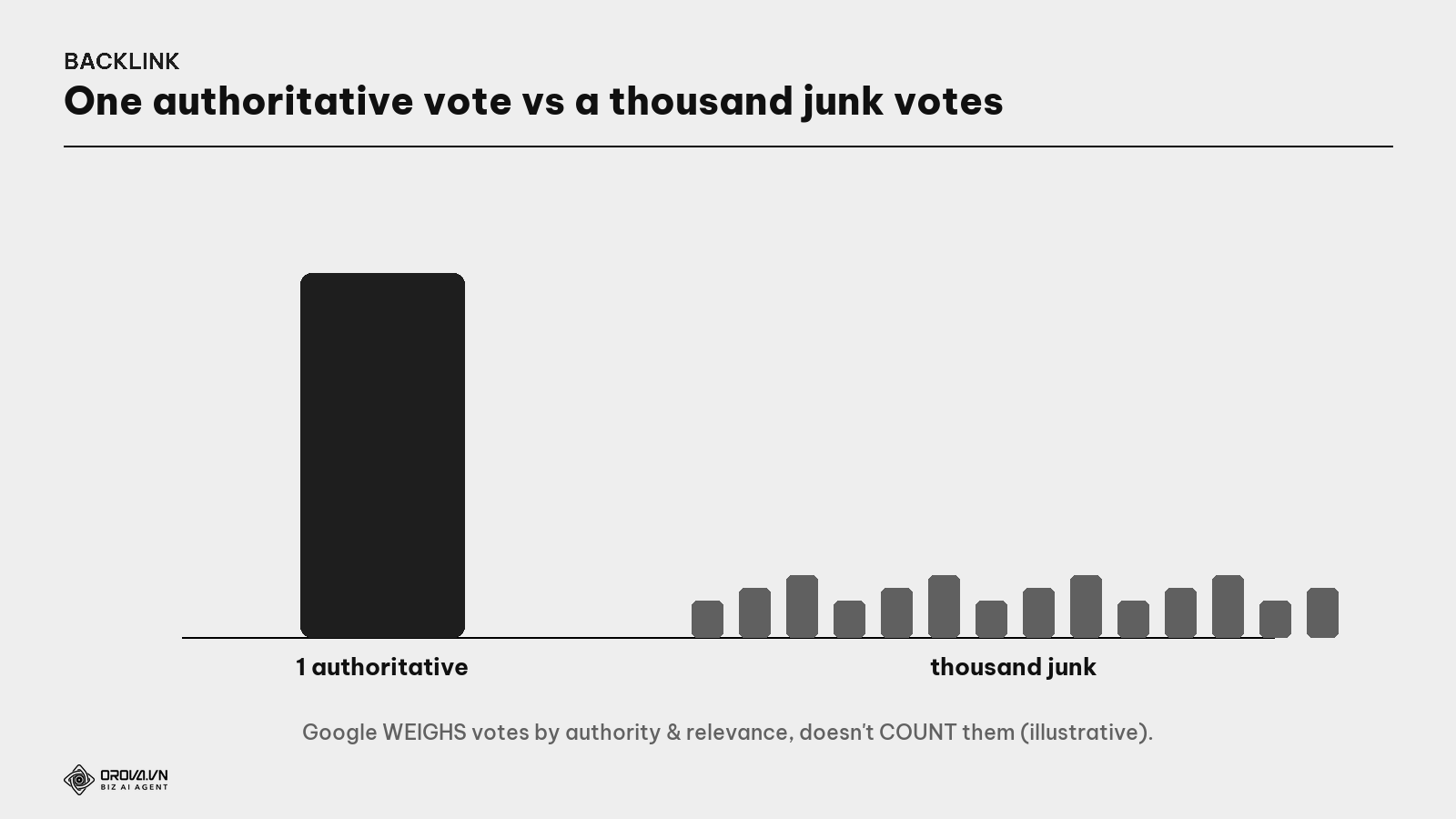
The most common mistake is chasing the number of links. The reality is the opposite: one link from an authoritative, relevant website is worth more than a thousand links from junk sites. Google doesn't count votes — it weighs them by the source's authority and relevance. Praise from a top expert outweighs a thousand praises from anonymous accounts.
What is link equity? The "authority" one page passes to another via a link. A link from a stronger, more relevant page passes more strength. This is why one quality backlink boosts rankings far more than many weak links combined.
A few terms to know
To understand and evaluate links, grasp a few concepts.
What are dofollow & nofollow? Dofollow is a "strength-passing" link — it transfers authority to the linked page (the default). Nofollow is a link tagged "don't count this vote" — passing no (or little) strength, often used for ads, comments, unvouched links. You need dofollow links from good sources to grow authority, but a natural link profile always mixes both.
What is anchor text? The clickable text of a link (e.g., the words "keyword research" carrying the link). The anchor gives Google a clue about what the target page is about. Natural, varied anchors are good; stuffing the same keyword anchor en masse signals manipulation and risks a penalty.
What are DA / DR? "Domain Authority" (Moz) and "Domain Rating" (Ahrefs) are estimated website-strength scores (0–100) created by third-party tools — NOT Google metrics. Use them to compare relative authority between sites, handy when choosing where to seek links, but don't treat them as a "Google score".
How to earn clean links (white hat)
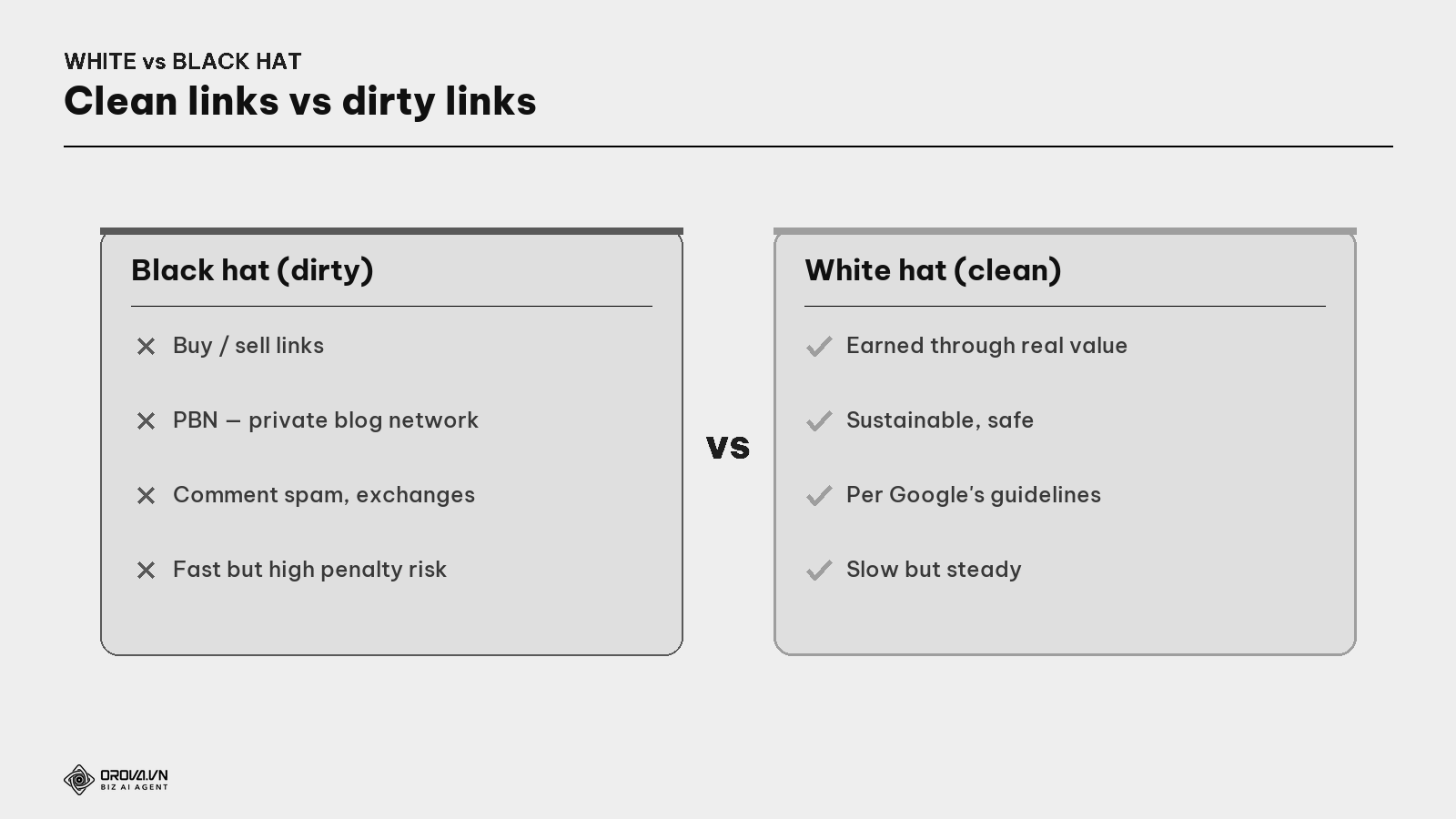
What is white hat? SEO done per Google's guidelines, sustainable, based on real value — the opposite of "black hat" (cheating, easily penalized). White hat link building means earning links by deserving them, not buying or manipulating.
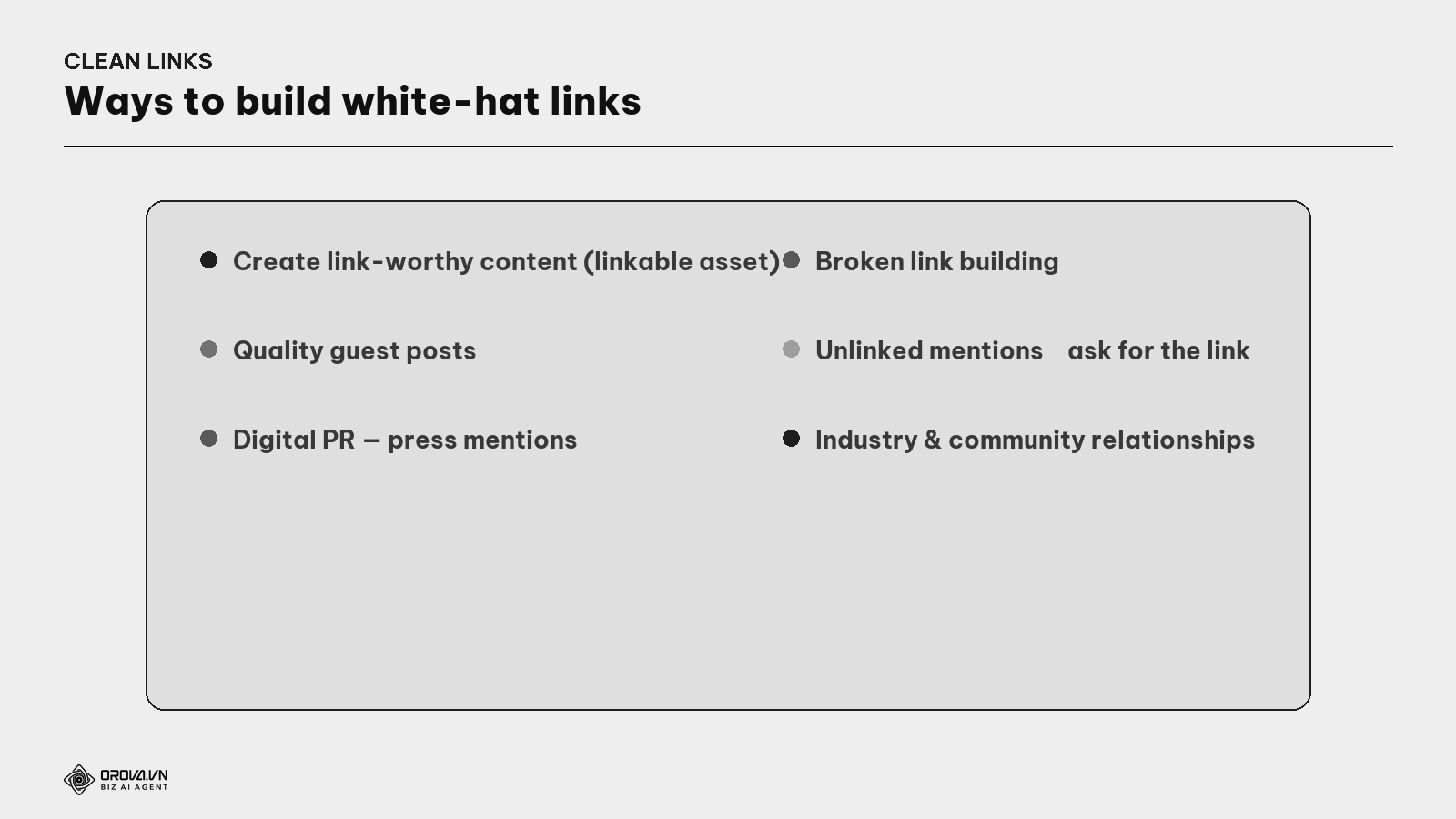
- Create link-worthy content — original research, free tools, deep guides, infographics. People link because it's useful (see the Digital PR & Linkable Assets guide).
- Quality guest posts — write valuable articles for reputable same-industry sites, with a natural link back.
- Digital PR — create newsworthy data/stories so press and reputable sites mention and link you.
- Broken link building — find broken links on other sites, suggest your content as a replacement.
- Unlinked mentions — someone mentions you without a link → politely ask them to add one.
- Industry relationships — join communities, collaborate; links come naturally from real relationships.
Warning: "black hat" links are a double-edged sword
There are fast but dangerous ways to get links — they can get your whole site penalized.
What is black hat? Ways of getting links that are fraudulent and violate Google's guidelines: buying/selling links, private blog networks, mass link exchanges, comment spam. Effective short-term but extremely risky — when Google detects them, it penalizes heavily, possibly wiping out your rankings.
What is a PBN (Private Blog Network)? A network of sites created solely to place links pointing to a main site to manipulate rankings. A clear violation; Google is very good at detecting PBNs and penalizing both the network and the benefiting site.
Safety rule: don't buy links, don't use PBNs, don't spam. A manual penalty can erase years of effort. A good link is one you deserve, not one you can buy.
Judging a backlink's quality
Not all links are equal. Four criteria for a good link:
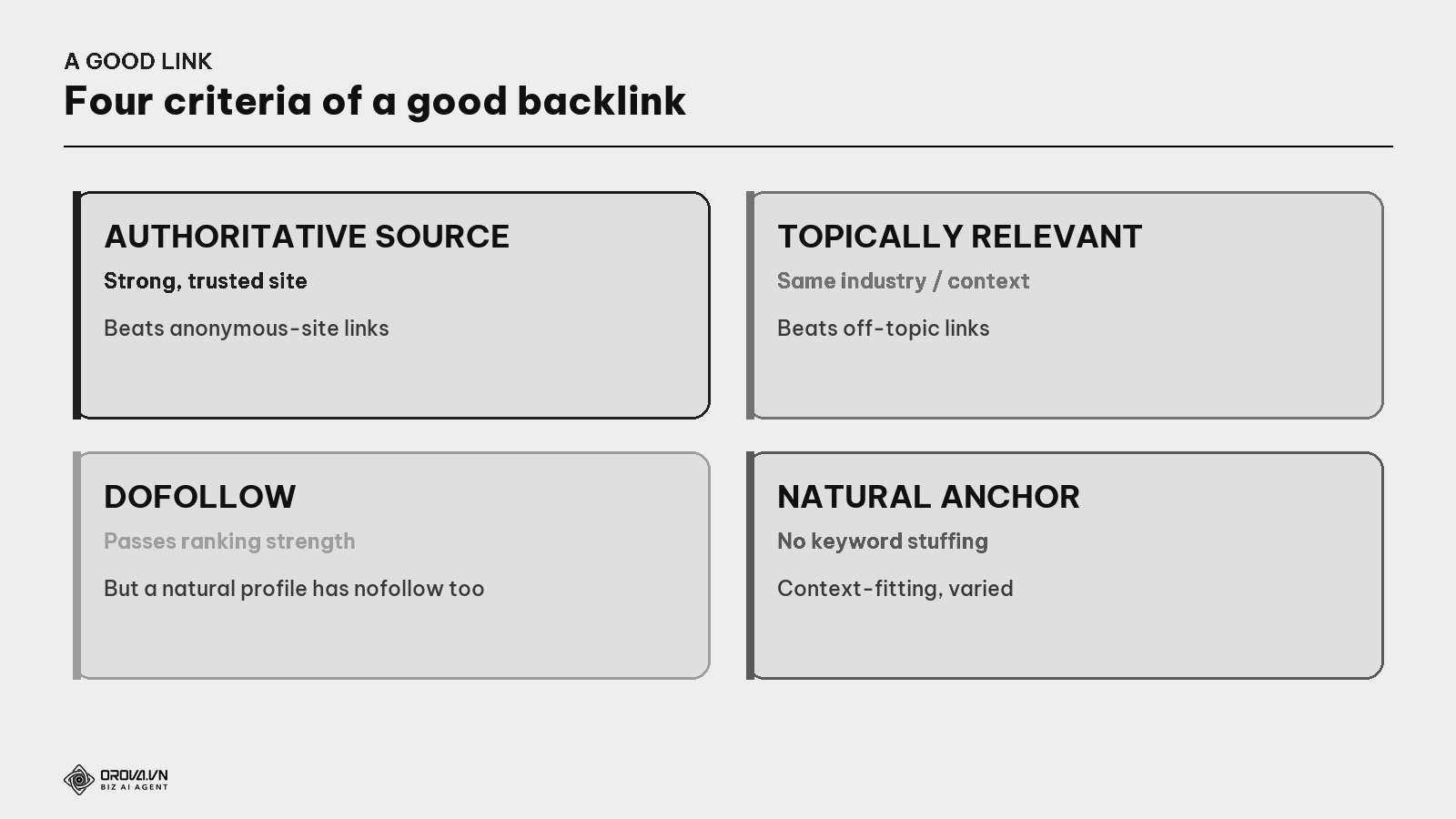
- Authoritative source — a link from a strong, trusted website is worth more than one from an anonymous site.
- Topically relevant — a link from a same-industry/context site is worth more than an off-topic one.
- Dofollow — a strength-passing link (but a natural profile still has nofollow too).
- Natural anchor — context-fitting, varied anchor text; no stuffing the same keyword.
A link meeting all four is worth more than dozens lacking them.
A sustainable link-building process
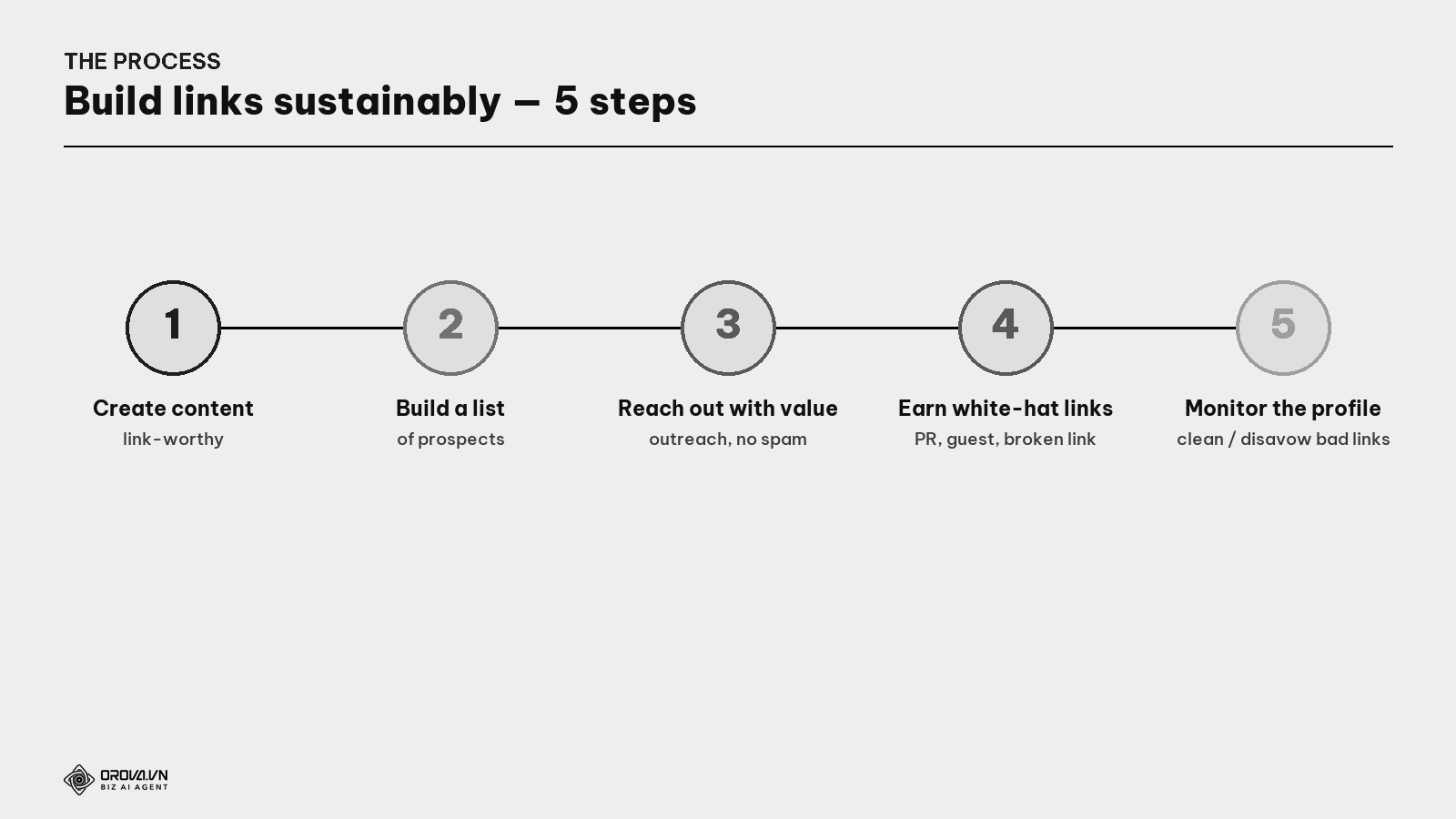
- Create link-worthy content first — without valuable "bait", earning links is very hard.
- Build a prospect list — same-industry sites, bloggers, press, with enough authority.
- Reach out with value (outreach) — a polite proposal, clearly stating the value the link brings them, no spam.
- Earn links via white-hat methods (guest posts, PR, broken link, unlinked mentions).
- Monitor the link profile — use a backlink checker; if junk/toxic links point to you, consider disavowing.
What is disavow? A Google tool letting you "reject" bad/spam links pointing to your site — telling Google not to count them. Use only for clearly toxic links (e.g., a competitor attack or leftover bought links), don't overuse.
"Pass" standard
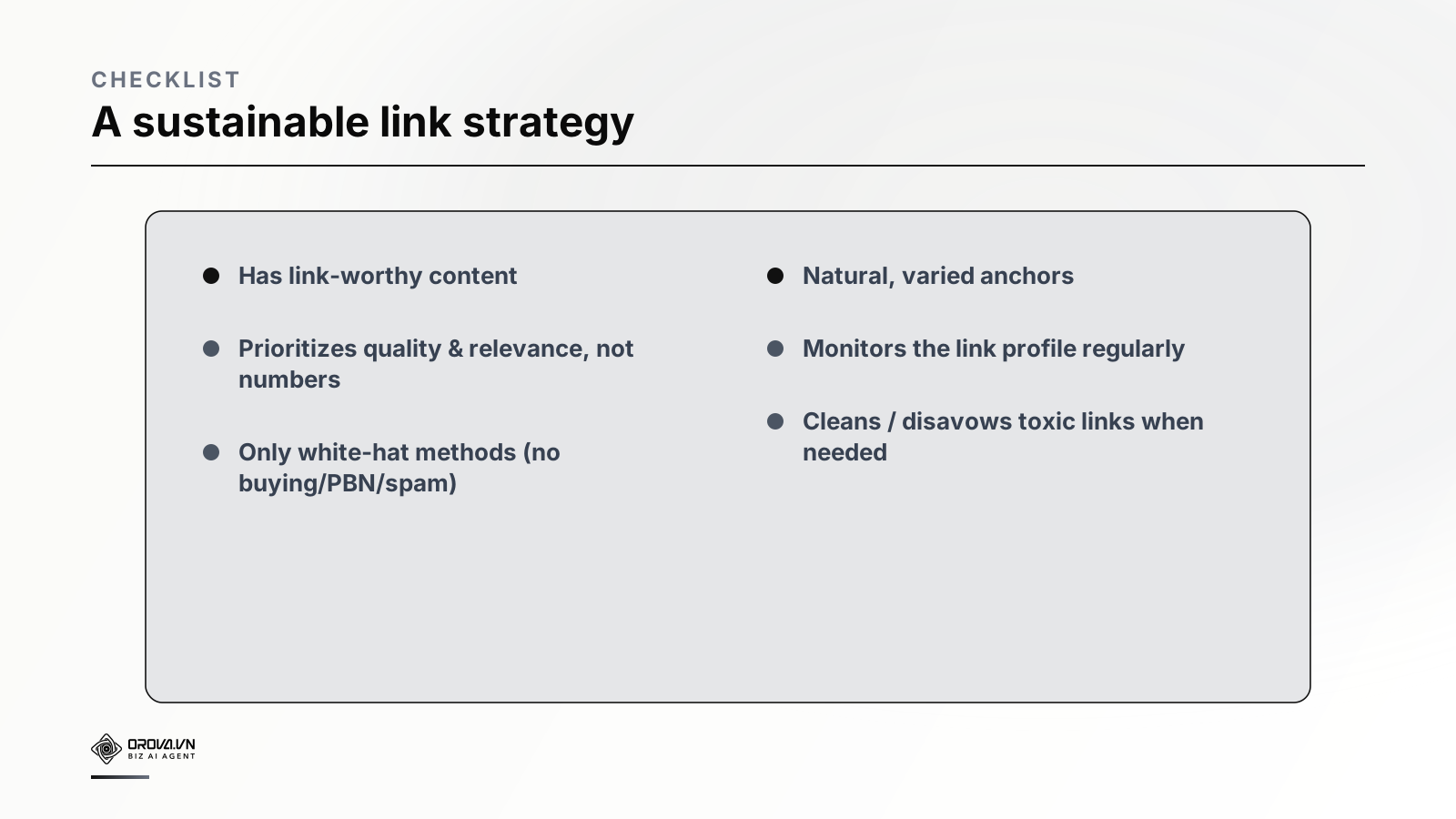
"Pass" standard: you have link-worthy content; your strategy prioritizes quality and relevance over chasing numbers; you only use white-hat methods (no buying links, no PBNs, no spam); anchor text is natural and varied; and you monitor your backlink profile regularly and handle toxic links when needed. At this level, the "good word" about your site is real word — Google trusts it, and authority accumulates sustainably instead of collapsing after an update.
Benefit: quality backlinks are one of the hardest-to-copy and most durable SEO assets. A competitor can copy your content, but not the authority other websites granted you via links. A clean, strong link profile lifts your whole site and makes even new content rank more easily — "trust capital" that pays interest for the long term.
FAQ
Are backlinks still important for SEO? Yes, still one of the strongest ranking factors — but quality and relevance matter much more than quantity now. A few authoritative, relevant links are worth more than hundreds of junk links.
Isn't buying links faster? Fast but extremely risky. Buying links violates Google's guidelines; if detected, you can get a penalty wiping out rankings. That "speed" isn't worth the risk of losing everything — earn links through real value.
Are nofollow links useless? No. Nofollow passes little/no ranking strength, but still brings referral traffic, brand awareness, and a natural link profile always mixes dofollow and nofollow. A profile of only optimized dofollow links looks suspicious.
Does high DA/DR guarantee a good link? Not absolutely. DA/DR are third-party scores, useful for relative comparison, but topical relevance and naturalness matter more. A relevant link from a mid-DR site can beat an off-topic link from a high-DR one.
How long until link building works? Slow and cumulative — usually months for authority to settle into rankings. It's a long-term investment, not an instant ranking button. In return, results are far more durable than short-term tricks.
Where do I start if my site is new? With link-worthy content + building industry relationships. Create a genuinely valuable "linkable asset" (research, tool, deep guide), then reach the right people in your field. Don't rush to chase numbers before you have anything worth linking to.
How do I find bad links pointing to me and handle them? Use a backlink checker (Ahrefs, Semrush, or the Links report in Search Console) to review your profile. If you see clearly spammy/toxic links (often from an attack or leftover bought links), consider the disavow tool so Google stops counting them.
Back to the newly opened pho restaurant
Remember the pho place where your own "best in town" sign convinced no one? Real reputation only came when others — food bloggers, magazines, customers — spoke well of you. And crucially: it had to be real word, from genuinely credible people; hiring fake praise or fabricating buzz eventually gets exposed and backfires.
Link building is earning that "good word travels far" for your website. Don't praise yourself by buying links, building PBNs, spamming — that's fake word, and Google penalizes it heavily when caught. Make genuinely great pho (link-worthy content), then let credible sources naturally speak well of you. Each quality backlink is a real endorsement — and reputation built on real word is durable, not collapsing after one gust of wind. In SEO as in life: only real word travels far for long.
This article is part of Orova's complete SEO guide series. It's a deep-dive within the cluster — see "Digital PR & Linkable Assets", "Internal Linking", and "E-E-A-T" for the full picture. Get started with Orova at orova.vn/en/seo.
Sources
Google Search Central (link guidance, link spam policies, disavow) · Ahrefs & Moz (judging backlink quality, DA/DR, link-building tactics) · Search Engine Journal (white hat vs black hat link building).
Want the links without the manual grind?
Here's the honest part: doing link building well by hand takes real time. Finding the right sites, checking whether a link is trustworthy, reaching out, following up, and tracking what you've already earned — none of that is hard to understand, but all of it adds up week after week, and it's easy to lose track of what's working.
This is exactly the kind of repetitive, detail-heavy work Orova SEO is built to take off your plate, automating the tracking and evaluation side of link building so you spend your time on strategy, not spreadsheets. If that sounds useful, feel free to take a look and see how it fits into your workflow.
Read next: Link Building Services: What Works in 2026 and What Doesn't · Buying Backlinks: What You Get and What It Really Risks
Let Orova SEO handle the repetitive part
Keyword research, drafting, refreshing old posts and rank tracking — running automatically on your own site.
Explore Orova SEO