
Performance Max, Demystified: What AI Watches Inside the Black Box
A media buyer I know spent four months convinced Performance Max was printing money for one of her e-commerce accounts. ROAS sat at a comfortable 6.2, the campaign ate its budget every day, and Google's interface flashed the reassuring green checkmarks that suggest everything is fine. Then she pulled a brand-traffic report through the API. Roughly 70% of that "revenue" came from people typing the brand name into search — customers who would have bought anyway, attributed to a campaign that was really just collecting the easy money and stamping its own name on it. Her real, incremental ROAS on cold demand was closer to 1.8. The black box had not lied, exactly. It had just declined to mention the most important thing.
That is the central tension of Performance Max. It promises to do the hard work for you — and it largely does — but it does so behind a wall of frosted glass. You can see that something is happening. You can see the outcome. You cannot see the mechanism, and you usually cannot see the cost hidden inside the outcome. Most advertisers respond by either trusting it blindly or refusing to use it at all. Both are mistakes. The right posture is the one my friend eventually adopted: treat PMax as a partly-sealed system you cannot reach into, and become very good at reading the few signals that still leak out at the edges.
What Performance Max actually is
Performance Max is Google's goal-based campaign type that runs a single campaign across every inventory Google sells: Search, Display, YouTube, Discover, Gmail, and Maps. You give it a conversion goal, a budget, some creative assets, and a few signals about who you want to reach. From there, Google's automation decides which channel to show your ad on, which audience to target, what to bid, and which creative combination to assemble — all in real time, all without asking you.
The appeal is obvious. Instead of running five separate campaigns across five surfaces, each with its own bidding logic and reporting quirks, you run one. The machine learns across all of them at once, sharing signal between channels. A user who watched your YouTube ad and later searched for a related term can be connected and bid on appropriately. In theory, this cross-channel learning produces results no human juggling five campaigns could match.
The catch is in the word "Max." To maximize across all that inventory, Google needs latitude — and it took it. Performance Max strips away nearly every traditional control. You cannot see which keywords triggered your ads. You cannot see a clean breakdown of spend by channel without fighting for it. You cannot exclude most placements through the normal interface. You cannot even see, in many accounts, how much of your conversion volume came from brand searches versus genuinely new demand. The campaign reports a number and asks you to be satisfied.
Why Google built it this way
It is tempting to read the opacity as a conspiracy to overcharge. The more grounded explanation is that the opacity is structural, not malicious — though the incentives do happen to align nicely for Google. When a single algorithm optimizes across six surfaces simultaneously, exposing every lever to the advertiser would let humans interfere with the optimization in ways that usually make results worse, not better. Every manual override is a constraint the algorithm has to work around. Google's data shows that advertisers who fiddle tend to underperform advertisers who feed the machine good inputs and step back.
So the design choice is defensible. But "defensible" does not mean "in your interest by default." The same opacity that prevents you from sabotaging the algorithm also prevents you from catching it when it optimizes toward cheap, low-value conversions — like brand search — that flatter the reported numbers while quietly failing to grow your business. The machine optimizes for the goal you set. If your goal is poorly specified, it will hit a target you did not actually want, and the box will not warn you.
The levers you still hold
Here is the reframe that changes everything: Performance Max hides the auction, not the inputs. You have lost real-time control over bidding and placement, but you retain a meaningful set of levers that shape what the algorithm can do. Optimization in PMax is not about reaching into the box mid-flight. It is about being deliberate with what you put in before the lid closes, and disciplined about reading what comes out.
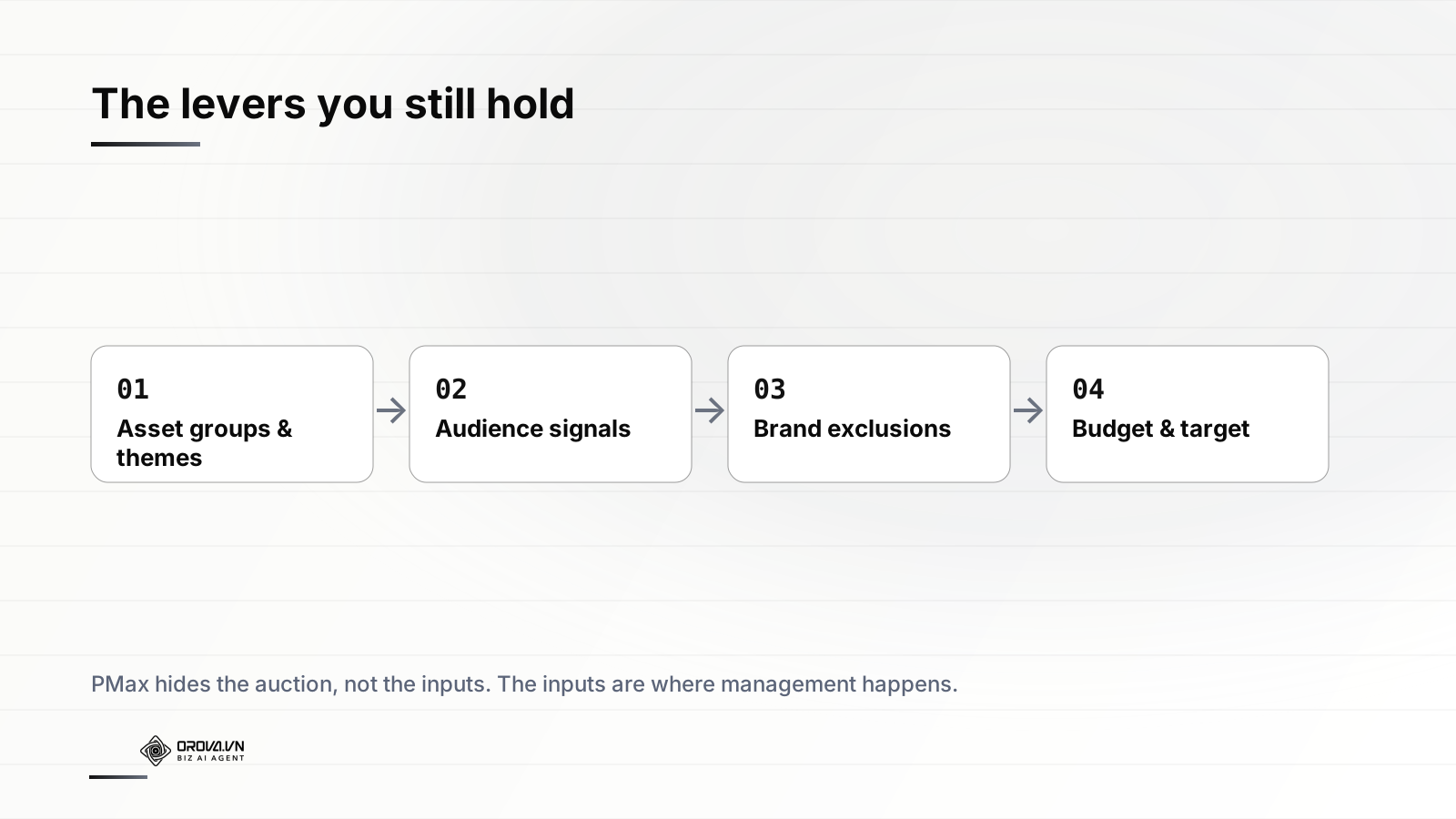
Asset groups and creative themes
An asset group is a bundle of creative — headlines, descriptions, images, logos, videos — organized around a theme. This is the single most underused lever in Performance Max. Most advertisers create one asset group, stuff it with everything, and wonder why their results are mushy.
The better approach treats asset groups the way you would treat ad groups in a traditional Search campaign: one per distinct theme, product line, or audience intent. If you sell running shoes, trail shoes, and recovery sandals, those are three asset groups, each with creative and a landing page that speaks specifically to that buyer. This does two things. It gives the algorithm cleaner thematic signal about what each cluster of inventory is for, and — crucially — it gives you the ability to read performance at the asset-group level rather than as one undifferentiated blob. When a campaign underperforms, the answer is almost always hiding in one asset group dragging down the others.
Within each group, asset quality matters more than people expect. Google rates assets "Low," "Good," or "Best," and starves the low-rated ones of impressions. A group full of "Low" assets is a group the algorithm cannot work with. Audit the ratings; replace the weak assets; give each group enough variety — at least 5 headlines, several descriptions, and a mix of image and video — that the machine has real combinations to test.
Audience signals
Audience signals are one of the most misunderstood inputs in the system. They are not targeting. They are suggestions. When you attach a customer list, a custom segment of in-market users, or your remarketing audiences to an asset group, you are telling the algorithm "people like these are likely to convert — start here." Google uses the signal to seed its learning, then expands beyond it as it finds patterns.
The practical implication: feed it your best first-party data. A list of recent high-value customers is a far stronger signal than a generic in-market category Google offers off the shelf. Custom segments built from competitor search terms and high-intent URLs outperform demographic guesses. You are not locking the campaign into these people — you are giving the cold-start phase a warm place to begin. Weak signals lead to a slow, expensive learning period; strong signals shorten it dramatically.
Search themes
Search themes are the closest thing PMax gives you to keywords, and they arrived because advertisers demanded some say over what searches their ads chase. You can supply up to a handful of phrases per asset group that describe the queries you want to compete for. Google treats them as another signal — it will still go beyond them — but they nudge the system toward the intent you actually care about.
Use them to point the campaign at non-brand, high-intent terms it might otherwise ignore in favor of easy brand wins. If you sell project management software, a search theme like "agile sprint planning tool" tells the algorithm where you want growth, rather than letting it coast on people already searching your company name.
Exclusions and budget
You can exclude brands you do not want to appear near, exclude specific account-level placements, and — through your Google rep or the API — request brand exclusions and negative keyword lists that prevent your PMax campaign from cannibalizing your own brand traffic. This last one is the most consequential lever in the entire system for many accounts, and it is buried. Excluding brand terms forces PMax to earn its conversions on cold demand, which is the only honest way to measure whether it is actually growing your business.
Budget and target settings round out the controls. Your target ROAS or target CPA is not a wish — it is an instruction that fundamentally reshapes behavior. Set a tROAS too high and the campaign throttles itself into a tiny corner of cheap conversions. Set it too low and it sprays spend across marginal inventory. The target is the steering wheel; treat changes to it with the seriousness they deserve, and never move it more than 10-15% at a time, or you reset the learning.
Reading the edges of the box
Once your inputs are clean, management becomes a monitoring discipline. You cannot watch the auction, but you can watch what leaks out around the seal — and a surprising amount leaks out if you know where to look. There are four edges worth watching closely.
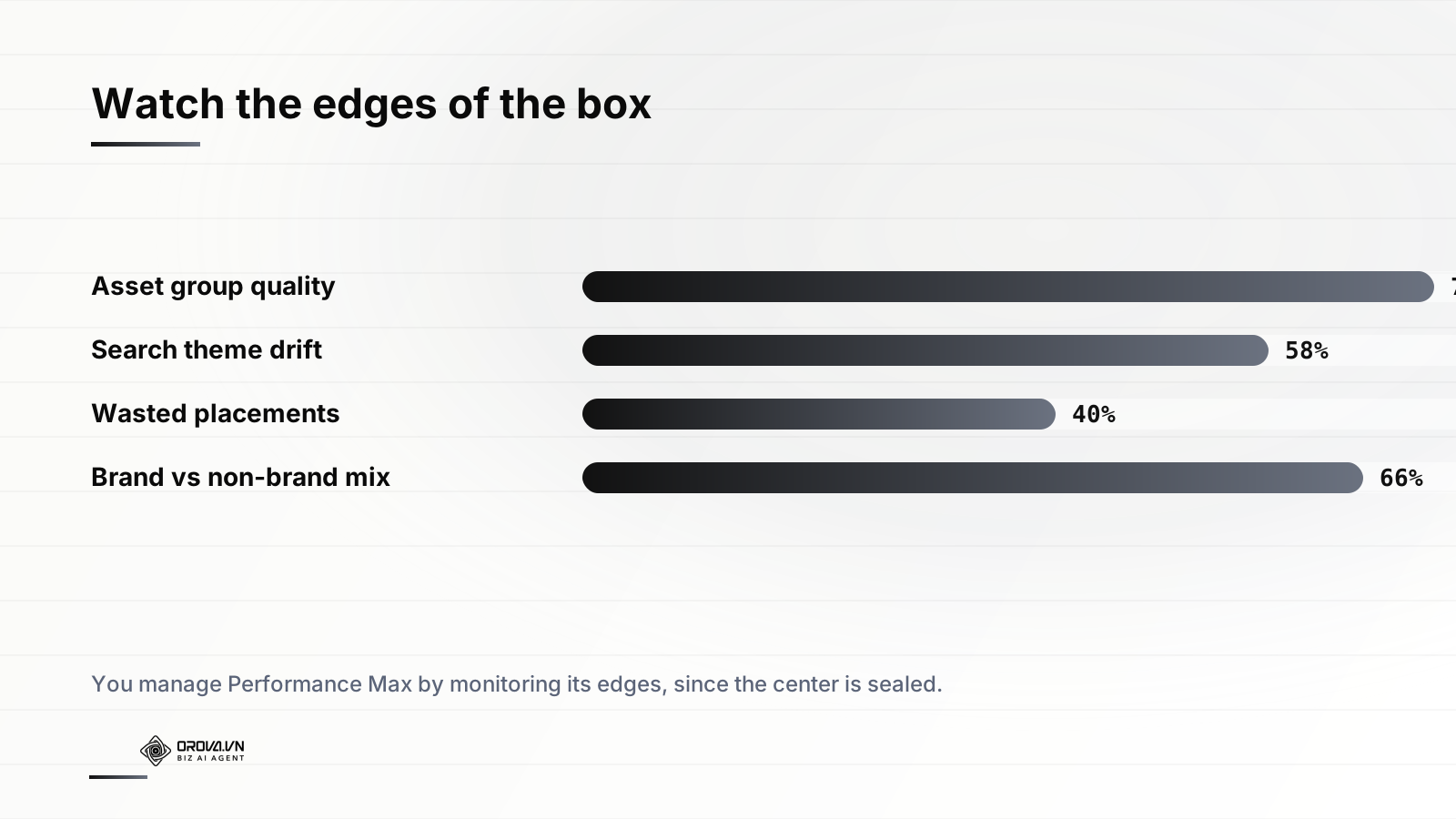
Brand versus non-brand mix
This is the edge that matters most, and the one Google works hardest to obscure. Performance Max loves brand search because brand search converts cheaply and lifts the reported ROAS with almost no effort. Left unchecked, a campaign will drift toward harvesting your existing demand and calling it growth.
The fix is to separate the two. Run a dedicated branded Search campaign to capture brand queries deliberately, then apply brand exclusions to your Performance Max campaign so it is forced onto cold, incremental demand. Now your PMax ROAS means something — it reflects new customers, not recycled ones. If you cannot get full brand exclusions, at minimum pull the brand-traffic breakdown regularly (it is available through the API and via specific reports) and mentally discount the headline number by whatever share is brand. A 6.0 ROAS that is 70% brand is a 1.8 ROAS wearing a costume.
Search theme drift
The search terms report for Performance Max is thin compared to traditional Search, but it exists, and it tells you what queries are actually triggering your ads. Check it. The pattern to watch for is drift: the algorithm slowly wandering from the intent you specified toward cheaper, lower-quality queries that technically convert but attract the wrong buyers. When you see irrelevant terms accumulating spend, that is your cue to add negatives and tighten search themes. Drift is gradual and easy to miss month to month, which is exactly why it deserves a recurring review rather than a once-and-done setup.
Wasted placements
Because PMax spans Display and YouTube, it will inevitably show your ads on low-quality placements — mobile game apps, made-for-advertising sites, content that has nothing to do with your product. The placement report shows where impressions landed. You will often find a meaningful slice of budget going to garbage inventory. Account-level placement exclusions and content exclusions claw some of this back. It is the PMax equivalent of weeding a campaign, and it pairs naturally with the broader discipline of hunting down inefficiency — the same instinct behind finding and cutting wasted spend with negative keywords in conventional Search. The surface is different; the principle is identical: stop paying for impressions that cannot convert.
Asset group quality
Finally, watch performance by asset group, not just by campaign. The campaign-level number is an average that hides the spread. Almost always, one or two asset groups carry the campaign while others bleed budget on weak creative or poorly matched themes. Without the asset-group structure described earlier, this signal is invisible — which is the entire reason for building that structure in the first place. Reallocate creative effort and budget signal toward what works; rebuild or retire what does not.
The discipline this actually requires
None of these checks is hard. The problem is that they are easy to skip, and the cost of skipping them is invisible until it is large. Performance Max is designed to feel finished. It runs, it spends, it reports a number, and nothing about the interface suggests you should be looking harder. The advertisers who win with PMax are the ones who refuse that comfort and build a recurring ritual instead.
A workable cadence looks like this:
- Weekly: scan the search terms report for drift, add negatives, and check that no asset group has slipped into "Low" asset ratings after Google's automatic asset experiments.
- Weekly: review placements and exclude any obvious garbage inventory before it compounds.
- Bi-weekly: pull the brand versus non-brand split and confirm the campaign is still earning on cold demand, not coasting on brand.
- Monthly: evaluate asset groups against each other, reallocate, and refresh creative in the weakest groups.
- Quarterly: reassess targets, audience signals, and whether the campaign structure still matches your product mix.
Write it down. Put it on a calendar. The single biggest predictor of PMax success across the accounts I have seen is not creative genius or clever bidding — it is whether someone is reliably looking at the edges on a schedule, or whether the campaign has been left to run on autopilot for a quarter while everyone assumed the green checkmarks meant all was well.
What good inputs look like in practice
To make this concrete, here is what a well-built Performance Max campaign tends to share:
- Asset groups split by genuine theme, each with a matched landing page, never a single catch-all group.
- At least 5 headlines, multiple descriptions, several high-quality images, and at least one video per group — assets rated "Good" or "Best."
- Audience signals seeded with first-party customer data and custom intent segments, not just off-the-shelf categories.
- Search themes pointing the campaign at non-brand, high-intent queries.
- Brand exclusions applied so the campaign is measured on incremental demand.
- A target ROAS or CPA set realistically and adjusted in small steps.
- Placement and content exclusions maintained, not set once and forgotten.
Notice that every item on that list is an input or a monitoring habit. Not one of them requires reaching into the auction. That is the whole point: the box is sealed, but you control what goes in and you can read what comes out. Master those two things and Performance Max stops being a leap of faith and becomes a tool you actually manage.
You cannot optimize what you cannot see — but you can shape what the algorithm sees, and you can watch the seams. That is the entire game.
Diagnosing a PMax campaign that has gone sideways
Most of the time the question is not "is this campaign good or bad" but "what specifically broke." The opacity makes diagnosis feel impossible, but the edges almost always reveal the cause if you interrogate them in the right order. Here is the sequence I run when a previously healthy Performance Max campaign starts deteriorating.
Step one: is the conversion drop real?
Before touching anything, confirm the problem is in the campaign and not in your tracking. PMax leans heavily on conversion data, and a broken tag, a changed conversion action, or a shift in attribution window will make a perfectly healthy campaign look like it collapsed overnight. Check that your conversion volume across the whole account moved in step with the campaign, or that it did not. A campaign-specific drop while the rest of the account holds steady points at the campaign. An account-wide drop on the same day points at tracking. This five-minute check saves people from "optimizing" a campaign whose only problem was a developer who shipped a new checkout page without the conversion tag.
Step two: did the brand-to-cold ratio shift?
A very common pattern is that ROAS looks stable or even improves while actual new-customer acquisition quietly falls off a cliff. That happens when the algorithm drifts toward brand harvesting. If your headline number is fine but new-customer counts are down, pull the brand split. You will often find the campaign has gradually replaced expensive cold conversions with cheap brand ones — the ROAS held, the business did not grow, and nothing in the interface raised a flag. This is precisely why the brand-versus-cold edge sits at the top of the monitoring list rather than the bottom.
Step three: did Google's automatic changes do this?
Performance Max runs its own experiments. It rotates assets, it tests final URL expansion, it adjusts which inventory it favors. Sometimes those automatic moves help; sometimes they wander into territory you would never have chosen. Final URL expansion in particular can send traffic to pages you did not intend to advertise. Check whether it is enabled and whether the expanded URLs make sense. If the algorithm started sending paid clicks to your blog or your careers page, that is budget evaporating with no chance of conversion, and it will not announce itself.
Step four: did the inputs go stale?
Creative fatigue is real even inside an algorithmic campaign. Assets that performed well for months can decay as the audience saturates, and the asset ratings will quietly slip. A campaign that "stopped working" is frequently a campaign whose creative simply aged out. Refreshing assets — genuinely new angles, not minor rewrites of the same three headlines — often revives performance more reliably than any bid adjustment. The same goes for audience signals: a customer list uploaded a year ago is a stale signal, and refreshing it with recent high-value buyers re-points the algorithm at your current best customers.
Run those four checks in order and you will identify the cause of the vast majority of PMax problems without ever needing to see inside the auction. The diagnostics live entirely at the edges — which is the recurring lesson of this whole campaign type.
The mindset shift that makes it work
The hardest part of Performance Max is not technical. It is psychological. Every other campaign type trained advertisers to feel in control: you wrote the keywords, you set the bids, you chose the placements, and the dashboard reflected your decisions back at you. PMax takes that feeling away and replaces it with a number and a request to trust. The instinct is to either rebel against the loss of control or surrender to it completely. Both instincts produce bad outcomes.
The advertisers who thrive make a quieter adjustment. They stop thinking of themselves as operators who pull levers in real time and start thinking of themselves as system designers and auditors. The work moves upstream — into the quality of inputs — and outward — into the rigor of monitoring. You are no longer flying the plane manually; you are building the flight plan, choosing the instruments, and watching the gauges for anomalies. It is a different job, and for many people a less satisfying one in the moment, because the feedback loop is slower and the wins are less visceral. But it is the job the campaign type actually requires, and pretending otherwise is how accounts quietly bleed budget for months.
This reframing also clarifies where human attention is best spent. The center of the box does not need your attention, because you cannot affect it and Google's automation is genuinely good at the narrow task of running the auction. Your attention is wasted there and valuable at the edges. Time spent staring at the campaign's headline ROAS wondering what to do is time better spent auditing asset groups, refreshing audience signals, and pulling the brand split. Direct your effort to the parts of the system you can actually move.
When PMax is the wrong tool
One honest caveat before the close. Performance Max is not always the right campaign type, and the marketing around it sometimes implies it is. It struggles when you have thin conversion data — the algorithm needs roughly 30 to 50 conversions a month to learn well, and below that it flails. It struggles when your margins are tight and you cannot afford the learning period's inefficiency. And it actively works against you when your account is small enough that PMax simply absorbs your existing brand demand and reports it as performance. In those cases, a tightly controlled Search campaign with real keywords and manual oversight will serve you better. Use PMax when you have enough conversion volume and enough cold demand to make the cross-channel learning worth the loss of control. Otherwise, keep the levers you can see.
The mature view is neither evangelism nor refusal. It is conditional adoption: use the black box where its strengths apply, feed it disciplined inputs, and never stop reading the edges. The advertisers who treat Performance Max as a partner to be managed — rather than a slot machine to be trusted — are the ones who get the cross-channel reach without quietly subsidizing Google's easy wins.
Watching the edges of the box every week is real work, and it is exactly the kind of work that gets skipped when humans are busy. Orova Ads is an AI agent that does this watching for you across Google, Meta, and TikTok — reading your campaign data every day, flagging brand drift, wasted placements, and weak asset groups, and executing the fixes to budgets, bids, targeting, and on/off states with your approval and a full audit log of every change. If you would rather have the edges monitored continuously than hope you remember to check, see how Orova Ads keeps Performance Max honest.
Run your business with AI Agents
Orova is the always-on Biz AI Agent — it plans, runs, and optimizes the work for you. Save time, unlock productivity.
Try it free