
"Ranking #1" Is Not a Business Goal
There is a sentence that gets said in marketing meetings with total confidence, and it deserves far more suspicion than it gets: "Our goal is to rank number one." It sounds like ambition. It sounds measurable. It sounds like a goal. It is none of those things in the way that matters — it is an activity dressed up as an outcome, and mistaking the two has quietly wasted an enormous amount of SEO effort.
This article is built around a single corrective idea, and a few aphorisms to make it stick. The central one is this: a ranking is a means; it was never supposed to be an end. Once you genuinely absorb that, a great deal about how you set SEO goals, report SEO results, and decide what to work on changes — for the better.
"You cannot deposit a ranking"
Start with the bluntest version of the argument. You cannot deposit a ranking into a bank account. You cannot pay a salary with a position. No customer has ever bought a product because of where its blog post sat in the search results — they bought because of what happened after they clicked, or they did not click at all.
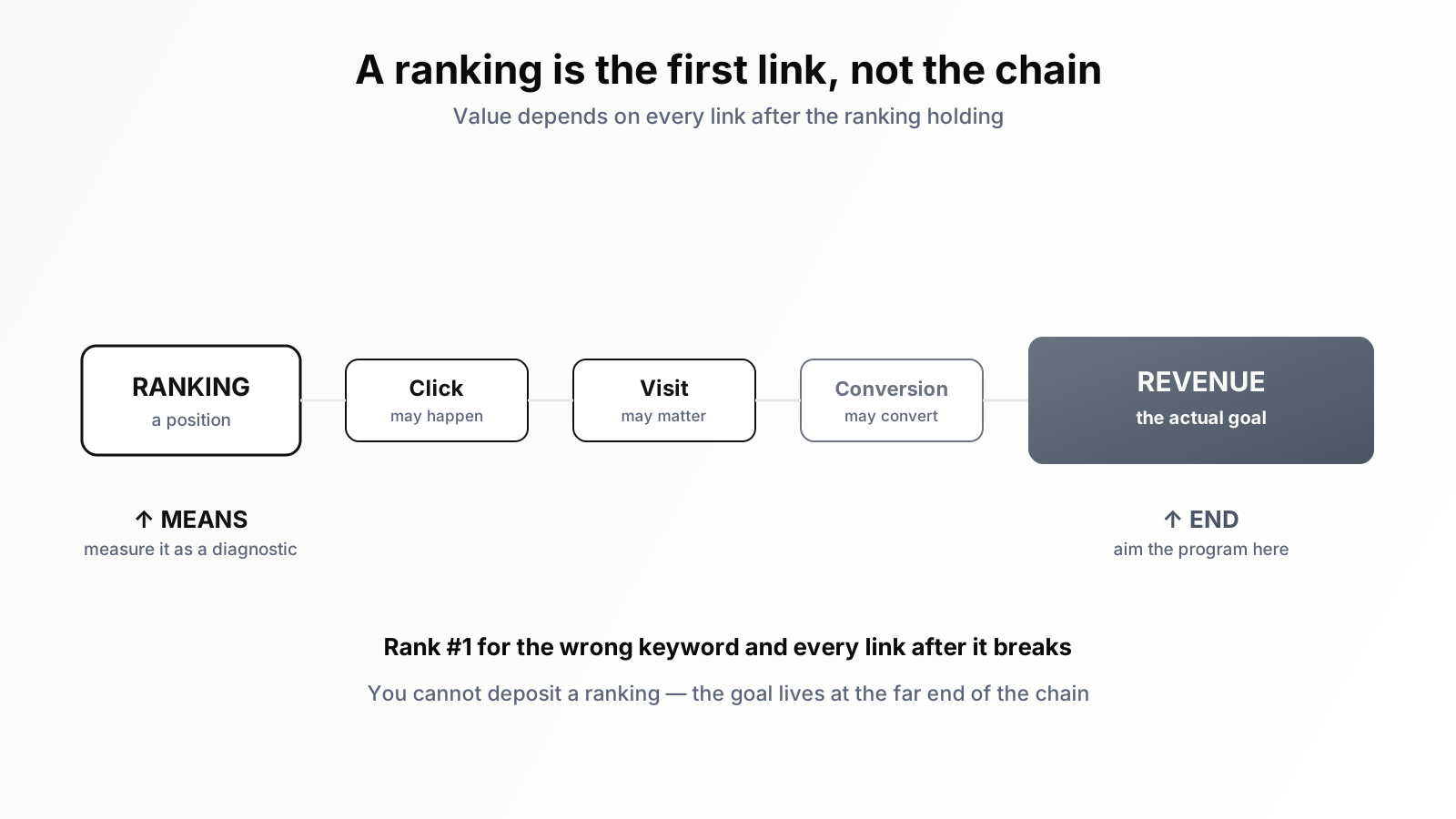
A ranking is a position on a page. It has no inherent value. Its only value is conditional: it may lead to a click, the click may lead to a visit that matters, the visit may lead to a conversion, and the conversion may lead to revenue. Every link in that chain can break. You can rank number one for a term nobody searches, and earn nothing. You can rank number one for a term plenty of people search, but with intent so mismatched to your page that every visitor bounces, and earn nothing. You can rank number one, get the click, get the visit — and have a page so weak at converting that the visitor leaves, and earn nothing.
"Rank number one" treats the first link in that chain as if it were the whole chain. It is the easiest link to see, the easiest to measure, and the most satisfying to celebrate — which is precisely why it gets mistaken for the goal. But you cannot deposit a ranking. The goal is always somewhere further down the chain.
"A goal you control completely is a task, not a goal"
Here is a second way to see the problem, and a second aphorism: if you have complete control over whether you hit it, it is a task, not a goal.
Real business goals have a quality that "rank number one" lacks — they depend on the market responding, not just on you executing. "Grow trial sign-ups" is a goal because customers have to choose to sign up; you cannot simply do it. "Increase organic revenue" is a goal because the market has to buy. These goals keep you honest, because hitting them proves something happened in the world, not just in your task list.
"Rank number one," by contrast, sits in an uncomfortable middle. It is not fully in your control — Google decides — but it is also not a market response. Ranking is an intermediate signal: useful as a diagnostic, useless as a destination. When a team adopts it as the goal, something subtle and bad happens. The team optimises for the ranking itself. They chase positions on terms they can win rather than terms that matter. They celebrate a number-one position and stop, never asking whether that position produced a single dollar. The metric becomes the mission, and the mission gets forgotten. This is the classic failure our piece on connecting SEO to the bottom line exists to fix.
"Rank number one for the wrong keyword and you have won nothing"
The cleanest demonstration of why rankings are not goals is the wrong-keyword problem. Imagine two outcomes. In the first, you rank number one for a keyword — but it is a term with little real search demand, or one searched by people who will never buy what you sell. In the second, you rank number five for a keyword searched constantly by people actively looking to buy a product like yours.
By the "rank number one" goal, the first outcome is the success and the second is the disappointment. By any business goal, it is the exact reverse. The number-five position on a high-intent, high-demand term will out-earn the number-one position on an irrelevant term, probably by a wide margin, possibly by an infinite one if the irrelevant term earns literally nothing.
This is not a corner case. It is the normal situation, and "rank number one" actively conceals it, because the goal contains no information about which keyword or why. It rewards the position regardless of whether the position is worth holding. As the aphorism goes: rank number one for the wrong keyword and you have won a contest nobody was paying prize money for.
"Measure the position you are in, but aim at the position you want the business in"
None of this means rankings are worthless or that you should stop tracking them. That would be the opposite error. Rankings are an excellent diagnostic. They are a leading indicator — they move before traffic does, and traffic moves before conversions do — which makes them genuinely useful for spotting problems and progress early. The point is not to ignore rankings. It is to put them in their proper place.
The proper place is this aphorism: measure the position you are in, but aim at the position you want the business in. Rankings belong in the measurement layer — the diagnostics you watch to understand whether things are on track. They do not belong in the goals layer — the small set of outcomes you have committed to achieving and will be judged against.
In practice, that means your SEO goals are stated in business terms: organic conversions, organic-attributed revenue, organic pipeline contribution, qualified traffic to commercially relevant pages. Rankings then appear underneath those goals as supporting evidence — "here is why the conversion number moved, or is about to" — not as the headline. The reframe is small to say and large in effect. It changes what the team optimises for, what gets celebrated, and what gets reported upward.
"A ranking with no intent behind it is a vanity metric in disguise"
It is worth being explicit about something the previous sections imply: a ranking detached from intent is a vanity metric, even though it rarely gets called one. Vanity metrics are usually accused of being soft things — follower counts, page views. But a hard-looking, precise number like "position 1 for [keyword]" can be just as much a vanity metric if it is not connected to a business outcome.
The test of a vanity metric is not whether it is precise; it is whether it changes a decision and whether it correlates with value. A ranking that you cannot connect to demand and intent fails that test. It looks rigorous, it feels like an achievement, and it tells you almost nothing about whether the business is better off. The remedy is to never report a ranking without, in the same breath, saying what the ranking is for — what the term means commercially, what intent sits behind it, what business outcome it is meant to feed. A ranking with that context is a useful diagnostic. A ranking without it is decoration.
"The honest goal survives the question 'so what?'"
Here is a simple test you can apply to any SEO goal, and an aphorism to remember it by: a real goal survives the question "so what?"; a fake one does not.
Apply it. "We rank number one for [keyword]." So what? "So we get more clicks." So what? "So we get more traffic." So what? "So... more people see us." The chain dribbles out into vagueness without ever reaching anything a business cares about. That dribbling-out is the tell. The goal could not survive the questioning because there was no business outcome at the end of it.
Now apply it to a better goal. "We grew organic trial sign-ups this quarter." So what? "So the product has more potential customers in it, acquired at low marginal cost, without paying for ads." There is no "so what?" left — you have arrived at something self-evidently valuable. A goal that survives repeated "so what?" is connected to the business. A goal that does not is an activity wearing a goal's clothing. Run your current SEO goals through this test and see which ones survive.
"Set the goal at the end of the chain, then work backwards"
If rankings are not the goal, what does a properly built SEO goal look like? The construction follows from everything above, and it has its own aphorism: set the goal at the end of the chain, then work backwards.
Begin at the far end — the business outcome. Organic-driven revenue, sign-ups, qualified pipeline: pick the one the business genuinely cares about. That is the goal. Then work backwards along the value chain. To produce that outcome you need conversions from organic visitors, so conversion rate and converting traffic become the metrics one step back. To produce those you need qualified visits, so traffic to commercially relevant pages is the metric a step further back. And to produce those visits you need visibility on the right terms — and that is finally where rankings enter, at the very back of the chain, as the earliest leading indicator.
Built this way, the whole structure has rankings in it — they are not discarded — but rankings are positioned correctly: as the first, earliest, most diagnostic signal feeding a chain whose endpoint is a real business outcome. The goal is the endpoint. The ranking is the instrument. Nobody confuses the two, because the structure itself makes the distinction. This backwards-from-revenue approach is part of building reports that survive scrutiny — our guide to the six SEO KPIs a boss actually cares about applies the same logic to what you put in front of leadership.
"What you celebrate is what you get more of"
A final aphorism, about culture rather than measurement: what you celebrate is what you get more of. This is why fixing the goal matters beyond the spreadsheet.
If a team celebrates rankings — sends the Slack message when a page hits position one, puts the position count in the monthly highlight reel — then the team will, rationally, produce more rankings, including rankings on easy, irrelevant, low-intent terms, because those are the cheapest way to generate the thing being celebrated. People optimise for applause. If instead the team celebrates organic conversions, organic revenue, qualified pipeline — the things at the end of the chain — then the team will produce more of those, and will naturally pursue only the rankings that actually feed them.
So the reframe in this article is not merely a reporting nicety. It quietly redirects the entire effort of the team. Stop celebrating positions. Start celebrating outcomes. Within a couple of quarters, the work itself changes shape — because what you celebrate is what you get more of, and you should make very sure you are celebrating something you can deposit in the bank.
Where an AI agent fits
Reframing goals from rankings to outcomes is a decision, not a tool — but living by that reframe day to day is harder than deciding it once. It means continuously connecting rankings to the demand and intent behind them, attributing conversions back to organic search, keeping the value chain visible from keyword to revenue, and resisting the gravitational pull back toward the easy, satisfying ranking number. That connecting work is constant.
An SEO AI agent is well suited to maintaining those connections. Orova can keep rankings tied to the keywords' intent and commercial value, track the full chain from visibility through traffic to conversions, and surface progress in outcome terms rather than position terms — so the reframe this article argues for is not just a one-time resolution but the default way your data is presented. The judgement about which outcomes matter stays yours. The agent keeps the ranking honestly in its place: a useful instrument, never the goal.
"Rank number one" was never a goal. It was an activity that learned to talk like one. Set your goals at the end of the chain, where the revenue is, keep rankings where they belong as a diagnostic, and celebrate the outcomes you can actually deposit. A ranking is a means. The goal was always somewhere further on.
Run your business with AI Agents
Orova is the always-on Biz AI Agent — it plans, runs, and optimizes the work for you. Save time, unlock productivity.
Try it free