
The Only 6 SEO KPIs Your Boss Actually Cares About
Open almost any SEO report and you will find the same thing: a dense grid of numbers. Keyword positions, impressions, click-through rates, domain authority, crawl errors, indexed pages, backlink counts, average ranking position by device, branded versus non-branded splits. It is thorough. It is also, for the person it is addressed to, nearly useless — because the person it is addressed to is not an SEO. They are a manager, a founder, or an executive, and they did not ask "how is our SEO doing?" because they wanted thirty metrics. They asked because they have a small number of real questions, and they are hoping your report answers them.
The gap between what SEOs measure and what their bosses care about is one of the most persistent reasons SEO is undervalued inside companies. Not because the work is weak, but because the reporting speaks a language the audience does not. This article is an attempt to close that gap. It argues that, however many metrics you track privately to do your job, the number you put in front of leadership should be small — six at most — and that those six should be chosen for what they tell a business, not for what they tell a technician.
Why most SEO reporting fails its audience
To fix the reporting problem, it helps to understand precisely how it goes wrong, because the failure is rarely a lack of effort. Most SEO reports fail for the opposite reason: they contain too much.
When you live inside SEO every day, every metric feels meaningful, because every metric connects to a decision you might make. Crawl errors matter because you fix them. Average position matters because you watch it move. Indexed page count matters because you noticed it drop last week. So you include all of them, reasoning that more information is more honest, more complete, more professional. But your audience does not live inside SEO. To them, a metric without a decision attached is just noise — and thirty metrics is thirty pieces of noise that bury the three or four signals they actually needed to hear.
The result is a particular kind of quiet failure. The executive skims the report, understands almost none of it, concludes that SEO is complicated and that you seem busy, and forms no clear opinion about whether it is working. That is the worst outcome. It is not "SEO looks bad" — it is "SEO is illegible," and an illegible function is the first one questioned when budgets tighten. A report nobody can read is, from a career and budget standpoint, barely better than no report at all.
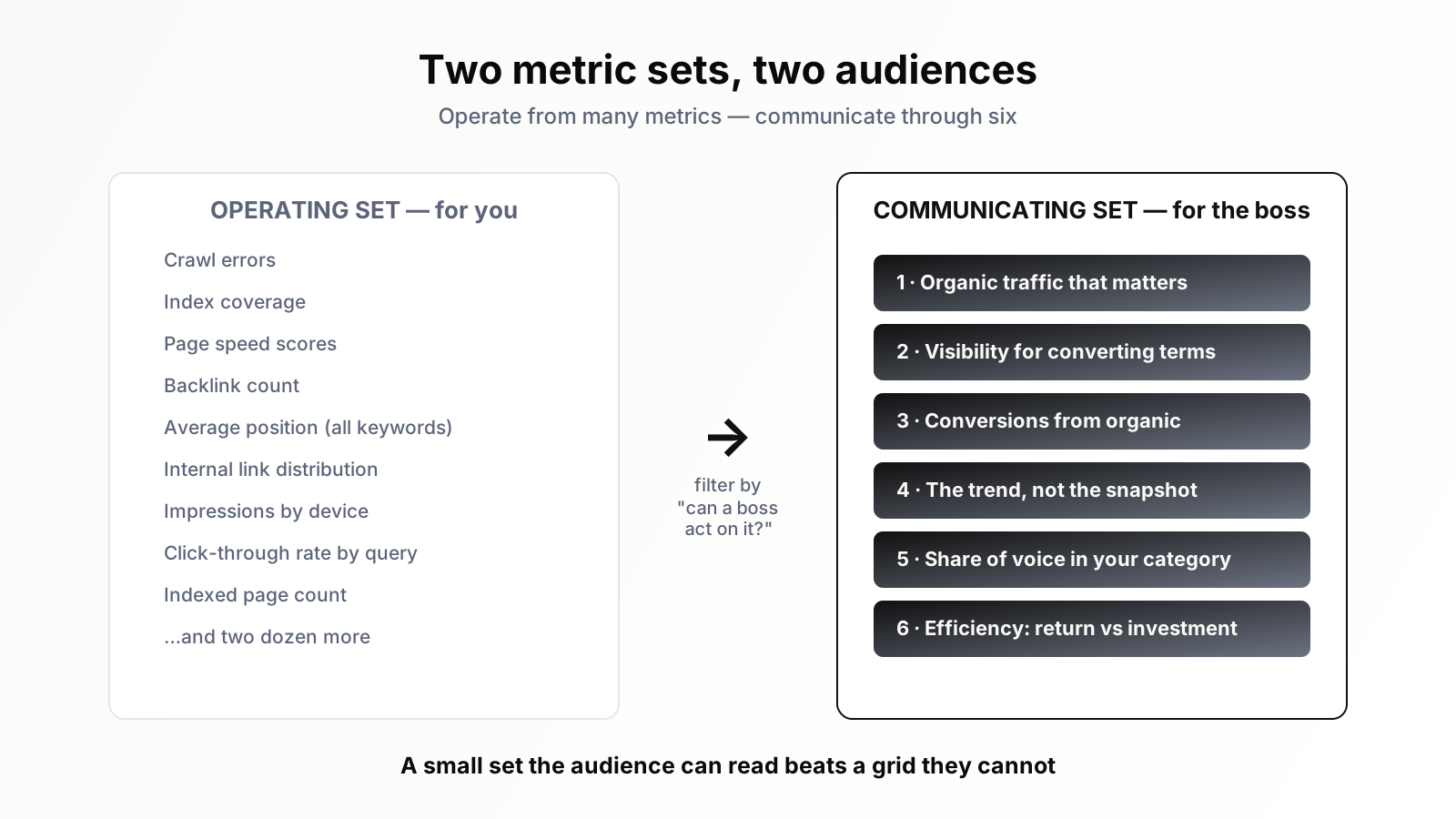
The fix is not to dumb the work down. It is to separate two distinct things that most SEOs collapse into one: the metrics you use to operate, and the metrics you use to communicate. The operating set can be as large as you like — it is for you. The communicating set must be small, and it must be chosen by a single test: would a non-SEO immediately understand why this number matters to the business? Six metrics pass that test. Here they are.
KPI one: organic traffic that matters
The first KPI is the one everyone expects — organic traffic — but with an important qualifier. Total organic sessions is a weak headline number, because it lumps together traffic that means very different things. A spike in visits to an old, irrelevant blog post is not the same business event as a rise in visits to your product and pricing pages, but raw traffic counts them identically.
So report organic traffic, but report it segmented in a way the business understands. At minimum, separate branded from non-branded: branded traffic is people already looking for you, and growth there is mostly a marketing and brand story, not an SEO one. Non-branded organic traffic — people who found you while searching for a problem you solve — is the number that actually measures whether SEO is expanding your reach. When you can, segment further by page type: traffic to pages with commercial intent is worth flagging separately from traffic to top-of-funnel content, because they sit at different distances from revenue.
The version of this KPI that lands with a boss is one sentence: "Non-branded organic traffic — people discovering us through search who weren't already looking for us — grew this quarter, and here is roughly where." That is a business statement. "Sessions are up 12%" is a number.
KPI two: keyword visibility for terms that convert
The second KPI handles rankings — but, like traffic, with discipline about which rankings. Tracking your position for hundreds of keywords and reporting an average is a habit that produces a number nobody can act on. A blended average across hundreds of terms can stay flat while everything that matters underneath it moves.
What leadership cares about is visibility for the specific terms tied to your business: the queries a potential customer types when they are close to buying, and the queries that define your category. That is a far shorter list — often a few dozen, not a few hundred — and progress on that list is a real business signal. "We now appear on page one for the searches our buyers actually use to find tools like ours" is something an executive can understand and care about. "Our average position improved from 14.2 to 13.6" is not.
Report keyword visibility, then, as movement on a deliberately curated, commercially relevant shortlist. The discipline of choosing that shortlist is itself valuable — it forces you to be explicit about which rankings you believe are worth winning, which is a strategic conversation worth having out loud.
KPI three: conversions from organic search
The third KPI is where most SEO reports go quiet, and it is the one that matters most. Traffic and rankings are inputs. The output a business cares about is what that traffic did. So report conversions from organic search: sign-ups, demo requests, trials started, leads captured, or whatever counts as a meaningful action in your business.
This is the KPI that reframes SEO from a traffic channel into a growth channel. The moment you can say "organic search produced this many trial sign-ups this quarter," SEO stops being an abstract activity and becomes a contributor to the same outcome the sales and product teams are measured on. You are speaking the company's native language.
Getting this number requires conversion tracking that attributes actions to the organic channel, which is a setup task — but it is the single highest-leverage piece of measurement infrastructure an SEO can invest in. Without it, you are forever reporting inputs and asking leadership to take the outputs on faith. With it, you report outcomes directly. If the link between rankings and revenue is something you want to think through more deeply, our piece on connecting SEO to the bottom line goes a level further.
KPI four: the trend, not the snapshot
The fourth item is less a separate metric than a rule about how the first three are presented: always show the trend, never the snapshot.
A single number — "we got 40,000 organic visits in April" — is almost meaningless to a decision-maker, because they have nothing to compare it against. Is that good? Is it better than March? Is it the result of your work or of seasonality? The number alone cannot say. The same number plotted as a line over the last twelve months answers all of those questions instantly. It shows direction, it shows pace, it shows whether a dip is a worrying break in a pattern or a normal seasonal trough.
SEO is a slow channel, and slow channels are best judged by trajectory. A boss looking at a twelve-month upward line understands, without being told, that the program is working and compounding. A boss looking at a single month's figure understands nothing and is left to guess. Make every headline KPI a trend line, label the obvious context — seasonality, a known algorithm update, a content push — and you have turned numbers into a story that reads itself.
KPI five: share of voice in your category
The fifth KPI introduces the one thing the first four miss: competitive context. Your traffic and conversions could be growing while your competitors grow faster — meaning you are winning in absolute terms and losing in relative terms. A boss, especially one who thinks about market position, wants to know that.
Share of voice is the metric that supplies it. In SEO terms it estimates how much of the total available search visibility, across the set of keywords that define your category, your site captures compared to competitors. The exact methodology matters less than the story it tells: are we gaining ground on the people we compete with, holding steady, or slipping?
This is a KPI executives intuitively grasp, because market share is a concept they already use everywhere else in the business. Framing organic visibility as a share of a competitive pie connects SEO to a way of thinking leadership already does naturally. It also guards against a complacent report — "everything is up" reads very differently next to "but two competitors are up more," and leadership should see both.
KPI six: efficiency — return relative to investment
The sixth and final KPI answers the question every budget-holder eventually asks, whether out loud or not: is this worth what we are spending on it?
You do not need a perfect ROI figure to answer that — perfect SEO ROI is genuinely hard, because organic results compound over long periods and attribution is messy. But you can and should report something about efficiency. That might be the trend in cost per organic conversion. It might be a comparison of the cost of acquiring a customer through organic search versus paid channels. It might simply be the trajectory of conversions produced against a roughly stable level of investment, showing that the channel is becoming more productive over time.
The point is to pre-empt the budget question by answering it before it is asked. An SEO who voluntarily reports on efficiency looks like someone who thinks about the business. An SEO who only ever reports activity and reach looks like a cost the moment money gets tight. This sixth KPI is, more than any other, the one that protects the program.
What to leave out — and why that is not dishonest
Choosing six KPIs means deliberately leaving dozens of metrics out of the report, and it is worth being clear that this is not hiding anything. Crawl errors, index coverage, page speed scores, backlink counts, internal link distribution — these are real and important, and you should track every one of them. They simply belong in your operating dashboard, not in your leadership report.
The test is whether a metric drives a decision the audience can make. Your boss cannot act on a crawl-error count; you can, and you will. Putting it in front of them does not add transparency — it adds noise that obscures the six signals they can act on. Keeping a clean operating set for yourself and a clean communicating set for them is not concealment. It is respect for two different audiences with two different jobs. If anyone asks for the detail, you have all of it, instantly. They almost never will. What they will remember is that your reports were the ones they could actually read.
How the six fit together as a story
Read in sequence, the six KPIs are not a list — they are a narrative, and that is the real reason to use them. Traffic that matters shows reach is growing. Visibility for converting terms shows that growth is aimed at the right searches. Conversions show the traffic is doing something valuable. The trend view shows it is sustained, not a fluke. Share of voice shows it relative to competitors. And efficiency shows it is worth the money.
An executive who reads those six, in that order, comes away with a complete and honest picture: SEO is reaching the right people, converting them, doing so consistently, gaining on the competition, and earning its budget — or, where one of those is not yet true, exactly which link in the chain needs attention. That is a report that builds trust, justifies investment, and makes the next budget conversation easier instead of harder. A thirty-metric grid does none of that, however hard it was to assemble. Building reports around the right small set of metrics is closely tied to designing a dashboard people actually read — the metrics and their presentation are two halves of the same problem.
Where an AI agent fits
Pulling six clean KPIs together is not difficult in concept, but it is fiddly and recurring in practice. The data lives across several places — Search Console, analytics, rank tracking, competitive tools — and someone has to gather it, segment branded from non-branded, isolate the commercially relevant keyword shortlist, attribute conversions to the organic channel, and assemble the trend lines, every reporting cycle, without letting the report quietly bloat back into a thirty-metric grid.
That recurring assembly is exactly the kind of work an SEO AI agent removes. Orova can connect to your search and analytics data, maintain the segmentation and the curated keyword shortlist, track conversions and share of voice over time, and produce a consistent six-KPI report on a schedule — leaving you to do the interpretation and the strategy, which is the part a boss actually wants from you. The discipline this article describes does not change. The agent simply makes it sustainable, so the clean report still looks clean six months from now.
Your next report does not need to be longer. It needs to be smaller, sharper, and built around the six numbers your boss was always really asking about. Track everything else for yourself. Show them these six — and watch SEO stop being the function nobody quite understands.
Run your business with AI Agents
Orova is the always-on Biz AI Agent — it plans, runs, and optimizes the work for you. Save time, unlock productivity.
Try it free