
Reverse-Engineering a Competitor's Content Strategy

A competitor's content strategy is not a secret document locked in their offices. It is published, in full, on their website, available to anyone willing to read it carefully. Every page they have put online is a piece of evidence about what they decided to do. Reverse-engineering their strategy is simply the discipline of collecting that evidence and reconstructing the decisions behind it.
This is not the same as the keyword gap analysis most teams run. A gap analysis asks "which terms do they rank for that we don't?" — a useful but narrow question. Reverse-engineering a content strategy asks something deeper: how does this competitor think? What audience are they writing for, what topics do they consider core, how do they structure their site, how often do they publish, what does a winning page look like to them, and where is their program strong versus where is it just coasting? Answer those questions and you do not just inherit a keyword list — you understand a competitor well enough to out-think them. This is a practical, step-by-step method for doing exactly that.
Before you start: pick the right subject
Reverse-engineering takes real effort, so do not waste it on the wrong company. The most instructive subject is not the market leader — their strategy was built with resources and authority you do not have, and copying it would be like a club team studying a national team's training schedule. The most instructive subject is a competitor one or two steps ahead of you: established enough to have a real content program, close enough that their decisions are decisions you could realistically make too.
Pick one such competitor and study them properly. A deep reconstruction of one relevant competitor teaches you more than a shallow glance at five. You can repeat the process for others later; the depth is what produces the insight.
Step one: map their site structure
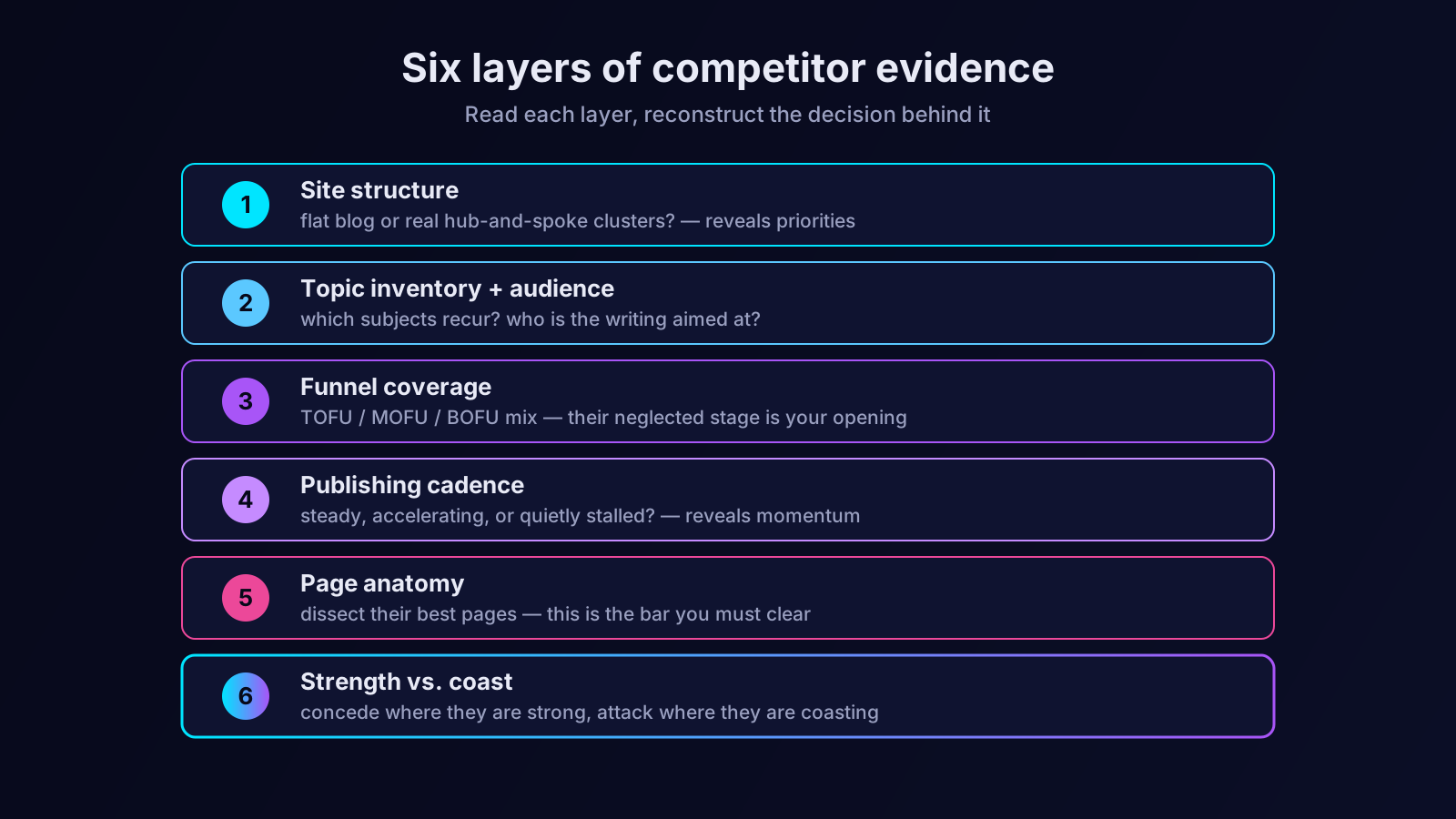
Start with architecture, because architecture reveals priorities. Find every section of their site that holds content — the blog, the resources hub, the help centre, the glossary, the comparison pages, the use-case pages. Sketch how it is organised. Is the blog a flat stream of posts in reverse-chronological order, or is it grouped into categories and hubs? Are there pillar pages — long, comprehensive guides — with clusters of supporting articles linking up to them?
Structure is strategy made visible. A competitor who has built genuine hub-and-spoke clusters is running a deliberate topic-authority play; they have decided to own subjects, not just publish posts. A competitor whose blog is an undifferentiated chronological feed either has no structural strategy or has not got to it yet — and that, for you, is a weakness worth noting. Spend time here. The shape of a content library tells you how seriously its owner is taking SEO before you have read a single article.
Step two: inventory their topics and infer their audience
Now list what they actually write about. Go through their content library and group every piece into themes. A pattern will emerge quickly: a handful of subjects they return to constantly, a wider ring of topics they cover occasionally, and an edge of one-off pieces. The constant subjects are their declared core — the territory they have decided to own.
From the topics, infer the audience. Read several pieces and ask who they are written for. Beginners or experts? Practitioners doing the work or executives approving budgets? Technical readers or non-technical ones? The vocabulary, the assumed knowledge, the examples, the depth — all of it points at a specific reader. This matters enormously, because the audience a competitor writes for tells you which customers they are competing for. If their content targets a reader who is not your buyer, they are less of a threat than the org chart suggests. If it targets exactly your buyer, you are in a direct contest for the same attention, and the rest of this analysis becomes urgent.
Step three: read their funnel coverage
Sort their content by where it sits in the buyer's journey. Top-of-funnel pieces are broad, educational articles for people just learning the subject. Middle-of-funnel pieces help someone actively evaluating solutions — frameworks, comparisons, deeper how-tos. Bottom-of-funnel pieces target people close to a purchase — comparison pages, alternatives pages, use-case pages, pricing-adjacent content.
Now look at the distribution, because the distribution is one of the most revealing things in the whole exercise. A competitor who has published a hundred top-of-funnel articles and almost no bottom-of-funnel content is running a traffic-and-awareness play; they may be getting visitors but struggling to convert them — and the bottom of the funnel is wide open for you. A competitor heavily weighted toward bottom-of-funnel comparison and use-case content is running a conversion-focused play and competing hard for buyers who are nearly ready to choose. The shape of their funnel tells you what they are optimising for, and just as importantly, what they are neglecting. Their neglected layer is your opening.
Step four: estimate their publishing cadence
Most blogs show publication dates, and dates let you reconstruct rhythm. Look at the last twelve to eighteen months. Are they publishing weekly, monthly, sporadically? Is the rate steady, accelerating, or has it quietly stalled?
Cadence reveals investment and momentum. A steady, sustained rhythm signals a real, resourced program with a system behind it — a serious competitor. An accelerating rate signals a team that has just increased its bet; expect them to get harder to beat. And a cadence that has stalled — a flurry of posts a year ago and near-silence since — is one of the most useful signals you can find. It often means the program lost its champion, its budget, or its priority. A competitor whose content has gone quiet is a competitor whose existing rankings are slowly going stale, and those rankings are now contestable in a way they were not eighteen months ago.
Step five: dissect their best pages
Identify the competitor's strongest individual pages — their most prominent guides, the articles ranking for their most valuable terms — and take them apart. This is where you learn what "good enough to win" looks like in your specific market.
For each strong page, examine the anatomy. How long is it? How is it structured — clear headings, scannable sections, or a wall of text? What does it include beyond prose: images, diagrams, tables, videos, downloadable resources, original data? How is it linked — does it pull in supporting articles and push readers toward a next step? How current is it; has it been updated recently? You are building a profile of the standard a page has to meet to rank in your category. That profile becomes your brief. To beat their page, yours has to clear the bar this dissection reveals — and then clear it by a visible margin.
Step six: separate strength from coast
The final and most valuable step is to read the whole reconstruction and divide the competitor's program into two categories: where they are genuinely strong, and where they are merely coasting on past work.
Genuine strength looks like this: a well-structured cluster, comprehensive and current pages, recent updates, internal linking that reinforces the topic. Attacking genuine strength head-on is expensive and slow; you would be trying to outdo a competitor at the thing they are best at. Coasting looks different: pages that rank but have not been touched in years, thin articles holding positions they no longer deserve, structural gaps, abandoned funnel stages, a cadence that has flatlined. Coasting positions are soft. They are held by inertia, not by quality, and inertia is beatable with one genuinely better page.
This is the strategic payoff of the entire exercise. A competitive content strategy is not "do everything the competitor does." It is "concede where they are strong, attack where they are coasting." The reverse-engineering process is what tells you, with evidence rather than guesswork, which is which. Without it you are attacking blind — possibly throwing effort at a competitor's fortress while ignoring their undefended flank.
Turning the reconstruction into your own plan
You now have, for one competitor: their structure, their core topics, their audience, their funnel shape, their cadence, their page-quality bar, and a map of strength versus coast. That is not yet your strategy — it is the intelligence your strategy should be built on.
Translating it is direct. Their neglected funnel stage becomes a priority for yours. Their coasting pages become a target list of winnable terms. Their page-quality bar becomes the minimum spec for every article you commission in that space. Their structural weakness — a flat, unclustered blog, say — becomes a structural advantage you can deliberately build, because a well-organised library outranks a chaotic one over time. And their genuine strengths become the areas where you compete on differentiation rather than head-to-head — a different angle, a different audience segment, a different format — instead of an unwinnable imitation contest. For how to organise the pages this produces, see our guides to topic clusters and turning keywords into a content plan.
Two mistakes that ruin a reverse-engineering exercise
The method is reliable, but two mistakes can quietly spoil it, and both are common enough to name directly.
The first is mistaking activity for strategy. A competitor publishes a great deal, so you conclude they have a sophisticated content strategy and you had better imitate it. But volume is not strategy. Plenty of companies publish constantly with no structure, no funnel logic, and no clustering — they are busy, not strategic. If you reverse-engineer such a competitor and faithfully reconstruct their approach, you have reconstructed chaos. The whole point of the six steps is to judge the quality of what a competitor does, not just catalogue the quantity. A competitor who publishes twice a month into well-built clusters is running a better strategy than one who publishes twice a week into an undifferentiated stream — and the exercise should tell you which is which, not just which is louder.
The second is reconstructing without acting. Reverse-engineering is genuinely interesting work, and that is a trap. It is easy to produce a beautiful, detailed reconstruction of a competitor's strategy, feel a glow of analytical accomplishment, file it, and never change a single thing about your own program. A reconstruction that does not change what you publish is a hobby, not a strategy input. Every reverse-engineering exercise should end with a short, concrete list: because of what we learned, here are the three things we will do differently. If you cannot write that list, the analysis was not finished — it was just admired.
What you owe the analysis: your own honest baseline
One step is easy to skip because it points the magnifying glass at yourself: before you can interpret a competitor's strategy, you need an honest map of your own. The whole exercise is comparative. "Their neglected funnel stage is your opening" only means something if you know your own funnel shape. "Their coasting pages are your target list" only helps if you know which terms you already cover.
So run the same six steps on your own site first. Map your structure, inventory your topics, read your funnel coverage, check your cadence, dissect your best pages, and separate your genuine strengths from your own coasting pages. It is uncomfortable — you will find your own neglected funnel stage and your own stale pages — but that discomfort is the point. A competitor reconstruction laid next to an honest self-reconstruction is what produces strategy. A competitor reconstruction with no self-knowledge to compare it against is just a description of another company. The mirror has to face both ways.
Make it a habit, not an event
A reverse-engineered strategy is accurate the day you finish it and slowly goes out of date afterwards, because your competitor keeps moving. Treat the deep reconstruction as a quarterly exercise and the light check — what did they publish, did their cadence change, did any coasting pages get refreshed — as a monthly one. A competitor strategy you understood a year ago is a competitor strategy you no longer understand.
Where an AI agent fits
Reverse-engineering is thorough work: crawling a competitor's library, classifying every page by topic and funnel stage, reconstructing publication timelines, dissecting top pages, comparing it all against your own site. Done by hand it is a focused multi-day project per competitor — which is why most teams do it once, superficially, and never again.
This is structured analysis at volume, the natural territory of an SEO AI agent. Orova can crawl a competitor's content, classify it by topic and funnel position, reconstruct their cadence, profile their strongest pages, and surface the contrast between their strong areas and their coasting ones — then keep that picture current month after month. The strategic interpretation stays yours: which competitors to study, what their patterns mean for your business, where to attack and where to differentiate. The agent supplies a complete, current reconstruction; you supply the strategy that uses it. That division is what lets a small team out-think a larger one — not by working harder, but by always knowing exactly what the competition is actually doing.
Let an AI Agent handle your SEO
Orova plans, writes, optimizes, and tracks rankings on its own — you just read the results.
Try it free