
TikTok Ads Optimization: Spark Ads, CTR, and Creative Velocity
Pull the spend report from any TikTok ad account that has been running for three months and you will notice something that does not happen on search. The top creative from week one is almost never the top creative in week twelve. Often it is not even running. A video that delivered a $6 cost per acquisition on Monday can be limping along at $19 by the following Monday, not because the offer changed, not because the landing page broke, but because the same fourteen-second clip has now been shown to the same person eight times and the feed has moved on. TikTok does not punish bad targeting the way Google does. It punishes stale creative, and it does so quickly.
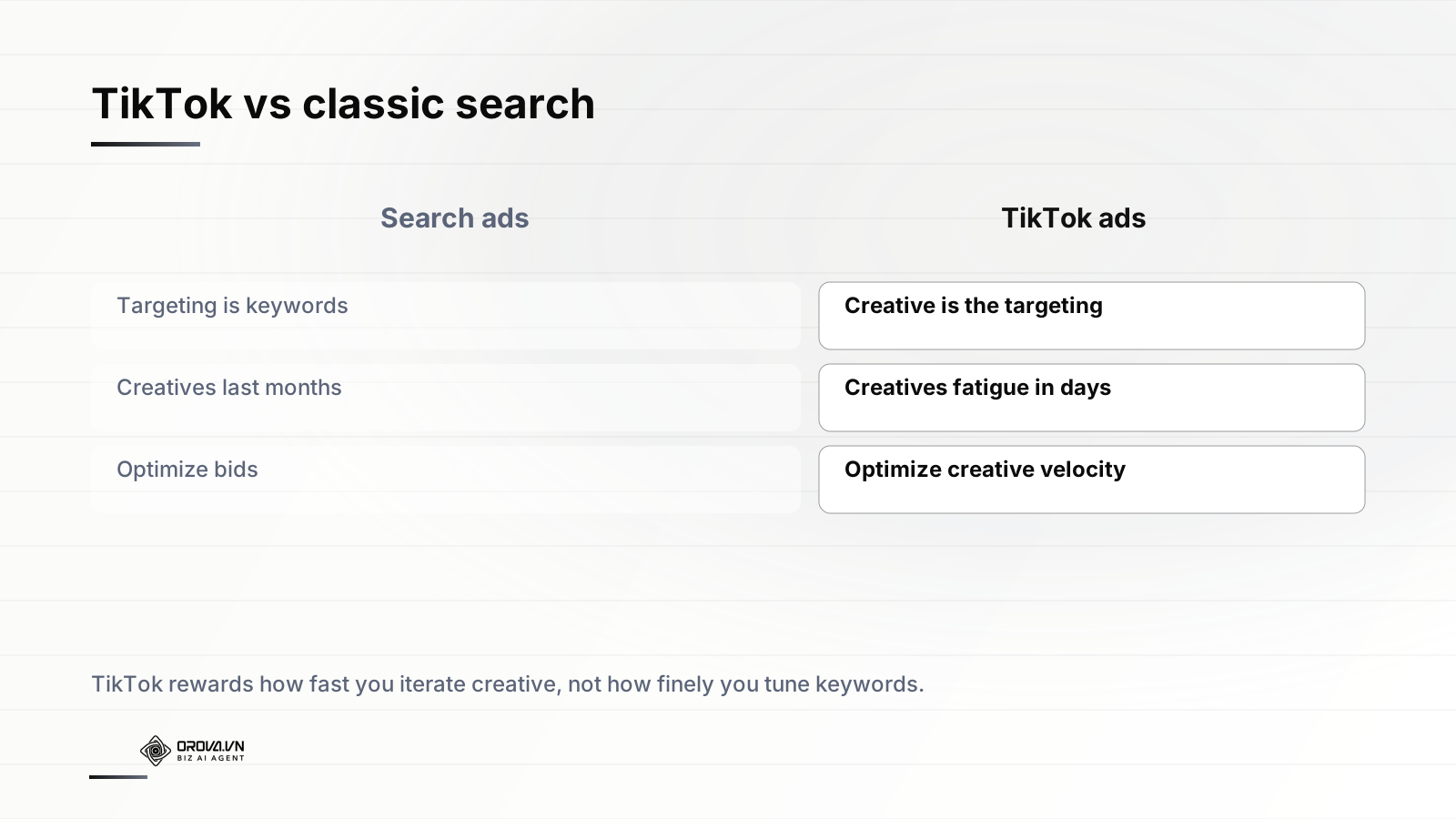
This is the single fact that reorganizes everything about how you run paid media on the platform. If you bring a search advertiser's instincts to TikTok — fine-tune the bids, refine the keyword match types, A/B test a headline for three weeks until significance — you will lose money slowly and never quite understand why. The lever that moves results on TikTok is not bid strategy or audience segmentation. It is the rate at which you produce, test, and replace creative. Practitioners call this creative velocity, and the accounts that win are almost always the ones that ship and kill videos fastest.
This article is a working guide to TikTok ads optimization built around that reality. We will cover why the platform behaves the way it does, how Spark Ads change the math, what the three-second hook is actually measuring, which signals to trust when reading early performance, how to run a kill-and-scale discipline without panicking, and where automation earns its place. The goal is not theory. The goal is a system you can run on Monday morning.
Why TikTok is a different machine
Start with the obvious thing that everyone underestimates: TikTok is a content platform that happens to sell ads, not an ad platform that happens to host content. The For You feed is a recommendation engine optimized to keep a person scrolling, and your ad is competing for attention against the most engaging organic videos the algorithm could find for that exact viewer. Nobody arrived on TikTok looking to buy anything. There is no query, no commercial intent, no moment where the user has raised their hand. The work your creative has to do is therefore enormous — it must interrupt entertainment with entertainment.
Compare that to search, where intent does the heavy lifting. When someone types "best running shoes for flat feet," half the selling is already done. The user has declared what they want; your job is to be present, relevant, and competitively priced. On TikTok nobody declares anything. The platform infers interest from behavior, and it infers it largely from how people react to your creative. This is why the phrase "creative is the targeting" has become a cliché among TikTok buyers — and unlike most clichés, it is literally true. When you upload a video, the algorithm shows it to a small seed audience and watches what happens. Strong watch-through and engagement tell it who else to find. Weak signals tell it to stop. Your creative is not just the message; it is the instruction set the system uses to locate your customer.
Three structural consequences follow, and they shape the entire optimization playbook:
- The auction rewards engagement, not just willingness to pay. A high bid on a boring video loses to a modest bid on a video people actually watch. You cannot buy your way past poor creative.
- Fatigue is fast because consumption is fast. A TikTok user might see hundreds of videos in a single session. Frequency accumulates in days, not weeks, and the moment a clip feels familiar it stops working.
- Native beats polished. Ads that look like ads get scrolled past. Ads that look like the content around them get watched. This is not a style preference; it is a measurable performance difference.
Hold those three ideas. Every tactic below is downstream of them.
The native trap, and how to avoid it
The most common expensive mistake is repurposing a beautifully produced brand film, slapping a 9:16 crop on it, and uploading it as a TikTok ad. It will underperform almost without exception. The production values that signal premium on a television screen signal "advertisement" in a feed of phone-shot clips, and the brain has learned to skip advertisements before they finish the first second. The fix is counterintuitive for brands that have invested in polish: shoot for the platform, in the language of the platform. Hand-held framing, a real person talking to the camera, captions burned in because most people watch on mute, a hook that starts mid-thought. This is why so many high-performing TikTok ads look like they cost nothing to make. They are designed to disappear into the feed until the message lands.
Spark Ads: borrowing the credibility of organic
If native is the goal, Spark Ads are the most direct route to it. A Spark Ad is a TikTok ad format that promotes a real organic post — either one from your own account or, with permission via an authorization code, one from a creator's account — as a paid placement. Crucially, it runs under the original creator's handle, keeps the real comments, likes, shares, and follows, and looks identical to the organic video it is built from. The viewer cannot tell it is an ad until they notice the small "Sponsored" label.
This matters for several concrete reasons that go beyond aesthetics:
- Social proof travels with the post. A video that already earned 40,000 organic views and 600 comments carries that credibility into the paid placement. New viewers see an active conversation, not a cold sales message, and engagement begets engagement.
- Engagement accrues to a real, persistent asset. Likes, comments, and follows generated by the campaign stay on the creator's actual post and account, which compounds organic reach over time rather than evaporating when the campaign ends.
- The format is inherently native. Because you are promoting genuine content rather than a studio-built advertisement, Spark Ads sidestep the native trap almost by default.
- Creator partnerships scale cleanly. When a creator's organic video about your product takes off, you can authorize and amplify it as a Spark Ad in minutes, putting paid weight behind proven organic momentum instead of guessing what will resonate.
The practical workflow looks like this. Encourage a steady stream of organic posting — your own and from creators you work with. Watch which posts gain traction on their own. Those are your validated creatives; the audience has already voted. Promote the winners as Spark Ads while they still feel fresh. This way the paid engine runs on creative that has been pre-tested for free by the organic feed, which is a far better starting point than launching cold videos and hoping.
There is a discipline point worth stating plainly. Spark Ads are not a substitute for creative volume; they are a multiplier on it. If you only post twice a month, you will have almost nothing to spark. The accounts that get the most from the format are the ones publishing enough organic content that a few posts naturally break out and become obvious candidates for amplification.
The three-second hook is not a slogan, it is a measurement
You will hear "you have three seconds to grab attention" repeated so often it sounds like a motivational poster. But the three-second hook is a real, instrumented stage of the funnel, and treating it as a measurable thing changes how you optimize. TikTok reports metrics for the percentage of viewers still watching at two seconds, at six seconds, at the 25%, 50%, 75%, and 100% marks. The earliest of these — how many people survive the opening — is the gate everything else depends on. If 80% of viewers bail in the first two seconds, it does not matter how good your offer is at second ten. Almost nobody got there.
So the opening is not creative flourish; it is the highest-leverage real estate in the entire ad. A few principles that hold up across categories:
- Start in motion or mid-action. The slow logo intro is dead on arrival. Open on a face, a hand doing something, a surprising visual, or a sentence already in progress.
- State the stakes immediately. "I wasted $4,000 before I figured this out" earns a few more seconds than "Hi guys, today I want to talk about..."
- Show, do not promise. A visible result, transformation, or problem in frame holds attention better than a verbal claim about one.
- Match the feed's energy. If the surrounding content is fast and casual, a slow corporate cadence reads as foreign and gets skipped.
Here is the optimization insight most people miss: because the hook is measurable, you can optimize it in isolation. Take a video that converts well once people watch it but has weak hold past two seconds. Do not throw the whole thing away. Re-cut the first three seconds — same body, same offer, new opening — and you may rescue a strong asset that was dying at the gate. Hook testing is one of the highest-ROI activities on the platform precisely because the body of a proven video is expensive to produce and the hook is cheap to swap.
Reading CTR and CVR without fooling yourself
Two signals do most of the diagnostic work on TikTok: click-through rate and conversion rate. Read together they tell you where a creative is failing, which is what lets you fix the right thing instead of guessing.
- Low CTR means the creative is not compelling enough to earn the click. The hook, the message, or the offer framing is the problem. The fault is in the video.
- Healthy CTR but low CVR means the creative is working — people want what they saw — but something after the click breaks the promise. Usually a slow landing page, a mismatch between the ad and the destination, or friction in checkout. The fault is downstream, not in the video.
- High CTR and high CVR is a winner. Scale it carefully and start planning its replacement, because it will fatigue.
- Low CTR and low CVR is a clean kill. Do not nurse it.
The discipline here is to let these two numbers route your attention. When CVR is the problem, no amount of creative iteration will save you, and conversely, when CTR is the problem, optimizing your landing page is wasted effort. This sounds obvious written down, yet accounts burn budget every day fixing the wrong half of the funnel because they looked at cost per acquisition alone instead of decomposing it.
Creative velocity: the actual optimization variable
Now we reach the core of TikTok ads optimization, the thing the entire platform's behavior has been pushing us toward. On search you optimize bids and keywords because creative lasts for months and intent is stable. On TikTok you optimize creative velocity — the rate at which you generate new creative, test it, kill the losers, scale the winners, and refresh before fatigue sets in — because everything else is downstream of how fast creative cycles through the feed.
Consider the math of fatigue. A meaningful share of strong TikTok creatives begin decaying within days to a couple of weeks of heavy delivery. That means a winner you found today is on a clock the moment you scale it. If your creative pipeline produces one new video a week, you will spend most of your time running tired creatives at deteriorating efficiency, because you cannot replace fatigued winners fast enough. If your pipeline produces ten or fifteen testable assets a week, you always have fresh candidates queued, you can kill fatiguing winners the moment efficiency dips, and your blended cost per acquisition stays low. The pipeline, not the campaign settings, is the bottleneck.
This is the same fatigue dynamic that plagues other feed-based platforms, and the diagnostic instincts transfer. If you have not internalized how repetition silently erodes performance, our breakdown of how ad fatigue and rising frequency burn out feed campaigns covers the underlying mechanics — the core lesson being that frequency is the leading indicator and cost-per-result is the lagging one. TikTok simply runs the same movie at double speed.
The velocity loop in practice
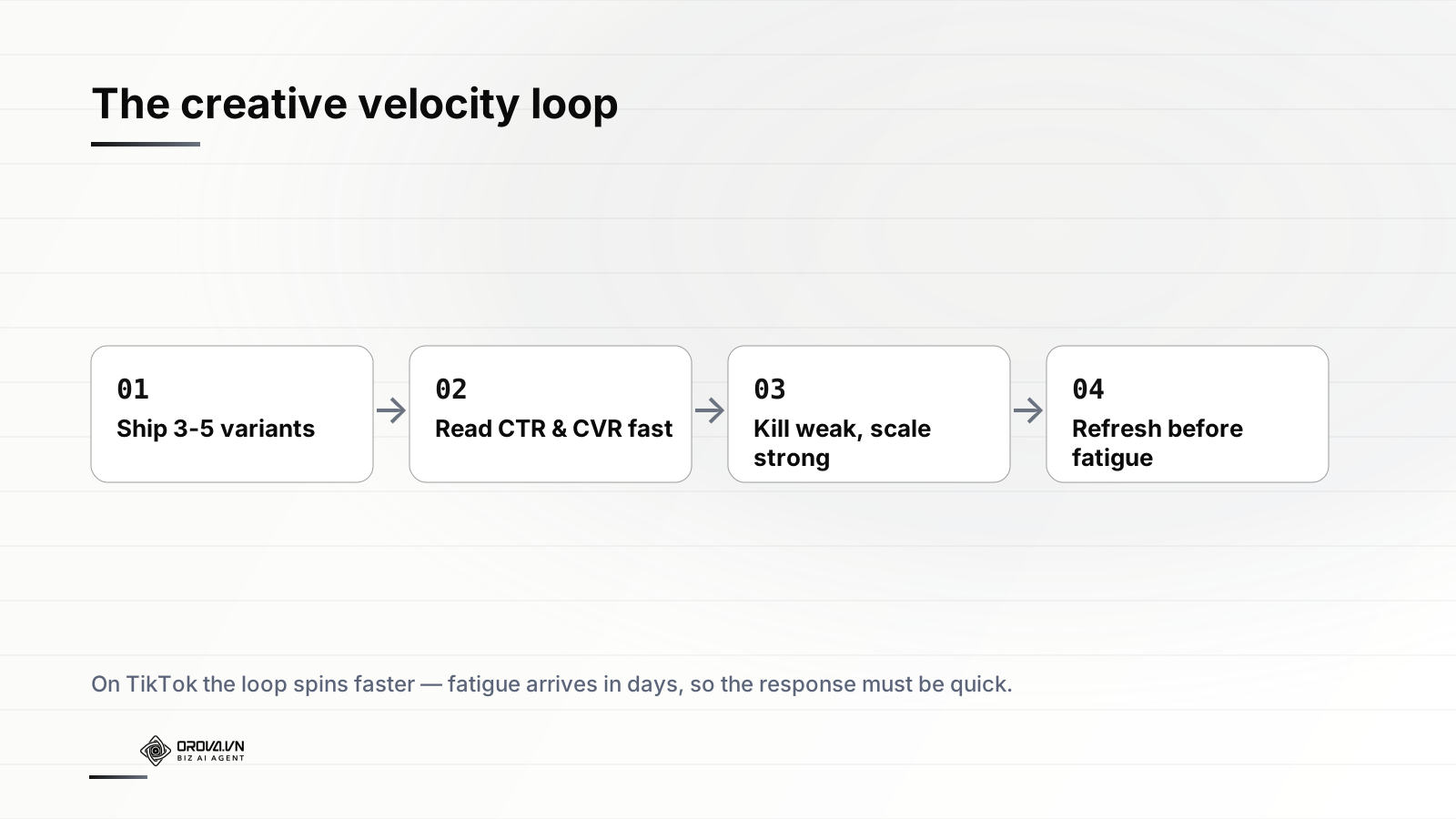
The operating system for a high-velocity account is a loop with four stations. Run it continuously, not as a quarterly campaign exercise:
- Ship three to five variants at once. Never test a single new video in isolation. Launch a small batch — different hooks, different angles, different creators — so the auction has options and you get comparative signal quickly. One video tells you almost nothing; five tell you where the demand is.
- Read CTR and CVR fast. Give each variant enough budget and impressions to produce a real read, then decide. The exact threshold depends on your conversion volume, but the principle is to make calls on days, not weeks. Waiting for textbook statistical significance on a feed that fatigues in days is a category error — by the time you are certain, the creative is already dying.
- Kill the weak, scale the strong. Cut underperformers without ceremony or sunk-cost sentiment. Move budget to the clear winners. The goal is not a fair fight among all creatives; it is the fastest possible reallocation toward whatever is working right now.
- Refresh before fatigue, not after. The mistake is waiting for a winner's metrics to collapse before producing its successor. By then you have already paid the inefficiency tax. Watch frequency and the early softening of CTR, and have the next batch ready so you replace fatiguing creatives on a schedule rather than in a panic.
Notice what this loop demands organizationally. It is less a media-buying skill than a production-and-decision skill. The bottleneck moves from the ad account to the content pipeline and to the speed of your kill-and-scale decisions. Teams that win on TikTok usually have a creative process that can reliably ship batches every week, often a stable of creators, and a clear, unsentimental rule set for what gets cut and what gets fed. The buyer's job becomes managing the flow rather than tuning the dials.
Killing weak videos without flinching
The hardest part of this loop for most teams is not making more creative; it is killing creative without emotional resistance. Someone wrote the script, someone appeared on camera, someone edited it. There is a natural pull to give a weak video "a little more time" or "a slightly bigger budget to be fair." On TikTok that instinct is expensive. Every dollar nursing a loser is a dollar not finding a winner, and the feed is moving on whether you decide or not.
Set rules in advance so the decision is mechanical rather than emotional. Define what a kill looks like — for example, a CTR meaningfully below your account benchmark after a defined spend threshold, with no conversions, gets cut. Define what a scale looks like — a creative beating your target CPA at a given spend gets a budget increase. When the rules are written down before the data comes in, you remove the temptation to rationalize, and you make decisions at the speed the platform requires. The accounts that win are not the ones with the best individual video. They are the ones that find and exit losers fastest, freeing budget and attention for the next test.
Scaling winners without breaking them
Scaling on TikTok has its own failure mode: push budget too aggressively on a winning creative and you can spike frequency, accelerate fatigue, and watch a $6 CPA balloon overnight. The same creative that was profitable at a modest daily spend can become unprofitable when you triple the budget in a day, because you are now showing it to the same people more often and reaching further into less-qualified audiences at once. Scale in deliberate steps, watch frequency and CTR as you go, and treat every winner as a depreciating asset whose successor should already be in production. A winner is not a destination; it is a head start on the next refresh.
Where automation actually helps
Run the velocity loop manually and you will quickly hit a human limit. The loop wants daily reads, fast kills, careful step-scaling, and frequency monitoring across many creatives at once — and it never stops. Doing this by hand across dozens of ad groups means either a person glued to the dashboard every morning or, more realistically, decisions that slip a day or two, which on a platform that fatigues in days is enough to erode your edge.
This is the natural seam for automation, and it is worth being precise about what should and should not be automated. The parts that genuinely benefit from machine speed are the repetitive, data-dense, time-sensitive operations:
- Daily reading of CTR, CVR, frequency, and spend across every active creative, surfacing what changed since yesterday instead of making you hunt for it.
- Flagging fatigue early by watching frequency climb and CTR soften before the cost-per-result number confirms the decline — catching the leading indicator, not the lagging one.
- Executing the mechanical kill-and-scale rules you defined, so budget moves toward winners and away from losers without waiting for someone to log in.
- Step-scaling winners in safe increments rather than risky one-shot budget jumps that spike frequency.
What should stay human is the creative judgment and the strategy: what story to tell, which hooks to test, which creators to partner with, and the brand-level calls about how far and how fast to scale. The right division of labor is automation handling the relentless daily operations and the human steering the creative and the strategy. That keeps the loop spinning at platform speed without handing over the decisions that actually require taste and context.
A realistic end-to-end rhythm
Putting it together, a healthy TikTok account on a weekly cadence looks roughly like this. The creative team ships a fresh batch of variants — a mix of new hooks on proven bodies, entirely new concepts, and any organic posts that broke out and are worth sparking. The new batch launches alongside the current winners. Each day, performance is read, fatigue is flagged, clear losers are cut, and clear winners get measured budget increases. Before any winner's efficiency visibly collapses, its successor is already in the queue. The blended cost per acquisition stays stable not because any single creative is immortal, but because the pipeline never runs dry and the decisions never lag. That stability is the real product of creative velocity, and it is achievable only when the boring operational work happens reliably every single day.
The takeaways worth keeping
If you remember only a handful of things from this guide, make them these. TikTok is a content platform, so your creative is your targeting — the algorithm finds your customer through how people react to your video, not through keywords. Spark Ads let you put paid weight behind native, pre-validated organic content, which is the cleanest path to ads that do not look like ads. The three-second hook is a measurable funnel stage you can optimize in isolation, often rescuing strong videos by re-cutting only the opening. CTR and CVR read together tell you which half of the funnel to fix. And above all, the variable you are really optimizing is creative velocity: ship batches, read fast, kill weak, scale strong, and refresh before fatigue. The account that cycles creative fastest wins, and that is a function of pipeline and decision speed far more than of clever campaign settings.
None of this is conceptually hard. It is operationally relentless. The loop is simple; running it every day across many creatives without slipping is where teams break down — and that is exactly the work worth handing to a system that does not get tired.
On TikTok specifically, almost all of this is decided before the third second — TikTok Creative Hooks: The First Three Seconds That Decide Your CPA breaks down the hook patterns that hold attention.
If keeping that loop spinning every day is the part that keeps falling off your plate, that is precisely what Orova Ads is built to do. It is an AI agent that manages paid campaigns across Google, Meta, and TikTok — reading your performance data daily, flagging fatigue before it costs you, and recommending and executing the budget shifts, bid changes, on-off calls, and audience moves that keep efficiency high. Every action runs with human-in-the-loop approval and a full audit log, so the machine handles the relentless daily operations while you keep the creative and strategy calls that actually need a person. See how it works at orova.vn.
Run your business with AI Agents
Orova is the always-on Biz AI Agent — it plans, runs, and optimizes the work for you. Save time, unlock productivity.
Try it free