
SEO ROI: Metrics, Funnel and the Formula to Prove It
Flying at night with no instruments
Imagine a pilot flying in the dark with not a single instrument: no altitude, speed, or heading. They feel like the flight is fine, but really don't know if they're climbing or descending, heading home or into a mountain. Flying by feel at night is the fastest way to crash.
Doing SEO with no measurement is exactly that. You publish steadily, feel like you're progressing, but don't know if it's actually working, what's working to do more of, what's useless to cut. And worst of all, when the boss asks the classic question — "All this money and effort in SEO, what did it actually return?" — you stammer, because you have no "instrument" to point to. Measurement is the instrument panel in the cockpit: it turns SEO from "flying by feel" into "flying by instruments", and turns your answer from "I think it's good" into "here's the number".
This guide shows how to install that panel: why to measure, vanity metrics vs business metrics, the metric funnel from impressions to revenue, the core metrics to track, how to calculate ROI in money, attribution, and the measurement process.
What is measuring SEO? Tracking the numbers that reflect how SEO is performing — from rankings and traffic to leads and revenue — to know what works, what doesn't, and to prove value in money. Without measurement, every SEO decision is a guess.
Vanity metrics vs business metrics
The biggest mistake is showing off numbers that sound big but don't speak to money.
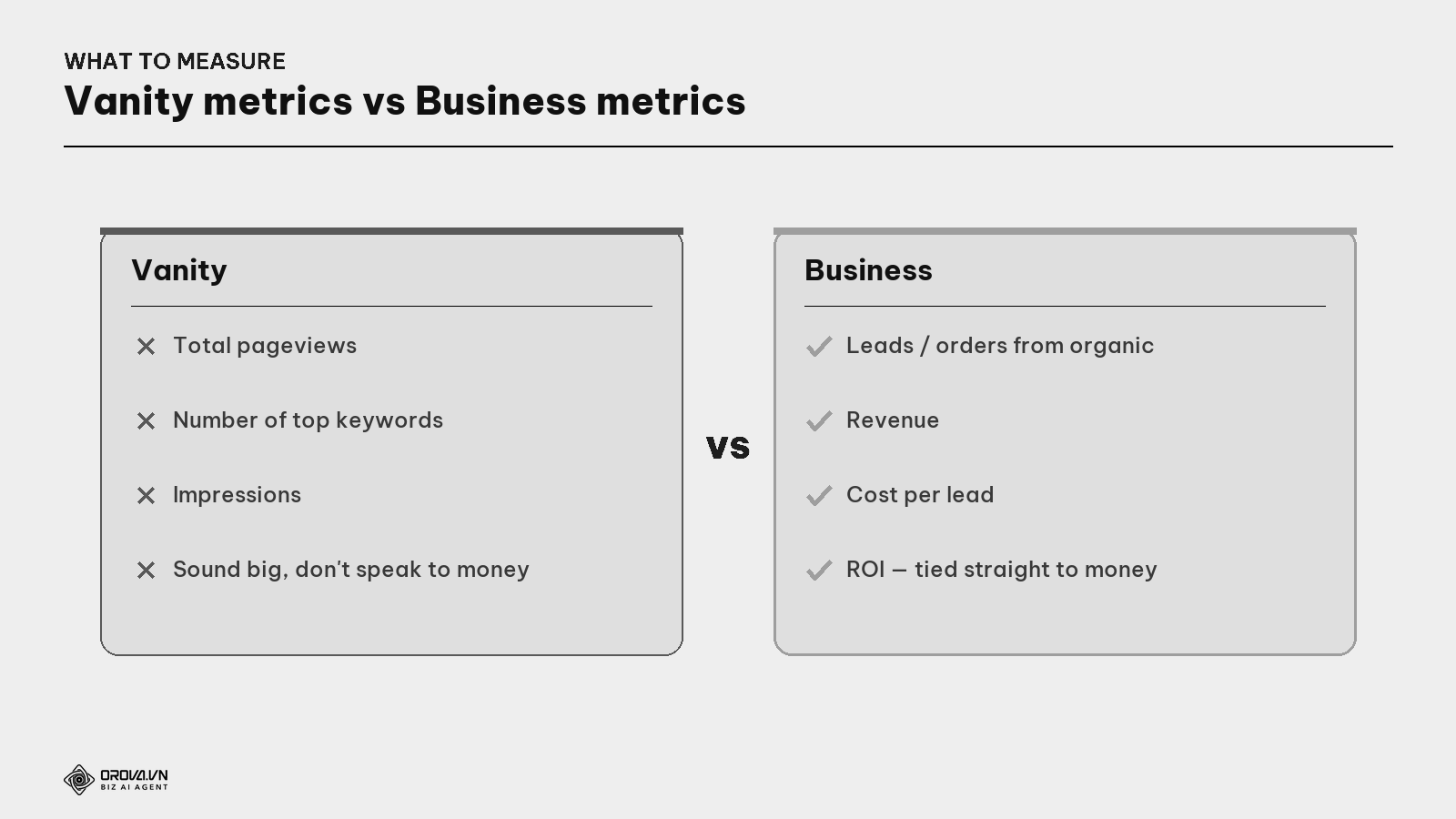
What is a vanity metric? A number that sounds impressive but doesn't reflect real business value — like total pageviews, number of top-ranked keywords, impressions. They're pleasant but answer the wrong question for the boss: lots of views with no orders is still "flying beautifully without reaching the destination".
What is a conversion? When a visitor takes a valuable action — leaves contact info (a lead), signs up, buys. It's the bridge between traffic and money: SEO isn't just to get visitors, but to turn visitors into customers.
The base rule: measure what leads to money, not what's easy to show off. Traffic only matters when it leads to leads, orders, revenue.
The metric funnel: from impressions to revenue
SEO metrics form a funnel — from "being seen" down to "making money". Understanding the funnel shows where each number sits and how much it matters.
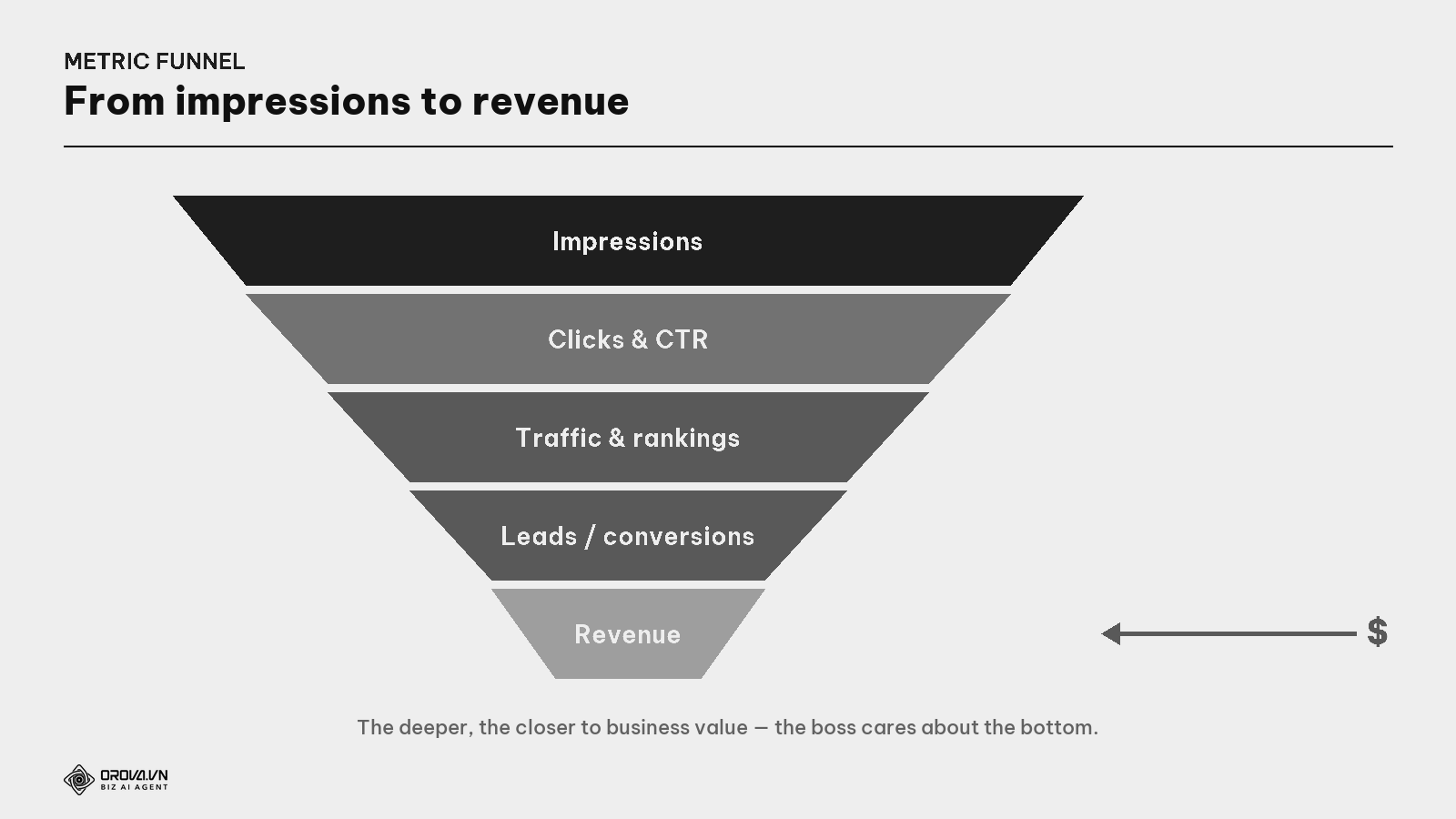
- Impressions — how many times you appear in results. Top of the funnel, farthest from money.
- Clicks & CTR — how many people click.
What is CTR (click-through rate)? The ratio of people who click to people who see (clicks ÷ impressions). CTR tells you whether your title/description is compelling enough to be clicked once shown.
- Organic traffic & rankings — how many people arrive from search, at what position.
- Leads / conversions — how many visitors take a valuable action.
- Revenue — real money from those conversions. Bottom of the funnel, closest to money.
The deeper you go, the fewer people notice but the more it speaks to real value. The boss cares about the bottom, not the top.
The core SEO metrics to track
You don't need to track a hundred things. Here's a core set enough to fly by.
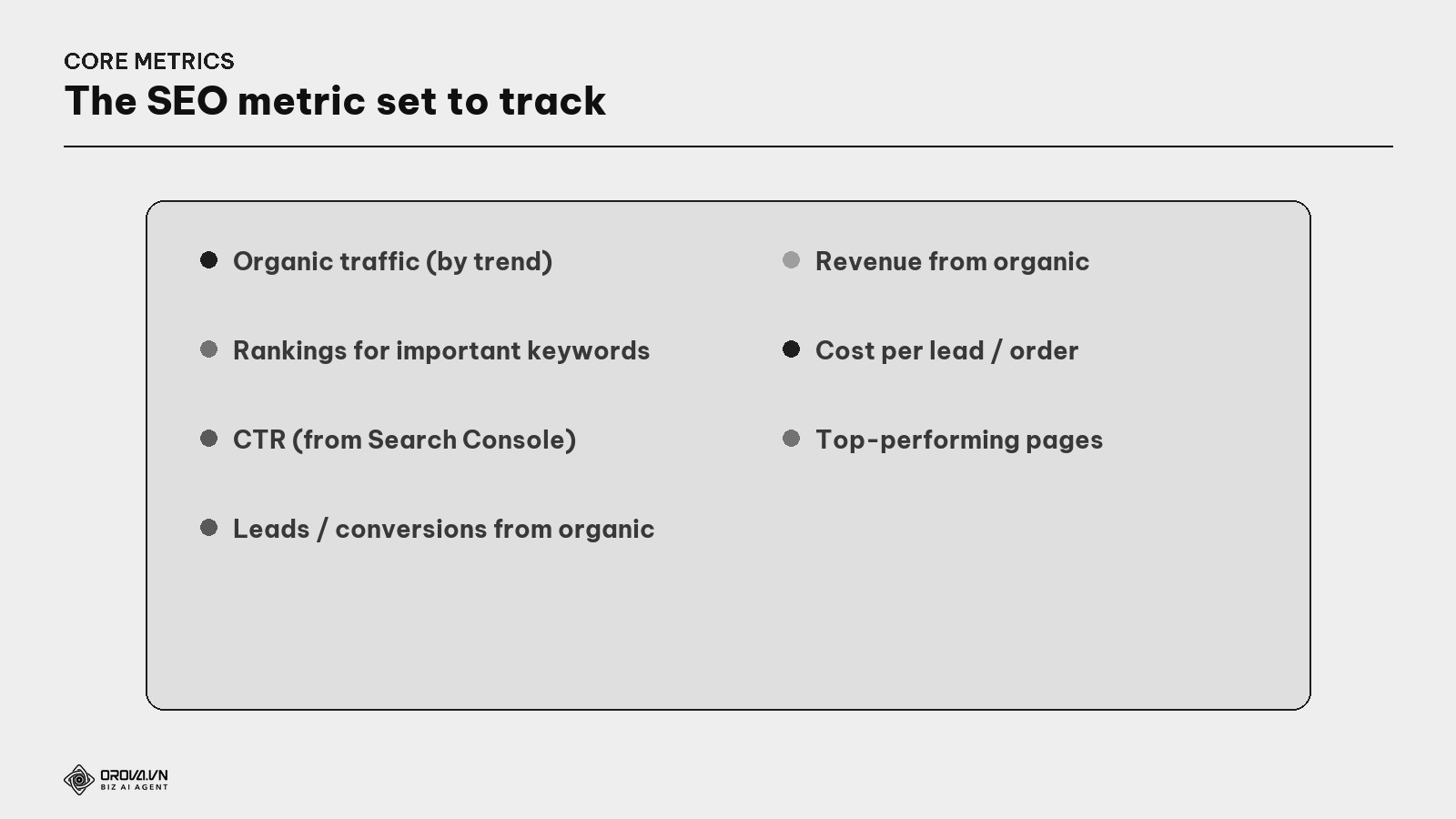
- Organic traffic by trend — how it rises/falls over time (not just one day's number).
- Rankings for important keywords — the business-tied keyword set, not every keyword.
- CTR (from Google Search Console) — to know if titles/descriptions attract clicks.
- Leads/conversions from organic — valuable actions coming from search.
- Revenue from organic and cost per lead/order — what the boss cares about most.
- Top-performing pages — to scale what works, fix what doesn't.
How to prove ROI in money
This is the part that turns "SEO seems good" into "SEO returned $X".
What is ROI? Short for "Return On Investment". The formula: ROI = (Value returned − Cost) ÷ Cost × 100%. It answers the boss's question directly: for every $1 put into SEO, how much comes back.
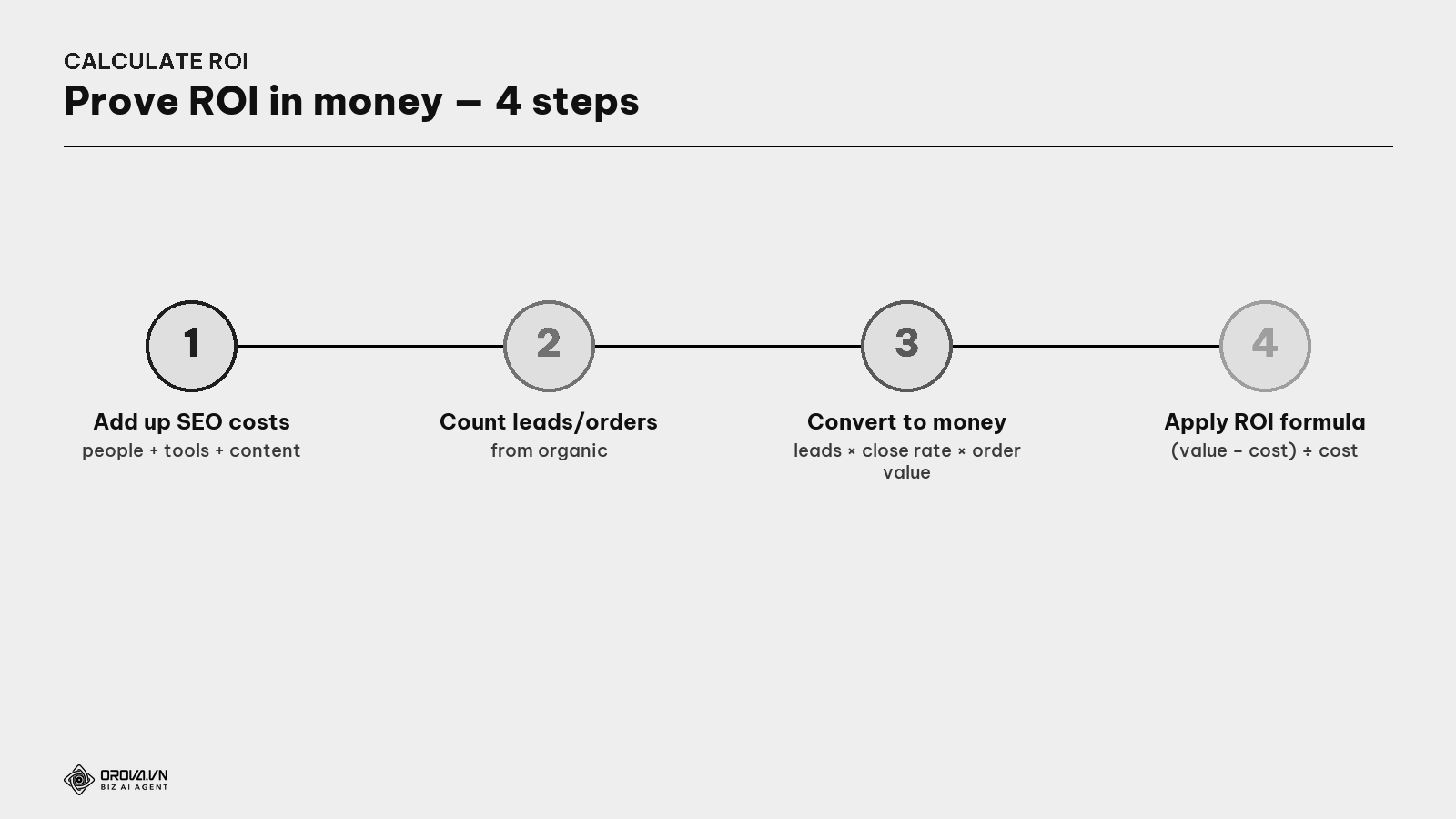
- Add up SEO costs — salary/contractors, tools, content costs for the period.
- Count leads/orders from organic — via GA4 + conversion tracking (see the GA4 + Search Console guide).
- Convert to money value — e.g.: 100 leads × 20% close rate × $200/order = value returned. (Illustrative numbers — use your real ones.)
- Apply the ROI formula — (value returned − cost) ÷ cost × 100%.
What are lifetime value (LTV) & cost per lead? LTV is the total money a customer brings over their whole relationship (not just the first order). Cost per lead = total cost ÷ number of leads. These two help compare SEO fairly with other channels (e.g., paid ads) — SEO usually gets cheaper over time, while ads stop bringing customers the moment you stop paying.
Attribution: where did this lead come from?
A measurement headache: customers often pass through many channels before buying. How do you know how much SEO contributed?
What is attribution? How you assign credit to channels in the customer journey. A customer might arrive first from search, return via an ad, then buy — each attribution model splits "credit" differently. Understanding attribution keeps you from undervaluing SEO just because it's often at the start of the journey (see the SEO Attribution guide).
The key point: don't only count the last channel before purchase. SEO often plants the seed at the top of the funnel (when a customer is just researching), so models counting only "last touch" make SEO look worse than it really is.
The measurement process
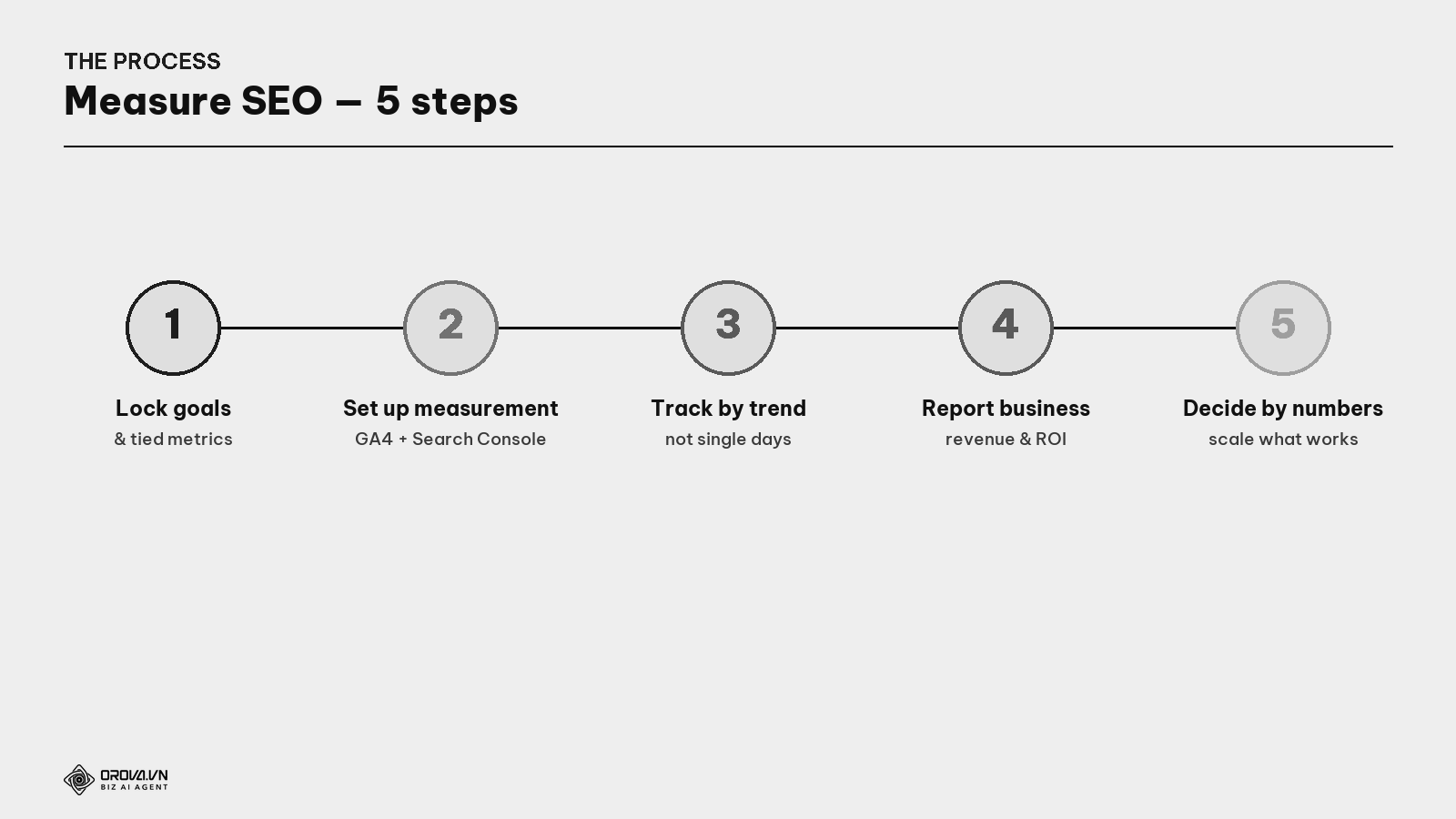
- Lock the business goals and metrics tied directly to them (leads? revenue?).
- Set up measurement — GA4, Google Search Console, and conversion tracking (see the GA4 + Search Console guide).
- Track by trend — period vs period, don't panic over a single day.
- Report in business metrics & ROI — speak the boss's language (money), not vanity.
- Use numbers to decide — scale what works, fix/drop what doesn't (an improvement loop).
"Pass" standard
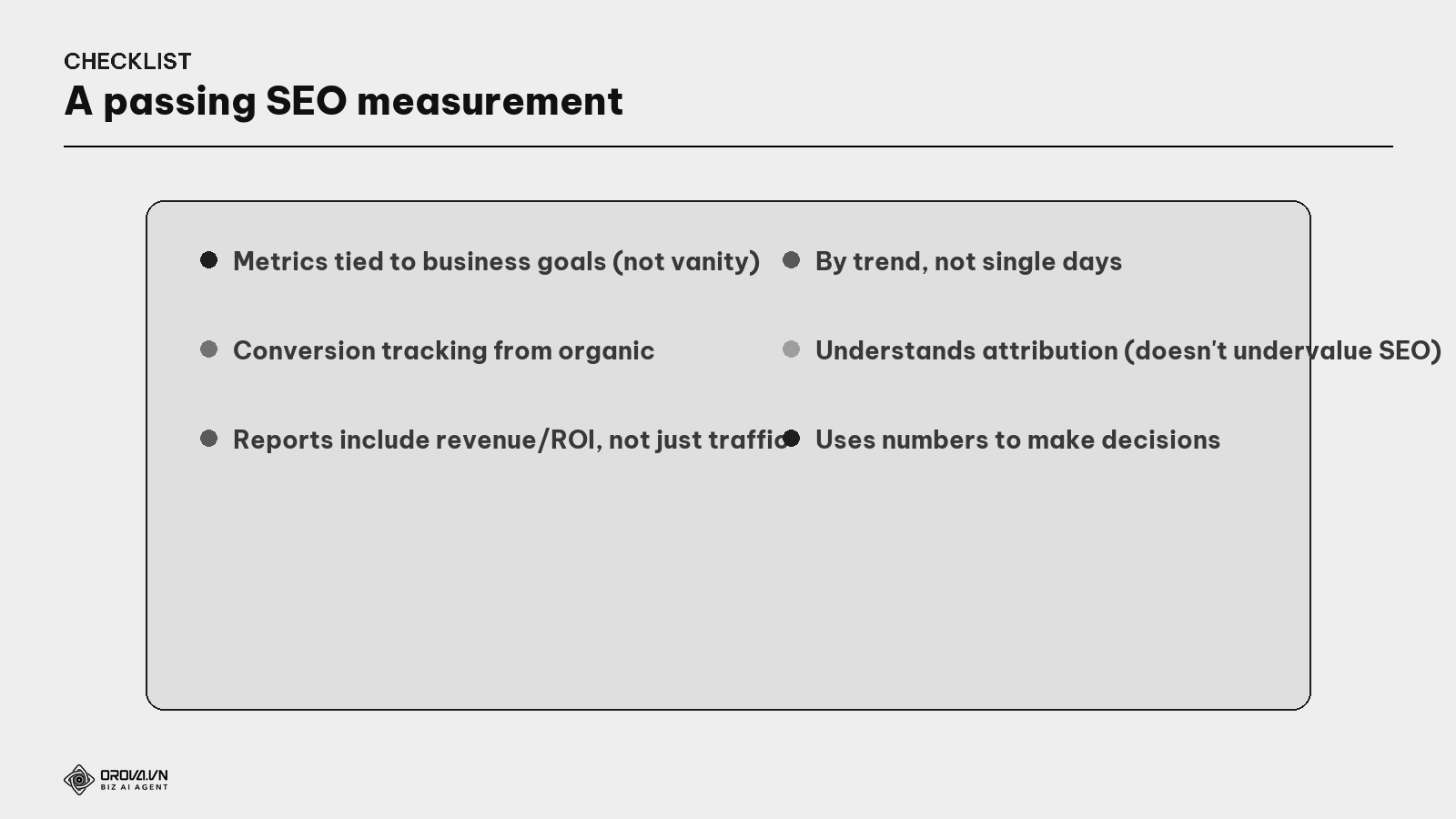
"Pass" standard: you track metrics tied to business goals (not just vanity); you have conversion tracking from organic set up; reports state revenue/ROI, not just traffic; you look at trends rather than panicking over single days; you understand attribution so SEO isn't undervalued; and you use numbers to make decisions, not just to show off. At this level, when the boss asks "what did SEO return", you have the number ready — and more importantly, you're flying SEO by instruments, not by feel.
Benefit: good measurement gives you two things: a compass to fly by (knowing what to do next, scaling what works) and evidence to defend the budget (proving ROI when the boss asks). SEO is a long-term investment, easily cut if you can't prove its value — measurement is how you both do better and keep the resources to continue.
FAQ
What's the most important SEO metric? There's no single "king" metric, but the one tied to your business goal — usually leads/revenue from organic and ROI. Traffic and rankings matter, but they're stepping stones to those numbers.
Traffic is up but revenue isn't — what's wrong? A sign you're attracting the wrong people or missing the conversion side. Check: is the traffic the right buying intent (see the Search Intent guide), and does the page have CTAs/BOFU content leading to action (see the Tone of Voice & CTA guide)?
Is calculating SEO ROI hard? You need conversion tracking and to convert leads to money, but the formula is simple: (value returned − cost) ÷ cost. The hardest part is attributing SEO correctly across a multi-channel journey — don't only count last touch.
How often should I look at SEO reports? By trend: review monthly to make decisions, avoid obsessing over single-day swings. SEO naturally fluctuates daily; trends of weeks–months reflect reality.
Are vanity metrics totally useless? Not quite — impressions and rankings help diagnose (e.g., low CTR despite high impressions = unappealing title). But don't report them as final achievements; they're diagnostic metrics, not result metrics.
How long until SEO shows positive ROI? Usually months, since SEO accumulates. In return, once it climbs, cost per lead drops over time (unlike ads, where stopping payment stops customers). Set long-term expectations and measure by cumulative trend.
How do I convince the boss when SEO isn't producing revenue yet? Report the leading indicators improving (right-audience traffic, business-keyword rankings, rising leads) + projected ROI by trend + cost-per-lead comparison vs paid channels. Show the boss "the instruments are moving the right way" rather than just promising.
Back to the cockpit
Remember the pilot flying at night with no instruments? They felt fine but didn't know if they were climbing or descending — and flying by feel at night is the fastest way to crash. With one instrument panel, they know exactly altitude, heading, speed, and bring the plane home safely.
Measurement is that instrument panel for your SEO. Don't publish and then feel like you're progressing — install the instruments: track business-tied metrics, measure conversions, calculate ROI in money, look at trends. Then you can both fly (know what to do next) and answer the boss's classic question with a clear number instead of "I think it's good". In SEO as in night flying: only with instruments do you reach the destination — and prove that you did.
This article is part of Orova's complete SEO guide series. It's a deep-dive within the cluster — see "GA4 + Google Search Console", "SEO KPIs & Dashboards for Leaders", and "SEO Attribution" for the full picture. Get started with Orova at orova.vn/en/seo.
Sources
Google Analytics 4 & Search Console Help (measuring traffic, conversions, CTR) · Ahrefs & Semrush (SEO metrics, ROI) · common marketing ROI frameworks (cost per lead, LTV, attribution).
Read next: Vanity Metrics in SEO: Which Ones to Stop Reporting
Let Orova SEO handle the repetitive part
Keyword research, drafting, refreshing old posts and rank tracking — running automatically on your own site.
Explore Orova SEO