
We A/B Tested 12 Blog CTAs — Here's the Winner
For one quarter, a single question ran our content team: which call to action at the end of a blog article actually turns a reader into a lead? Not which one we liked the look of, not which one a best-practices article recommended, but which one, tested against the others on real readers, genuinely performed. So we did the unglamorous thing. We took a set of high-traffic articles, drew up twelve different calls to action, and ran them as a structured series of A/B tests over twelve weeks.
This article is the write-up. A note on honesty before we start: this is a field report, not a laboratory paper. We are deliberately not publishing precise conversion percentages, because a single team's numbers on a single set of articles in a single quarter are not a universal law, and dressing them up as one would mislead you. What travels — what is genuinely useful to another team — is not our exact figures but the patterns: which kinds of CTA consistently beat which other kinds, and, more importantly, why. Those patterns are the real findings, and they are what this article reports.
How the test was set up
A quick word on method, because a result is only as trustworthy as the test that produced it. We selected articles that already had stable, meaningful traffic, so the tests would gather enough readers to mean something rather than producing noise. We split traffic so that each variant was shown to a comparable, randomised slice of visitors. We let each test run long enough to stop being dominated by day-of-week swings and short-term flukes.
The metric we cared about was not clicks on the CTA. It was the next step actually completed — a reader who, after the article, genuinely took the action the CTA invited. A CTA that gets clicked but leads nowhere is a vanity result, and we wanted to know what produced real movement, not what produced a satisfying click-rate. With that framing set, here is what the twelve variants taught us.
Finding one: any CTA beats no CTA, by a wide margin
One of our twelve variants was a control: the article simply ends, with no call to action of any kind. We included it because the "no CTA, stay helpful, stay non-salesy" approach is genuinely common, and we wanted to measure its cost rather than assume it.
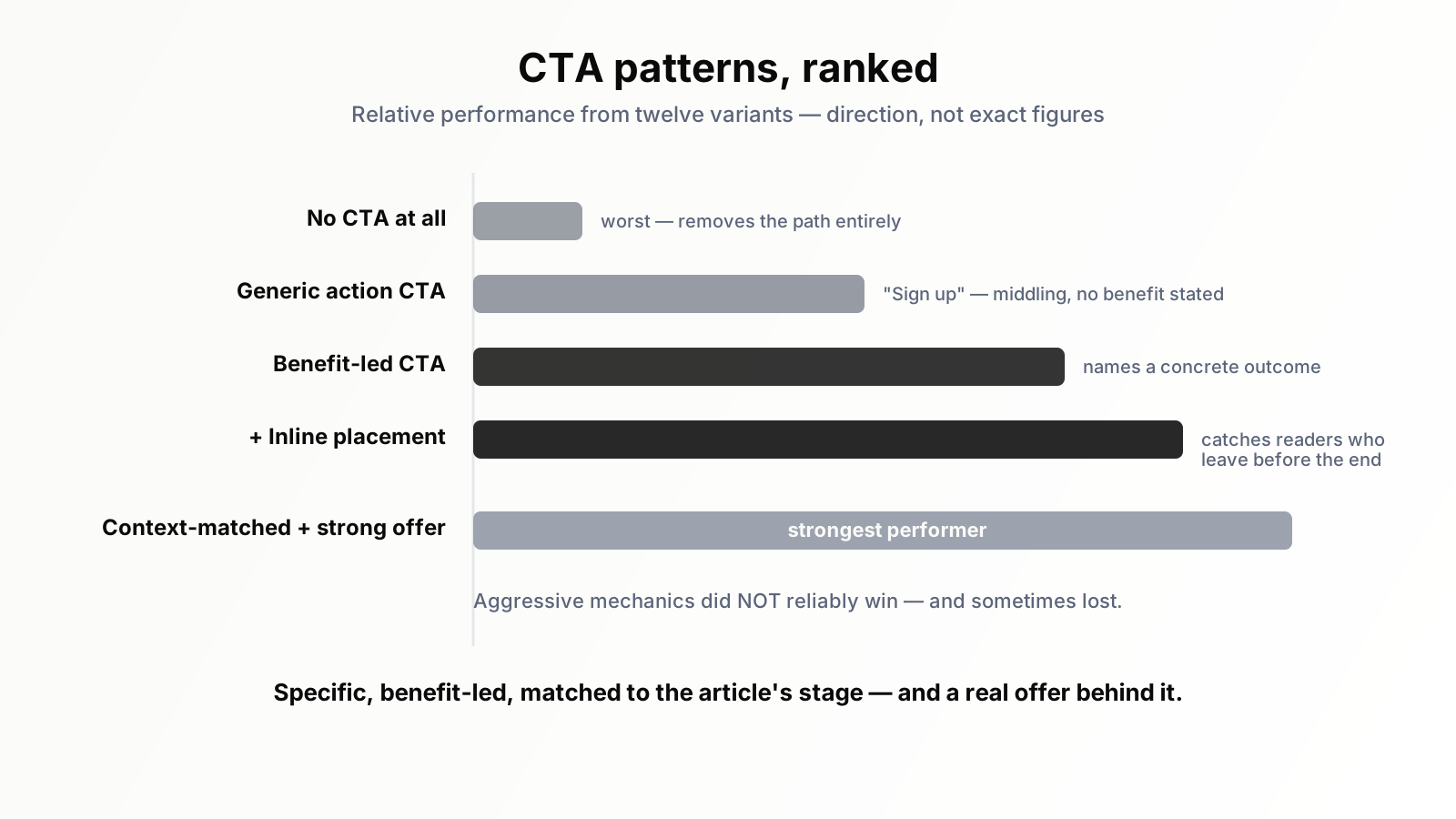
The cost was large and unambiguous. Across every article we tested, the no-CTA ending was comfortably the worst performer of the twelve. This sounds obvious stated plainly, but it is worth sitting with, because the no-CTA ending is usually chosen on purpose, out of a sincere wish not to be pushy. The pattern in our data is blunt: ending an article with nothing does not read to the reader as tasteful restraint. It simply removes the path. A reader who was helped and was open to a next step is given none, and so takes none. The first and least surprising finding is also the one teams most need to hear: the worst CTA we tested still beat the absence of one, every single time.
Finding two: specific benefit-led CTAs beat generic action CTAs
Several of our variants were generic action CTAs — the familiar "Start your free trial," "Sign up," "Get started." Several others were benefit-led: they named a concrete, specific thing the reader would get, framed around the reader's outcome rather than the action's label.
The benefit-led variants consistently and clearly outperformed the generic ones. This was one of the most reliable patterns in the whole quarter. A CTA that described a specific, near-term outcome — seeing something useful, getting a concrete answer, solving a named piece of the reader's problem — drew meaningfully more completed next steps than a CTA that simply named the action. Our reading of why: a generic action CTA leaves the reader's silent cost-benefit question unanswered — what do I get, what does it cost me in time and risk? A benefit-led CTA answers that question inside the CTA itself. The reader does not have to do the mental work of figuring out whether the click is worth it, because the worth is stated. The lesson that travels: describe the value, not the verb.
Finding three: context-matched CTAs beat one-size-fits-all CTAs
This was, for us, the most valuable finding of the quarter, and the one that changed how we work. Some of our variants used the identical CTA regardless of which article it sat on. Others were matched to the article's context — an early-stage educational article got a CTA offering a small next step in learning; a later-stage, evaluation-type article got a CTA offering something closer to a product trial.
The context-matched variants consistently outperformed the one-size-fits-all variants. And the gap was widest precisely on the early-stage articles. On an introductory, educational piece, a CTA demanding a big commitment — book a demo, talk to sales — was among the weakest things we ran, while a CTA offering a modest, relevant next step performed strongly. The pattern is clear and, in hindsight, intuitive: the right CTA depends on where the reader of that specific article is in their journey. A reader who arrived to learn a concept is not ready for a sales conversation, and asking for one repels rather than converts. Match the size of the ask to the stage of the reader.
Finding four: placement changed the result as much as wording
We had assumed this test was about what the CTA said. Several variants quietly taught us it was also about where the CTA sat. We tested the same CTA placed only at the end of the article against the same CTA also appearing as a natural, relevant inline mention partway through.
The variants that included a well-placed inline CTA — offered at the moment in the article where it was genuinely contextually relevant — consistently outperformed the end-only versions. The pattern makes sense once you picture reader behaviour honestly: a meaningful share of readers never reach the end of a long article. An end-only CTA, however well written, is simply never seen by those readers. A relevant inline CTA catches the engaged reader who will drift away before the final paragraph. The lesson: a CTA the reader never reaches converts no better than no CTA at all, and placement is part of CTA design, not an afterthought to it.
Finding five: aggressive CTAs did not win — and sometimes lost
We were braced for an uncomfortable result here. We tested some restrained variants against some aggressive ones — earlier, larger, more insistent, harder to ignore. The conventional fear is that the aggressive version wins on raw conversion even as it annoys people, forcing a trade-off between performance and taste.
Our quarter did not show that trade-off. The most aggressive variants did not reliably win, and on some articles they underperformed the calmer, well-matched ones. Our interpretation: a CTA works by spending trust the article has earned, and an aggressive CTA that fires before the article has delivered much value has no trust to spend. It interrupts the value delivery that would have made a later, calmer CTA welcome. This was a genuine relief to find, and it is the pattern we would most encourage other teams to test for themselves: in our data, the well-judged CTA and the well-mannered CTA were frequently the same CTA. You did not have to choose between converting well and treating readers decently.
Finding six: the offer behind the CTA mattered more than the button
A subtler pattern emerged when we looked across the variants. We had been thinking of the test as a test of CTAs — wording, colour, placement. But the strongest-performing variants had something deeper in common: the thing on the other side of the click was genuinely, immediately valuable to the reader.
A CTA leading to something the reader would plainly find useful — a relevant tool, a genuinely deeper guide, a concrete answer — outperformed an equally well-worded CTA leading to something generic or self-serving. This reframed our conclusion. The CTA wording is the visible part, and it matters, but it is ultimately a promise; if the promise is weak, no amount of polish on the button rescues it. The pattern that travels: invest in making the next step genuinely worth taking, not only in making the invitation well phrased. A great CTA in front of a mediocre offer is still a mediocre result.
What we changed after the quarter
Patterns are only worth gathering if they change behaviour, so here is what we changed. We stopped ever ending an article with nothing. We rewrote our CTAs to lead with a specific benefit rather than a bare action verb. We stopped using one templated CTA across the whole blog and began matching the CTA to the stage of each article's reader. We added relevant inline CTAs to long articles instead of relying on an end-only placement. We eased off aggressive CTA mechanics, having found no evidence they were worth their cost. And we started judging a CTA partly by the quality of the offer behind it, not only by its wording.
None of these are dramatic. Together they describe a shift from treating the CTA as a templated afterthought to treating it as a designed, per-article decision — which is, in one sentence, the whole finding of the quarter.
Finding seven: the test itself taught us how little we knew
There is a meta-finding worth stating, because it is the one that changed our process most. Before the quarter, our team had strong opinions about CTAs. We "knew" which wording sounded best, which placement felt right, which offers were strongest. We had picked our blog's CTAs based on that confident intuition, and we had never questioned them.
The test embarrassed several of those opinions. Variants we expected to win underperformed; variants we included almost as filler did surprisingly well. Our intuitions were not worthless — some held up — but they were nowhere near as reliable as we had assumed, and the gap between what we believed and what readers actually did was wide enough to matter to revenue. The lesson is humbling and useful in equal measure: a CTA is a hypothesis, not a fact, and the only honest way to know whether one works is to test it on real readers. The teams that get CTAs right are not the ones with the best instincts. They are the ones who stopped trusting their instincts and started measuring. We had run our blog for a long time on confident guesses. One quarter of structured testing taught us that the guesses were, often, simply wrong.
Finding eight: small CTA gains compound across a whole blog
One last pattern, and it is the one that justifies the entire exercise. Looked at on a single article, the difference between a mediocre CTA and a well-built one can seem modest — a matter of degree, not transformation. It is tempting to conclude the work is not worth the effort.
That conclusion collapses the moment you zoom out from one article to a whole blog. A SaaS content operation does not have one article; it has dozens, soon hundreds, each receiving traffic every month. A CTA improvement that helps a little on one article helps a little on every article it is applied to, every month, indefinitely. The same modest gain, multiplied across the entire library and across time, becomes a substantial and permanent lift in how much revenue the existing traffic produces — with no new traffic required. This is the quiet economics of CTA work: it is not a dramatic single win, it is a small structural improvement applied broadly and held forever. That is exactly the kind of improvement that is easy to dismiss article by article and foolish to dismiss in aggregate. The quarter convinced us that CTA discipline is not a nice-to-have polish task. It is one of the highest-leverage things a content team can do with traffic it already has.
The honest limits of this report
One more note in the spirit of honesty. This was one team, one set of articles, one quarter, one product. The direction of our findings — no CTA loses, benefit beats verb, matched beats generic, placement matters, aggression does not reliably pay, the offer matters most — lined up with what sound reasoning about reader psychology would predict, which gives us some confidence they generalise. But the magnitude of every effect will differ for your audience, your product, and your articles. Treat this report as a set of well-supported hypotheses to test on your own readers, not as constants to copy. The right CTA for your blog is discoverable the same way we discovered ours: by testing, on your real readers, and measuring the next step actually completed.
Where an AI agent makes CTA work sustainable
Running this quarter taught us one final, slightly deflating thing: the findings are easy to state and hard to sustain. Matching a specific, benefit-led, well-placed CTA to every article, and keeping the next-step paths coherent as the blog grows into hundreds of articles, is real, continuous work — exactly the kind of work that quietly slides back toward a lazy template the moment the team gets busy.
That is where an SEO AI agent earns its place. Orova understands where each article sits in the reader's journey and helps match an appropriate next step and internal-link path to it, rather than stamping one generic CTA across everything — and it keeps those paths coherent as the content library scales. The patterns from our quarter are not hard to understand. Applying them consistently across an entire, growing blog is the hard part, and that is precisely the part an agent is built to carry. We learned what good CTAs look like by testing for a quarter. Keeping every article's CTA good, permanently, is a job better handed to a system than to memory and good intentions. (For more on building the plan behind the pages, see turning keywords into a content plan.)
Run your business with AI Agents
Orova is the always-on Biz AI Agent — it plans, runs, and optimizes the work for you. Save time, unlock productivity.
Try it free