
AI Visibility Tracking: A Framework That Actually Works
You ask your team for a number on how your brand shows up in ChatGPT, Perplexity, or Gemini, and what you get back is a shrug and a sentence: "you can't measure AI visibility." Meanwhile you can see, anecdotally, that fewer people are typing your category into Google and more are asking an AI assistant instead — and the data backs up the feeling: 68% of US Google searches in the first four months of 2026 ended without a click, up from 60% in 2024, according to SparkToro — but nobody in the room can tell you if your brand is even part of that answer. You are left reporting the same old traffic chart, knowing it no longer tells the whole story, and having no good reply when leadership asks what you are doing about it.
The old approach treats this as an all-or-nothing problem: either there is one official score for AI visibility tracking, or the whole thing is unmeasurable and not worth the effort. That framing is wrong, and it is costing you time — teams either build nothing and wait for a magic dashboard, or they buy a tool that spits out one confident-looking number and call it done, without knowing what that number actually covers or misses. Either way, you are making budget and content decisions in the dark, on a topic that is only going to matter more.
This piece replaces that shrug with a working method. By the end, you will know exactly where to look for real signals — from your own analytics and server data to simple checks you can run by asking the AI engines directly — and how to combine them into a picture solid enough to act on. You will also know, honestly, what still cannot be measured, so you stop chasing a perfect number that does not exist and start using the ones that do.
The short answer
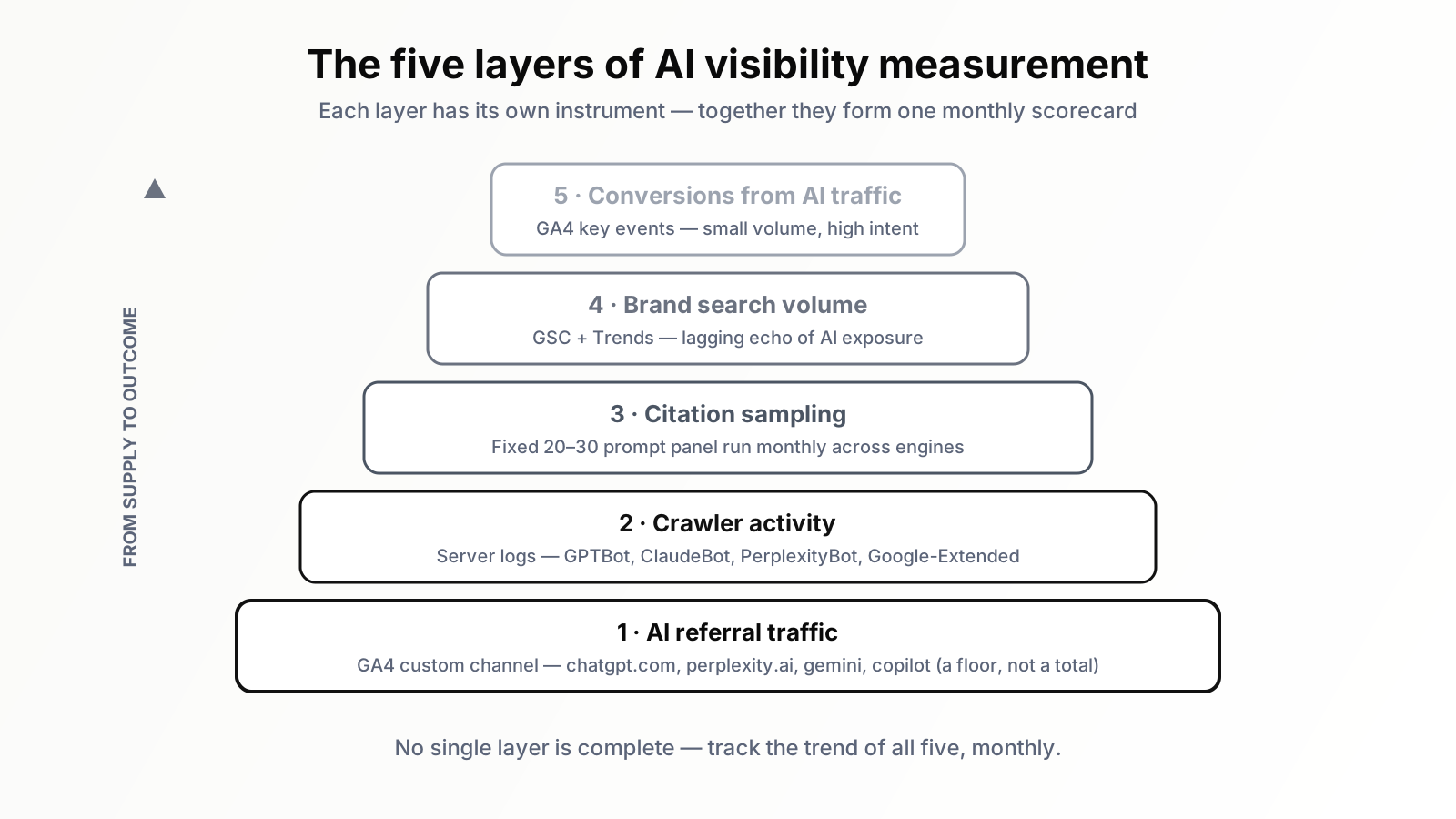
AI visibility is measurable across five layers: referral traffic from AI platforms in GA4, AI crawler activity in your server logs, citation sampling by querying the engines directly with a fixed prompt set, brand search volume as a lagging proxy, and conversions from AI-referred visitors. No layer is complete alone; together they form a workable monthly scorecard.
That is the whole thesis in one paragraph. The rest of this article unpacks each layer, because the details — especially the limitations — are where most teams either give up too early or claim too much.
Why the "can't measure" feeling is real
Before defending the five layers, it is worth taking the objection seriously, because it did not come from nowhere. Four real constraints feed it.
There is no Search Console for ChatGPT. Google, whatever its faults, gives you an official, free, first-party report of your impressions and clicks. OpenAI gives you nothing. Neither does Perplexity, Anthropic, or Microsoft in any comparable form. The entire reporting reflex that SEO built over fifteen years — open the console, read the graph — has no equivalent on the AI side. Teams reach for the familiar instrument, find it missing, and conclude the territory is unmappable rather than that it needs different instruments.
There is no ranking to track. Rank tracking works because a search results page is a discrete, ordered list: you are position 4 or you are not. An AI answer is a paragraph. Your brand is mentioned, cited, paraphrased without attribution, or absent — and there is no stable ordinal position to plot over time. The mental model of "tracking rankings" genuinely does not transfer, and tools that force AI answers into a rank-shaped report are abstracting away more than they admit.
Answers are not deterministic. Ask the same model the same question twice and you can get different answers, different sources, different brands mentioned. Sampling variance is built into the medium. A team that asks ChatGPT once, sees a competitor cited, and panics — or sees themselves cited and celebrates — is reading noise as signal. Any honest measurement has to be statistical rather than anecdotal, and that feels alien to people used to deterministic rank checks.
Personalisation muddies replication. What a logged-in user with months of chat history sees can differ from what a fresh session sees. Memory features, location, custom instructions, and model version all shift the output. You cannot fully replicate any individual user's answer, which means you are always measuring a representative condition, not the universe of real sessions.
All four constraints are real. Notice, though, what they actually establish: that AI visibility cannot be measured the way rankings were measured — with one official console, one deterministic position, one number. They do not establish that it cannot be measured at all. Plenty of things that matter are measured without a console or a rank: brand awareness, share of voice in PR, word of mouth. Marketing has always measured fuzzy things with layered proxies. AI visibility is the newest member of that family, and it is friendlier to measurement than most, because three of its five layers produce hard numbers from your own properties.
Layer 1: AI referral traffic in GA4
The first layer is the most concrete and the one most teams skip out of sheer unawareness: when someone clicks a link inside a ChatGPT, Perplexity, Gemini, or Copilot answer, that visit lands in your GA4 property like any other referral. The sessions are already there. They are simply buried, because GA4's default channel grouping has no concept of "AI" and files these visits under generic Referral — or, worse, under Unassigned — where nobody looks.
The sources to watch are recognisable by their referrer domains: chatgpt.com, perplexity.ai, gemini.google.com, and copilot.microsoft.com, plus a long tail of smaller assistants. The clean way to surface them is a custom channel group with a regex condition that sweeps these referrers into a dedicated "AI" channel, so the segment shows up in standard reports next to Organic Search and Paid instead of requiring an ad-hoc exploration every time someone asks. The full setup — regex, channel ordering, the Unassigned trap — deserves its own walkthrough, and we have one: see the step-by-step guide to measuring AI search traffic in GA4, and the broader piece on what SEOs should actually track in GA4 for where this segment fits among everything else.
Now the honesty clause, because every layer gets one. This number is a lower bound, not a total. A meaningful share of AI-referred visits arrives with no referrer at all — users copy a URL from an answer and paste it into a new tab, click out of a native app that strips the referrer, or pass through privacy layers that do the same. Those sessions land in Direct, indistinguishable from someone typing your URL from memory. So when your AI channel shows 400 sessions, the true figure is 400 plus an unknowable remainder hiding in Direct. Report it as a floor: "at least this much." A floor that trends upward month over month is still a perfectly good trend line — you just cannot treat it as a census, and you should say so in the report before someone else says it for you.
Layer 2: crawler activity in your server logs
Layer 1 measures humans arriving from AI answers. Layer 2 measures something earlier in the pipeline: the AI systems themselves reading your site. Before any model can cite you, recommend you, or summarise your explanation, its infrastructure has to fetch your pages — and those fetches leave fingerprints in your server logs under declared user-agent strings. GPTBot (OpenAI), ClaudeBot (Anthropic), PerplexityBot (Perplexity), and Google-Extended (Google's AI-training control) are all real, documented user agents, alongside the retrieval-time agents some platforms send when answering a live question. These are not exotic forensics; they are lines in the same access logs your server has been writing all along.
What the layer tells you operates at two levels. The binary level: are AI crawlers reaching your site at all? If your CDN, firewall, or an overzealous robots.txt rule blocks them, your AI visibility ceiling is zero regardless of how good the content is, and no amount of optimisation downstream will matter — this is the first thing to verify, not the last. The distribution level: which pages do they fetch, and how often? Crawl frequency is a demand signal. If GPTBot hits your pricing comparison and your technical explainers weekly but never touches your news section, you have learned something about which of your content AI systems consider worth ingesting — intelligence you cannot get from any analytics interface, because it happens before any human session exists. The practical mechanics — parsing logs, verifying agents against published IP ranges so you do not count spoofers, deciding what to allow — are covered in our guide to how GPTBot, ClaudeBot, and PerplexityBot crawl your site.
Honesty clause: a crawl is not a citation. A fetch proves ingestion, not influence — the model read the page; whether it ever uses the page in an answer is invisible at this layer. Treat crawler activity as the supply-side indicator: necessary, measurable, and silent about outcomes. That is exactly why the next layer exists.
Layer 3: citation sampling — asking the engines directly
This is the layer that replaces rank tracking, and it works on the same principle pollsters use: when you cannot observe the whole population, sample it under controlled conditions and track the trend.
The method is simple to describe. Build a fixed panel of 20 to 30 prompts — the questions your actual customers ask in your niche, phrased the way real people phrase them. Not keyword strings; questions. "What's the best way to automate SEO reporting for a small team?" rather than "seo reporting tool." Pull them from sales calls, support tickets, community threads, and the long-tail queries already in your Search Console. Then, on a fixed schedule — monthly is the practical cadence for most teams — run every prompt through ChatGPT, Perplexity, and Gemini, and record for each: Was your brand mentioned? Was your site cited as a source? In what framing — recommended, listed among options, mentioned in passing? And critically: who was cited instead of you? That last column is often the most actionable thing in the whole exercise, because it tells you exactly which competitors and which publications the models currently trust in your space, which is a target list, not just a scoreboard.
From the raw grid you compute simple rates: mention rate (brand named in X of 30 prompts), citation rate (site linked as a source in Y of 30), per-engine breakdowns, and the competitor frequency table. Plotted monthly, these rates are the closest thing AI search has to a ranking report — and unlike a ranking report, they also tell you the shape of the conversation you are missing. The deeper question of what makes models cite one source over another is its own discipline; the companion pieces on why citations are the new rankings and how to actually earn them cover the influence side, while this layer covers the observation side.
Honesty clause, and this layer needs the longest one. This is sampling, not a census. Thirty prompts approximate a question space with effectively infinite phrasings; your mention rate is an estimate with error bars, not a market share figure. Two rules keep it honest. First, hold conditions constant: run every monthly round logged out, or from the same clean account, in the same country, and note the date — because model versions change, and an answer shift after a model update is a different event than an answer shift after your content improved. Second, never react to a single data point. One competitor citation in one answer is variance; the same competitor cited in eleven of thirty prompts, two months running, is signal. If you keep those two rules, a humble spreadsheet beats an expensive black-box "AI rank tracker," because you know exactly what your number means and exactly what it does not.
Layer 4: brand search volume as a lagging proxy
The fourth layer measures an echo. A meaningful pattern in AI-era discovery is that the AI answer is the introduction, not the destination: someone asks Perplexity for options, sees your brand recommended, and does not click the citation — but a day later, they Google your brand name. The AI exposure happened entirely outside your instrumentation; the brand search is its measurable shadow.
The instrument here is one you already own. In Search Console, filter performance to brand queries — your name and its common misspellings — and watch impressions over time. In Google Trends, watch your brand term against a competitor basket. If your branded impressions climb while your non-branded rankings and your ad spend hold steady, something upstream is introducing your name to people, and in 2026 the most plausible new upstream source is AI answers. Pair the timing against Layer 3: if your citation sampling shows your mention rate rising in March and your brand impressions rise in April, you are watching the same phenomenon from two angles, and the corroboration is worth more than either line alone.
Honesty clauses, two of them, because this layer attracts the most wishful thinking. First, brand search is a confounded proxy: PR, ads, a conference talk, a viral post — anything can move it. It corroborates; it never proves. Treat it as supporting evidence in a triangulation, not a standalone KPI. Second, a hard fact about Search Console that vendors and conference speakers routinely blur: Google does not break out AI Overviews impressions as a separate search type. When your result appears inside an AI Overview, that impression is folded into the ordinary "Web" search type, indistinguishable in the data from a classic blue link. There is no filter, no report, no export that isolates "AIO visibility" in GSC today. Anyone promising to read your AI Overviews performance straight out of Search Console is promising something the data model does not contain — what AI Overviews actually do to your clicks and impressions, and how to reason about them honestly, is exactly why we wrote the complete guide to AI Overviews. Use brand volume as the lagging echo it is, and resist the urge to relabel it as something more precise.
Layer 5: outcomes — conversions from AI traffic
The first four layers measure visibility. The fifth measures whether the visibility is worth anything, and it is the layer that turns the whole framework from a curiosity into a budget argument.
Once Layer 1's custom channel group exists, every downstream GA4 report can be cut by it — including conversions. Signups, demo requests, purchases, key events of any kind, attributed to the AI channel exactly as they are to Organic or Paid. And here is the finding that teams who do this work report with remarkable consistency: AI traffic is small and converts well. The volume is a fraction of organic search, which is precisely why it gets dismissed in channel reviews — but the visitor who arrives from an AI answer has often already received the explanation, the comparison, and the shortlist inside the conversation. They click through pre-qualified. Where an organic visitor lands on your blog post to start evaluating, the AI-referred visitor frequently lands to finish.
This is also the layer that retires the most common executive objection: "AI traffic is only 3% of sessions, why are we spending time on it?" Sessions are the wrong denominator. If that 3% of sessions produces 9% of signups, the channel is pulling three times its weight, and the correct response to a small high-intent channel is investment, not dismissal — the same logic behind why zero-click search doesn't mean zero value. Honesty clause: this layer inherits Layer 1's undercount. Conversions from referrer-less AI visits sit in Direct, so your AI conversion figure is also a floor. The intent pattern usually survives the undercount; the absolute count does not.
What you genuinely cannot measure — keeping the quote honest
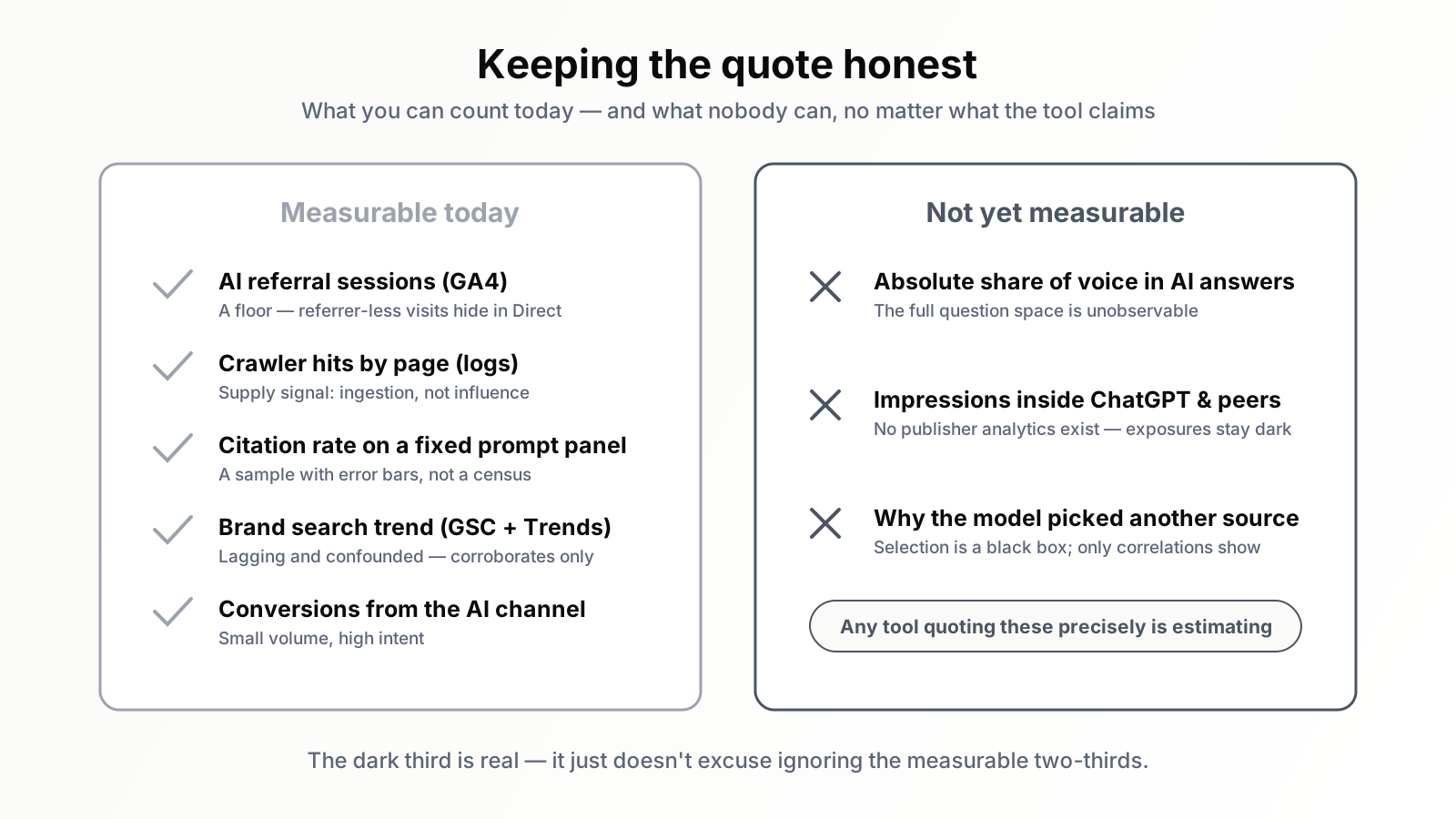
A framework that claims everything is measurable would be making the mirror-image error of the quote it is rebutting. Three things remain genuinely out of reach in 2026, and a credible scorecard names them.
Absolute share of voice in AI answers. Your prompt panel estimates your presence in 30 questions you chose. The real population — every phrasing, every language, every user context, every model version — is unobservable from the outside. You can know you are trending up in your sample; you cannot know you "appear in 12% of relevant AI answers," and any tool quoting a number like that has quietly substituted its sample for the universe.
Impressions inside ChatGPT and its peers. When ChatGPT mentions your brand and the user nods and moves on — no click, no search — that exposure left no trace you can collect. There is no impression counter, and unless platforms decide to publish publisher-facing analytics, this stays dark. You see the clicks (Layer 1) and the echo (Layer 4); the exposures themselves are invisible.
Why the model chose someone else. When sampling shows a competitor cited in your place, no log explains the selection. Retrieval, training data, authority signals, phrasing fit — the mechanism is a black box even, in meaningful ways, to the companies running it. You can correlate — pages that are well-structured, factually dense, and widely referenced get cited more — but you cannot inspect the decision. Anyone claiming to have reverse-engineered it precisely is extrapolating.
So the quote keeps a third of its territory. The mature position is not "everything is measurable" or "nothing is" — it is knowing which side of the line each metric sits on, and refusing to let the genuinely dark third excuse ignoring the measurable two-thirds.
Assembling the monthly AI visibility scorecard
Five layers only become management information when they share a page. The assembly is deliberately boring: one scorecard, reviewed monthly, trends mattering more than absolutes.
- AI referral sessions (GA4 custom channel) — monthly, labelled as a floor. Watch: month-over-month trend, platform mix.
- AI crawler hits (server logs) — monthly roll-up of fetches by bot and by top pages. Watch: blocked bots (should be deliberate, never accidental), shifts in which content gets crawled.
- Mention and citation rate (prompt panel, 20–30 prompts, fixed conditions) — monthly run. Watch: rate trend per engine, competitor frequency table.
- Brand impressions (GSC brand-query filter + Trends) — monthly, explicitly labelled "lagging, confounded." Watch: direction, and timing against the citation rate.
- Conversions from AI channel (GA4 key events by channel) — monthly. Watch: conversion rate versus organic, share of total conversions versus share of sessions.
Three habits make the scorecard trustworthy rather than theatrical. Annotate model releases and major site changes on the timeline, so a swing in citation rate can be honestly attributed. Keep the limitation labels on the page itself — "floor," "sample," "confounded" — because a scorecard that admits its error bars survives executive scrutiny, and one that does not gets dismantled by the first skeptical question. And resist adding a blended "AI visibility score" that averages the five layers into one number; the layers measure different stages of different journeys, and collapsing them manufactures exactly the false single number the original quote correctly says does not exist.
Cost check, since the objection to all of this is usually effort: layers 1 and 5 are a one-time GA4 configuration. Layer 4 is two saved filters. Layer 2 is a log query you template once. Layer 3 is the only recurring labour — an hour or two of structured prompt-running per month, less once you systematise it. This is an afternoon of setup and a short monthly ritual, not a headcount.
The verdict on the quote
"You can't measure AI visibility" is right about a single word and wrong about the sentence. Right: there is no one number — no console, no rank, no deterministic score, and the dark third (true share of voice, in-platform impressions, the model's reasoning) is genuinely dark. Wrong: the leap from "no single number" to "can't measure," which in practice functions as a reason to do nothing while the discovery layer of the internet reorganises itself. Five instruments, four of which you already own, produce a layered picture honest enough to act on: traffic floor, crawl demand, sampled citations, brand echo, and conversions. The teams that build this scorecard now will spend 2027 steering with data while their competitors are still repeating the quote.
And because the recurring cost lives almost entirely in layer 3 and the monthly assembly, this is precisely the kind of structured, repetitive work worth handing to an agent: Orova tracks your AI search visibility alongside your classic SEO data, so the scorecard maintains itself and your team spends its hours on the only part no instrument covers — making the content worth citing in the first place.
Turning This Framework Into a Weekly Habit
Everything in this framework works, but doing it by hand every week is a real time sink: pulling AI referral segments in GA4, digging through server logs for crawler activity, manually asking multiple AI engines the same questions to sample citations, tracking brand search volume over time, and then tying it all back to actual conversions. Each layer alone is manageable; keeping all five going in parallel, month after month, is where most teams quietly give up and go back to the old traffic chart.
Orova SEO is built to carry that ongoing tracking for you, pulling these signals together automatically instead of leaving you to stitch them together by hand every week. If you would rather spend your time acting on the picture than assembling it, it is worth a look.
Let Orova SEO handle the repetitive part
Keyword research, drafting, refreshing old posts and rank tracking — running automatically on your own site.
Explore Orova SEO