
Perplexity Sends Real Traffic — Here's Who It Links To
If you have been trying to see website traffic free from AI answer engines, you have probably run into the same wall: your analytics dashboard shows a trickle of visits from somewhere called Perplexity, but no one can tell you why those visits happened, what page got cited, or whether it is worth chasing. Meanwhile everyone online is telling business owners that AI answers are quietly stealing their clicks, which makes the whole topic feel like something to worry about rather than something you can actually measure — and the worry has data behind it, since according to sparktoro, 68% of US Google searches in the first four months of 2026 ended without a click at all, up from 60% in 2024.
The usual advice does not hold up well once you try to use it. Most guidance about AI search is either theoretical — "optimize for AI" with no specifics — or borrowed straight from Google SEO habits, which do not map cleanly onto how an AI engine actually picks its sources. Checking this by hand means opening dozens of chats, guessing which of your pages got mentioned, and hoping the pattern repeats — a slow, unreliable way to see website traffic free of guesswork.
This article replaces the guessing with a real audit. We ran a structured study of Perplexity's citations in one niche, tracked which kinds of pages it favors, and matched that against our own analytics to see what the resulting traffic actually looks like. By the end, you will know what kind of content gets picked, how fast those picks change, and what specific changes on your own pages are worth trying first.
Why we ran this analysis
Our team had a practical problem, not an academic one. We build software that tracks search visibility, and through 2025 we watched a new line item creep into our customers' analytics: referral sessions from perplexity.ai. The volume was small — usually one to three percent of search-driven sessions — but the behavior of those sessions looked unusual. Longer engagement. Deeper scroll. Higher trial signup rates. The kind of traffic you would happily take more of.
At the same time, almost everything written about earning AI citations was either recycled speculation or advice extrapolated from Google. We have already published a complete guide to Google's AI Overviews, and one consistent lesson from that work was that each AI surface has its own selection logic. What earns a spot in an AI Overview is not automatically what earns a Perplexity citation. If we wanted to advise anyone — including ourselves — on Perplexity specifically, we needed Perplexity-specific evidence.
There was also a second motivation. Perplexity's architecture is genuinely different from Google's. It combines its own crawled index with real-time web retrieval, then composes an answer and attributes claims to numbered sources. That pipeline has two implications worth testing. First, the retrieval step might reward different page properties than classic ranking does — extractability and answer density rather than aggregate link authority. Second, because the answer is synthesized from a handful of sources rather than a ranked list of ten blue links, the competition is not for position one through ten; it is for a citation slot among typically four to eight sources. We wanted to know what wins those slots.
How we built the sample
A quick note on method, because everything that follows depends on it. These are our own numbers from our own sample in one niche. We are not claiming they generalize to e-commerce, health, finance, or local queries, and we deliberately avoid quoting industry-wide statistics because, frankly, nobody has reliable ones yet.
Here is what we did:
- Query set: 204 queries in the SEO and SaaS software niche, split across four intent buckets — informational definitions ("what is" queries), how-to queries, comparison and "best tool" queries, and troubleshooting queries.
- Collection: we ran each query through Perplexity three times over a six-week window (early run, mid run, late run), producing 612 answers. Running the same query at different times let us measure citation churn as well as composition.
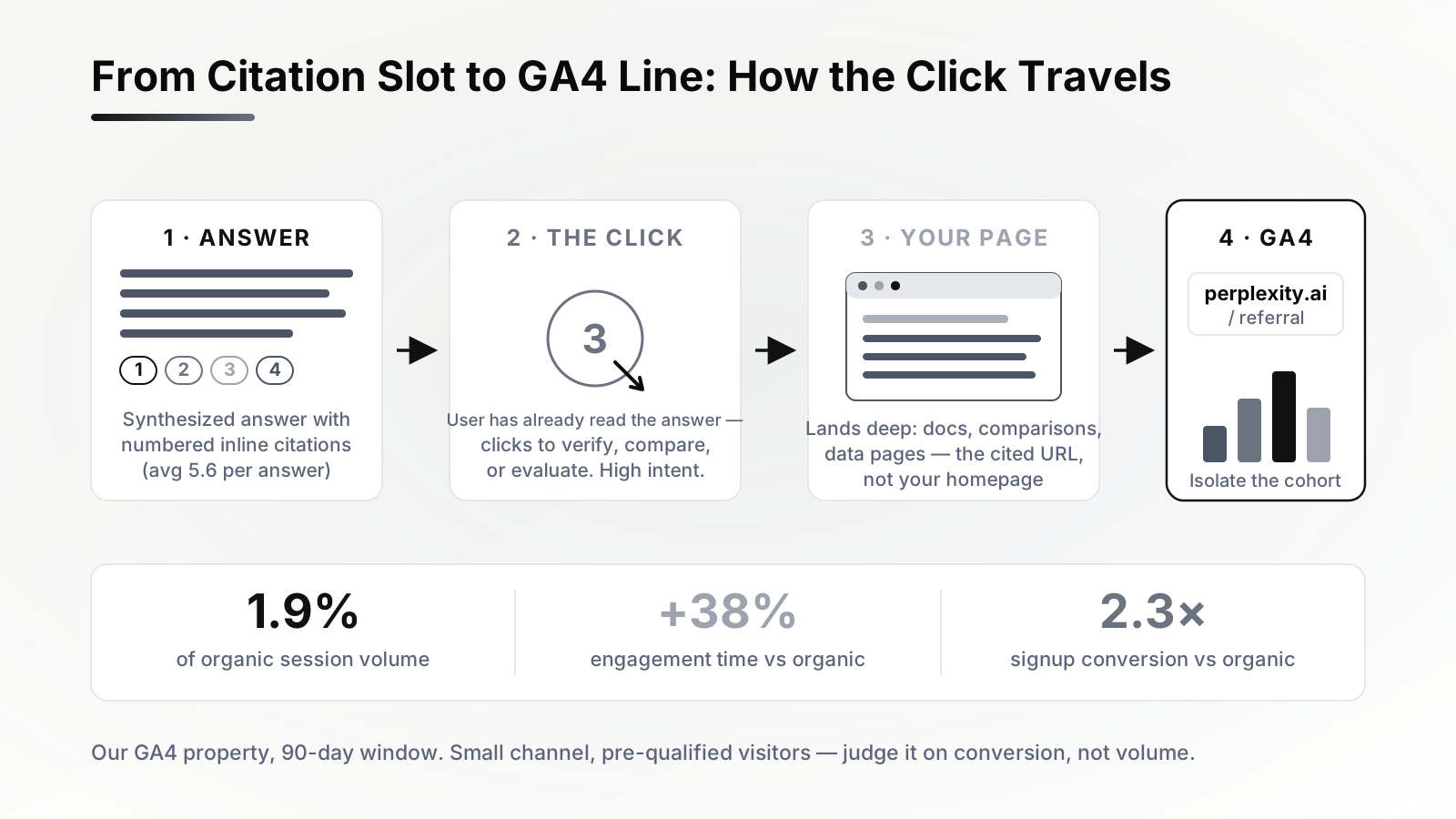
- Citation logging: we recorded every numbered citation in every answer — 3,419 citation slots in total, an average of 5.6 citations per answer.
- Classification: we manually classified each cited URL by page type (direct-answer article, comparison or listicle, original data or research page, product documentation, forum or community thread, news, other) and logged the visible publish or update date where one existed.
- Google comparison: for each query we also captured Google's top ten organic results in the same week, so we could measure overlap between Perplexity's sources and Google's first page.
- Traffic verification: separately, we analyzed our own GA4 property to characterize sessions arriving with the source/medium perplexity.ai / referral.
Two caveats before the findings. Perplexity's answers vary by phrasing, session context, and model configuration, so a different team running a similar study would get somewhat different numbers. And our niche is unusually well-served by documentation and comparison content, which almost certainly inflates those categories relative to, say, recipe queries. Treat the exact percentages as one team's measurement, and the patterns as the useful part.
Who Perplexity cites: the page-type breakdown
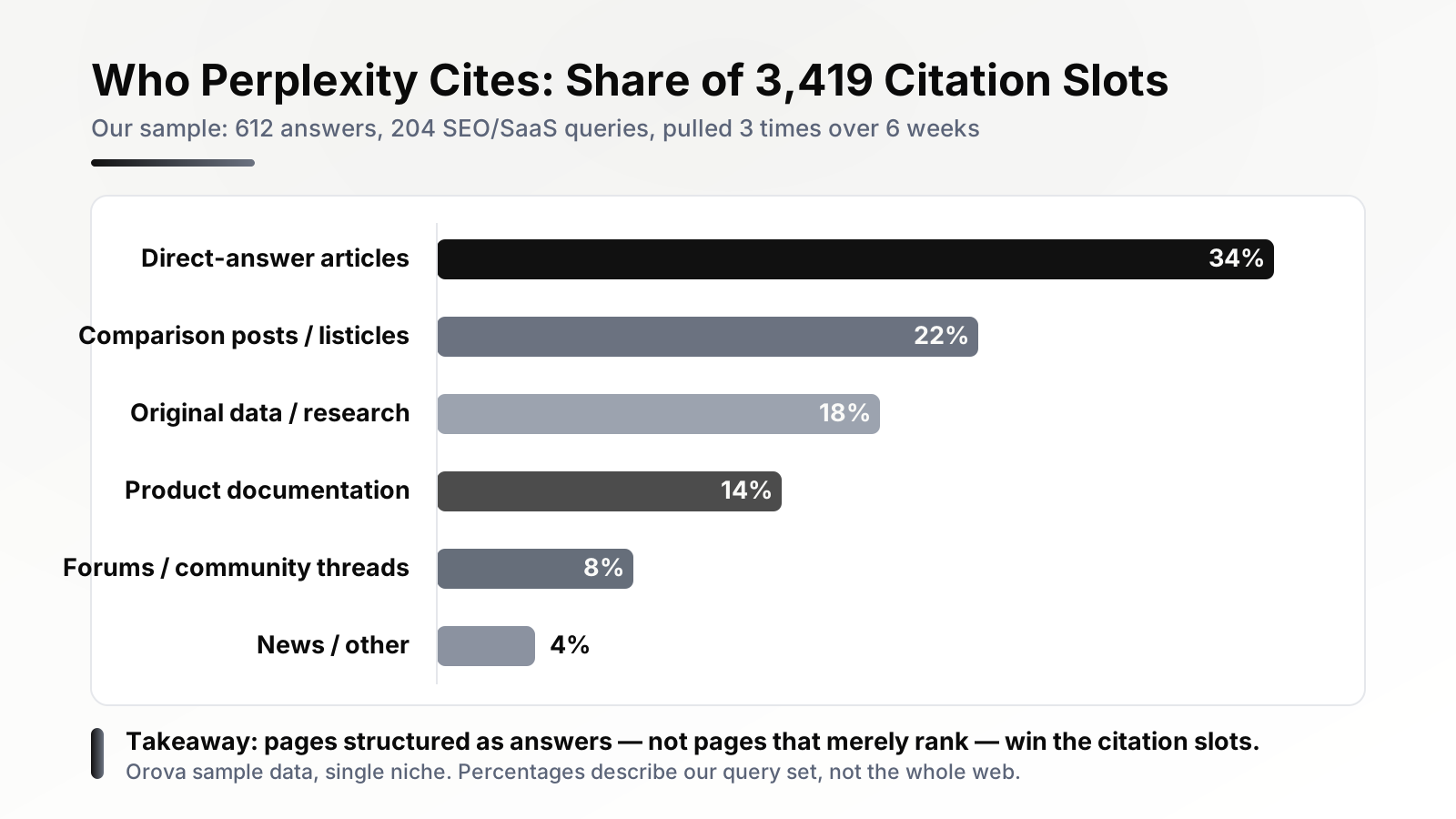
The headline finding is that Perplexity has a strong, consistent preference for pages that function as answers rather than pages that merely rank. When we classified all 3,419 citation slots in our sample, the distribution looked like this:
- Direct-answer articles — 34 percent. Pages that state the answer plainly near the top: a definition in the first hundred words, a numbered process, a clearly labeled "short answer" block. These dominated informational and how-to queries.
- Comparison posts and listicles — 22 percent. "Best X for Y" roundups, "A vs B" pages, and structured comparison tables. On commercial-intent queries this category alone took nearly half the citation slots.
- Original data and research pages — 18 percent. Benchmark write-ups, survey results, pricing analyses, anything with first-party numbers. These punched far above their share of the web; there simply are not many of them, yet they kept getting cited.
- Product documentation — 14 percent. Help-center articles, API references, setup guides. For troubleshooting queries, documentation was the single most-cited type.
- Forums and community threads — 8 percent. Reddit-style threads and community Q&A, mostly on troubleshooting and "is X worth it" queries where lived experience matters.
- News and everything else — 4 percent. News appeared almost exclusively on queries with a temporal angle.
Three patterns inside this breakdown deserve a closer look, because they explain most of the variance we saw.
Answer-shaped beats authority-shaped
The clearest pattern in the whole study: when two pages covered the same topic, Perplexity cited the one that committed to an answer. We repeatedly saw mid-authority blogs cited over far stronger domains whose pages buried the answer under eight hundred words of preamble. In 41 of our informational queries, the cited page contained an explicit answer within the first 150 words; the higher-authority page that Google ranked first for the same query did not, and was not cited. Retrieval systems extract passages, and a passage that answers cleanly is worth more to a synthesis engine than a domain name. This is the core thesis of generative engine optimization, and our sample supports it more strongly than we expected.
Comparison pages are citation magnets on commercial queries
For "best" and "vs" queries, Perplexity's answers are almost always structured as a shortlist with attributes — and to build that shortlist it leans heavily on pages that already did the structuring. Comparison posts with real tables, explicit criteria, and per-option pros and cons took 47 percent of citation slots on our commercial-intent bucket. Thin listicles that just stacked ten H2s with affiliate links did noticeably worse: of the listicle citations we logged, the overwhelming majority included a visible comparison table or a stated evaluation methodology.
Original numbers get cited even from small sites
The 18 percent share for original data understates how interesting this category is. These citations went to domains of every size, including sites that, by any conventional authority metric, should not compete in this niche. One pattern we logged eleven separate times: an answer's general claims cited big publishers, while its specific number — a price, a percentage, a benchmark figure — cited a small site that had actually produced the number. If you publish the only first-party data point on a question, you are, for citation purposes, the canonical source regardless of your domain rating.
Recency matters more than on Google
We logged a visible publish or last-updated date for about three-quarters of cited pages, and the skew toward fresh content was unmistakable. Sixty-two percent of dated citations pointed to pages published or updated within the previous eighteen months. On "best tool" queries the skew was sharper: 78 percent within twelve months. Pages with the current year in the title or a recent "last updated" stamp recurred constantly.
For comparison, when we dated the pages in Google's top ten for the same queries, only 49 percent fell inside that eighteen-month window. Google's classic results still carry plenty of aging evergreen pages held up by accumulated links; Perplexity's retrieval appears far more willing to swap an older authoritative page for a newer adequate one. Our practical takeaway was blunt: in this niche, an unmaintained page is a decaying Perplexity asset even when its Google position is stable. Refreshing dates cosmetically is not the lesson — we tested that, as described below, and it did nothing on its own — but genuinely updated content with visible date signals clearly aligns with what gets retrieved.
Domain diversity: Perplexity is not Google's top ten with extra steps
The most strategically important finding came from cross-referencing citations against Google's first page. We expected heavy overlap — the lazy assumption is that AI engines launder Google's rankings into prose. That is not what we found.
Across the sample, only 38 percent of Perplexity's citation slots pointed to URLs that appeared in Google's top ten for the equivalent query in the same week. Another 21 percent pointed to different URLs on domains that did have a top-ten result. The remaining 41 percent of citation slots went to domains entirely absent from Google's first page for that query.
Drill into that 41 percent and the texture gets more interesting:
- Documentation pages that Google ranked on page two or three but that answered the literal question precisely.
- Small and newer sites — we counted 63 domains in our citation log that we would classify as small or recently launched (low authority, modest publishing history). Several were cited repeatedly across runs, which suggests deliberate retrieval rather than noise.
- Forum threads that Google's first page suppressed for that phrasing but that contained a concrete, specific resolution.
- Recently published pages that had not yet accumulated the links to crack Google's first page but were already in Perplexity's index — PerplexityBot had crawled some of our own new pages within days of publication, well before they ranked anywhere meaningful.
Per answer, the engine also spread its bets: the average answer cited 5.6 sources from 4.9 unique domains, and across the whole sample we logged 1,108 unique domains — meaningfully broader than the pool of domains occupying Google's top ten for the same 204 queries. The competitive implication is real. If you are a smaller site that cannot out-muscle entrenched domains in classic rankings, Perplexity is a surface where the fight is closer to even, because the unit of competition is the passage, not the domain. We have made a version of this argument before in our guide to getting cited by ChatGPT, Gemini, and Perplexity, but seeing 41 percent of slots go to outside-the-top-ten domains in our own logs turned it from a talking point into a planning assumption.
Citation churn: the slots are not settled
Because we ran every query three times over six weeks, we could measure stability. Between the first and third runs, 34 percent of citation slots changed — either a new source replaced an old one, or the answer restructured around different sources entirely. Informational definition queries were the most stable; "best tool" queries churned the most, with nearly half their citations changing across the window.
This churn is good news if you are currently invisible. A Google top-ten position in a competitive niche can take a year of link building to crack; a Perplexity citation slot, on this evidence, gets re-litigated continuously. Several pages we updated mid-study (more on that below) appeared in citations within two to three weeks of the update. The flip side is that won slots are not safe, which argues for monitoring citations the way you monitor rankings — repeatedly, not once.
What the referral traffic actually looks like in GA4
Citations are the supply side. The demand-side question is whether anyone clicks those numbered links, and here our own analytics gave us a clean read. Perplexity referrals are straightforward to isolate in GA4: they arrive as source perplexity.ai with medium referral. Build an exploration filtered to that source/medium pair and you can compare the cohort against organic search directly. (If your GA4 setup is not ready for this kind of analysis, our walkthrough of what SEOs should actually track in GA4 covers the foundations.)
Over a recent 90-day window on our own property, the perplexity.ai / referral cohort looked like this compared with our organic search baseline:
- Volume: small. Perplexity referrals were equivalent to about 1.9 percent of our organic sessions. Nobody should expect this channel to rival Google on volume today.
- Engagement: substantially higher. Average engagement time per session ran 38 percent above organic, and pages per session about 1.4 times organic.
- Conversion: the standout. Trial signups per session came in at 2.3 times our organic average. The pattern held across both runs of the analysis we did during the study window.
- Landing pages: skewed to depth. Perplexity visitors disproportionately landed on documentation, comparison pages, and data-heavy posts — the exact page types the citation analysis predicted — rather than the homepage or broad category pages.
The mechanism is intuitive once you watch the product. A Perplexity user has already read a synthesized answer. When they click citation [3], they are not browsing — they are verifying, going deeper, or evaluating a specific tool the answer surfaced. The answer engine absorbed the low-intent portion of the journey and forwarded you the high-intent remainder. We wrote about this dynamic in why zero-click search doesn't mean zero value, and the Perplexity cohort is the cleanest illustration of it we have measured: fewer clicks, but each click arrives pre-qualified by the answer itself.
One measurement honesty note: this almost certainly undercounts Perplexity's real influence. Users who read an answer, never click, and later search your brand name or type your URL directly show up as organic brand or direct traffic. The referral line is the visible floor, not the ceiling.
What we changed on our own pages — and what moved
Findings are cheap; interventions are evidence. Midway through the study we picked 40 of the 204 queries where we had a relevant page that was not being cited, applied a consistent set of changes to 24 of those pages, left the other 16 untouched as a rough control, and watched the final two collection runs plus three follow-up weeks.
The changes we applied:
- Added a 40-to-60-word direct answer at the top of each page, bolded, phrased to stand alone if extracted — the same convention we now use on every post, including this one.
- Restructured headings into question form where natural, so each H2/H3 plus its first paragraph formed a self-contained retrievable unit.
- Added or rebuilt comparison tables on the commercial pages, with explicit criteria rows rather than feature-dump columns.
- Inserted at least one first-party data point per page — a number from our own product data or testing that existed nowhere else.
- Made freshness legible: visible "last updated" dates, updated examples, and accurate dateModified in structured data — alongside genuine content updates, not instead of them.
- Verified crawlability for PerplexityBot in our logs and robots rules. (We also added an llms.txt file, with low expectations — it remains a proposed convention, and we saw no evidence in this study that any engine consumed it. We treat it as cheap insurance, not a tactic.)
The result: before the intervention, those 40 tracked queries showed our pages in 9 answers. By five weeks after, we were cited in 17 — roughly doubling, while the untouched control pages went from 4 citations to 5. The biggest movers were the pages that got a direct-answer block plus a first-party number; pages that only got cosmetic freshness changes barely moved, which is why we are confident the date stamp alone is not the lever. With a sample this size we will not pretend this is laboratory-grade causal proof — but a doubling against a flat control, concentrated in the pages that received the structural changes, is enough signal for us to roll the pattern out site-wide.
A practical checklist for earning Perplexity citations
Condensing the citation analysis and the intervention results into something you can act on this quarter:
- Lead with the answer. Every page targeting a question should resolve it within the first 150 words, in a passage that survives being quoted out of context. This was the single strongest correlate of citation in our sample.
- Build real comparison assets for commercial queries. Tables, stated criteria, honest trade-offs. Structured comparisons took nearly half the citation slots on our commercial bucket; thin listicles did not.
- Publish at least one number nobody else has. Original data was 18 percent of citations from a tiny fraction of pages. A modest first-party benchmark or survey outperforms another synthesis of other people's syntheses.
- Treat documentation as a citation surface. If you have a product, your help center is competing for troubleshooting answers. Write docs that answer the question, not just describe the feature.
- Keep priority pages genuinely current. The recency skew is real. Schedule substantive refreshes for citation-target pages at least twice a year, with visible and truthful date signals.
- Confirm PerplexityBot can reach you. Check server logs for the user-agent, audit robots.txt, and make sure your key pages render their core content without requiring JavaScript gymnastics.
- Measure the loop. Track which queries cite you (sampled manually or with tooling), and isolate perplexity.ai / referral in GA4 so the channel's quality — not just its volume — is visible to whoever sets your priorities.
- Re-check monthly. A third of citation slots in our sample turned over within six weeks. Both your wins and your gaps are temporary.
None of this conflicts with classic SEO; almost all of it makes pages better for Google's AI surfaces too. The overlap with what works in AI Overviews and other answer engines is substantial — the broader playbook lives in our answer engine optimization guide — but the weighting differs. Perplexity, on our evidence, weights extractability, structure, originality of data, and freshness more heavily, and aggregate domain authority less heavily, than the Google surfaces we have studied.
What we would caution against
Three failure modes we either observed or flirted with ourselves. First, do not chase volume parity. Perplexity referrals were under two percent of our organic sessions; if you judge this channel on session count, you will abandon it before its conversion quality pays off. Judge it on revenue per session and assisted brand demand. Second, do not fake the signals. Cosmetic date bumps did nothing in our intervention set, and stuffing "direct answer" blocks with marketing copy produces passages no synthesis engine wants to quote. The engine is selecting for usefulness-per-passage; the only durable strategy is to actually be useful per passage. Third, do not treat our percentages as universal constants. They describe one niche, one window, one team's query set. Run a smaller version of this study in your own niche — even 30 queries pulled twice, a month apart, will tell you which page types win your citation slots and how much churn you are dealing with.
It is also worth saying plainly: this channel is young and the platform iterates quickly. Citation behavior, source mixes, and even how referrals are attributed can shift. The durable assets are the ones that win across every answer engine — answer-shaped pages, original data, current content, clean crawlability. The platform-specific tactics are the part you should hold loosely.
The bottom line
Perplexity sends real traffic, and it sends a particular kind: small in volume, high in intent, and addressed to the pages that earned a numbered citation by being the clearest, freshest, most concrete source available at retrieval time. In our 612-answer sample, the engine showed a decisive preference for direct-answer structure, genuine comparisons, first-party data, and documentation — and it drew 41 percent of its citations from domains Google's first page ignored. For smaller sites especially, that is not a threat narrative. It is an open lane, and one where effort converts to visibility in weeks rather than years.
The operational challenge is that none of this is visible in a classic rank tracker. Citation slots churn monthly, the referral cohort hides inside GA4 unless you isolate it, and the pages that need answer-block and freshness work rarely announce themselves. That monitoring loop is exactly what we built Orova to run: it tracks where your pages surface across AI answer engines alongside classic rankings, ties the perplexity.ai referral cohort to conversions, and flags the citation-target pages going stale — so the analysis we spent six weeks doing by hand becomes a dashboard you check over coffee. However you tool it, start measuring now. The teams that treat AI citations as a tracked channel this year will be the ones the answers keep pointing to next year.
Turning this into a routine, not a one-time project
Doing this properly by hand is the hard part. Pulling repeated answers, logging every citation, classifying page types, and cross-checking it all against your analytics takes hours of careful, repetitive work — and it goes stale fast, because citation patterns keep shifting.
Orova SEO is built to handle that repetitive tracking for you, so you can see this kind of AI citation and traffic picture without doing the manual pulls yourself. If you want to see what it looks like for your own site, it is worth a look.
Related reading: Local SEO: What It Is and Whether It Still Pays Off
Let Orova SEO handle the repetitive part
Keyword research, drafting, refreshing old posts and rank tracking — running automatically on your own site.
Explore Orova SEO