
AI Agents for Performance Marketing: How Orova Ads Automates Ad Optimization
Performance marketing has a scaling problem. The advertising platforms are extraordinarily powerful, but running them well demands hundreds of contextual decisions every single day — far more than any team can make carefully when budgets are large and time is short. Orova Ads was built to close that gap: a platform of specialized AI agents that automate and optimize advertising campaigns across Google, Meta, and TikTok, applying the same logic that seasoned performance marketers rely on — at a scale and speed no human can match.
This article explains what Orova Ads is, the structural problems in paid media it was designed to solve, how its agents turn more than 200 expert optimization actions into dependable automation, and who gets the most value from it.
What is Orova Ads?
Orova Ads is a system for building specialized AI agents that continuously monitor, analyze, and optimize paid advertising campaigns. Instead of a single generic "autopilot," you assemble agents — each configured around a clear objective and a defined set of rules — and let them do what manual optimization simply cannot: watch every metric, on every campaign, all day, and act the moment the data calls for it.
Where a human marketer reviews campaigns once or twice a day, an Orova agent evaluates them continuously. Where a human leans on memory and intuition, an agent applies a consistent, documented framework to every decision. The outcome is optimization that is faster, more consistent, and fully explainable — three things that are remarkably hard to achieve at the same time by hand.
Why performance marketing is so hard to scale
To understand why AI agents are such a natural fit for paid media, it helps to look at the three structural problems that make the discipline so difficult to run well — and so difficult to teach to others.
1. Overwhelming complexity
On a single advertising platform there are hundreds — sometimes thousands — of possible optimization actions at any given moment. Budgets, bids, audiences, placements, creatives, schedules, bid strategies, exclusions, and dozens of other levers all interact. Because every situation is different, there is rarely one "correct" move; there is only the right move for this campaign, with this data, right now. That contextual depth is exactly what makes the craft so hard to standardize into a simple checklist.
2. Expertise that won't transfer
Because the decisions are so situational, performance marketing is notoriously hard to teach. Even senior specialists often optimize on experience and feel rather than a written, repeatable formula. The consequence is painful for any growing team: the best judgment lives inside a few people's heads, and it rarely scales cleanly to new hires. Training takes months, quality is inconsistent, and the moment a key person leaves, hard-won knowledge walks out the door with them.
3. Data overload and a ticking clock
Each platform produces a flood of metrics, with countless valid ways to interpret them. In practice, a manager might get only an hour or two a day to actually review campaigns and act on what they see. When spend runs into the hundreds of millions of VND per day, that limitation is expensive: every hour of delayed optimization is budget quietly leaking away. Money that leaves an ad account does not come back, so even small, late decisions compound into real losses over a month.
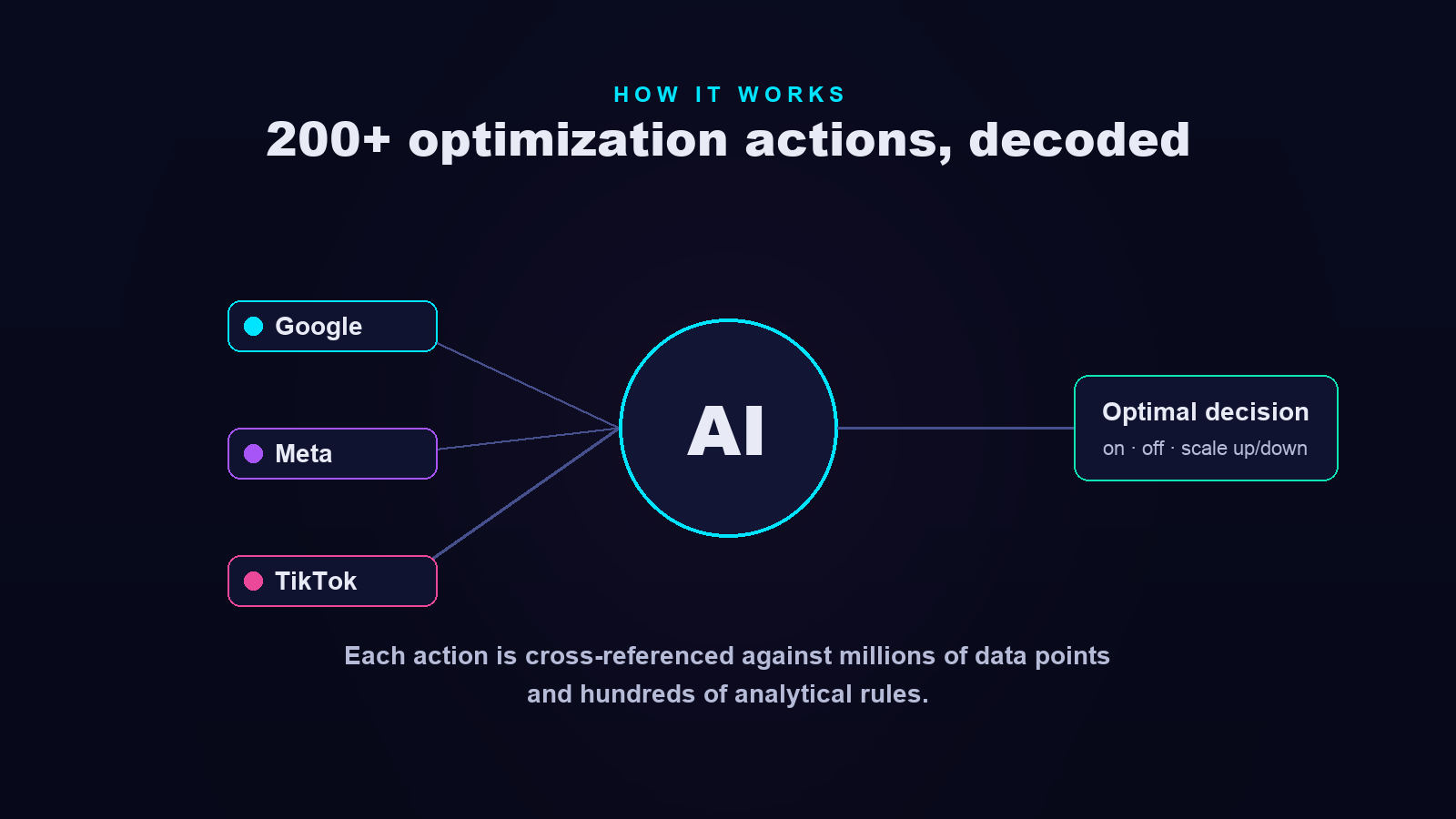
How Orova Ads works: 200+ optimization actions, decoded
Orova Ads is built on a single conviction: an expert's decision-making can be made explicit. We mapped the underlying logic for more than 200 optimization actions across Google, Meta, and TikTok — the concrete moves experienced marketers make to protect spend and grow performance. These are not vague principles; they are specific, repeatable actions, each with a clear trigger and a clear expected outcome.
The kinds of decisions an agent can own include:
- Budget management — shifting spend toward what is working and away from what is not, and pacing budgets so they neither under-deliver nor overspend.
- Bidding and bid strategy — adjusting targets and strategies as cost and conversion data accumulate.
- Audience and targeting — expanding, narrowing, or excluding audiences as performance signals emerge.
- Creative rotation — promoting winning creatives and retiring fatigued ones before they drag results down.
- Scheduling and dayparting — concentrating spend in the hours and days that actually convert.
- Waste control — catching and cutting the small leaks — poor placements, irrelevant search terms, broken funnels — that quietly erode return.
For every action, the AI cross-references millions of historical data points and applies hundreds of analytical rules before committing to a decision. It is the difference between an optimization made on a hunch in a spare ten minutes and one validated against a vast body of evidence in seconds.
The decision framework: on, off, scale up, scale down
Underneath all of that complexity, most optimization resolves into a small number of clear actions: turn something on, turn it off, scale it up, or scale it down. The hard part was never naming the action — it was knowing exactly when, and by how much, to take it. That is the judgment Orova Ads encodes.
Each agent continuously asks the same disciplined questions a great marketer would: Is this segment delivering against its goal? Is the trend improving or decaying? Is there enough data to act with confidence, or should it wait? Is the timing right? By answering those questions against data rather than gut feeling, the agent reaches the optimal call — and because the logic is explicit, you can always see why it decided what it did.
From tacit expertise to a system that scales
The real breakthrough here is not raw speed — it is transferability. Knowledge that was once almost impossible to teach a single person, let alone replicate across an entire team, can now be encoded into an agent and executed reliably forever after. Once that expertise lives in a machine, it runs continuously and scales without friction: the same proven strategy, applied across every campaign, every hour, hundreds or thousands of times over — with no fatigue, no drift, and no missed windows.
Knowledge that used to be nearly impossible to scale to another human can now be taught to a machine — and then executed at a hundred, a thousand, even a million times one person's capacity.
For a business, that changes the economics of growth. Your best practices stop being a bottleneck tied to a handful of specialists and become a system you can deploy on demand.
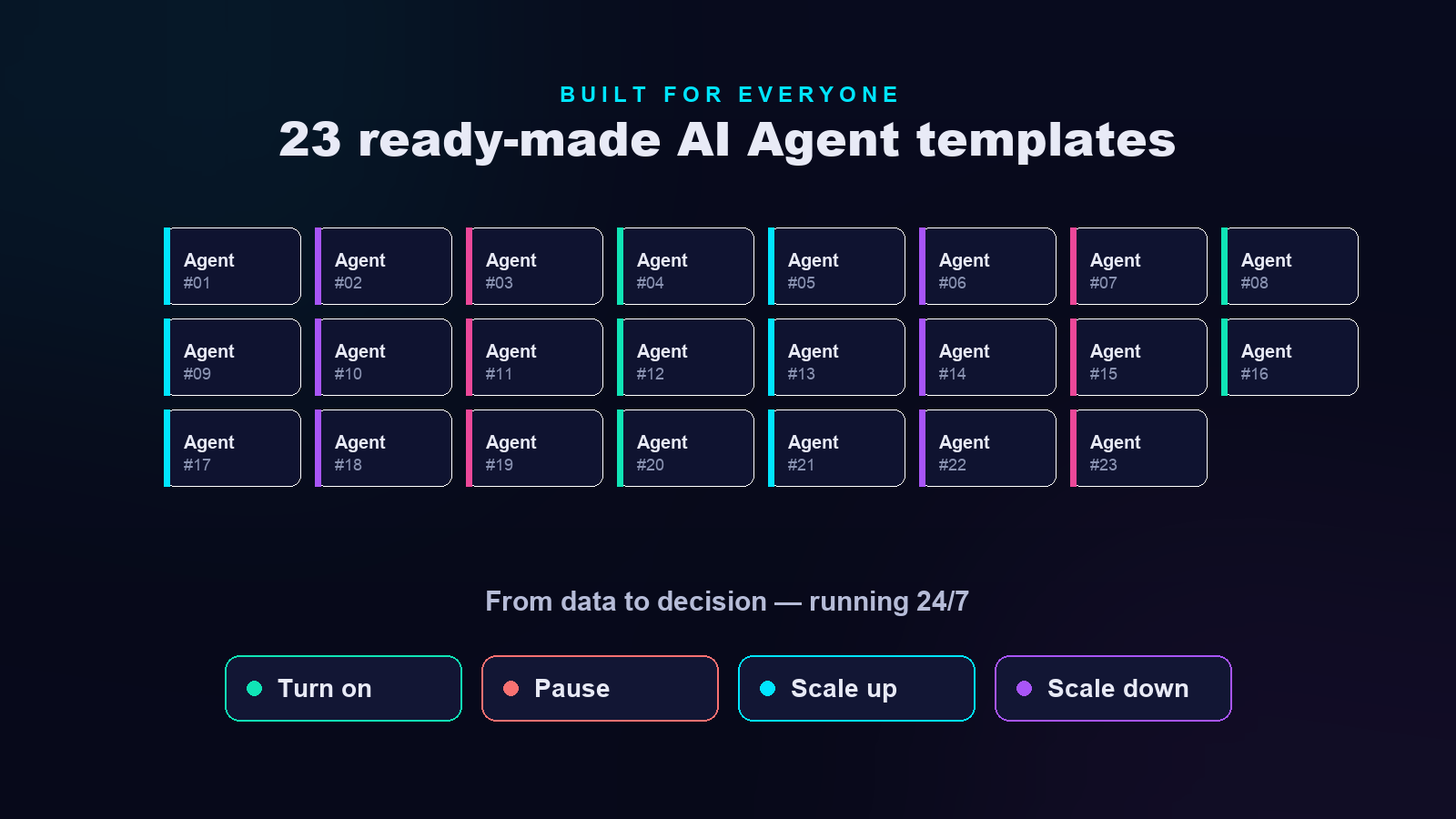
23 ready-made AI Agent templates
Orova Ads delivers its full power in expert hands, but it is built for everyone. The methodology comes packaged as 23 pre-configured AI Agent templates, each tuned to a specific optimization goal — so you do not have to design a strategy from a blank page. You can pick a template that matches your objective, point it at your accounts, and start.
Because every business is different, each template is fully customizable. You can adjust the objectives, thresholds, and rules to match your own strategy, your accounts, and your appetite for risk — keeping a human firmly in control of how aggressive each agent should be. Beginners get a proven starting point; experts get a powerful, configurable foundation they can shape to their exact playbook.
One methodology, three platforms: Google, Meta, and TikTok
Most teams run across multiple channels, and each platform has its own quirks, metrics, and best practices. Orova Ads brings Google, Meta, and TikTok under one consistent methodology, so the discipline you apply on one channel carries over to the others. Instead of juggling three separate mental models and three separate routines, your agents apply the same rigorous, data-grounded logic everywhere — while still respecting what makes each platform unique.
On Google, that might mean managing search, Performance Max, and shopping with close attention to search terms and bidding signals. On Meta, it means navigating audience dynamics, creative fatigue, and budget optimization across a fast-moving auction. On TikTok, it means keeping pace with rapid creative turnover and a feed that rewards freshness. The underlying decision-making is the same everywhere; what changes is the context the agent reasons over. That is precisely what makes a unified methodology so valuable — you raise the floor on every channel at once, rather than being excellent on the one platform you know best and average on the rest.
Staying in control: automation with guardrails
Automation only earns trust when you stay in control of it. With Orova Ads, you decide how much authority each agent has — from cautious recommendations you review and approve, to fuller automation within the limits you define. Objectives, thresholds, and risk tolerance are all yours to configure, and because every decision is explained, you are never left guessing why something changed. The goal is not to remove the marketer; it is to remove the drudgery and the delay, so your judgment is applied everywhere, consistently, instead of only where you happened to look that day.
Workspace controls add another layer of safety. Clear roles separate who can use the agents from who manages the team and who handles billing, so responsibilities stay unambiguous as your operation grows. You get the leverage of automation without giving up oversight — the combination that makes hands-off optimization something you can actually trust with real budget.
From reactive to proactive optimization
Most manual optimization is reactive by necessity: you notice a problem hours after it began, then scramble to contain it. An always-on agent flips that dynamic. Because it is watching continuously, it catches a budget pacing issue, a fatiguing creative, or a spiking cost-per-result while the impact is still small — and acts before a bad hour becomes a bad day, and a bad day becomes a bad week. Over a full month, the difference between catching problems in minutes versus hours is the difference between a tight, efficient account and one that quietly bleeds margin.
This is where the compounding value of automation really shows. A single well-timed pause or budget shift may save a modest amount. But hundreds of those small, correct decisions — made consistently, day after day, across every campaign — add up to a materially better return that no part-time manual routine can match.
A shared template library that compounds
Beyond the built-in agents, you can create your own and publish them to the shared Orova Ads Template Library. Every contribution makes the collective knowledge base sharper and broader over time. It is a simple but powerful idea: individual expertise, once captured as an agent, becomes a resource the whole community can build on — and everyone's results improve as the library grows.
Who Orova Ads is for
Orova Ads is designed for anyone who spends real money on paid media and wants more from every dollar:
- Agencies managing many accounts, who need consistent quality and continuous optimization without linearly hiring more specialists.
- In-house performance teams who want to encode their best practices, reduce key-person risk, and free senior time for strategy instead of routine maintenance.
- Founders and SMBs without a dedicated expert, who want professional-grade optimization out of the box through ready-made templates.
In every case the promise is the same: tighter control of spend, fewer costly delays, and the optimization discipline of an expert running around the clock.
Why this matters now
For years, "ad tech" mostly meant dashboards and rules: tools that showed you data, or fired a blunt action when a single metric crossed a line. They helped, but they could not reason. They had no sense of context, no ability to weigh competing signals, and no judgment about when to wait versus when to act. The marketer still had to do all the thinking — the tools just made the data easier to look at.
AI agents change the nature of what software can do here. An agent does not just surface a number; it interprets it the way an experienced specialist would, weighs it against everything else happening in the account, and decides. That is a genuine shift — from software that assists your judgment to software that applies your judgment. For a field as decision-dense and time-starved as performance marketing, that shift is exactly what was missing. Orova Ads exists to capture this moment: to take the expertise that has always been trapped in people's heads and turn it into agents that work at the scale modern advertising actually demands.
Getting started
If your team is spending real budget on advertising, the question is no longer whether optimization should be automated — it is how soon you can put proven performance logic to work. The fastest way to see what Orova Ads can do is to try it: pick a template, connect a campaign, and watch the agent reason through the same decisions your best marketer would, continuously. Start with one account and a single objective, keep the agent on a tight leash while you build trust, then widen its authority as the results speak for themselves. There is no need to rebuild your stack or retrain your team to begin — you simply give your best practices a place to run without you.
Frequently asked questions
Which platforms does Orova Ads support?
Orova Ads works across Google, Meta, and TikTok, applying one consistent optimization methodology to all three.
Do I need to be a performance marketing expert to use it?
No. Orova Ads ships with 23 ready-made AI Agent templates, each built around a specific goal, so you can start without designing a strategy from scratch. Experts can customize everything; beginners can rely on the defaults.
Can I customize the AI agents?
Yes. Every template is fully customizable — objectives, thresholds, and rules — so each agent matches your strategy and your risk tolerance.
How does an agent decide what to do?
For each potential action, the agent cross-references millions of historical data points and applies hundreds of analytical rules before reaching a decision — turn on, turn off, scale up, or scale down — and the logic behind each decision is explicit.
How much control do I keep over automated changes?
As much as you want. You set each agent's objectives, thresholds, and risk tolerance, and you choose whether it recommends changes for your approval or acts within the limits you define. Every decision is explained, and workspace roles keep feature usage, team management, and billing clearly separated.
Where can I try it?
You can experience the demo and learn more at orova.vn/en/ads.
Put proven optimization on autopilot
Performance marketing rewards consistency, speed, and discipline — exactly the qualities that are hardest to sustain by hand across large budgets and long hours. Orova Ads turns the hard-won judgment of experienced marketers into AI agents that apply it tirelessly, around the clock, at a scale no team can reach alone.
👉 Experience the demo at orova.vn/en/ads.
Related reading: Orova SEO for organic growth, and the Orova Affiliate program.
Let an AI Agent handle your SEO
Orova plans, writes, optimizes, and tracks rankings on its own — you just read the results.
Try it free