
Programmatic SEO: Powerful, Overhyped, and Easy to Botch

Programmatic SEO has a marketing problem, which is ironic for a discipline that is itself a marketing tactic. It is sold, in conference talks and breathless threads, as a kind of cheat code: build a template, plug in a dataset, generate ten thousand pages, harvest the traffic. The framing is seductive and it is, in its essential promise, misleading. Programmatic SEO is a genuinely powerful technique. It is also overhyped, frequently misunderstood, and — this is the part the cheat-code framing conveniently omits — extraordinarily easy to botch.
This is a critique, and the target is not the technique. The target is the way the technique is sold and, consequently, the way it is attempted. Done with judgement, programmatic SEO is one of the strongest tools in the SEO toolkit. Done the way it is usually pitched, it is a fast and efficient way to publish thousands of pages that do not deserve to exist and that can drag an entire site down with them.
What programmatic SEO actually is
Strip away the mystique and the mechanism is simple. You identify a query pattern that repeats across many values — "[city] plumbers," "[software A] vs [software B]," "weather in [city]," "[job title] salary in [country]." You build one page template designed to satisfy that query pattern. You connect a structured dataset that supplies the values. And you generate one page per value, automatically, at whatever scale the dataset allows.
That is the whole idea. Its power is real and worth acknowledging plainly: it can capture an enormous surface of long-tail demand that no team could ever address by writing pages one at a time. The big travel, real-estate, and marketplace sites that dominate those query patterns are not out-writing everyone. They are out-structuring everyone, programmatically. The technique works. The critique is not of whether it works. It is of the conditions under which it works, conditions the hype systematically hides.
The hype, stated plainly so it can be answered
The overhyped version of programmatic SEO makes, roughly, three promises. That it is a volume play — more pages, more traffic, linearly. That it is easy — a template and a spreadsheet, a weekend project. And that it is low-risk — worst case, the pages just don't rank and you've lost nothing.
All three promises are wrong, and they are wrong in ways that matter. It is not primarily a volume play; volume is its mechanism, not its merit. It is not easy; the hard parts are simply invisible in a conference slide. And it is emphatically not low-risk; a botched programmatic build does not fail harmlessly — it can actively damage the site it lives on. Take the misconceptions one at a time, because each one, believed, leads directly to a specific way of botching the job.
Botch number one: scaling pages with no underlying demand
The volume framing produces the first and most common failure. A team gets excited about the page count and works backward from it: "we can generate fifty thousand pages, so let's find a dataset with fifty thousand rows." The dataset becomes the goal, and demand becomes an afterthought.
The result is tens of thousands of pages targeting query patterns that, value by value, almost nobody actually searches. "[Software] integration with [obscure tool nobody pairs it with]." "[Service] in [tiny town]." The pattern is real; the demand at most of its values is not. You have not captured long-tail demand. You have manufactured long-tail supply for which there is no demand — pages built to answer questions no one is asking.
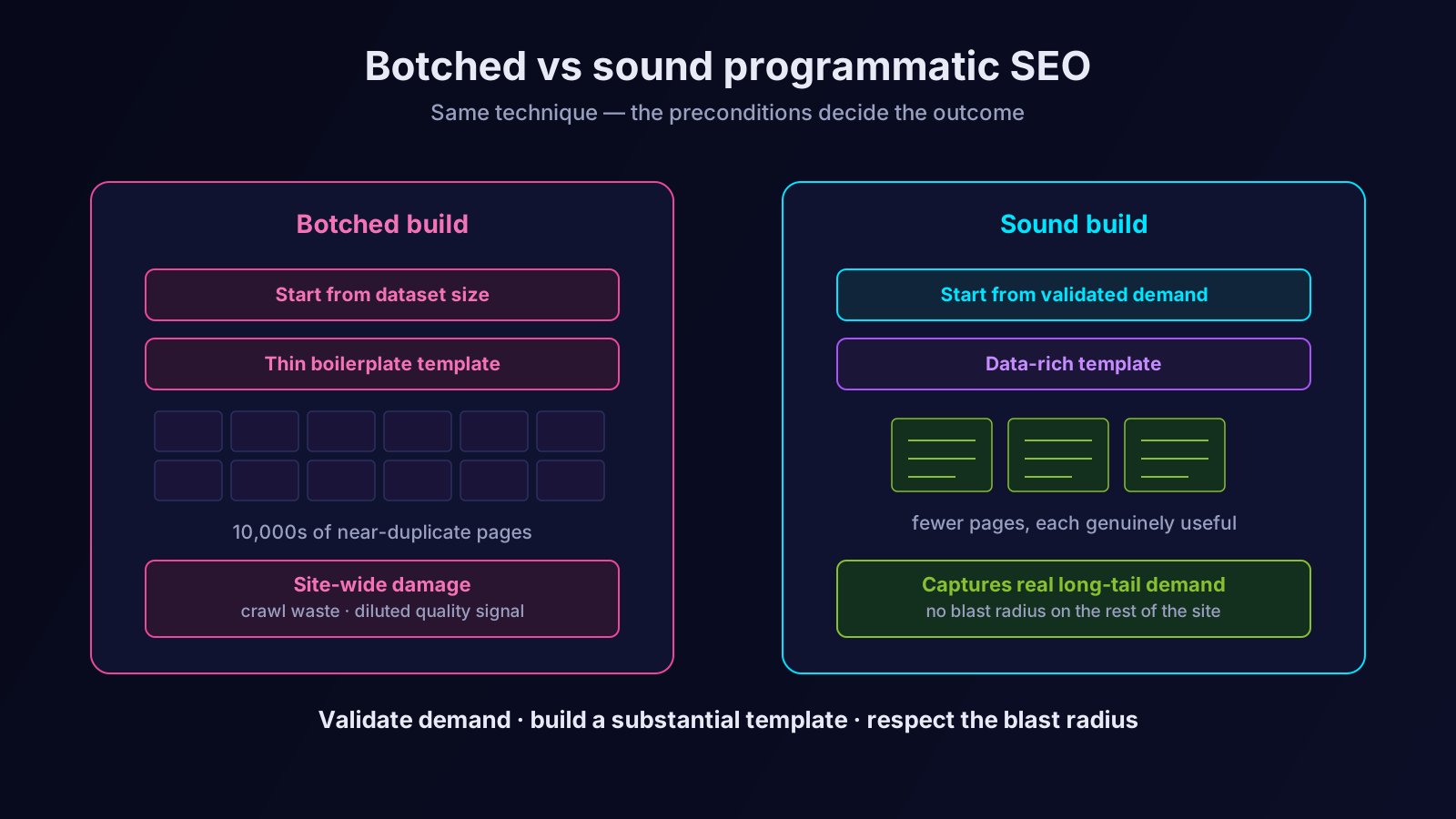
The discipline the hype omits is brutal and unglamorous: programmatic SEO must start from validated demand, not from dataset size. Before generating a single page you have to establish that the query pattern has real search volume across a meaningful share of its values. Often this means generating far fewer pages than the dataset technically permits — only the values where demand genuinely exists. That is the correct outcome. A focused programmatic build of two thousand demand-validated pages beats a sprawl of fifty thousand speculative ones, every time. The number of rows in your spreadsheet is not a target. It is a temptation.
Botch number two: the thin-page template
The "it's easy" misconception produces the second failure, and it is about the template itself. A programmatic page is only as good as its template, because the template is the page — repeated. If the template is thin, you have not built one thin page. You have built a thin-page machine, and then run it ten thousand times.
The classic botched template wraps a small dataset value in a large quantity of boilerplate. The same intro paragraph, the same headings, the same surrounding text on every page, with only a name, a number, and a couple of fields swapped in. To a reader — and to a search engine assessing the page — these are near-duplicate pages offering almost nothing. Generating ten thousand of them does not produce ten thousand assets. It produces ten thousand instances of the same thin page wearing different labels.
A programmatic template is not a page you write once. It is a page you write ten thousand times simultaneously. Every weakness in it is published at scale.
The hard, hidden work is making the template genuinely substantial at every value — which means the underlying dataset has to be rich enough that each generated page carries real, specific, useful information unique to its value, not boilerplate with the value sprinkled in. That is difficult. It is the actual work of programmatic SEO, and it is precisely the work the "template plus spreadsheet, easy weekend" pitch pretends does not exist.
Botch number three: ignoring the site-wide blast radius
The "low-risk" misconception produces the third and most serious failure, because it is the one that does damage beyond the programmatic pages themselves.
Here is what the harmless-failure story misses. When you inject ten thousand thin, near-duplicate pages into a website, they do not sit quietly in a corner failing to rank. They become part of the site. Search engines crawl them, spending crawl budget that your genuinely valuable pages needed. They become part of how the site's overall quality is assessed — and a site that is mostly thin programmatic pages can find its quality signal dragged down as a whole. They can trip duplicate-content and low-value-content evaluations that color the engine's read of the entire domain.
In other words, a botched programmatic build is not a contained failure. Its blast radius is the whole site. Pages that had nothing to do with the programmatic project can lose rankings because the project diluted the domain around them. This is the risk the hype most needs you not to think about, because "you might harm the site you already have" is a far less shareable message than "generate ten thousand pages this weekend." It is also the true risk profile of the technique.
When programmatic SEO is the right call
A fair critique has to say when the technique is correct, because it genuinely often is. Programmatic SEO is the right tool when several conditions hold together: there is a query pattern with real, distributed search demand across many of its values; you have access to a dataset rich and accurate enough that each page can carry substantial unique information; and the resulting pages genuinely serve the searcher better than a generic page would. The big marketplaces and travel and data sites use programmatic SEO well because they meet exactly these conditions — they have proprietary, rich data and they serve query patterns with massive distributed demand.
Programmatic SEO is the wrong tool when those conditions do not hold — when the demand is speculative, when the dataset is thin, when the only thing scaling is boilerplate. The technique does not adapt to a weak case. It just amplifies it. Choosing it well is a judgement call about your specific demand and your specific data, and that judgement is the part the cheat-code framing erases entirely.
Programmatic and editorial are not rivals
One more piece of hype to puncture: the implied framing that programmatic SEO is a replacement for the slow editorial kind — why write articles one by one when you can generate thousands? That framing is a category error. The two approaches answer different query shapes and belong together.
Programmatic SEO handles repetitive, structured query patterns where the value is data delivered consistently at scale. Editorial content handles queries that need genuine explanation, real experience, judgement, and a differentiated point of view — exactly the things a template cannot carry. A mature site uses both: programmatic pages for the structured long tail, editorial pages for everything that needs a human mind behind it. A team that has been sold programmatic SEO as a way to stop writing has been sold a misunderstanding of what it is for. For the editorial side of that pairing, our practical content-planning workflow covers the work programmatic generation cannot do.
The maintenance cost nobody budgets for
There is one more thing the cheat-code framing omits, and it is the cost that arrives after launch. A programmatic build is not a project you finish. It is a system you now own, and systems have ongoing costs.
Consider what changes underneath a programmatic site over time. The dataset goes stale — prices, availability, statistics, and facts that were accurate at generation drift out of date, and now you have ten thousand pages quietly displaying wrong information. The query patterns shift; demand that justified a set of pages a year ago may have moved. The template itself needs revision as design standards and search expectations evolve, and revising a template means regenerating, or at least re-checking, every page built from it. Pages that stopped earning their place need to be identified and pruned, because a programmatic build, left untended, slowly accumulates the same dead weight any content archive does.
None of this is in the conference talk. The talk ends at "generate ten thousand pages," as if generation were the finish line. It is the starting line. A team that launches a programmatic build without budgeting for its maintenance has not completed a project — it has adopted a liability that will look fine for a few months and then begin to decay, page by page, into exactly the thin, stale sprawl that drags a domain down. Factor the maintenance in before you launch, or do not launch.
The metric trap of page count
A final critique, aimed at how programmatic builds get reported internally, because the reporting habit drives the bad behaviour. Programmatic SEO produces one number that is irresistibly easy to cite: pages published. "We launched forty thousand pages this quarter" is a sentence that sounds enormous, and it travels well in a status update.
It is also, on its own, meaningless — and worse than meaningless, because it actively rewards the botched version of the technique. The team that validated demand carefully and generated three thousand substantial pages has a smaller, less impressive number than the team that scaled a thin template to forty thousand. If page count is the metric, the disciplined team looks like the underachiever. The incentive points exactly the wrong way.
The honest metrics for a programmatic build are the same as for any content: how many of the pages actually rank, how much qualified traffic they bring, and whether that traffic does anything of value. Reported that way, a focused build almost always beats a sprawling one, and the incentive points back toward discipline. As long as a programmatic project is judged by how many pages it produced, it will keep being botched — not out of carelessness, but because the scoreboard is rewarding the botch.
The honest summary
So: programmatic SEO is powerful — it can capture a surface of demand no manual effort could reach. It is overhyped — sold as easy, low-risk, and a pure volume play when it is none of those. And it is easy to botch — the three botches above (unvalidated demand, thin templates, ignored blast radius) are not edge cases; they are the default outcome of attempting the technique the way it is usually pitched.
The corrective is not to avoid programmatic SEO. It is to refuse the cheat-code story and treat it as what it actually is: a serious technique with strict preconditions, real hidden work, and genuine downside risk. Validate demand before generating. Build a template rich enough to be substantial at every value. Respect the site-wide blast radius. Do those things and the power is real. Skip them — as the hype invites you to — and you have built an efficient machine for harming your own site.
Where an AI agent fits
It is worth being clear about how AI relates to all of this, because AI is making the botch easier to commit. The "generate ten thousand pages" pitch is far more tempting now that generating the text is nearly free — which means the demand-validation and quality discipline this critique argues for is more important than ever, not less.
Used well, an SEO AI agent supports exactly that discipline. Orova can do the unglamorous, decisive work the hype skips: testing whether a query pattern has real, distributed demand before any pages are generated, identifying which values are worth a page and which are not, and assessing whether the resulting pages would genuinely serve searchers or merely add thin pages to the domain. The point of the technique was never to publish the most pages. It was to capture real demand with pages that deserve to exist — and that is the standard a serious agent should be helping you hold, not the page count.
Let an AI Agent handle your SEO
Orova plans, writes, optimizes, and tracks rankings on its own — you just read the results.
Try it free