
The Content Quality Bar AI Still Has to Clear
Most conversations about AI content quality stall in the same place. One side says AI writing is fine now, indistinguishable from human work. The other side says it is hollow and obvious. Both are arguing about a single, mushy variable — "is it good?" — and a single variable cannot resolve a question this layered. The more useful move is to stop treating quality as one thing and break it into its components, then ask, for each component separately, how reliably AI clears the bar.
That is the project of this article: a structured breakdown of what "quality" actually decomposes into for a piece of content, and an honest, component-by-component assessment of where AI is already reliable, where it is unreliable, and where it essentially cannot help at all. The point is not to score AI. The point is to know, precisely, which parts of the quality bar you can delegate and which parts you still have to clear yourself.
Quality is not one bar — it is five
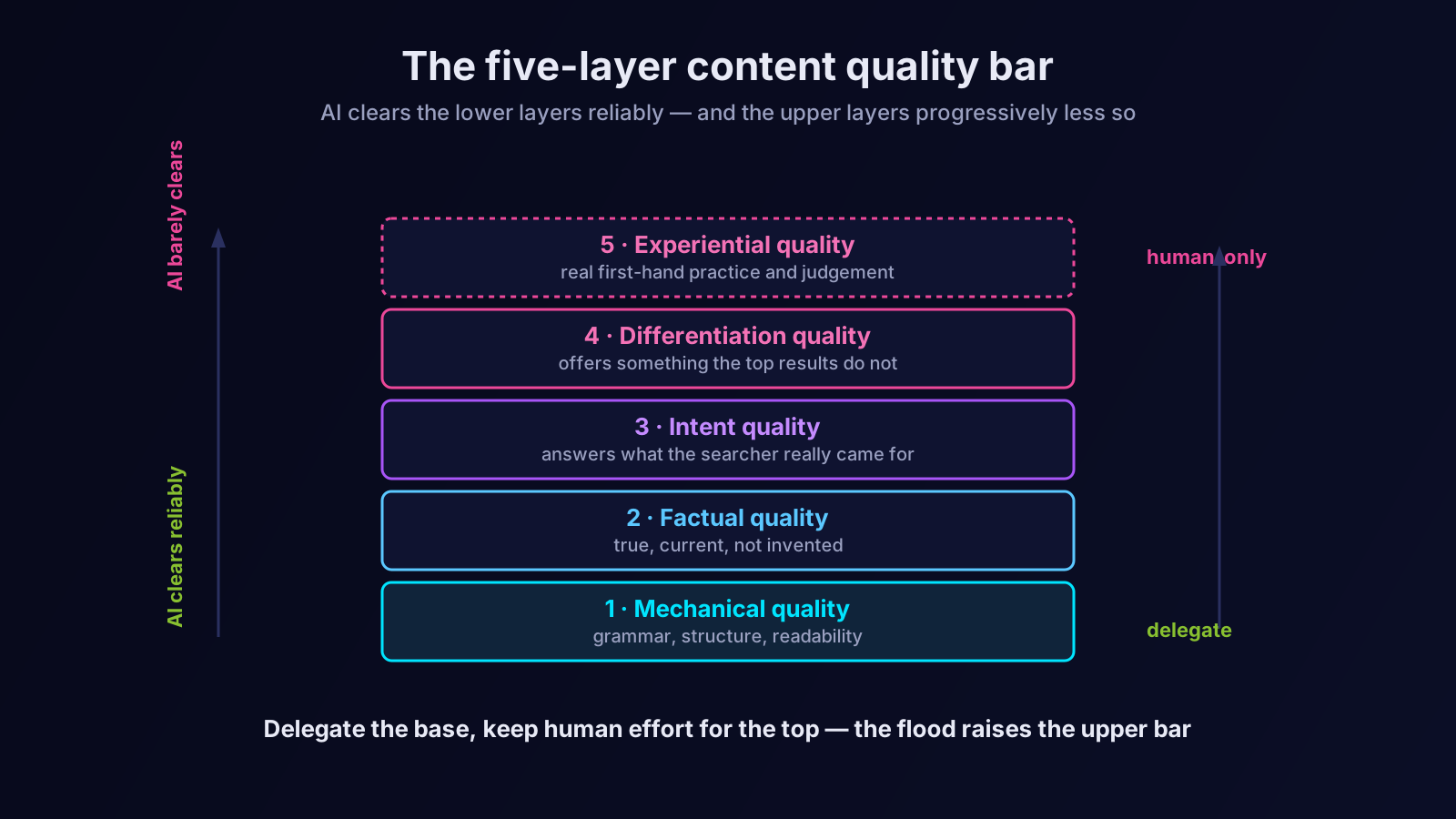
When an editor says a draft "isn't good enough," they are compressing at least five distinct judgements into one verdict. Pulled apart, the quality bar has five separable layers, and they are worth naming because AI's competence varies enormously across them:
- Mechanical quality — grammar, spelling, sentence construction, readability, structural cleanliness.
- Factual quality — whether the claims are true, current, and not invented.
- Intent quality — whether the piece actually answers what the searcher came to resolve.
- Differentiation quality — whether it offers something the existing top results do not.
- Experiential quality — whether it carries genuine first-hand knowledge: real practice, real consequences, real judgement earned by doing the thing.
A page can be flawless on one layer and bankrupt on another. That is precisely why the flat question "is it good?" produces such unproductive arguments. Take the layers in order, from the one AI clears most easily to the one it clears least.
Layer one: mechanical quality — effectively solved
This is the layer where the AI-optimists are simply right, and there is no use pretending otherwise. Modern language models produce prose that is grammatically clean, correctly spelled, structurally orderly, and easy to read. On the mechanical layer, AI does not merely clear the bar — it clears it more consistently than the average human writer working at speed, and far more consistently than a tired one at the end of a long brief.
The analytical point here is a warning, not a celebration. Mechanical quality used to be a reasonable proxy for overall quality. If a piece was clean, well-structured, and readable, that fluency usually correlated with a writer who had also done the thinking. That correlation is now broken. AI delivers the fluency for free, decoupled from any of the deeper layers. A draft can read beautifully and be factually wrong, intent-blind, undifferentiated, and experientially empty. So the first consequence of the breakdown is this: stop reading mechanical polish as evidence of quality. It is no longer evidence of anything except that a competent tool was used.
Layer two: factual quality — unreliable, and confidently so
Here the picture turns. AI models generate fluent text by predicting plausible continuations, and "plausible" is not "true." They will state a date, a definition, a statistic, or an attribution with total grammatical confidence and no underlying verification. Sometimes it is correct. Sometimes it is subtly, dangerously wrong. And critically, the writing gives no signal which is which — the false claim is delivered in exactly the same assured tone as the true one.
This is the layer most damaging to SEO content specifically. A search engine's whole project is to surface trustworthy information; a page riddled with confident inaccuracy is the precise opposite of what it wants to rank, and the inaccuracy also quietly destroys reader trust in everything else on the page. The analytical conclusion is firm: factual quality cannot be delegated. AI can draft the claims, but every factual assertion — every figure, date, name, definition, and "studies show" — has to be verified by a human or against a real source before publication. This is not optional polish. It is the load-bearing checkpoint of the whole pipeline.
Layer three: intent quality — partial, and improving
Intent quality asks whether the piece resolves what the searcher actually wanted. AI is moderately good here and getting better, with a specific and predictable failure mode worth understanding.
Give a model a clear, well-scoped instruction — "explain X to a beginner," "compare A and B for a buyer deciding between them" — and it generally produces something that addresses that instruction. Where it fails is on the unstated half of intent. A searcher querying "how to do X" may, beneath the surface, actually need to know whether they should do X at all, or which of three versions of X applies to their situation. A human writer with domain experience reads that subtext from the query and the wider context. AI tends to answer the literal question and miss the real one. The practical implication: intent quality is best protected upstream, in the brief. If the brief carries an accurate, experienced reading of search intent, AI will usually execute against it competently. If the brief is thin, AI will faithfully produce a piece that answers the wrong question fluently. The judgement still has to come from a human; AI executes it well once it exists. Our workflow for turning keywords into a content plan covers how to capture that intent reading before drafting begins.
Layer four: differentiation quality — structurally weak
Differentiation asks: does this page offer something the current top results do not? This is where AI faces not a temporary limitation but a structural one, and the structure is worth understanding because it will not simply improve with the next model release.
A language model is trained on what already exists. Its competence — its fluency, its instinct for what to say about a topic — is a sophisticated synthesis of the consensus it absorbed in training. Ask it to write about a well-covered subject and it will produce, with great smoothness, the average of everything already written about that subject. That is not a flaw in the implementation; it is the nature of the technology. And the "average of everything already written" is, by definition, the one thing a differentiated page cannot be.
An AI draft on a familiar topic is not a bad page. It is an extraordinarily competent restatement of the existing page-one consensus — which is exactly what a reader who already found page one does not need.
So differentiation has to be supplied from outside the model: a genuine opinion, a contrarian read, a fresh framework, proprietary data, a real case, a structural rethink of the topic. AI can take a differentiating angle and express it superbly. It cannot reliably originate one. On this layer the bar is not "verify what the model produced" but "bring something the model could not have." That something is a human contribution, and there is currently no automating it.
Layer five: experiential quality — essentially uncleared
The top layer is the one AI cannot clear at all, and the reason is not about model capability. It is about the world.
Experiential quality is the texture of having actually done the thing: the mistake you only learn by making it, the number that came out of your own account rather than a benchmark, the judgement call that has a scar behind it, the specific detail no synthesis of public text contains because it never entered public text. Search engines have spent years signalling — through the language of experience, expertise, authority, and trust — that they want exactly this. They want to know a real practitioner stood behind the page.
AI has no experiences. It can produce text in the register of experience — "in my years of doing this, I've found..." — but that is a stylistic imitation with nothing underneath, and discerning readers, increasingly, feel the hollowness even when they cannot name it. This layer is not delegable in any form. It is the human contribution in its purest state. The implication for a pipeline that uses AI is direct: AI handles the layers below, which frees human effort upward — toward verification, toward the intent and differentiation judgements, and above all toward injecting the real experience that is the one thing a model fundamentally cannot fake.
Reading the breakdown as an operating model
Lay the five layers out and a clear operating model appears, almost by itself. AI is genuinely strong at the bottom of the stack and genuinely weak at the top — and the sensible response is to divide labour along exactly that gradient.
Let AI carry the lower layers it clears reliably: mechanical execution, structural drafting, and intent execution against a well-built brief. Spend human attention on the upper layers it cannot: verifying every fact, supplying the differentiating angle, and embedding the lived experience. This is not a compromise position between the optimists and the pessimists. It is the resolution of their argument. The optimists are describing the bottom of the stack. The pessimists are describing the top. Both are looking at a real thing; they were just never looking at the same layer.
A team that internalises this stops asking "can AI write our content?" — a question with no useful answer — and starts asking "which layer is this checkpoint protecting, and who is the right party to clear it?" That is a question a process can actually be built around.
The bar that is rising while you read this
One more analytical point, because it changes the stakes. The quality bar is not fixed. It is rising, and AI itself is the reason it is rising.
As AI makes the lower layers cheap and abundant, mechanically clean and consensus-summarising content floods every results page. When that content is everywhere, it stops being a way to stand out and becomes the baseline — the minimum, the price of entry. Which means the layers that distinguish a page are migrating upward. Tomorrow's competitive bar is not "well-written and accurate." Those are table stakes. The bar is "well-written, accurate, and genuinely differentiated, and carrying real experience" — precisely the upper layers AI cannot clear on its own. The flood of AI content does not lower the quality bar. It raises it, by making everything below the top layers worthless as a differentiator.
The mistake of measuring the wrong layer
One practical consequence of the breakdown deserves its own treatment, because it explains a great deal of bad decision-making in content teams. Most quality-control processes inspect the layer that is easiest to inspect — and the layer that is easiest to inspect is the mechanical one.
It is genuinely easy to check whether a draft is grammatically clean, structurally orderly, and readable. A reviewer can do it quickly, and the verdict feels objective. So review processes gravitate toward exactly that check, and a draft that reads smoothly gets waved through as "quality content." This was always a slightly lazy way to assess content, but it used to be defensible, because mechanical fluency correlated with the deeper layers. Now that AI delivers mechanical fluency for free and decoupled from everything else, this review habit has become actively dangerous. A team can run a diligent-looking quality process that inspects only the one layer AI already aces, and publishes draft after draft that is mechanically perfect and bankrupt above the base.
The corrective is to design the review around the layers that are hard to inspect and easy to skip — factual verification, intent fit, differentiation, and experiential depth. Those checks are slower and feel more subjective, which is precisely why processes avoid them and precisely why they are the checks that now matter. A quality process that does not deliberately inspect the upper layers is not a quality process. It is a fluency process wearing a quality process's clothes.
Why the human layers cannot simply be added at the end
There is a tempting workflow that the breakdown quietly rules out, and it is worth naming so teams do not drift into it. The tempting workflow is: let AI produce the whole draft, then have a human "add the experience and the angle" at the end, like garnish on a finished plate.
It rarely works, and the reason is structural. The upper layers — differentiation and experiential quality — are not surface decoration that can be applied to a finished consensus draft. They are load-bearing. A genuine differentiating angle changes what the article argues, which changes its structure, which changes what each section needs to say. A real experience is not a sentence you sprinkle in; it reshapes the piece around itself. If you let AI build the entire consensus draft first and then try to inject the human layers, you are renovating a finished building — and you usually end up either doing a superficial job that fools nobody, or quietly rewriting most of the draft anyway.
The workable sequence is the reverse. The human layers come first, or at least early: decide the angle, identify the experience the piece will carry, and let those decisions shape the brief. Then AI executes the lower layers against a brief that already has the upper layers built into its bones. The division of labour is real, but it is a division across the structure of the work, not a relay race where the human runs the last leg. Build the differentiation in at the start, or you will pay to build the whole thing twice.
What this means for using AI well
The honest conclusion of the breakdown is neither dismissal nor hype. AI clears the lower layers of the quality bar reliably and the upper layers poorly — and a content operation should be designed around that exact contour, not around a vague hope that the tool is "good enough" or a blanket fear that it is not.
That is the design philosophy behind a serious SEO AI agent. Orova is built to take the layers it can genuinely carry — mechanical drafting, structural execution, intent execution against a well-formed brief — so that scarce human attention is freed for the layers only a human can clear: verifying every claim, choosing the differentiating angle, and supplying the real experience that the rising quality bar increasingly demands. Used that way, AI does not lower your quality bar to meet the machine. It lets you spend all of your human effort on the part of the bar that was always going to decide whether the page deserved to rank.
Let an AI Agent handle your SEO
Orova plans, writes, optimizes, and tracks rankings on its own — you just read the results.
Try it free