
How to Make AI Content Pass the "Was a Human Here?" Test
There is a quiet test that every piece of content now has to pass. A reader lands on the page, scans the first few sentences, and forms an instant verdict: was a human actually here? Not "was this written by a machine" — that is the wrong question, and a question nobody can reliably answer by looking. The real test is whether a thinking person was involved at all. Whether someone with judgment, context, and something to say shaped this page, or whether it was extruded and shipped. Readers run this test in under ten seconds, and so, increasingly, do the systems that decide what ranks.
This article breaks down that test analytically. It is not a guide to "humanising" AI text by swapping words or adding fake typos. It is an examination of what the human-presence signal actually consists of, why AI content so often fails it, and what genuine human involvement looks like when it is done properly. The goal is content that passes the test because a human really was here — not content disguised to look that way.
Reframing the question
Start by discarding the framing most people use. The common worry is "will Google detect that this is AI-written?" That framing is unhelpful for two reasons. First, Google has stated plainly that AI-assisted content is not against the rules; what it penalises is content created primarily to manipulate rankings rather than to help people, regardless of how it was produced. Second, reliable detection of AI text is, at the level of an individual well-edited page, not a solved problem — and building your strategy around evading a detector is building on sand.
The useful framing is different. The question is not "does this look AI-generated?" but "does this show evidence of a human mind?" Those are not the same thing. A page can be entirely AI-drafted and pass — if a knowledgeable human directed it, supplied real input, corrected it, and shaped it. A page can be entirely human-typed and fail — if the human had nothing to say and simply produced generic, sourceless prose. The presence of a human, not the absence of a machine, is what the test measures.
What the human-presence signal is made of
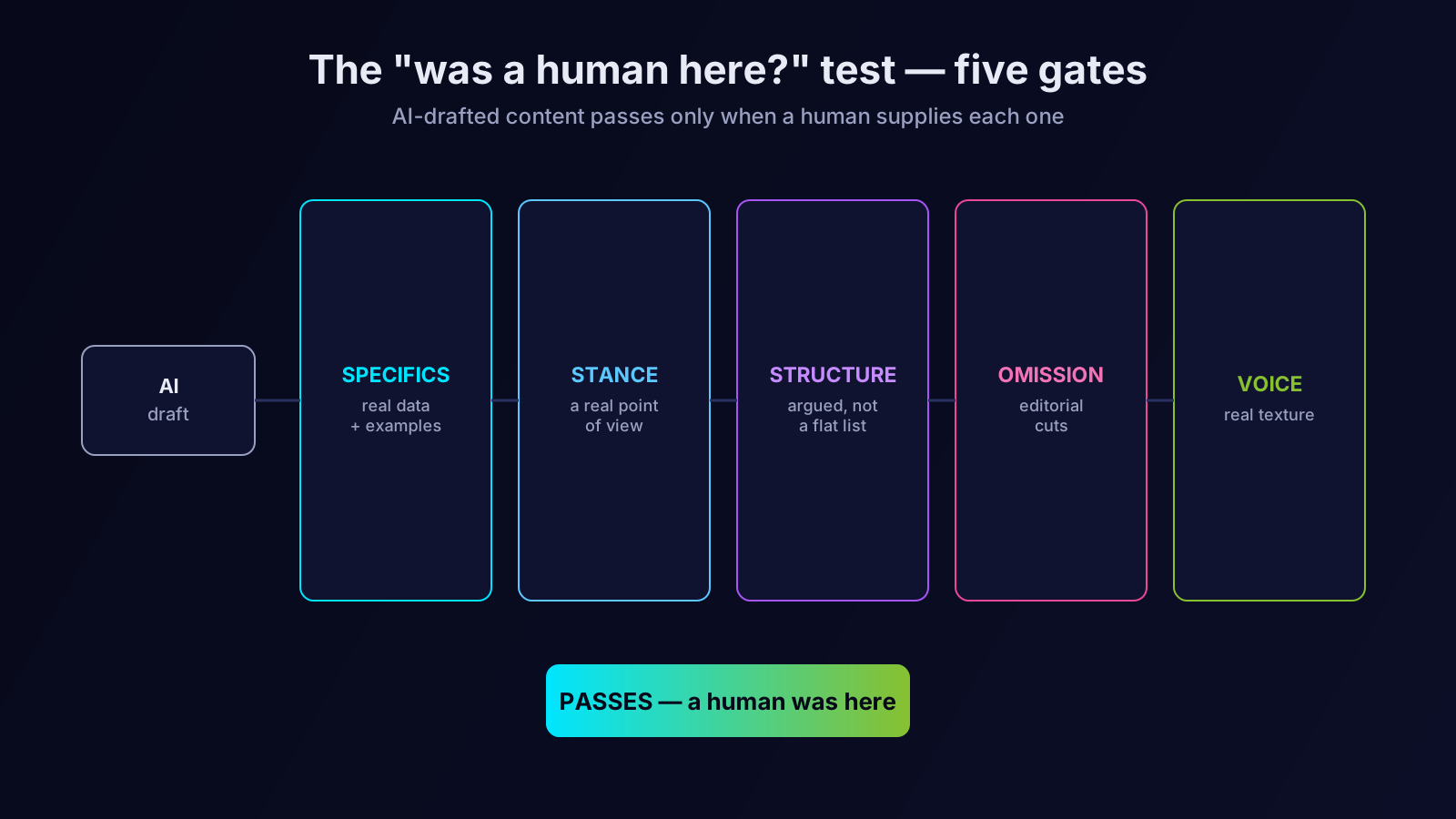
If "was a human here" is the test, we need to break it into the specific, observable things that constitute a pass. There are five, and they are worth examining one at a time.
Specificity that could not be guessed
The strongest single signal of human presence is specific information that a model could not have produced on its own. The exact number from your own data. The particular thing a client said. The step in a process where everyone gets stuck. The detail that contradicts the conventional wisdom. AI, working only from its training and a generic prompt, produces the average of everything ever written on a topic — accurate, fluent, and entirely unsurprising. A human who has actually done the work produces specifics. When a page is dense with non-obvious, verifiable specifics, a human was clearly involved, because nothing else could have supplied them.
A genuine point of view
Generic content is relentlessly even-handed because it has no stake in anything. It lists pros and cons, presents "both sides," and concludes that "it depends." A human who knows a subject has formed opinions. They will tell you that one common practice is a waste of time, that a popular tool is overrated, that the standard advice fails in a specific situation. A point of view is risky — it can be wrong, it can be disagreed with — and that risk is precisely why it reads as human. Machines, by default, are calibrated to avoid risk and therefore to avoid stance.
Structure that serves the argument
Default AI structure is a list of co-equal points. "Five ways to do X," each section roughly the same length, no section depending on another. Human thinking is rarely shaped like that. It builds — one idea sets up the next, an objection is raised and then answered, the order of the sections matters because the argument has a direction. When a page is organised as a reasoned progression rather than a flat enumeration, it signals that a mind, not a template, decided the shape.
Editorial judgment about what to leave out
One of the clearest fingerprints of human involvement is omission. AI tends to be exhaustive — it includes every subpoint, every caveat, every adjacent fact, because it has no sense of what the reader needs versus what merely could be said. A human editor cuts. They remove the section that does not earn its place, the caveat nobody needs, the throat-clearing introduction. A page that is shorter than it could have been, and tighter as a result, shows that someone exercised judgment about relevance — and judgment about relevance is irreducibly human.
Voice and the texture of real language
Generic content has a recognisable texture: smooth, balanced, slightly inflated, fond of certain transitions and certain hedges. It is the prose equivalent of a stock photo. Human writing has texture — a rhythm, a vocabulary, the occasional sharp sentence, a willingness to be plain. Voice is the hardest of the five signals to fake and the easiest to feel. It is not about quirks or deliberate imperfection. It is about the page sounding like it came from somewhere specific rather than from everywhere in general.
Why AI content fails the test by default
Understanding the five signals explains, almost mechanically, why so much AI content fails. A language model asked to "write an article about X" with no further input has nothing to be specific about, no stake to take a position from, no argument to structure around, no reason to omit anything, and no particular voice. It defaults to the centre of its training distribution. The result is fluent, correct, comprehensive, and completely absent of human presence — because, functionally, no human was present. The prompt was a vending-machine button, and the output is a vending-machine snack.
This is the crucial diagnosis. AI content fails the test not because of some detectable statistical signature in the words, but because the typical AI workflow removes the human from the loop. The failure is a process failure, not a technology failure. Which means the fix is also about process.
How AI content passes — the human's job
If the failure is the absent human, the solution is the present one. Passing the test is not about post-processing AI text to disguise it. It is about structuring the work so a knowledgeable human contributes the five things a model cannot. Concretely, that means the human does the following.
Before drafting, the human supplies the raw material the model lacks — the real data, the specific examples, the actual point of view, the argument the piece should make. A prompt that includes these produces a draft with human signal baked in. A prompt that omits them cannot.
After drafting, the human edits as an editor, not a proofreader. They check every claim for accuracy, because fluent text is fluently wrong as easily as fluently right. They cut what does not belong. They reorder sections so the argument builds. They sharpen the generic sentences into specific ones. They add the detail the model could not know. By the time they are finished, the page carries genuine human judgment on every screen — not because the AI was tricked into producing it, but because a human put it there.
This is more work than pressing generate and publishing the result. It is considerably less work than writing from a blank page. That trade — AI handles the draft and the structure, the human handles the judgment and the substance — is the workflow that passes the test reliably.
The ten-second scan and what it really judges
It is worth lingering on how fast the human-presence verdict is reached, because the speed reveals what is actually being measured. A reader does not parse your article. They do not weigh your arguments or check your sources in the first ten seconds. They glance — at the opening sentence, the shape of the page, the first subheading, perhaps the start of the second paragraph — and a verdict forms before any conscious evaluation has happened. This is pattern recognition, and it is fast because the patterns of cardboard are so familiar.
What the scan picks up is texture, not content. Does the opening sentence say something, or clear its throat? Does the page look like a flat list of equal blocks, or like an argument with a shape? Does the first paragraph contain a specific, or only generalities? The reader is not consciously running the five-signal checklist — but the signals are exactly what their pattern recognition is tuned to. A page that fails the scan has lost the reader before the substance ever gets a hearing. This is why the human signals cannot be an afterthought applied to the final paragraph. They have to be present from the first sentence, because the first sentence is most of what gets judged.
The practical consequence is about where you spend editorial attention. The opening, the subheadings, the first line of each section — these carry disproportionate weight, because they are what the scan samples. An article whose middle is excellent and whose opening is generic will be abandoned before the excellence is discovered. Front-load the evidence of a human. Put a specific in the first paragraph. Make the first subheading say something. Earn the rest of the reader's attention in the ten seconds you are actually given.
What does not make content human
Because the demand for "human-sounding" content is loud, a set of false solutions has grown up around it, and they are worth dismissing directly so you do not waste effort on them.
Inserting deliberate imperfections does not make content human. Adding a few casual phrases, a contraction here, a sentence fragment there, even a planted typo — none of this supplies any of the five signals. It is cosmetic. A page with folksy phrasing and no specifics, no stance, and no argued structure is still cardboard; it is cardboard wearing a friendly hat. Readers and ranking systems alike are responding to substance, and surface texture is not substance.
Running text through a "humaniser" tool does not make content human either. These tools paraphrase — they swap vocabulary and reshuffle sentence structure to alter the statistical fingerprint of the text. They change how the words are arranged. They cannot add a specific the author never knew, a position the author never took, or a cut the author never decided to make. They operate on the wrong layer entirely.
And padding does not make content human. Longer is not more human; often it is less, because length without substance just means more cardboard. The human signal is about density of judgment, not quantity of words. A tight eight-hundred-word piece dense with specifics and stance passes the test that a meandering three-thousand-word piece fails. The common error in all three false solutions is the same one: treating human presence as a property of the text's surface rather than a property of the thinking behind it.
The connection to E-E-A-T and rankings
The "was a human here" test is not a separate concern from search performance — it is the same concern in plainer language. Google's quality framework rewards content that demonstrates experience, expertise, and trustworthiness. Every one of the five human-presence signals is a way that experience and expertise become visible on the page. Specificity is experience showing its work. A point of view is expertise willing to be accountable. The test a reader runs in ten seconds and the test Google's systems run over time are looking for the same thing: evidence that a credible mind stood behind the words.
This also reframes the role of AI in a sound content workflow. AI is not the threat to quality; the unsupervised use of AI is. Used inside a process that keeps a knowledgeable human firmly in the loop, AI lets that human spend their limited time on the parts only they can do.
Where an AI agent fits
It may seem paradoxical to recommend an AI agent in an article about keeping humans in the loop, but the logic holds. The reason humans get squeezed out of content work is volume — there is more to research, draft, check, and maintain than the available hours allow, so corners get cut and the human contribution shrinks. An SEO AI agent attacks the volume problem so the human contribution can stay large where it counts.
Orova works as that agent: it handles the structured, repeatable load — research, first drafts, consistency checks, internal linking, surfacing pages whose facts have gone stale — and it does so in a way designed to leave the judgment work for a human. It is not a button that produces finished articles with no one present. It is a tool that clears away the mechanical effort so the person remains free to supply the specificity, the stance, and the editorial judgment that make content pass the only test that matters. Used that way, AI does not remove the human from the page. It makes sure the human's time is spent where their presence can actually be felt.
Let an AI Agent handle your SEO
Orova plans, writes, optimizes, and tracks rankings on its own — you just read the results.
Try it free