
Why Most AI Blog Posts Read Like Wet Cardboard

You know the feeling. You click a search result, start reading, and within two sentences a small part of your brain quietly switches off. The words are all there. The grammar is immaculate. The paragraphs are tidy little rectangles. And yet reading it feels like chewing a damp paper towel — technically food-adjacent, structurally intact, utterly without flavour. You have just encountered the modern AI blog post, and you are not imagining the texture. It really does read like wet cardboard, and there are specific, diagnosable reasons why.
This is a piece about those reasons. It is meant to be entertaining, because the wet-cardboard genre deserves a little mockery. But it is also genuinely useful, because once you can name why this content tastes of nothing, you can stop producing it — which, given that you are reading an SEO blog, is presumably the point.
Exhibit A: the introduction that introduces nothing
The wet-cardboard blog post almost always opens the same way. "In today's fast-paced digital landscape, businesses are constantly looking for ways to stay ahead of the competition." Read that sentence again. It contains five nouns and conveys zero information. It would be equally true of a blog post about email marketing, forklift maintenance, or competitive cheese rolling. It is not an introduction. It is a throat being cleared, at length, into a microphone.
The reason this happens is mechanical. A language model asked to write an introduction, with no specific angle handed to it, reaches for the safest possible opening — the statistical centre of every introduction it has ever seen. The centre of all introductions is, unsurprisingly, a beige paste of "in today's world" and "ever-evolving" and "now more than ever." A human writer with something to say opens with the thing they have to say. A model with nothing to say opens with the verbal equivalent of polite weather chat.
Exhibit B: the relentless tyranny of the list of five
Notice how many AI blog posts contain exactly five tips, five strategies, five mistakes, or five best practices. Not four. Not seven. Five. There is nothing sacred about the number five. The universe did not arrange its truths into convenient quintets. But the model, asked for "tips," produces a flat list, and a flat list of five feels safely substantial without being intimidating.
The deeper problem is not the number — it is the flatness. Each of the five points sits in its own little box, the same size as the others, connected to nothing. Point three does not build on point two. Point four does not complicate point three. There is no argument, no progression, no reason the points appear in this order rather than any other. It is less an article than a spice rack. A human who actually understands a subject writes content that goes somewhere — one idea leading to the next, a tension set up and then resolved. Wet cardboard does not go anywhere. It just lies there, in five equal pieces.
Exhibit C: the chronic, incurable both-sidesism
Ask the wet-cardboard post a direct question and watch it refuse, with enormous politeness, to answer. "Should you blog daily or weekly?" Well, it depends on your goals, your resources, your audience, and your industry. Daily posting has benefits, but also drawbacks. Weekly posting has benefits, but also drawbacks. Ultimately, the best approach is the one that works for you.
Thank you. Deeply illuminating. We have travelled eight hundred words to arrive precisely where we started, except now slightly bored.
This compulsive even-handedness is not balance — it is the absence of a stake. A model has no skin in the game, no client who suffered, no campaign that failed, no opinion that cost it anything. So it hedges everything, because hedging is risk-free and a real position is not. A human expert, by contrast, will look you in the eye and say "post weekly, daily is a trap for teams your size, here is why." That sentence could be wrong. That is exactly what makes it worth reading. Wet cardboard is never wrong because it never says anything, and never saying anything is its own, more boring kind of wrong.
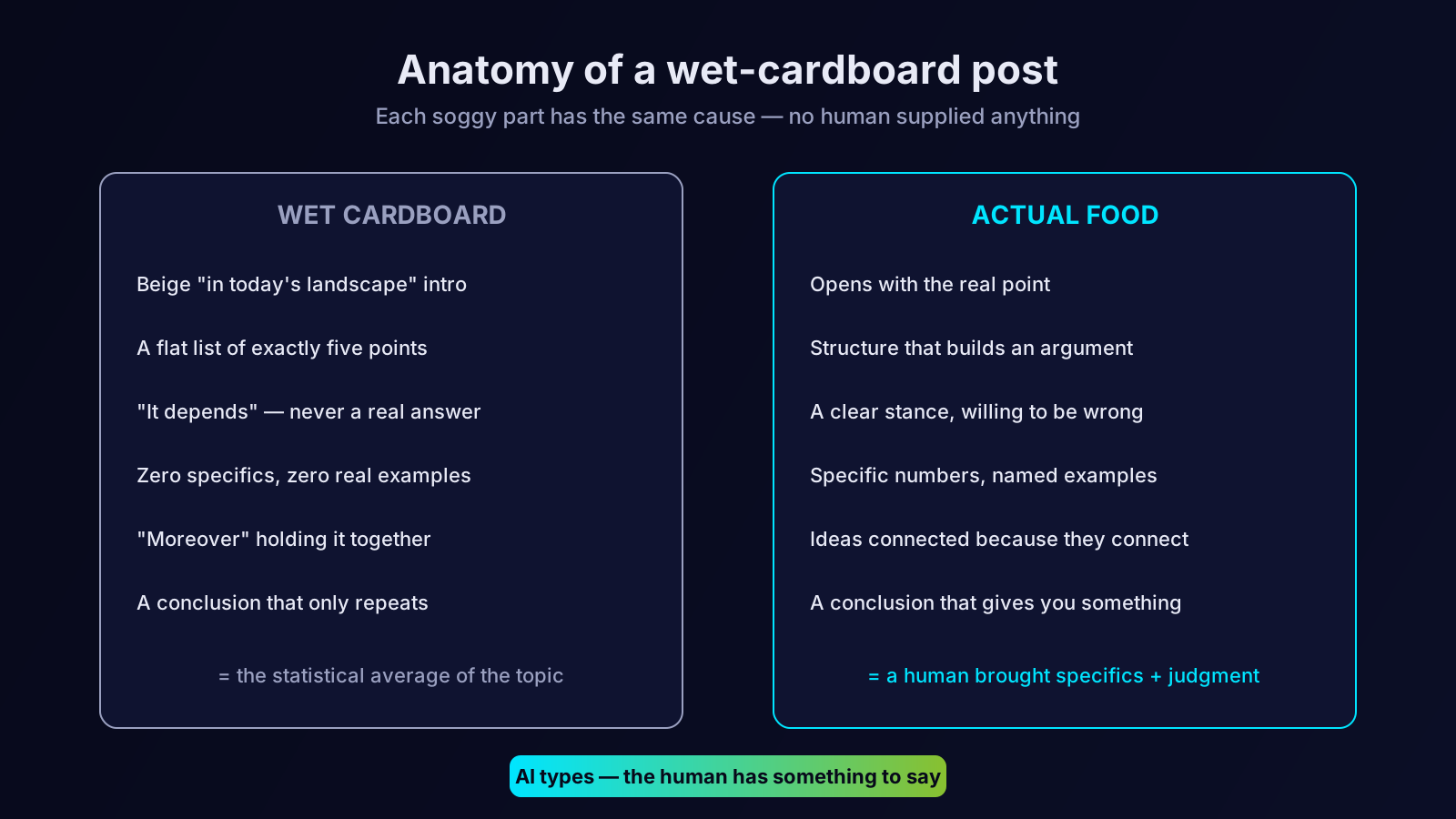
Exhibit D: the suspicious absence of any actual facts
Read a wet-cardboard post closely and notice what is missing: anything specific. There is no number that came from somewhere. No example with a real name. No moment where something went wrong. No detail that surprises you. Every sentence is true in the way that "water is wet" is true — accurate, agreed-upon, and completely useless.
This is the cardboard's defining flavourlessness. Specifics are where flavour lives. "Most teams struggle with consistency" is cardboard. "The team I worked with managed three posts in week one, then nothing for six weeks, because nobody owned the calendar" is food. The model produces the first kind because it is generating from the average of everything written on the topic, and the average of everything is, by definition, generic. The second kind requires a human who was actually there. No human, no specifics. No specifics, no flavour. Cardboard.
Exhibit E: the transitions assembled in a transition factory
"Furthermore." "Moreover." "It is important to note that." "In conclusion." The wet-cardboard post is held together with a small, sad set of industrial-grade connectives, applied like staples. They are not wrong, exactly. They are just lifeless — the prose equivalent of office carpet. Real writing connects ideas because the ideas are genuinely connected; you can feel one thought pulling the next along. Cardboard prose connects ideas because a connective word was structurally required at that point, so one was inserted. "Moreover" is doing the work that an actual logical relationship should be doing, and it is not strong enough to do it.
Exhibit F: the conclusion that concludes by repeating
And then, the grand finale. "In conclusion, blogging is an important part of any digital marketing strategy. By following the tips outlined above, you can improve your content and achieve your goals. Remember, consistency is key." The wet-cardboard conclusion does not conclude. It restates. It takes the thin gruel of the article and serves it to you a second time, lukewarm, in case you missed how thin it was the first time. A real conclusion leaves you with something — a sharpened point, a final twist, a call to actually do something. Cardboard leaves you with a summary of the cardboard.
Exhibit G: the headings that promise and the paragraphs that don't deliver
There is one more soggy fixture worth exhibiting. The wet-cardboard post often has perfectly serviceable subheadings — "Understanding the Basics," "Key Considerations," "Best Practices to Follow." You read the heading, mildly hopeful, and then the paragraph beneath it spends two hundred words restating the heading in longer words. "Understanding the basics is important. The basics form the foundation. Without a solid grasp of the basics, it can be difficult to progress." Yes. We are aware. We read the heading. It said "basics." We were promised understanding and delivered a definition of the word "basics."
This happens because the model treats a heading as a topic to be filled rather than a promise to be kept. A human writer uses a heading as a small contract: this section will tell you a specific thing. The cardboard post uses a heading as a label on an empty box. The tell is that you could delete the entire section and lose no information, because the heading already contained everything the section says. If a section can be replaced by its own title, that section is cardboard, and a reader's instinct to skim straight past it is entirely correct.
The cardboard tax nobody puts on the invoice
Here is the part that should worry anyone publishing this stuff. Wet-cardboard content is not free just because it was cheap to make. It carries a tax, and the tax is collected quietly.
The first instalment is the reader who bounces. They arrived with a question, sensed the cardboard within seconds, and left for a result that might actually feed them. That bounce is a vote, and enough votes are noticed. The second instalment is the trust you do not build. A reader who finishes a genuinely useful article remembers the source; a reader who escapes a flavourless one remembers nothing, or worse, remembers being bored by your brand. The third instalment is the opportunity cost — the same hours, spent on one genuinely good page instead of five soggy ones, would have produced an asset that compounds rather than five that quietly underperform forever.
And the fourth instalment is the slow one. Publish enough cardboard and it becomes the texture of your whole site. New visitors calibrate their expectations downward. The good page you eventually publish is read with the suspicion the cardboard earned. A site is judged in aggregate, and a pile of flavourless content drags down everything filed next to it. The invoice never arrives in one lump. It is just deducted, a little at a time, from every metric you care about.
The actual diagnosis, said plainly
Enough autopsy. Here is the cause of death, and it is the same for every exhibit above. Wet-cardboard content is what you get when a language model is asked to write something and a human supplies nothing. No angle, no data, no opinion, no examples, no editing — just "write a blog post about X," followed by "publish." The model, having nothing human to work with, produces the statistical average of the topic. And the statistical average of any topic is, necessarily, generic, flavourless, structureless, and stanceless. It is cardboard because it was made of nothing but other cardboard, blended.
This matters beyond aesthetics. Search engines are increasingly good at recognising content that demonstrates real experience and expertise versus content that demonstrates neither — it is the heart of how modern content quality is judged. Wet cardboard does not just bore readers. It signals, loudly, that nobody who knew anything was involved.
How to make content that is, in fact, food
The cure is not to ban AI. The cure is to stop asking AI to write from nothing. Hand it something to work with. Give it the real number, the actual example, the position you have decided to take, the structure the argument should follow. Then edit what comes back like an editor and not a spellchecker — cut the beige intro, demolish the both-sides hedge, replace the generic sentences with specific ones, throw out the conclusion that only repeats.
Do that, and the cardboard turns into something with texture. Not because you tricked a machine into sounding human, but because a human genuinely showed up — bringing the specifics, the stance, and the judgment that no model generates on its own. AI handled the typing. You handled the having-something-to-say. That division of labour is the entire difference between a meal and a moist napkin.
Where an AI agent comes in
Here is the part that sounds like a contradiction and is not. The reason humans stop showing up — the reason the cardboard gets published — is volume. There is more to research, draft, link, and maintain than the hours allow, so the human contribution gets squeezed until it disappears and the model is left writing from nothing. The fix for that is not less automation. It is better automation, aimed at the mechanical load so the human can stay in the room for the part that matters.
Orova works as that kind of SEO AI agent. It takes on the structured, repetitive effort — research, first drafts, internal linking, surfacing pages that have gone stale and bland — inside a workflow built to keep a human firmly in charge of the angle, the specifics, and the editorial cuts. The goal is not to generate more cardboard faster. It is to clear the busywork so you have the time and attention to make every page taste of something. Wet cardboard is a process failure. A better process — automation for the mechanics, humans for the judgment — is how you stop serving it.
Let an AI Agent handle your SEO
Orova plans, writes, optimizes, and tracks rankings on its own — you just read the results.
Try it free