
The AI Content Penalty Myth, Debunked With Evidence
One belief has shaped more content decisions in the last two years than almost any other: the conviction that Google penalises AI-generated content. It is repeated as settled fact in agency meetings, in LinkedIn posts, in the cautious internal policies of marketing teams that have quietly banned AI assistance "to be safe." It feels prudent. It feels like the responsible position. And it is, on close examination of the evidence, a myth — or at least a serious distortion of a more nuanced reality.
This article examines the AI content penalty claim the way a research question deserves to be examined: by looking at what Google has actually said, what its documented behaviour shows, what the observable patterns across the web suggest, and where the genuine kernel of truth inside the myth lies. No fabricated statistics, no invented case studies — just the publicly available evidence, read carefully.
What "penalty" actually means
Before testing the claim, define the term, because the word "penalty" is doing a lot of unexamined work. In SEO, a penalty has a specific meaning: a manual action, applied by a human reviewer at Google, that demotes or removes a site for violating guidelines, and that appears as a notification in Search Console. That is distinct from an algorithmic adjustment, where a site simply ranks lower because an updated algorithm assesses its content as less valuable than competitors'. No notification, no human reviewer, no flag — just a changed verdict.
This distinction is the crux of the whole debate. When people say "Google penalises AI content," they usually picture the first thing — a punitive flag triggered by detecting machine-written text. The evidence does not support that picture. It supports something closer to the second — and the difference is not pedantic. It changes what you should do.
The primary evidence: what Google has stated
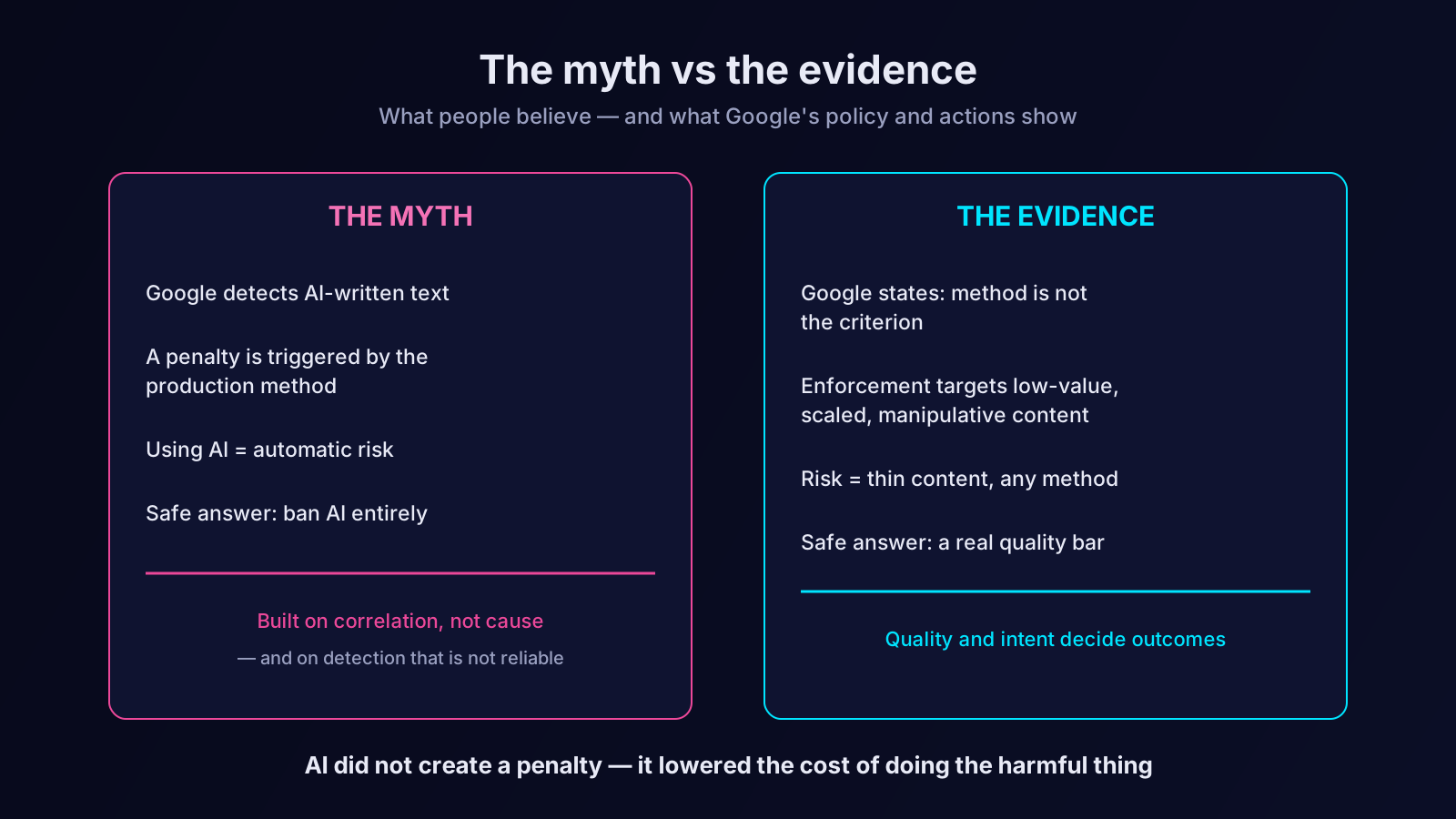
Start with the most direct evidence available — Google's own public position, stated repeatedly and in plain language. Google has said that it does not penalise content simply because it was produced with AI. Its guidance focuses on a different criterion entirely: the purpose behind the content. Content created primarily to manipulate search rankings — regardless of whether a human or a machine produced it — is what the guidelines target. Content created to genuinely help people is rewarded, again regardless of the production method.
This is not a leaked memo or an inference. It is Google's stated, on-the-record policy, expressed consistently across official documentation and public statements from its search team. A research-minded reader should weigh primary sources heavily, and the primary source here is unambiguous: the method of production is not the criterion. The intent and the quality are.
Could Google be saying one thing and doing another? It is a fair question, and it is why we should not stop at the official statement. But the burden of proof shifts. To believe in an AI-method penalty, you need evidence that contradicts a clear, repeated, official position. So look at the behavioural evidence.
The behavioural evidence: what Google's actions show
Two documented patterns are worth weighing. The first concerns AI-content detection itself. If Google operated a penalty triggered by detecting AI authorship, it would need reliable detection. Yet the broader evidence on AI text detection — across the entire field, not just Google — is that detecting well-edited AI-assisted text at the level of an individual page is unreliable. Detectors produce false positives on human writing and false negatives on machine writing. Building a punitive system on an unreliable trigger would punish human writers at random, which no rational search engine wants. The technical difficulty of reliable detection is itself evidence against a detection-based penalty.
The second pattern is more telling. Google's documented enforcement actions and major algorithm updates in recent years have repeatedly targeted a describable problem: large volumes of low-value content produced primarily to capture search traffic rather than to serve readers. The official framing of these efforts centres on scaled content abuse and unhelpful content — content at scale with little original value. Notice what the criterion is and is not. It is not "was AI used." It is "was a large amount of low-value, manipulation-focused content produced." A site can fall foul of that by mass-producing thin human-written articles. A site can stay clear of it while using AI extensively, if what it publishes is genuinely useful.
Read together, the behavioural evidence aligns with the stated policy. Google acts against low-value, manipulative content at scale. It does not act against the use of a particular drafting tool.
Why the myth is so persistent
If the evidence points one way, why does the myth survive? A research-minded look should explain the error, not just correct it. Several mechanisms keep it alive.
The first is a correlation mistaken for causation. When AI writing tools became widely accessible, many sites used them to do the obvious wrong thing — generate enormous volumes of generic articles fast. Some of those sites then lost rankings. Observers concluded "AI content was penalised." But the sites had two things in common, not one: they used AI, and they mass-produced low-value content. The second variable, not the first, matches Google's documented criterion. The AI was incidental — a faster way to do the harmful thing, not the harmful thing itself.
The second mechanism is the comfort of a simple rule. "Don't use AI" is an easy policy to state and enforce. "Don't produce low-value content at scale, regardless of method" requires judgment about what counts as low-value. Teams gravitate to the simple rule even when the evidence supports the nuanced one.
The third is the incentive structure of commentary. "Google will penalise your AI content" is a more alarming, more shareable claim than "Google evaluates content quality regardless of production method." Alarm travels. Nuance does not.
The kernel of truth inside the myth
Debunking a myth honestly means acknowledging what it gets right, because the AI content penalty myth is not pure fiction. It is a true observation wearing a false explanation.
The true observation is this: a great deal of AI-generated content does perform badly in search, and some of it has lost rankings dramatically. That part is real. The false explanation is that this happened because the content was AI-generated. The accurate explanation is that this content shared the actual disqualifying trait — it was low-value, generic, unsupervised, produced at scale to chase traffic — and AI simply made producing that kind of content cheaper and faster than ever before.
So AI did not create a new penalty. It dramatically lowered the cost of doing the thing that has always underperformed. The risk is real; the mechanism is misidentified. If you take away one sentence, take this: the danger is not the tool, it is the unsupervised, volume-first way the tool is most often used.
Testing the myth against its own predictions
A useful way to evaluate any claim is to ask what it predicts, then check whether reality matches. If Google operated a penalty triggered by detecting AI authorship, several specific things would have to be true. Examining each one is a fair test of the claim.
The myth predicts that AI-assisted content would lose rankings as a class — broadly, regardless of quality. That is not what is observed. A great deal of AI-assisted content ranks perfectly well, and has for some time, while a great deal of human-written content ranks poorly. Performance tracks quality far more closely than it tracks production method. If the method were the trigger, the pattern would be method-shaped. It is not; it is quality-shaped.
The myth predicts that Google would need, and would therefore have, reliable AI detection. But Google has not claimed to operate such detection as a ranking mechanism, and the wider evidence on detecting well-edited AI text is that it is unreliable. A penalty cannot be built on a trigger that fires at random. The absence of a reliable detector is a prediction the myth fails.
The myth predicts that careful, high-quality AI-assisted content would still be at risk simply for being AI-assisted. Yet Google's own guidance explicitly says appropriate use of AI is not against its policies, and points instead to quality and intent. An official statement directly contradicting the prediction is strong counter-evidence.
Finally, the myth predicts that the safe response is to avoid AI entirely. But sites that use AI well — inside a disciplined process — are not the ones losing rankings. The sites losing rankings are the ones publishing low-value content at scale, a group that includes plenty of all-human operations. The recommended "safe" behaviour does not correlate with the safety it promises. On every prediction it makes, the myth fails the test. A claim that fails every one of its own predictions is not a cautious position. It is simply wrong.
Why the distinction changes what you do
It would be easy to treat this as an academic correction — interesting, but without practical weight. It is not. Believing the wrong explanation leads to the wrong actions, and the costs are real.
A team that believes in a method penalty bans AI assistance. In doing so it discards a genuine productivity gain — faster research, faster drafting, faster maintenance — to guard against a risk that the evidence does not support. Meanwhile, because the team has misidentified the danger, it does not necessarily fix the thing that actually creates risk. It can ban AI and still publish thin, generic, human-typed content at volume, and that content is exposed exactly as before. The ban addressed a phantom and left the real exposure untouched.
A team that understands the real criterion does the opposite. It does not waste energy policing tools. It spends that energy policing value — ensuring every published page genuinely helps the reader it targets, refusing to mass-publish generic articles, keeping a knowledgeable human in the editorial loop. That team can use AI freely, because it has correctly located the risk and is managing the variable that matters. The distinction between "method penalty" and "quality criterion" is not a debating point. It is the difference between protecting yourself from an imaginary threat while ignoring a real one, and the reverse.
What the evidence means for your strategy
If the penalty-for-method myth is set aside, what does the evidence actually recommend?
It does not recommend banning AI assistance. A blanket ban discards a genuine productivity gain to protect against a risk the evidence does not support. It does recommend something more disciplined: use AI inside a process that guarantees quality, because quality — not method — is the real criterion. That means a knowledgeable human supplying real input and exercising real editorial judgment, every published page genuinely useful to the reader it targets, and no mass-publishing of generic articles whose only purpose is to catch a query. Content built that way is safe whether AI touched it or not. Content built the other way is at risk whether AI touched it or not. The variable that matters is value, and value is the variable you should manage.
This also reframes how AI belongs in a sound content workflow. The question is never "is AI allowed." It is "is our process producing genuinely valuable content." Get that process right and AI is an accelerant. Get it wrong and no production method saves you.
Where an AI agent fits
The evidence-based conclusion — quality and intent decide outcomes, not the tool — is exactly the principle a well-designed SEO AI agent is built around. The danger has never been AI assistance; it has been AI assistance without supervision, structure, or a quality bar. An agent designed correctly closes that gap rather than widening it.
Orova works as that agent. It does not mass-produce generic articles and hope; it operates inside a workflow that keeps a human in control of the judgment and the quality decisions, while it handles the structured, repeatable load — research, drafting, internal linking, and flagging pages that have drifted toward thinness. The aim is content that is safe by construction: genuinely useful, properly supervised, and indifferent to the production-method myth because it satisfies the criterion that actually matters. The AI content penalty, as commonly imagined, is not real. The quality bar is very real — and meeting it, consistently and at scale, is the problem worth solving.
Let an AI Agent handle your SEO
Orova plans, writes, optimizes, and tracks rankings on its own — you just read the results.
Try it free