
The Anatomy of a Content Brief That Actually Gets Used
There is a particular kind of document that gets created with great ceremony, attached to a task, and then never opened again. The content brief is often that document. A strategist spends a morning writing it, a writer skims the title and the word count, and the rest — the intent notes, the angle, the structure, the carefully gathered references — goes unread. The article that comes back bears little resemblance to the plan, the strategist rewrites half of it, and everyone privately concludes that briefs are a waste of time.
The conclusion is wrong. Briefs are not a waste of time. Bad briefs are a waste of time, and most briefs are bad — not because the people writing them are careless, but because nobody has ever told them what a brief is actually for. A brief is not paperwork. It is the single document that decides whether an article ranks, converts, and matches its strategy, or whether it drifts into a generic blog post that happens to share a title with the plan. This article breaks down the anatomy of a brief that gets used — every component, why it earns its place, and what happens when it is missing.
What a brief is actually for
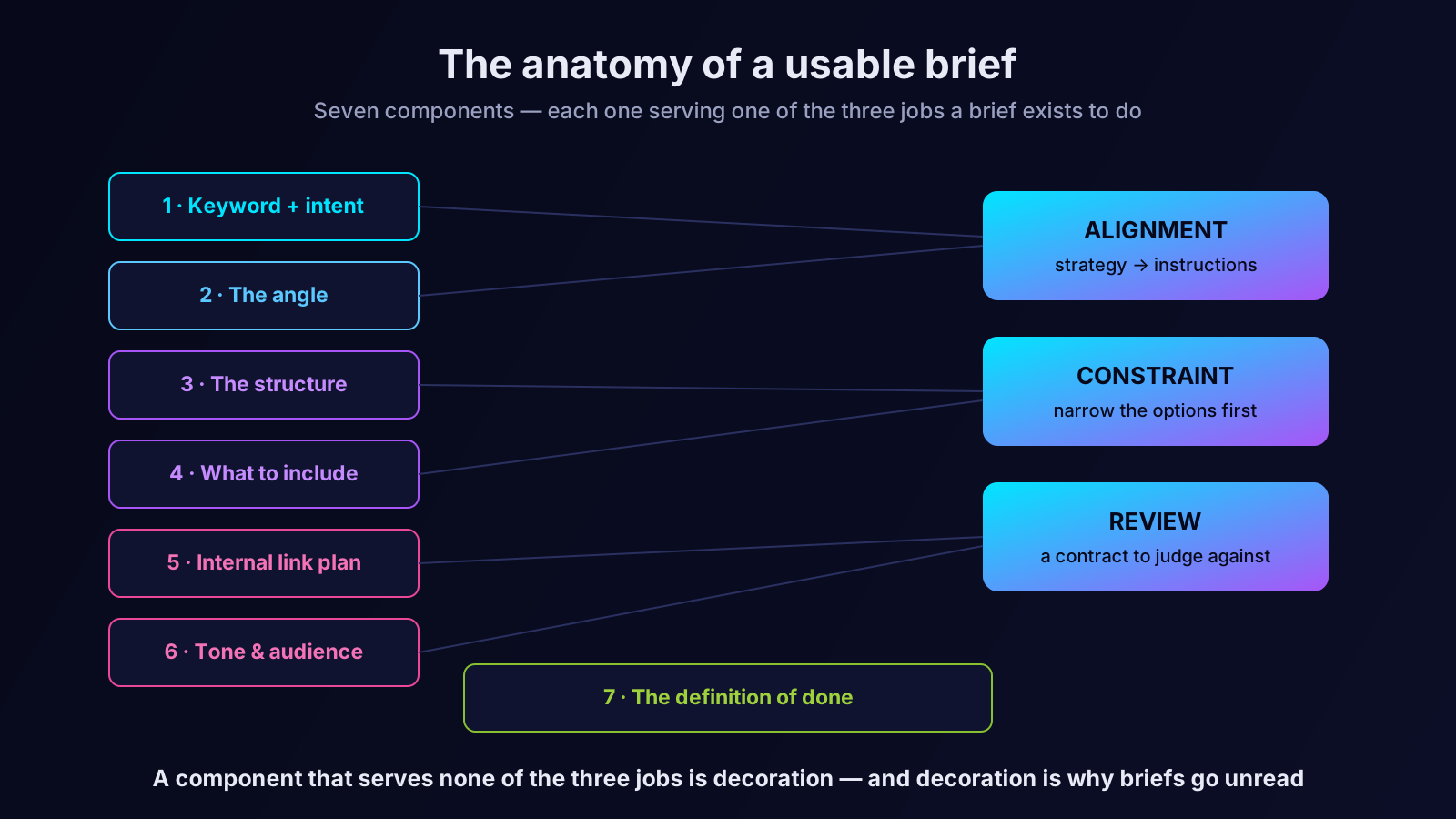
Before listing components, it helps to be precise about the job. A content brief has three jobs, and a brief that does all three is worth the hour it takes to write.
The first job is alignment. The brief is where the strategy — the keyword, the intent, the cluster, the position in the funnel — gets translated into instructions a writer can act on. Without it, the writer is guessing at the strategy, and a guess is right about half the time.
The second job is constraint. A good brief narrows the writer's options before they start. That sounds restrictive, and it is — deliberately. A writer staring at a blank page with a title and nothing else will produce something, but it will be shaped by their assumptions, not the strategy's intent. The brief removes the wrong directions so the writer can spend their energy on the right one.
The third job is review. A brief is the contract against which the draft is judged. When the draft comes back, the brief tells you whether it did the job — not "is this good writing" but "did this do what we agreed it would do." Without a brief, review collapses into taste, and taste-based review is slow, subjective, and demoralising for everyone.
Hold those three jobs in mind. Every component below exists to serve one of them. If a section of your brief template serves none of them, it is decoration, and decoration is exactly what makes writers stop reading briefs.
Component one: the target keyword and the intent behind it
Every brief starts with the keyword the article targets — but the keyword alone is not enough, and this is where most briefs already fail. A keyword is a string of words. Intent is what the person typing those words actually wants. The brief must state both.
Write the keyword, then write one plain sentence describing what someone searching it is trying to do. Are they trying to understand a concept? Solve a specific problem? Compare options before a purchase? Complete a task? The answer determines everything downstream — the format, the depth, the tone, the calls to action. An informational query answered with a sales pitch fails. A commercial query answered with a textbook chapter fails. The intent sentence is small, it takes thirty seconds to write, and it prevents the single most expensive mistake in content production. If your brief template has a keyword field but no intent field, add the intent field today. For more on reading intent correctly, our guide on turning keywords into a content plan covers the classification in depth.
Component two: the angle
The angle is the part of the brief that separates a forgettable article from a memorable one, and it is the part most briefs omit entirely.
For any given keyword, a dozen articles already exist. The reader's search results page is full of them. If your brief simply says "write an article about X," the writer will produce article number thirteen — competent, complete, and indistinguishable from the twelve above it. The angle is the brief's answer to the question: why would anyone read ours instead of one already ranking?
An angle might be a contrarian position, a specific point of view, a piece of original experience, a clearer structure, a sharper definition, a focus on a sub-audience everyone else ignores. It does not need to be revolutionary. It needs to be a deliberate choice rather than an accident. A brief that names the angle gives the writer something to build around. A brief that leaves the angle blank gets back whatever angle the writer happened to land on — which is usually no angle at all.
Component three: the structure
A usable brief includes a proposed outline — the H2 sections the article should cover, in order. This is the component writers value most and strategists most often skip, because it feels like doing the writer's job for them.
It is not. Outlining is a strategic act, not a writing act. The structure of an article determines whether it fully answers the query, whether it covers the sub-questions a searcher also has, whether it flows in an order that makes sense. Those are strategy decisions, and making them in the brief means the writer spends their time on prose rather than on guessing at organisation. It also makes review dramatically faster: when the draft arrives, you check it against the agreed structure instead of reverse-engineering whether the organisation was sound.
The outline does not need to be rigid. Tell the writer it is a starting point they can improve with reason. But give them the starting point. A brief without a structure section asks the writer to do strategic work disguised as writing work, and most will skip it.
Component four: what to include — facts, sources, points to cover
A good brief hands the writer the raw material they need so they are not starting from an empty page and a search bar.
This means the specific points the article must cover — the sub-questions a thorough piece should answer. It means any facts, definitions, or data the writer should use, with sources, so they are not inventing or half-remembering. It means links to the cluster pages this article should connect to, and the pillar it should link up to. It means examples or scenarios that would strengthen the piece. The more of this raw material the brief supplies, the less the writer improvises — and improvised research is where errors and thin coverage creep in. This component is also where you prevent the writer from accidentally duplicating an article you have already published.
Component five: the internal linking plan
Internal links are too important to leave to the writer's memory of what else exists on the site. The brief should name them explicitly.
List the pages this article should link to, with the reason for each link and a suggested anchor. List the pillar page it must connect up to. If existing articles should link down to this new one once it is published, note that too, so the linking gets done rather than forgotten. Writers cannot link to pages they do not know exist, and no writer holds the full site map in their head. The brief is where the linking strategy becomes concrete instructions. Skipping this component is how sites end up with hundreds of articles and almost no internal links between them — the single most common and most fixable structural weakness in content libraries. Our piece on internal linking strategy explains why this matters so much.
Component six: tone, audience, and constraints
The brief should describe who the article is for and how it should sound — briefly, but explicitly.
Who is the reader? A technical practitioner, a marketing generalist, an executive, a beginner? Their level determines how much you explain and how much you assume. How should the article sound — authoritative, conversational, plain, energetic? What should it avoid — jargon, hype, hedging, the clichés of the niche? Are there constraints: a word range, a required call to action, formatting rules, a deadline?
This component is short. A few sentences cover it. But without it, every writer applies their own default tone, and a blog assembled from a dozen writers' defaults reads like a dozen different companies. Consistency of voice is a strategy decision, and the brief is where it gets enforced.
Component seven: the definition of done
The final component is the one almost no brief includes, and it is the one that makes review fast and fair. State, explicitly, what a finished article must satisfy to be accepted.
This is a short checklist: the article fully answers the target intent, it follows the agreed structure or improves on it with reason, it includes the required internal links, it covers every must-include point, it matches the tone and audience, it stays within the word range, it has no unsupported claims. When the draft arrives, you run it against this list. The list turns review from a subjective verdict into an objective check, which makes it faster for the strategist and far less demoralising for the writer — feedback against an agreed standard is feedback they can act on, where feedback against unstated taste is just frustration.
The brief test: would a stranger produce the right article?
Here is a simple way to know whether your brief is good enough. Imagine handing it to a competent writer who knows nothing about your company, your strategy, or your previous conversations. Could they produce roughly the article you intended?
If yes, the brief is doing its job — the strategy is in the document, not in your head. If no — if the right article depends on context only you hold — then the brief is incomplete, and every gap will be filled by the writer's assumptions. The test exposes exactly which components are missing. A writer who produces the wrong angle was not given the angle. A writer who missed key points was not given the must-include list. A writer who linked to nothing was not given the linking plan.
Why most briefs go unread — and how to fix it
Even good briefs get ignored if they are unusable in a different way: too long, badly formatted, burying the important parts under preamble. A brief is a working document, not a report. It should be scannable. Clear headings for each component. The keyword and intent at the very top. The structure as an actual outline, not a paragraph describing an outline. The must-include points as a list, not a wall of prose.
If a writer has to read three paragraphs to find the angle, they will skip the angle. If the brief looks like an essay, it will be skimmed like an essay. Format the brief the way you want the writer to use it — as a reference they return to while writing, not a document they read once and abandon. The best briefs are denser and shorter than the worst ones.
Where an AI agent fits
Writing a complete brief — keyword and intent, a researched angle, a full structure, must-include points with sources, an internal linking plan, tone notes, a definition of done — is genuine work. Done well, it takes the better part of an hour per article. Across a content program producing dozens of articles a quarter, that is a serious, recurring cost, and it is the cost that tempts teams to cut briefs down to a title and a word count — which is exactly how briefs became useless in the first place.
This is structured, repeatable work built on research, which is what an SEO AI agent does well. Orova can draft a full brief for a target keyword — classifying the intent, analysing what already ranks to propose a distinct angle, building a structure from the sub-questions searchers actually ask, surfacing the internal links to existing pages on your site, and assembling the must-include points. What you receive is a complete brief to review and sharpen rather than build from an empty template. The anatomy in this article does not change. The agent simply removes the hour of assembly that makes teams skip the brief and pay for it later in rewrites.
A brief is not paperwork to be tolerated. It is the highest-leverage hour in your content process — the one document that decides whether an article does its job. Give it the seven components above, format it to be used, and test it against the stranger. Do that, and the brief stops being the document nobody opens and becomes the reason the article comes back right the first time.
Let an AI Agent handle your SEO
Orova plans, writes, optimizes, and tracks rankings on its own — you just read the results.
Try it free