
I Reviewed 100 Briefs — The Best Ones Did These 5 Things

Spend enough time around content teams and you start to notice that the quality of the published articles is downstream of something almost nobody looks at: the brief. Two writers of similar skill, given two briefs for similar keywords, will produce wildly different articles — and the difference tracks the briefs far more reliably than it tracks the writers. The article is, to a surprising degree, decided before anyone starts writing.
So we set out to study briefs directly. Over an extended period, working across content programs of different sizes and industries, we reviewed and compared a large set of content briefs — roughly a hundred — alongside the articles they produced and how those articles eventually performed. The aim was not to count anything precisely; it was to find the qualitative patterns. What did the briefs that consistently produced strong articles have in common, and what did the weak ones share? The honest finding is that brief quality varied enormously, that the variation was not random, and that the best briefs clustered around five recurring habits. This article walks through all five.
What we were actually looking at
A word on method, because it shapes what the findings can and cannot claim. We were not running a controlled experiment, and we will not pretend otherwise — there is no clean way to isolate a brief's effect from a writer's skill or a topic's difficulty. What we did was simpler and, for a practical purpose, more useful: we read briefs in bulk, alongside their outcomes, and looked for patterns that recurred often enough and strongly enough to be worth acting on.
The clearest pattern was the spread itself. Briefs were not uniformly mediocre with a few good ones; they ranged from near-useless — a title and a word count — to genuinely excellent documents that read like a strategy compressed into a page. And the excellent ones were not excellent in a hundred different ways. They shared a small, consistent set of habits. Those habits are the substance of this piece. Read them as observed patterns, not laws — but patterns consistent enough that we would not write a brief without them.
Habit one: the best briefs stated intent, not just the keyword
The most consistent divider between strong and weak briefs was also the simplest. Weak briefs named a target keyword and stopped. Strong briefs named the keyword and stated, in plain language, what the person searching it actually wanted.
This pattern was strikingly consistent. Across the briefs we reviewed, the ones that named the intent explicitly produced articles that matched what the searcher was looking for; the ones that named only the keyword produced articles that matched the keyword's surface and missed its intent — a how-to where readers wanted a definition, a definition where they wanted a comparison. The articles were not badly written. They were aimed at the wrong target, and the brief never gave them the right one.
The reason the pattern is so strong is that intent is the decision everything else depends on. Format, depth, tone, structure, calls to action — all of them follow from intent, and a writer who has not been told the intent infers it, with roughly the accuracy of a coin toss. The best briefs removed the guess. The intent statement is one sentence. It was, in our review, the single highest-return sentence in any brief. For more on classifying intent correctly, our guide on turning keywords into a content plan covers the distinctions in depth.
Habit two: the best briefs named a specific angle
The second pattern separated articles that were merely complete from articles that were worth reading. The strong briefs did not just say "cover this topic." They specified an angle — a particular take, a point of view, a reason this article would be different from the dozen already ranking.
Reading across the set, the difference in outcomes was visible. Briefs with no angle produced what we came to call "competent thirteenth articles" — accurate, thorough, and indistinguishable from the twelve results above them on the page. They tended to plateau: they ranked somewhere on the second page and stayed there, because there was no reason for a reader, a linker, or a search engine to prefer them. Briefs that named an angle produced articles with a discernible shape — a contrarian position, an original framework, a focus on a sub-audience others ignored — and those articles behaved differently. They earned links and citations more often, because people cite a point of view, not a summary.
The angle did not have to be dramatic. The pattern was not that the best briefs had brilliant angles; it was that they had deliberate ones. A modest, clearly chosen angle beat no angle every time. The weak briefs were not choosing a bad angle. They were leaving the choice to chance, and chance usually chose nothing.
Habit three: the best briefs included a real structure
The third pattern was about the outline. Weak briefs left structure to the writer — a keyword, an angle perhaps, and "you figure out the sections." Strong briefs included a proposed structure: the H2 sections, in order, that the article should cover.
Two effects showed up consistently in the articles that resulted. The first was completeness. Articles written from briefs with a real structure tended to cover the sub-questions a thorough piece should cover, because the structure had been built to include them. Articles written from structureless briefs more often had gaps — they answered the main question and missed the adjacent ones a reader also had, sending that reader back to search. The second effect was on revision. Articles from structured briefs came back closer to right and needed lighter editing; articles from structureless briefs frequently needed the most expensive kind of fix — structural rework after the prose was already written.
What the pattern revealed is that outlining is strategic work, and the strong briefs treated it as such. Leaving structure to the writer is not delegation; it is asking the writer to do strategy under the label of writing, and the results showed the cost. Our piece on structuring content into topic clusters explains why structure carries so much weight.
Habit four: the best briefs planned the internal links
The fourth pattern was one we almost missed, because its absence is so normal it looks like the default. Most briefs said nothing about internal links. The strong ones named them explicitly — which existing pages this article should link to, which pillar it should connect up to, and sometimes which existing articles should link down to it once published.
The pattern in outcomes was clear and a little stark. Articles from briefs with no linking instructions tended to be linking-poor — a couple of links if the writer happened to remember relevant pages, often none. Articles from briefs with an explicit linking plan were properly woven into their cluster. And the consequence compounds: a content library built one unlinked article at a time becomes, after a year, a pile of isolated pages — individually fine, collectively a missed opportunity. The strong briefs prevented that, one brief at a time, because they treated linking as an instruction rather than a hope.
The reason this habit matters is mundane and decisive: writers cannot link to pages they do not know exist, and no writer holds a full site map in their head. The brief is the only reliable place for the linking plan to live. Our guide on internal linking strategy goes deeper on why this is among the cheapest wins available.
Habit five: the best briefs defined what "done" meant
The fifth pattern was the rarest — present in only a minority even of the strong briefs — and where it appeared, it changed the whole production process. These briefs ended with an explicit definition of done: a short checklist stating what a finished article had to satisfy to be accepted.
The effect was less on the article and more on everything around it. Briefs with a definition of done were attached to review cycles that were faster and noticeably less fraught. Review against a checklist is an objective check — did it answer the intent, follow the structure, include the links, cover the must-have points, stay in the word range. Review without one collapses into taste, and taste-based review is slow, inconsistent between reviewers, and demoralising for writers, because the feedback feels like a verdict on them rather than a measure against an agreed bar.
The articles from these briefs also tended to need fewer revision rounds — not because the writers were better, but because they knew the target. A writer who can see the acceptance criteria writes toward them. A writer guessing at what the reviewer wants writes, submits, and waits to find out. The definition of done made the standard visible, and a visible standard is one a writer can actually hit.
The pattern behind the patterns
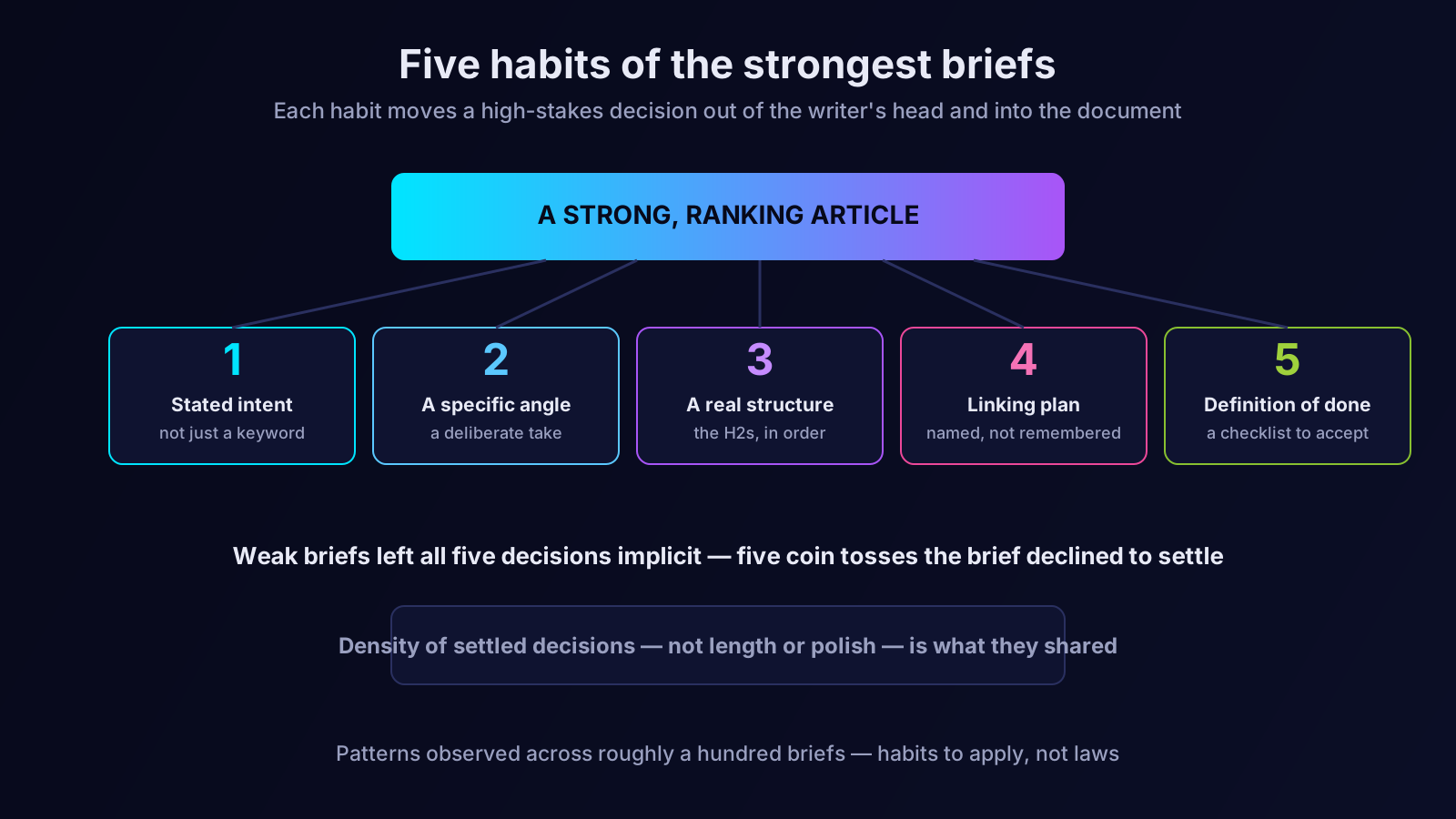
Step back from the five habits and a single principle connects them. Every one of them is an act of moving a decision out of the writer's head and into the document.
The intent statement moves the targeting decision into the brief. The angle moves the differentiation decision into the brief. The structure moves the organisation decision into the brief. The linking plan moves the connection decision into the brief. The definition of done moves the acceptance decision into the brief. Weak briefs, by contrast, left all five decisions implicit — to be made by the writer, mid-draft, by inference. And inference, repeated across five high-stakes decisions, is why the weak briefs produced such inconsistent articles. It was not the writers. It was five coin tosses the brief declined to settle.
This reframes what a brief is. It is not a description of an article to be written. It is the set of decisions that determine the article, made deliberately and in advance, by the person with the strategic context. The best briefs we reviewed were short — often shorter than the rambling weak ones — but every sentence settled something. That density of settled decisions, not length and not polish, was what the strong briefs had in common.
What this means for your next brief
The practical takeaway is not "write longer briefs." Several of the worst briefs we saw were long — long on preamble, context, and throat-clearing, short on decisions. The takeaway is to audit your brief against the five habits and ask, for each: is this decision settled in the document, or am I leaving the writer to make it alone?
Is the intent stated, or only the keyword? Is there a deliberate angle, or just a topic? Is there a real structure, or is the writer outlining from scratch? Are the internal links named, or left to memory? Is "done" defined, or will review be a matter of taste? A brief that can answer all five honestly is, in the pattern we observed, the kind of brief that produces strong articles repeatedly rather than occasionally.
Where an AI agent fits
The findings are clear, and so is their cost. A brief with all five habits — stated intent, a researched angle, a complete structure, a named linking plan, a definition of done — is real work, repeated for every article in a program. It is precisely the work that gets compressed, under deadline pressure, into the title-and-word-count brief that our review found at the weak end of the range. The habits are known. The discipline to apply them every time is the hard part.
This is structured, repeatable, research-backed work, which is what an SEO AI agent is built for. Orova can draft a brief that already carries the five habits — classifying the intent, analysing the ranking competitors to propose a distinct angle, building a structure from the sub-questions searchers ask, surfacing the internal links to existing pages on your site, and assembling a definition of done. You review and sharpen a complete brief rather than build one from an empty template under time pressure. The patterns in this study do not change. The agent removes the friction that, in practice, is the reason most briefs land at the weak end.
A hundred briefs taught one durable lesson: the article is largely decided before it is written, and the brief is where that deciding happens. The strong briefs were not longer or more polished — they were denser with settled decisions. Give your next brief the five habits, and you stop hoping for a good article and start engineering one.
Let an AI Agent handle your SEO
Orova plans, writes, optimizes, and tracks rankings on its own — you just read the results.
Try it free