
How to Outline an Article So It Ranks Before You Write It

Most writers treat the outline as a formality — a quick list of headings scribbled before the real work of writing begins. They get it slightly wrong, start writing anyway, and discover the structural problems three paragraphs from the end, when fixing them means rewriting half the article. The outline gets blamed for being useless. It was not useless. It was rushed.
Here is the claim this article will defend: the outline is where an article either earns its ranking or loses it, and that outcome is largely decided before a single sentence of prose is written. A well-built outline is not a list of headings. It is a model of how completely the article will answer a search query, and search engines reward completeness. Get the outline right and the article is most of the way to ranking. Get it wrong and no amount of polished writing rescues it. This piece breaks down how to build an outline that ranks — analytically, component by component — and why the structure decides the result.
Why structure is a ranking factor in disguise
Search engines do not have a metric called "good structure." But they have metrics that structure controls, and that makes the outline a ranking factor by proxy.
Consider what a search engine is trying to do: serve the result that most completely and most usefully satisfies the query. An article's structure is the clearest signal of how completely it covers a topic. An outline that addresses the main query and every reasonable sub-question covers the topic thoroughly. An outline that addresses the main query and stops covers it partially. The thorough article is the better result, and over time, the better result is what gets rewarded — through rankings, through the behaviour of satisfied readers who do not bounce back to the results page, through the article becoming the one others cite.
Structure also controls how a search engine reads the article. Headings tell it what each section covers. A logical heading hierarchy tells it how the sub-topics relate. A well-outlined article is legible to a machine; a badly outlined one, however well written, is a paragraph soup the engine has to guess its way through. The outline, then, is not preparation for the ranking work. It is the ranking work, done early, where it is cheap to change.
Step one: define the query and its real intent
An outline cannot be built in the abstract. It is built to answer a specific query, so the first analytical step is to state that query and the intent precisely.
Write the target keyword. Then write what the searcher actually wants — not the words they typed, but the goal behind them. Someone searching "content outline" might want a definition, a how-to, a template, or examples. Each goal demands a different article. Until the intent is pinned down, the outline has no target to aim at, and an outline aimed at nothing produces an article that satisfies nobody. This is the foundation; everything below is built on it.
Step two: surface every sub-question
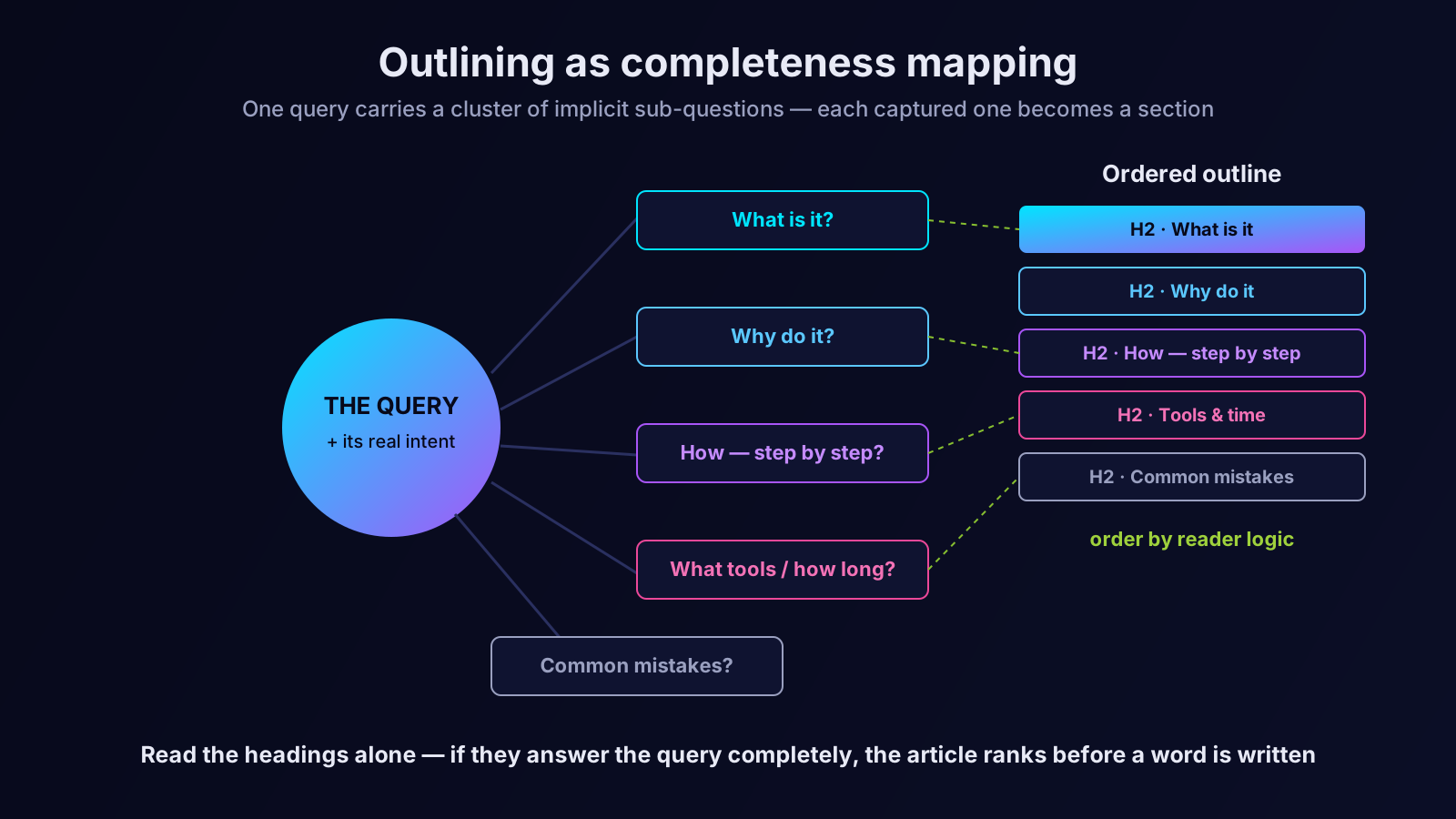
This is the analytical heart of outlining. A search query is never as simple as it looks — behind it sits a cluster of related questions the searcher also has, often without consciously listing them. The outline must surface those sub-questions, because each one that goes unanswered is a gap, and gaps are where completeness leaks away.
Take the query "how to do a content audit." The searcher's stated question is the procedure. But sit with it and the implicit questions appear: What is a content audit? Why do one? How often? What tools do I need? What do I do with the findings? How long does it take? What are the common mistakes? An article that answers only the stated question — the steps — is incomplete, even if the steps are excellent. The reader finishes with questions still open and goes back to search for them. An article whose outline anticipates and answers all of them sends the reader away satisfied.
The sub-questions come from the same free, observable sources every time: Google's "People Also Ask" boxes, autocomplete, the related searches at the foot of the results page, the actual structure of the articles currently ranking, and the questions your own audience asks. You are not guessing at what to cover. You are reading the demand directly and turning it into structure.
Step three: order the sections by reader logic
A complete set of sub-questions is not yet an outline. The sections need an order, and the order is an analytical decision, not a cosmetic one.
The principle is reader logic: arrange the sections in the sequence a reader needs them. Definitions and context come before procedures, because you cannot follow steps for a thing you do not understand. Foundational concepts come before advanced ones. Within a how-to, steps run in the order they are performed. The "what could go wrong" section comes after the "how to do it" section, because warnings are only meaningful once the reader knows what they are warning about.
Bad ordering does real damage. An article that explains advanced tactics before defining the basic concept loses the beginner in the first section. An article that buries the answer to the core query under six sections of preamble loses the impatient reader — and most readers are impatient. Good ordering means the reader can travel the article top to bottom and never feel lost or stalled. Search engines, reading the same article, see a logical progression rather than a jumble. Order is structure made coherent.
Step four: weight the sections
Not every section deserves equal space, and the outline is where you decide the proportions — before the writing, where rebalancing is free.
Mark, for each section, roughly how substantial it should be. The section that answers the core query deserves the most depth. A definition section can be brief. A "common mistakes" section might be a tight list. This weighting prevents the most common structural failure in drafts: an article that spends four hundred words on the introduction and definition, then rushes the actual answer into two thin paragraphs because the writer ran low on energy and word budget. When the outline assigns weight, the writer knows where to invest, and the article's depth lands where the reader's need is greatest rather than where the writer's enthusiasm happened to peak.
Step five: pin the headings to real language
The headings in the outline become the H2s in the article, and they do double duty: they organise the piece for the reader and they signal the topic to the search engine. So the headings should be written, in the outline, in the language searchers actually use.
A heading like "Implementation considerations" is vague to a reader and invisible to a search engine. A heading like "How to do a content audit step by step" is clear to both. Where a section answers a specific sub-question, phrasing the heading as that question is often the strongest choice — it matches how people search and it tells the engine exactly what the section delivers. Settle the headings in the outline. By the time the article is written, the writer should be filling in sections under headings that are already doing their structural and SEO work.
Step six: place the internal links
A ranking article is not a solo performer; it sits in a cluster, and the outline is where the connections to the rest of the cluster get planned rather than left to chance.
For each section, note where it should link out — to the pillar page the article supports, to sibling articles that cover an adjacent sub-topic in more depth, to related pieces a reader of this section would naturally want next. Planning links at the outline stage means they land where they make contextual sense, woven into the argument, rather than being bolted on at the end as an afterthought. It also means the article is built as a connected node from the start. Our guide on structuring content into topic clusters explains why a connected article outperforms an isolated one, and the outline is where that connection is designed in.
The test: does the outline answer the query without the prose?
Here is how to know an outline is finished. Read the headings, in order, as if they were the whole article. Do they, by themselves, constitute a complete and logical answer to the target query?
If yes, the article is structurally sound and the writing can begin with confidence — the prose now only has to deliver what the structure already promises. If no — if reading the headings leaves an obvious gap, an illogical jump, or an unanswered sub-question — then the outline is not done, and finishing it now costs minutes. Discovering the same gap after the article is written costs a rewrite. This test is the entire argument for taking outlining seriously: every structural problem is cheap to fix in the outline and expensive to fix in the draft.
The outline as a defence against scope creep
There is a second, less obvious benefit to a thorough outline, and it shows up not while you write but while you research. Without an outline, research has no boundary. You start reading around the topic, every source opens three more, and the article quietly swells — a tangent here, an interesting-but-irrelevant section there — until it is half again as long as it should be and the core answer is buried under material the searcher never asked for.
An outline is the boundary. Once the sections are agreed and weighted, anything you discover that does not fit a section is, by definition, out of scope for this article. That is not a loss — the interesting tangent is often a perfectly good idea for a different article, a sibling in the same cluster — but it does not belong here. The outline lets you recognise scope creep the moment it appears, because creep is simply material with no home in the structure. An article that stays inside its outline answers its query cleanly. An article that wandered answers its query and several others, and a reader looking for one answer has to wade through the rest.
This matters for ranking as much as for readability. A focused article on a specific query sends a clear signal about what it is for. A sprawling article that drifts across four adjacent topics sends a blurred one, and a blurred signal competes weakly against a focused competitor. The outline keeps the article pointed at the one query it was built to win.
How the outline survives contact with the draft
An outline is a plan, and plans meet reality when the writing starts. A good writer will, partway through, see a better order for two sections, or notice that a planned section has nothing real to say, or find that a single heading actually contains two distinct ideas. The outline should not be so sacred that these discoveries get suppressed — that produces an article that obeys a flawed plan.
But the changes should be made deliberately, not drifted into. The discipline is simple: when the draft wants to depart from the outline, stop and update the outline first, then continue. This keeps the outline and the article in sync, so the outline remains a true map of the piece — useful for the writer's own navigation, and useful later for review. It also forces the change to be a decision rather than an accident. A writer who reorders sections in the outline has thought about whether the new order serves the reader. A writer who simply starts writing in a different order has not. The outline does not stop evolving when the writing begins; it evolves alongside the draft, deliberately, and stays accurate to the end.
Why writers skip this — and why it backfires
Outlining properly is unglamorous and it feels slow. Surfacing every sub-question, ordering by reader logic, weighting sections, settling headings, planning links — it is twenty or thirty minutes of analytical work before the satisfying part begins. The temptation to scribble five headings and start writing is strong.
But the time is not saved; it is deferred and multiplied. The structural problems an outline would have caught do not disappear when you skip the outline. They surface in the draft, where the writer is emotionally invested in the words already on the page, where moving a section means rewriting transitions, where adding a missing topic means finding room for it in a piece that already feels finished. A thorough outline is the cheapest possible insurance against the most expensive possible rework. Twenty minutes of analysis up front routinely saves hours of reconstruction later.
Where an AI agent fits
Building an outline this way is real analytical work for every single article: pinning the intent, mining every sub-question from People Also Ask and related searches and the ranking competitors, ordering by reader logic, weighting the sections, phrasing the headings in search language, and placing the internal links. Done properly it is a serious recurring cost, and it is precisely the work that gets compressed into five rushed headings when a content schedule gets tight.
This is structured analysis at volume, which is what an SEO AI agent handles well. Orova can produce a full working outline for a target keyword — classifying the intent, surfacing the sub-questions from the way people actually search, proposing a logical section order, suggesting search-aligned headings, and identifying the internal links to existing pages on your site. What you get is a structured outline to refine and approve rather than build from a blank page. The analysis in this article does not change. The agent removes the friction that makes writers skip the step that decides whether the article ranks.
The outline is not the warm-up before the real work. It is the work that decides the outcome, done early, where every change is cheap. Treat it as a model of how completely your article will answer its query — surface every sub-question, order by reader logic, weight the sections, settle the headings, plan the links — and you will have built an article that ranks before you have written a word of it.
Let an AI Agent handle your SEO
Orova plans, writes, optimizes, and tracks rankings on its own — you just read the results.
Try it free