
Tone of Voice: Why Your SaaS Blog Sounds Like Everyone Else

Read ten SaaS blog posts in a row and a strange thing happens: you stop being able to tell them apart. Not the topics — the topics differ — but the sound. The same brisk, friendly, slightly breathless register. The same "in today's fast-paced digital landscape." The same "let's dive in." The same reassuring "the good news is." Cover the logos and you could not name the company. Every SaaS blog has decided, independently and apparently simultaneously, to sound exactly like every other SaaS blog.
This is a problem, and it is worth being blunt about why. Tone of voice is not a decorative finish applied after the real work. It is a strategic asset — one of the few things a competitor genuinely cannot copy from you — and most SaaS companies are throwing it away. They are publishing competent, helpful, completely interchangeable content, and then wondering why none of it builds anything that resembles a brand. This article is a critique of the SaaS blog house style: how it got this way, why it costs more than it appears to, and what to do about it.
The house style nobody chose
The first thing to understand about the generic SaaS voice is that almost nobody decided on it. There was no meeting where a team reviewed options and selected "friendly, brisk, mildly enthusiastic, faintly corporate." It accreted.
It accreted because writers, sensibly, look at what already exists and pattern-match to it. A new content writer joins a SaaS company, reads the existing blog and a dozen competitor blogs to absorb "how we write," and faithfully reproduces the average of everything they read. They are not being lazy. They are being conscientious — fitting in is what a new hire is supposed to do. But the average of everything is, by definition, generic, and the next writer averages that, and the register converges. The generic SaaS voice is not a choice. It is what you get when nobody makes a choice and everyone copies the room.
It is also actively encouraged by the way content is briefed. A brief that specifies a keyword, a word count, and a structure — but says nothing about voice — is implicitly instructing the writer to use their default, and the writer's default is the industry average they have absorbed. Silence on tone is not neutrality. It is a vote for the generic.
Why "professional and friendly" describes nothing
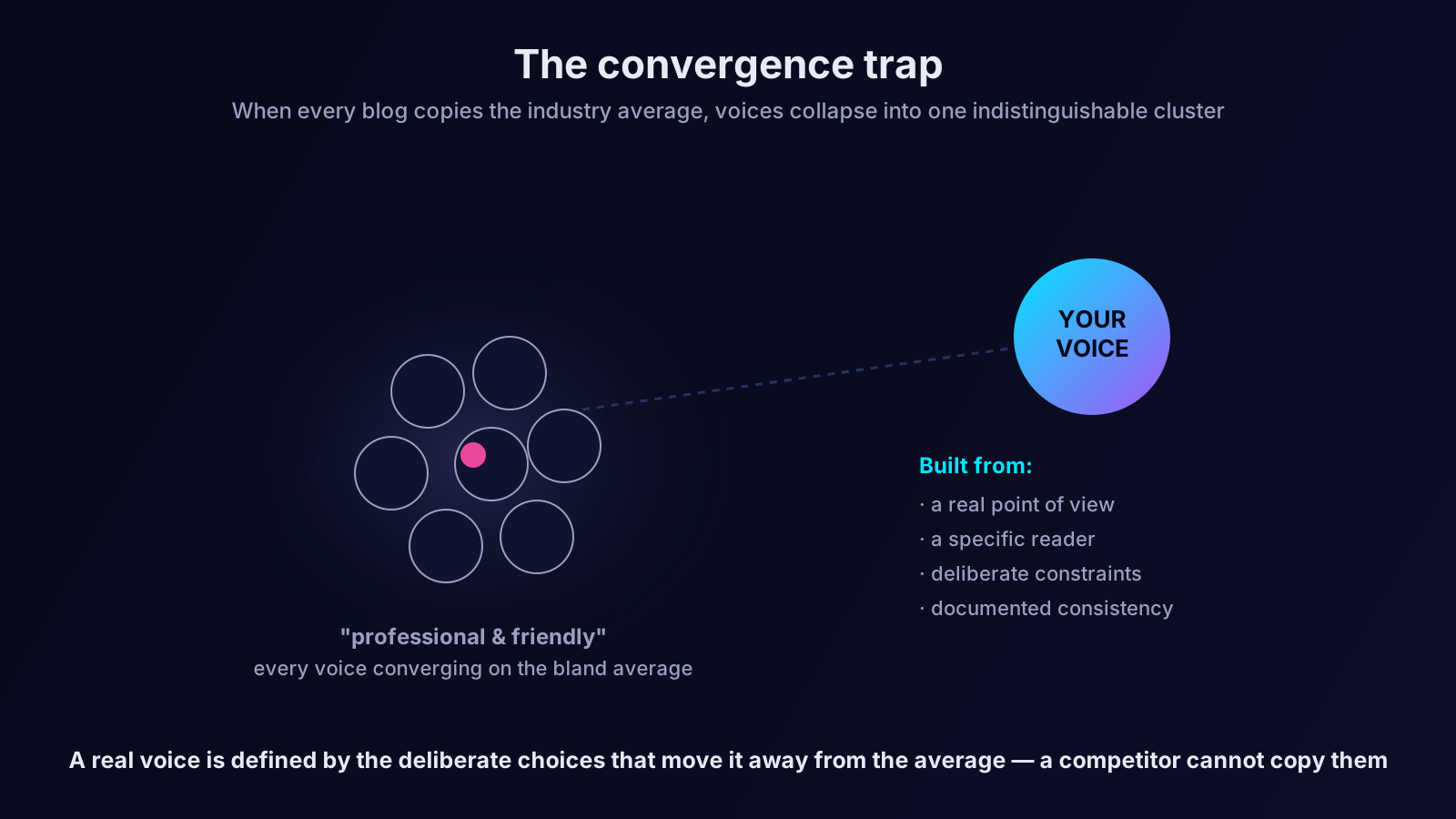
Ask a SaaS marketing team to describe their brand voice and you will almost always get the same answer: "professional but approachable," "friendly and helpful," "clear and conversational." These phrases feel like an answer. They are not.
They describe nothing because their opposites are absurd. No company's brand voice is "unprofessional and hostile" or "confusing and cold." "Professional and friendly" is not a position; it is the absence of one — the default settings, restated as if they were a decision. A real voice is defined by the specific choices it makes that another brand would not make. It is defined by what it is willing to be that the generic voice is not: opinionated, dry, intense, plain to the point of bluntness, funny, severe, warm in a particular and unusual way.
Here is the test. A real voice description contains trade-offs — things the brand deliberately gives up. "We are direct, even when it is uncomfortable, and we will never soften a point with corporate padding." "We are warm and personal, and we will sound less authoritative than our competitors as the price of it." Those are positions; they cost something. "Professional and friendly" costs nothing, rules out nothing, and therefore guides nothing. If your voice guidelines could be pasted into a competitor's brand book without anyone noticing, you do not have a voice. You have a description of the default.
The hidden cost of sounding like everyone
The generic voice is not obviously broken. The articles are helpful. They rank, sometimes. Readers do not complain. So it is worth being precise about what it actually costs, because the cost is real and it is hidden.
It costs memorability. A reader who finishes a generically-voiced article retains the information, perhaps, but retains nothing about the company that published it. There was no personality to attach the memory to. The next time they have the problem, they search again from scratch, because nothing about you stuck. A distinctive voice makes the company itself memorable — and a company a reader remembers is a company they return to.
It costs trust of a particular kind. The generic voice is relentlessly reassuring — everything is easy, every problem has good news, every process is a breeze. Readers have learned to discount this. A voice willing to say a thing is hard, willing to admit a trade-off, willing to disagree with the consensus, reads as a voice that is telling the truth. Reassurance is cheap and everyone offers it. Honesty has a texture, and texture is persuasive.
It costs the one moat a competitor cannot cross. A competitor can copy your features, your pricing, your topics, even your article structure. They cannot copy a genuine voice, because a genuine voice is bound up with a real point of view, and a point of view cannot be lifted. Every SaaS company that defaults to the generic voice is declining to build the one asset that is structurally defensible. That is the real cost — not a worse article, but a forfeited advantage.
The phrases that give the game away
The generic SaaS voice has tells — recurring phrases so common they have become invisible to the people writing them. Naming them is useful, because you cannot stop using a crutch you cannot see.
"In today's fast-paced digital landscape." "Let's dive in." "The good news is." "It's no secret that." "Whether you're a beginner or a seasoned pro." "At the end of the day." "Game-changer." "In this article, we'll explore." "But first, let's take a step back." None of these phrases is wrong, exactly. Each is just empty — a sound the writing makes while it gets to the point, a filler that signals "this is a blog post" without adding meaning. They are the verbal equivalent of stock photography: technically content, contributing nothing, and instantly marking the writing as undifferentiated.
The fix is not to ban the phrases — banning produces stilted writing that is avoiding words rather than choosing them. The fix is to notice them, treat each one as a prompt to ask "what am I actually trying to say here," and say that instead. The empty phrases are usually standing in for a real sentence that was never written. Write the real sentence.
What a real voice is built from
A distinctive voice is not a costume. It is not adding jokes, or being edgy, or affecting a quirky persona. Those are decorations, and decorations applied to an empty position read as gimmicks. A real voice is built from something underneath.
It is built, first, from a genuine point of view — actual opinions about the subject. A company that believes something specific about how its field should work will sound like itself, because the opinions shape the sentences. A company with no opinions can only describe, and description is where the generic voice lives.
It is built from knowing the reader specifically — not "marketers" but a particular kind of marketer, with particular frustrations and a particular level of knowledge. A voice aimed at a specific person is automatically more distinctive than a voice aimed at everyone, because aiming at everyone forces you to the bland average that offends no one.
It is built from deliberate constraints — the things the voice will not do. We do not pad. We do not hype. We do not hedge every claim into mush. We do not explain things the reader already knows. Constraints shape a voice more than permissions do, because they are the choices a competitor's voice did not make.
And it is built from consistency, which means it has to be written down and enforced through the brief. A voice that lives only in the head of one founder evaporates the moment a second writer joins. A voice that is documented — with real examples of in-voice and out-of-voice sentences, not abstract adjectives — survives the team scaling.
The objection: doesn't SEO reward the safe, generic style?
There is a reasonable counter-argument worth meeting directly. Does a distinctive voice not risk the rankings? Is the safe, plain, generic style not what search engines prefer?
It is a misunderstanding. Search engines do not reward blandness; they reward the result that best satisfies the searcher. Nothing about a distinctive voice prevents an article from being thorough, accurate, well-structured, and genuinely useful — and those are the things that rank. A strong voice and strong SEO fundamentals are not in tension; they are layered. You build the article on sound structure and real substance, and the voice is how that substance is delivered.
If anything, voice helps the signals that increasingly matter. A memorable, opinionated article earns more of the reader behaviour search engines watch for — time spent, return visits, the reader not bouncing back to the results page unsatisfied. It earns more citations and more links, because people link to writing that has a point of view, not to the thirteenth interchangeable explainer. The generic voice is not the safe choice for SEO. It is the choice that competes on substance alone while forfeiting every advantage voice could have added.
The role of the editor — and why most blogs do not have one
There is a structural reason the generic voice persists that has nothing to do with writers and everything to do with what happens after the draft is written. A distinctive voice is not only created at the writing stage; it is protected at the editing stage. And most SaaS blogs do not really have an editing stage — they have a review stage, which is a different and weaker thing.
A reviewer checks whether the article is accurate, complete, and on-topic, then approves it. An editor does that and more: an editor reads the draft against the voice and pushes it toward the voice — cutting the empty phrases, flagging the sentences that drifted into the generic register, asking "is this how we would say it?" The reviewer accepts a competent generic article. The editor refuses to, because competent-and-generic fails a standard the reviewer was never asked to apply.
When a blog has no editor in this sense — when the loop is write, check, publish — the voice has no guardian. Every writer's drift toward the average passes straight through, because nobody's job is to catch it. The fix is not necessarily a new hire; it is a new step. Someone, at the editing stage, has to read every draft specifically for voice, with the documented voice guide open beside them, and treat a drift into the generic as a defect to be corrected rather than a stylistic preference to be tolerated. A voice that is created but not defended erodes one unedited article at a time.
Voice is not the same as formatting
One more confusion is worth clearing up, because it lets teams believe they have a voice when they do not. Many SaaS blogs have a strong, consistent format — a recognisable article template, a house approach to headings, a standard intro shape, a familiar way of using lists and callouts — and they mistake that consistency for a voice.
It is not. Format is the skeleton; voice is the personality. Two articles can share an identical format and sound nothing alike, and two articles can share a voice while taking completely different shapes. A consistent format is genuinely useful — it makes a blog feel coherent and a reader feel oriented — but it is the easy half of the problem, and it is the half a competitor can copy in an afternoon by examining your pages. The hard, defensible half is the voice: the actual sentences, the point of view inside them, the register, the things the writing is willing and unwilling to say.
A team that has invested in a polished format and stopped there has built a recognisable container for an unrecognisable voice. The container is worth having. But do not let it disguise the absence of the thing inside it. When you read your blog and it feels consistent, ask whether what is consistent is the layout or the voice — because only one of those is the asset a competitor cannot take.
How to escape the average
Escaping the generic voice is not a rebrand. It is a sequence of small, concrete moves. Define a real voice — with positions and trade-offs and constraints, not adjectives. Write it down with paired examples of in-voice and out-of-voice sentences. Put voice into every content brief, so silence stops voting for the generic. Build the empty-phrase tells into editing, so the crutches get noticed. And read your published articles next to three competitors' — honestly — and ask whether a reader could tell yours apart. The answer to that question is the whole measure of whether the work is done.
Where an AI agent fits
Holding a consistent, distinctive voice across a content program is genuinely hard. It is not a one-time decision; it is a standard that has to be applied to every article, by every writer, every week — and the gravitational pull toward the safe average is constant. It is exactly the kind of consistency that erodes quietly as a team and a publishing schedule grow.
This is where a defined voice and an SEO AI agent work together. Orova can be given your documented voice — your positions, your constraints, your in-voice and out-of-voice examples — and apply it consistently across every article it drafts, while keeping the structure, intent matching, and internal linking that the piece needs to rank. The strategic work in this article does not change: defining a real voice is a human decision about what your company believes and refuses to do. But once that voice exists, an agent can hold it steady across volume, where a growing team of writers would otherwise drift back toward the average. The voice is yours. The consistency is the agent's job.
Sounding like everyone else is not a neutral default. It is a slow forfeit of the one asset a competitor cannot take. Define a voice with real positions, write it down, enforce it through the brief, and read your work honestly against the crowd. The goal is simple to state and hard to reach: a reader should be able to cover your logo and still know it was you.
Let an AI Agent handle your SEO
Orova plans, writes, optimizes, and tracks rankings on its own — you just read the results.
Try it free