
Batch, Schedule, Publish: A System for Consistent Output

Most content programs do not fail because the team cannot write. They fail because the work happens in the wrong order, at the wrong time, in the wrong frame of mind. Someone sits down on Tuesday morning to "do content," and that single block has to contain choosing a topic, researching it, outlining it, writing it, finding an image, editing it, formatting it, and publishing it — eight different jobs requiring eight different mental modes, crammed into one session, every week. It is exhausting, it is slow, and it produces inconsistent work, because no human switches cleanly between research-brain and writing-brain and editing-brain eight times before lunch.
There is a better way to organise the same work, and it is not a productivity trick — it is a system. Batch the like work together, schedule the output in advance, and let publishing become an automatic event rather than a weekly scramble. This article lays out that system, step by step, so that consistent output stops depending on heroics and starts depending on a process. The system has three parts, and they go in order.
The problem with doing it all at once
Before the system, it helps to be precise about why the all-at-once approach is so costly, because the cost is not obvious until you name it.
The hidden tax is context-switching. Every one of those eight jobs uses a different part of your attention. Research is open, divergent, exploratory — you are gathering and following threads. Writing is focused and generative — you are producing, in flow, ideally without interruption. Editing is critical and convergent — you are cutting, tightening, and judging. These modes actively fight each other. Trying to research while writing produces a draft full of half-finished thoughts and open browser tabs. Trying to edit while writing produces paralysis, because the critical voice strangles the generative one. Every time you switch, your brain pays a reload cost — and the all-at-once method makes you pay that cost over and over, every single week.
The result is not just slowness. It is inconsistency. When every article is produced in one frantic mixed-mode block, the quality depends entirely on how that particular block went — whether you were fresh, whether you were interrupted, whether the research happened to go smoothly. Some weeks the article is good. Some weeks it is rushed. The output is a lottery, and a content program that wants to rank cannot be a lottery. It needs to be a process that produces a reliable result regardless of how any single Tuesday feels.
Part one: batch the like work
The first move is to stop organising work by article and start organising it by type of work. Instead of taking one article all the way through all eight steps, you take one kind of step across many articles at once. This is batching, and it is the core of the system.
In practice, you separate the work into a small number of distinct batches and do each batch in its own dedicated session. A planning batch: in one sitting, choose and brief the next several articles — topics, target keywords, intent, angle. A research batch: in another session, research all of those briefed articles in one continuous research-mode block. A writing batch: in a focused session — ideally protected from interruption — draft several articles back to back, staying in generative mode the whole time. An editing batch: in a separate session, in critical mode, edit the drafts. A production batch: in one go, handle the unglamorous final mile — images, formatting, links, metadata — for everything ready.
The gain is immediate and structural. Within a batch, you are in one mental mode and you stay there, so the reload cost is paid once instead of eight times. You get better at each job because you are doing it repeatedly in a row — the third article you research in a session goes faster and deeper than the first. And the quality stops being a lottery, because each kind of work now happens in the conditions that suit it: writing in flow, editing with a cold critical eye, research with room to wander. (Batching pairs naturally with planning ahead — a batch of briefs is far easier to produce when you already have a structured plan to draw from, which is what our keywords-to-content-plan workflow is designed to give you.)
Part two: schedule the output
Batching produces a pile of finished articles. The second part of the system is what you do with that pile: you do not publish them as they finish. You schedule them.
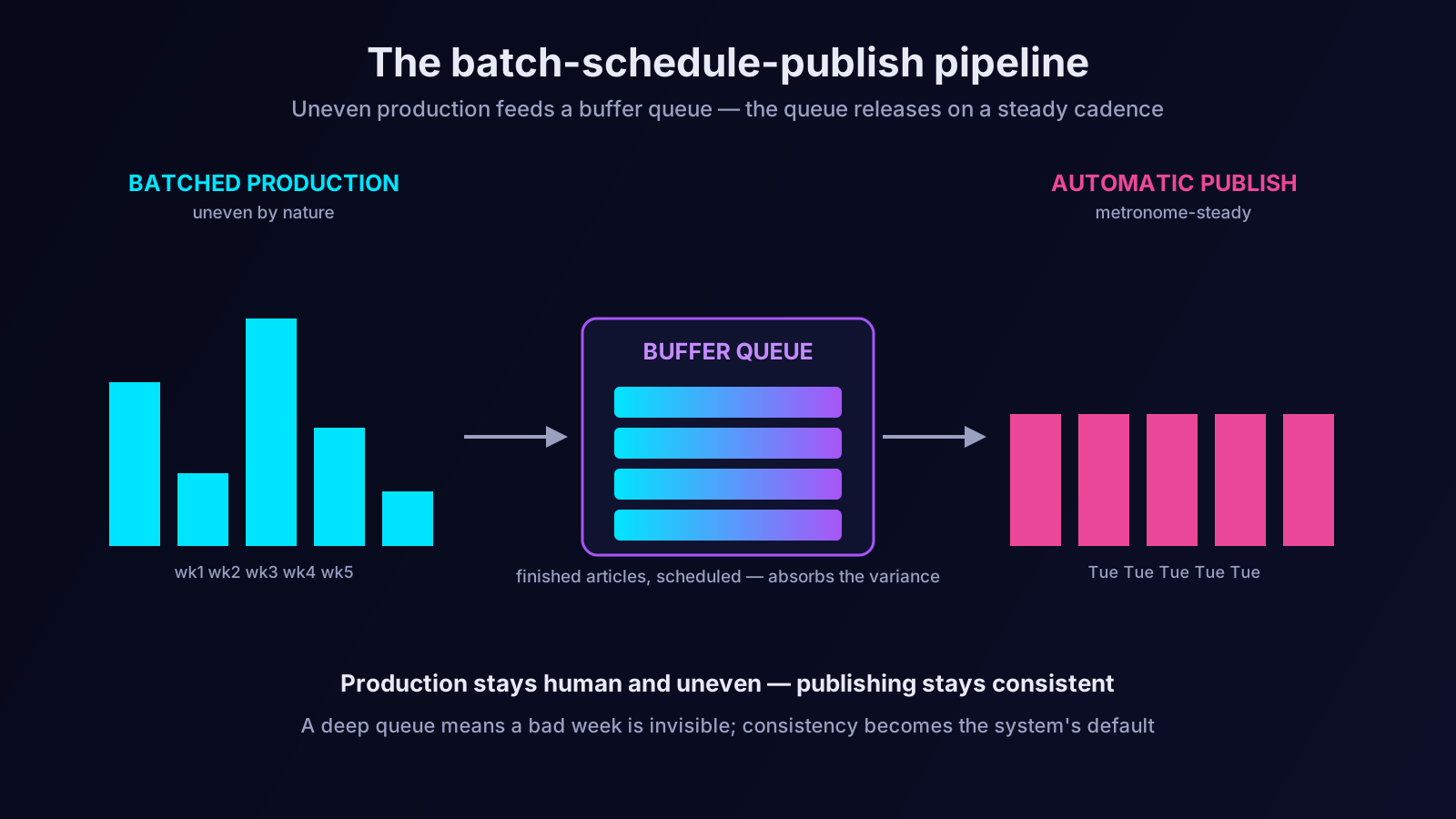
This is the step that separates a consistent program from a bursty one. If you publish each article the moment it is done, your publishing rhythm directly mirrors your production rhythm — and production is naturally uneven. A great week produces five finished pieces; a hard week produces one. Publish-on-completion turns that unevenness loose on your audience and on search engines: five posts on Monday, then silence for two weeks, then three at once. The blog looks neglected and then frantic, in turns.
Scheduling decouples the two rhythms. Finished articles do not go straight out; they go into a queue. From that queue, they publish on a fixed, even cadence — one every Tuesday, say — regardless of whether they were finished yesterday or three weeks ago. Production can be as uneven as real life makes it. Publishing stays metronome-steady. The queue absorbs all the variance, the way a reservoir absorbs the difference between uneven rainfall and steady supply.
This is also where buffer becomes real and visible. A healthy queue is never empty — it holds several finished, scheduled pieces ahead of the publish date at all times. That buffer is what lets a genuinely bad week happen without the public rhythm faltering: a week with zero output simply draws the queue down a little, and the cadence never even notices. Without a queue, one bad week is a visible gap. With a well-stocked queue, one bad week is invisible. The buffer is not optional polish on the system. It is the part of the system that makes it robust.
Part three: make publishing automatic
The third part is the smallest and the most important: the actual act of publishing should require no human decision and no human effort. It should be a scheduled event that simply happens.
The reason this matters is psychological as much as practical. If publishing requires someone to remember, to log in, to click — then publishing is a recurring task that can be forgotten, delayed, or deprioritised on a busy day. And the moment it gets delayed once, the consistency the whole system was built to deliver is broken. By contrast, when the article is scheduled and the publishing happens on its own, consistency is no longer a thing anyone has to actively maintain. It is the default behaviour of the system. Nobody has to remember to be consistent, which means nobody can forget.
So the rule is: by the time an article enters the queue, it is completely finished — written, edited, formatted, illustrated, linked, with its metadata done and its publish date set. Nothing is left to do at publish time. The human work all happens upstream, in the batches. The publishing itself is automatic, and consistency becomes a property of the machine rather than a discipline of the people.
How the three parts reinforce each other
It is worth seeing why these three parts form a system rather than a list of three separate tips — because they are genuinely interdependent, and a team that adopts only one of them usually gets disappointed.
Batching without scheduling gives you efficient production feeding an erratic publishing rhythm — you have made the work better but the audience still sees the bursts. Scheduling without batching gives you a steady public cadence fed by a chaotic, exhausting production process — the queue is steady but the people filling it are still scrambling. Automatic publishing without a healthy queue behind it just means an empty schedule fires reliably and publishes nothing.
Together, though, they close a loop. Batching makes production efficient and high-quality. Scheduling and the buffer queue convert that uneven production into a steady, decoupled output rhythm. Automatic publishing makes that rhythm self-sustaining and forgetting-proof. The output is consistent, the work is humane, and the consistency does not depend on anyone being heroic in any given week. That is the whole goal: a content program where being consistent is what happens when nobody does anything special, rather than something that requires constant effort to maintain.
Common ways the system breaks
The system is robust, but a few predictable mistakes can undermine it, and naming them helps you keep it healthy.
The first is letting the queue run dry. A buffer only buffers if it has depth; a queue holding exactly one article is not a buffer, it is a countdown. The discipline is to treat re-stocking the queue as urgent before it is nearly empty, not after. The second is batching too large — trying to research twelve articles in one session is its own kind of fatigue, and the last few get the tired version of your attention. Batches should be big enough to capture the mode-switching savings and small enough to stay within a focused session. The third is letting unfinished work into the queue — "I'll add the images later" — which quietly reintroduces a publish-time task and breaks the automatic-publishing principle. The queue is for finished articles only. The fourth is mistaking a temporarily full queue for permission to stop producing; the queue draws down constantly, and a few skipped production batches will empty even a healthy one. The system runs continuously or it does not run.
How to introduce the system without a painful transition
If you already run a content program, switching to this system overnight is a mistake — you cannot batch and schedule a backlog that does not yet exist, and trying to invent one in a single week recreates exactly the all-at-once pressure the system is meant to remove. The transition has to be gradual, and there is a sensible order to it.
Start by adopting batching alone, while keeping your current publishing habits. For a few weeks, simply group your work by type — a planning session, a research session, a writing session, an editing session — without changing when anything goes live. This is the lowest-risk change, it pays off immediately in reduced mode-switching, and it builds the muscle of working in batches before anything else depends on it.
Once batching is comfortable, use it to build the queue. Because batched production is more efficient, it will, over a few weeks, produce slightly more finished work than you publish — and that surplus is the buffer. Do not publish the surplus; let it accumulate. When the queue holds several finished, scheduled pieces, you have a real buffer, and only then do you switch on the steady cadence and automatic publishing. The buffer must exist before the metronome starts, or the metronome is just a faster way to run dry.
Introduced in that order — batch first, accumulate the queue, then schedule — the transition is calm. There is never a moment where the system depends on something that is not yet built. The team feels the benefit of batching long before the steady cadence goes live, which also makes the change easy to sell internally: it is a sequence of small, obviously-good steps rather than one disruptive leap.
Why the system protects quality, not just sanity
It is tempting to read everything above as a productivity system — a way to make a content team calmer and more efficient. It is that, but it is also, less obviously, a quality system, and that is worth making explicit.
Quality suffers most under two conditions: time pressure and mode-confusion. A writer rushing to finish a piece in one mixed session, with the publish deadline that same day, produces worse work than the same writer drafting in a calm, protected writing batch with the piece not due for two weeks. An editor who has just finished writing cannot edit cleanly, because the critical mode and the generative mode interfere. The all-at-once method maximises both time pressure and mode-confusion on every single article.
The batch-schedule-publish system attacks both. Batching gives each kind of work its own clean mental mode, so writing happens in flow and editing happens with a genuinely cold eye. The scheduling buffer removes the time pressure, because by the time a piece is being written it is not due for weeks — there is room to do it properly, to let a draft rest, to research a little deeper. The system does not merely make consistent output possible. It makes consistent output at a consistent quality possible, which is the only kind of consistency worth having. A reliable stream of mediocre articles is not the goal; a reliable stream of genuinely good ones is, and the system's calm is precisely what protects the quality.
Where an AI agent strengthens the system
The batch-schedule-publish system is sound and entirely workable by hand — but its weak point is always the same: production capacity. The queue only stays full if the batches keep producing, and the batches are still real human work. A few disrupted weeks, a couple of departures, a busy quarter, and the queue draws down faster than it refills. The system does not fail loudly; it just slowly empties, and one day the buffer is gone.
This is the precise point where an SEO AI agent strengthens the system rather than replacing it. The most batchable, most repeatable parts of the pipeline — the research, the structured first drafts, the consistency and overlap checks — are exactly the parts an agent handles well and at volume. With those handled, your people spend their batch time on the parts that need human judgement: editing, adding real expertise, sharpening the voice, quality control. The production batches keep the queue reliably full, which means the buffer stays deep, which means the steady cadence holds even through the weeks that would once have drained it.
This is what Orova is built for: taking the repeatable production work off the team so the queue behind your publishing schedule never runs dry. The system in this article is the same with an agent or without one — batch, schedule, publish. The agent simply makes the hardest part to sustain, keeping the buffer full, far easier to sustain. Build the system first. Then make sure the pipeline feeding it can keep up. Consistency, done right, is not a discipline. It is the natural output of a process built so that nobody has to be heroic to keep it running.
Let an AI Agent handle your SEO
Orova plans, writes, optimizes, and tracks rankings on its own — you just read the results.
Try it free