
"Quality Over Quantity" Is a Cop-Out — You Need Both
"Quality over quantity." It is the most agreeable sentence in content marketing. Nobody argues with it. It sounds wise, it sounds disciplined, it sounds like the considered position of someone who has seen the alternative and rejected it. And it is, very often, a cop-out — a comfortable phrase that teams reach for to excuse publishing too little, too slowly, while feeling principled about it. This article is built around a handful of aphorisms about that phrase and the false choice it smuggles in. The first, and the one everything else hangs from, is simple:
"Quality over quantity" is usually said by someone losing on both.
It is worth sitting with that, because it stings for a reason. The teams genuinely producing excellent content at low volume are rare, and they almost never describe themselves with the slogan — they are too busy. The phrase, in the wild, is far more often a defence. It is what a team says when the blog publishes one post a month and someone asks why. It reframes a capacity problem as a values problem. "We could publish more, but we choose not to, because we care about quality" sounds so much better than "we cannot reliably publish more, and we are not certain the one post is excellent either." The slogan does not describe a strategy. It describes a feeling — the feeling of wanting the moral high ground of quality without having to prove it.
The false choice at the centre of it
The deepest problem with "quality over quantity" is the little word in the middle. Over. It presents quality and quantity as opposites on a single dial — turn one up and the other must come down. That framing is wrong, and almost everything that follows in this article is an argument against it. Which leads to the second aphorism:
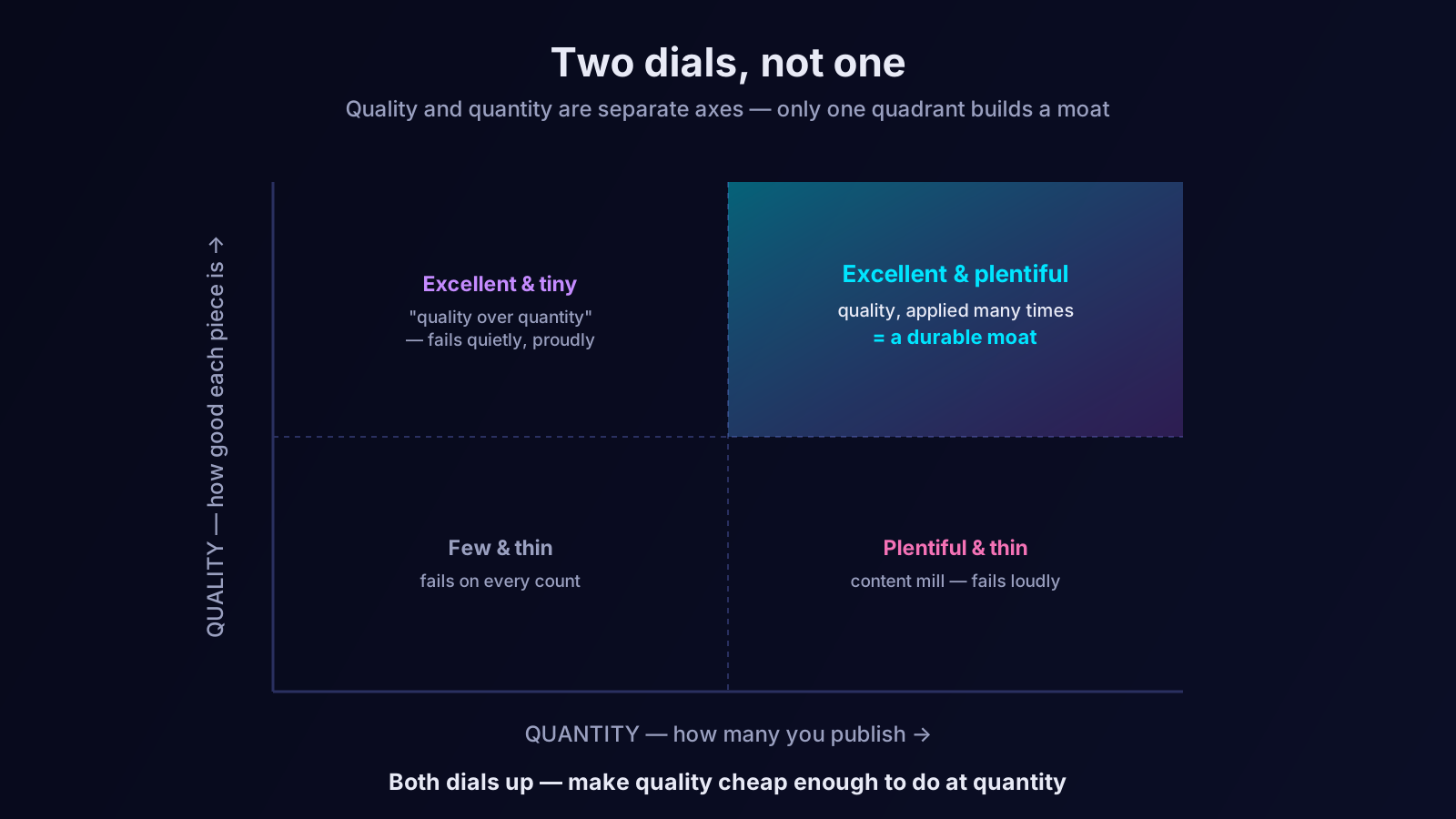
Quality and quantity are not a dial. They are two separate dials.
One dial controls how good each article is. The other controls how many you publish. They are connected — turning the quantity dial too far past your capacity will drag the quality dial down — but they are not the same dial, and within your real limits you set each one independently. The team publishing one mediocre post a month has not "chosen quality." They have set both dials low. The slogan lets them feel they made a noble trade when, in fact, they simply have a small program that is not especially good. Naming the two dials separately removes the hiding place. You do not get to lose on quantity and call it a quality decision.
Why quantity is not a dirty word
Some of the discomfort here comes from a quiet snobbery: the belief that wanting to publish more is somehow crass, the mark of a content mill, the opposite of caring. That belief is worth dismantling, because it is doing real damage. Which brings the third aphorism:
One brilliant article is a brilliant article. A hundred brilliant articles is a moat.
Search does not reward a single excellent page the way it rewards demonstrated, broad, repeated excellence across a whole subject. A site that has covered an entire topic thoroughly — many strong pages, interlinked, each reinforcing the others — is in a different competitive position than a site with one superb post and a lot of empty space. That position is the moat. And a moat is, unavoidably, made of quantity: it is many good pages, not one. You cannot build topical authority, cover the long tail of real questions, or create an interlinked cluster with a single article, however brilliant. The structure that actually wins in search is plural. (This is the whole logic behind topic clusters — depth across many pages, not a lone showpiece.)
So quantity is not the enemy of quality. Quantity is how quality compounds. A hundred genuinely good articles is not "quantity over quality" — it is quality, applied a hundred times, which is a completely different and far more powerful thing than quality applied once and then defended with a slogan.
Why quality alone is not enough either
To be fair to the other side: the slogan exists because the opposite failure is real. Teams genuinely do publish floods of thin, near-identical, AI-extruded pages that help no one and rank for nothing, and "quality over quantity" is a sane reaction against that. Thin content at volume is a real and common mistake. But the correct response to one failure mode is not to leap into the other. Which is the fourth aphorism:
A thin blog and a tiny blog fail the same way — they just fail politely or proudly.
A blog of two hundred thin pages fails because none of them are good enough to rank or to be worth reading. A blog of six excellent pages fails because six pages, however good, cannot cover a subject, cannot build a moat, cannot capture the breadth of real demand. Both blogs lose. The thin one loses loudly and a little shamefully. The tiny one loses quietly and feels principled about it. But losing while feeling principled is still losing. The slogan offers the tiny blog a way to lose with dignity, and dignity is not the goal. The goal is a content program that actually works — and a program that works needs both dials turned up: each article good, and enough of them to matter.
The honest reframe
If "quality over quantity" is the cop-out, what is the honest version? It is not a slogan, it is a standard. The honest reframe is this: every article must clear a real quality bar, and you must publish as many bar-clearing articles as you sustainably can. Quality is the floor. Quantity is the ambition. They are not in tension — the floor does not move, and you try to do as much above it as possible.
This reframe kills the excuse. You can no longer publish one post a month and call it a quality strategy, because the standard now explicitly asks the second question: was that the most bar-clearing content you could have produced? Usually the honest answer is no — not because the team does not care about quality, but because producing quality content is slow, and slow work caps volume, and the slogan was covering for that cap rather than confronting it. Which is the fifth aphorism, and the pivot of the whole argument:
"Quality over quantity" is what you say when quality is expensive. Make it cheaper and the dilemma disappears.
Why the trade-off felt real
The reason the false choice felt true for so long is that, historically, it nearly was. Producing a genuinely good article is a lot of work — research, understanding the competition, drafting, editing, structuring. That work is slow, and a team only has so many hours. So in practice, with a fixed amount of human time, turning the quantity dial up really did tend to pull the quality dial down, because the same hours were being spread across more pieces. The trade-off was not imaginary. It was the visible consequence of one real constraint: quality content was expensive to produce, and expense limited volume.
Notice what that means, though. The trade-off was never a law of content. It was an artefact of a cost. The dilemma existed because excellence was expensive — and a dilemma that exists because something is expensive is not a permanent dilemma. It is a pricing problem. Lower the cost of producing a quality article and the forced trade-off between the two dials loosens, and eventually dissolves. The slogan treated a temporary cost constraint as an eternal truth about the universe. It is not. It is just a cost.
How to tell a real quality strategy from the cop-out
If "quality over quantity" is so often an excuse, how do you tell when a low-volume program is genuinely a considered quality strategy and when it is the slogan covering for a capacity problem? There are a few honest tests, and they are worth applying to your own program before applying them to anyone else's.
The first test is the quality of what does get published. A real quality strategy produces pages that are visibly, demonstrably excellent — pieces that are the best resource on their topic, the ones competitors quietly copy. If the low-volume blog's articles are merely fine — competent, unremarkable, indistinguishable from average — then it is not winning on quality either, and the slogan is pure cover. A quality strategy has to actually show its quality. "We publish little, but what we publish is exceptional" is only a defence if the second half is true and obvious.
The second test is whether the low volume is a choice or a ceiling. Ask plainly: if you could publish twice as many articles, all of them clearing your quality bar, would you? If the honest answer is yes — and it almost always is — then your volume is not a strategic choice. It is a capacity limit you are describing with a flattering word. A genuine quality strategy can articulate a real reason to keep volume low — a tiny niche with few real questions, a deliberate focus on depth in one cluster — that is not just "we cannot produce more."
The third test is whether the program is winning. A real quality strategy, even at low volume, should be producing results within its niche — pages that rank, that earn links, that convert. If the blog is small, unremarkable in quality, and not winning, then "quality over quantity" is not describing a strategy at all. It is describing a program that is quietly failing, dressed in a sentence that makes the failure sound like a principle.
The cost of the slogan is the years it buys you
It is worth being blunt about what the cop-out actually costs, because the cost is easy to miss — it is not a visible failure, it is an invisible delay.
A team that adopts "quality over quantity" as a comfortable excuse does not crash. The blog does not collapse. Nothing dramatic happens at all. The program simply stays small, stays slow, and stays roughly where it is — a handful of decent pages, a trickle of traffic, year after year. Because nothing is visibly broken, nobody raises an alarm. The slogan reassures everyone that the smallness is a virtue, so the smallness is never treated as a problem to solve.
Meanwhile a competitor who refused the false choice — who held a real quality bar and pushed volume as hard as they sustainably could — spends those same years building the moat. They cover the whole subject. They build the interlinked clusters. They accumulate the topical authority. And by the time the slogan-comforted team finally notices it has been lapped, the gap is not a few articles wide. It is years of compounding wide, and years of compounding is extremely hard to close. The cop-out's real price is not a bad quarter. It is a head start, handed for free, to whoever was less comfortable with the slogan.
Where an AI agent ends the cop-out
This is where the argument lands somewhere practical. The whole "quality versus quantity" framing rests on one assumption — that producing a quality article will always be slow and expensive enough to cap how many you can make. An SEO AI agent is what makes that assumption finally false.
An agent does not lower the quality bar; the bar is set by readers and search engines and stays exactly where it was. What it lowers is the cost of clearing that bar. The slow, repeatable work behind every good article — the research, the structured first draft, the checks against what already ranks and what you have already published — gets handled by the agent, while your people spend their time on the judgement, expertise, editing, and voice that make a piece genuinely excellent. The result is more articles, each one still cleared against the same standard. Both dials go up. The trade-off that "quality over quantity" was built to manage simply stops being a trade-off, because its underlying cause — expensive quality — has been removed.
This is what Orova is built to do: make quality cheap enough to do at quantity, so a content team no longer has to choose between a thin blog and a tiny one. The honest goal was always both — every article good, and many of them. The slogan was a way of pretending that was not the goal because the goal was hard to reach. It is less hard now. So retire the cop-out. You do not need quality over quantity. You need quality, at quantity, and the only real question left is how cheaply you can produce it.
Let an AI Agent handle your SEO
Orova plans, writes, optimizes, and tracks rankings on its own — you just read the results.
Try it free