
The Content Cadence That Won't Burn Out Your Team
I have burned out a content team. Not metaphorically — properly, the way you burn out an engine by running it past its limit for too long. It happened in slow motion, over about eight months, and for most of those months I genuinely believed I was doing a good job. We were hitting our numbers. The calendar was full. Every week the posts went out on schedule. And then, gradually and then suddenly, the whole thing fell apart — the writers stopped caring, the quality slid, two good people left, and I was left looking at a publishing schedule I had built like a trap and walked my own team into.
This is the story of how that happened, what I got wrong, and the cadence I run now — one designed, before anything else, around the people who have to sustain it. If you manage a content team, or you are a team of one trying not to grind yourself down, I hope some of this saves you the eight months it cost me.
The schedule I was proud of
The cadence that broke us looked, on paper, like success. We published four articles a week. The calendar was mapped out two months ahead. Every slot had a topic, an owner, and a due date. When anyone asked how the content program was going, I could point at that calendar — full, organised, relentless — and feel the particular pride of a manager whose machine is running.
I had built it the way I now think most aggressive cadences get built: by looking at what ambitious-sounding number I wanted, and then dividing the work to fit. Four a week sounded serious. It sounded like scale. I did not start from what the team could sustainably do; I started from the number I wanted to report, and worked backwards. That direction — number first, capacity second — was the original mistake, and every other problem grew out of it.
The slow tells I ignored
Burnout did not announce itself. It leaked out in small signs, and because each sign was small, I explained every one of them away.
First the drafts started arriving exactly on the deadline instead of comfortably before it — the buffer had quietly vanished. Then the research got thinner; pieces that would once have taken a day of digging were turned around in an afternoon, and they read like it. Then the writers stopped pitching ideas of their own. The blog had always had a low hum of "what if we wrote about…" — that hum went silent, and I did not notice the silence because silence is easy not to notice. Then the small errors crept in: a wrong figure here, a broken link there, the kind of thing that does not happen on work people have the time and energy to care about.
Each of these, on its own, I had a reason for. Busy week. Hard topic. Everyone is a bit tired. What I could not see — because I was looking at the calendar, not at the people — was that they were not separate problems. They were one problem, the same problem, showing itself in four places: the cadence was above what the team could sustain, and the team was absorbing the gap by quietly spending themselves.
The week it broke
The collapse, when it came, was not dramatic. One of my best writers — thoughtful, reliable, the person whose drafts needed the least editing — sent a message saying she could not look at the blog anymore. Not angry. Just flat, and done. A few weeks later a second writer left. And in the exit conversations the same phrase came up, in slightly different words, from both: it never stopped. There was never a moment to breathe, to think, to do a piece properly, to feel anything but behind. The treadmill never slowed down, so eventually they stepped off it.
That was the week I finally understood what I had built. I had not built a content program. I had built a treadmill, set the speed by what looked good in a report, and then mistaken the fact that nobody had fallen off yet for proof that the speed was fine. It was not fine. It had never been fine. It had just taken eight months for the cost to become visible, and by then it cost me two people.
Rebuilding the cadence around people
When I rebuilt the program, I started from a different question. Not "how many articles do I want?" but "what rhythm can these specific people sustain — at quality, indefinitely, without dreading Monday?" The whole cadence got designed outward from that question, and it changed almost everything.
I set the number from capacity, not ambition
The first and biggest change was direction. Instead of picking a number and dividing the work to fit, I sat with the team and we worked out, honestly, how much genuinely good content they could produce in a normal week without eating into evenings or skipping the thinking. The number that came back was lower than four a week. Noticeably lower. And I published that lower number, deliberately, because a cadence the team can actually hold is worth more than an impressive one that quietly destroys them. The number became an output of capacity, not an input the capacity had to somehow stretch to meet.
I built in real buffer
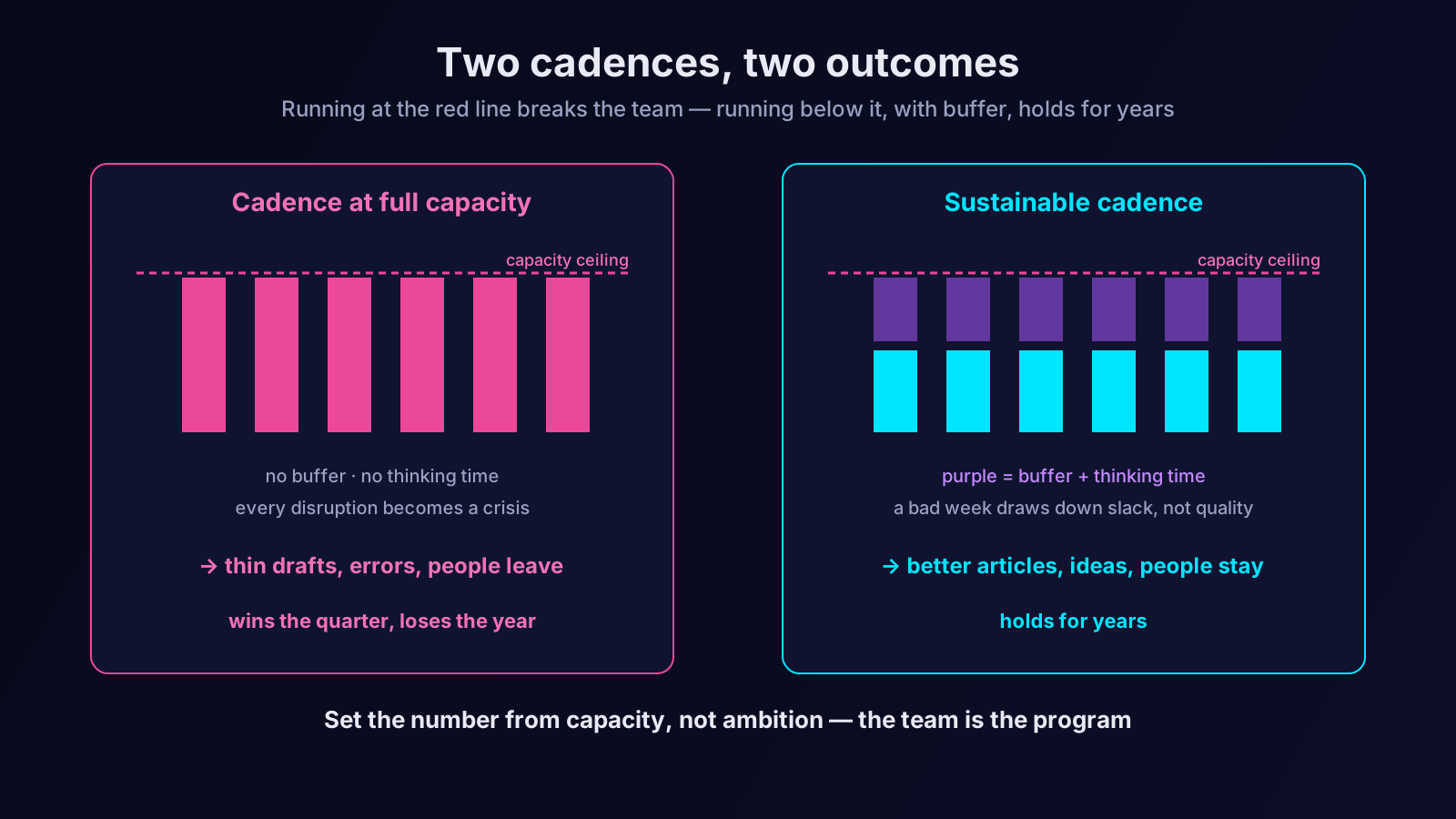
The old calendar had every writer working on the piece due that week — zero slack, so any disruption immediately became a crisis or a quality cut. The new rhythm runs with a deliberate buffer: at any time there are finished, edited pieces sitting ready ahead of the publish date. That buffer is not laziness. It is the thing that lets a sick day, a hard topic, or a genuinely bad week happen without the schedule lurching and without anyone publishing something they are ashamed of. A cadence with no buffer is a cadence that converts every normal human event into an emergency.
I protected thinking time
The silence where the idea-pitching used to be taught me that a team running flat-out has no spare capacity to think — and a content team that cannot think slowly stops being good. So the new rhythm explicitly includes time that is not assigned to producing the next piece: time to research the next quarter, to revisit and improve old posts, to pitch, to learn. It looks, on a calendar, like slack. It is not slack. It is the difference between a team that generates ideas and a team that merely processes them.
What the slower cadence actually produced
Here is the part that genuinely surprised me, and the part I most want anyone reading this to believe before they have to learn it the hard way: the slower cadence did not slow down our results. It improved them.
The articles got better, because the people writing them had the time and the energy to make them good. Better articles ranked better and earned more links and brought more traffic per piece — so a smaller number of stronger articles outperformed the larger number of tired ones. The writers, no longer running on empty, started pitching ideas again, and some of those ideas became our best-performing posts. Nobody else left. The blog became, slowly, a place people wanted to do good work rather than a treadmill they were enduring.
The lesson was almost insultingly simple in hindsight. I had been treating the human cost of an aggressive cadence as separate from the results — as a regrettable side effect of a strategy that was otherwise working. It was not separate. The human cost was the results. Tired people write tired articles, and tired articles do not perform. Sustainable people write good articles, and good articles do. Caring for the team was not in tension with the numbers. It was how you got the numbers.
The signs I watch for now
I do not trust myself to never make this mistake again, so I have turned the slow tells I once ignored into a checklist I actively watch. When drafts start landing exactly on deadline instead of ahead of it, the buffer is eroding. When research gets visibly thinner, the cadence is squeezing the thinking. When the idea-pitching goes quiet, the team has no spare capacity left. When small errors creep in, people no longer have the energy to care about the details. Any one of these is an early warning that the rhythm has crept above the sustainable line — and the response is not to demand more discipline. It is to slow the cadence down, immediately, before the slow tells become an exit interview.
The thing about burnout is that it is almost always visible months before the collapse, in exactly these small signs — and almost always ignored, because the calendar is still full and the posts are still going out. The full calendar is the disguise. It looks like health right up until the week it does not.
The honest trade-off
I want to be straight about the trade-off, because pretending there isn't one would be its own kind of dishonesty. A sustainable cadence does mean publishing fewer articles in any given month than an all-out sprint would. If your only horizon is the next eight weeks, the aggressive cadence will, briefly, look like it is winning.
But content is not an eight-week game, and a team is not a renewable resource you can spend and re-buy. The aggressive cadence wins the quarter and loses the year — it loses it to thinning quality, to errors, to people leaving and taking their knowledge and their momentum with them. The sustainable cadence loses the quarter, narrowly, and wins the year and every year after it, because the team is still there, still good, still improving, still wanting to do the work. Once I had seen both play out, the trade-off stopped feeling like a trade-off. A rhythm your team can hold for years simply beats one they can hold for eight months. It is not close.
Where an AI agent fits the human picture
I used to assume the only way to publish more was to push the team harder — that output and team health were on opposite ends of one lever, and managing content meant choosing how much of one to trade for the other. That assumption is what made my treadmill feel inevitable. It is not inevitable, and an SEO AI agent is part of why.
The exhausting part of a content cadence was rarely the writing my team most enjoyed. It was the surrounding grind — the keyword research, the digging through what already ranks, the structuring, the checking that a new piece did not overlap an old one, the repetitive scaffolding around every article. Orova takes that grind on: it handles the research and the structured first draft, leaving the people to do the part that needs them — the expertise, the judgement, the editing, the voice. That does not push the team harder. It does the opposite. It removes the part of the workload that was burning them out, which means a healthier cadence and a higher one can finally be the same cadence.
If I could send one message back to the manager I was, proud of his full calendar and blind to the slow tells, it would be this: the calendar is not the program. The people are the program. Build the cadence around what they can sustain, protect their time to think, watch for the small signs, and use whatever tools you have to take the grind off their plate rather than piling more on. Do that and the numbers follow. I learned it the expensive way. You do not have to.
Let an AI Agent handle your SEO
Orova plans, writes, optimizes, and tracks rankings on its own — you just read the results.
Try it free