
Bid Strategy Explained: tCPA, tROAS, and When AI Should Change Them
A few years ago I watched a perfectly healthy lead-gen campaign get strangled by a single number. The account manager had set a Target CPA of $40, which was exactly the cost the campaign had been delivering. Then a competitor pulled out of the auction, click costs dropped, and the algorithm — doing precisely what it was told — started buying every cheap conversion it could find. Cost per lead fell to $28. Great news, except the manager saw the new low number, panicked that they were "leaving performance on the table," and tightened the target to $30. Volume collapsed by 60% in four days. The system had been told to find leads under $30, and there simply weren't that many at that price. Two weeks of recovery later, they were back where they started, minus the wasted spend and the learning phase reset.
That story is the whole problem with automated bidding in miniature. The strategies themselves — Target CPA, Target ROAS, Maximize Conversions, Cost Cap — are not complicated. What's hard is knowing the difference between a number that should be left alone and a number that should be moved, and resisting the very human urge to fiddle. This guide walks through what each strategy actually does, why your targets drift even when you do nothing, when loosening or tightening is the right call, and the specific rules a well-built AI agent uses to decide. The goal is for you to read a bidding dashboard the way an experienced practitioner does: mostly with patience, occasionally with decisive action.
What automated bidding is actually doing
Every ad auction is a real-time prediction problem. When someone is about to see an ad slot, the platform estimates how likely that particular person is to convert, multiplies that probability by how much the conversion is worth to you, and decides what to bid on your behalf. Automated bidding strategies are just different instructions for how to turn those predictions into bids. They share the same machinery; they differ in what they are told to optimize.
The single most important thing to understand is that you are not setting a bid. You are setting a goal, and the system reverse-engineers thousands of individual bids per hour to hit it. A Target CPA of $40 doesn't mean "bid $40." It means "spend my budget in whatever pattern produces conversions that average around $40 each." The system will happily bid $90 for one click it thinks will convert and $3 for another, as long as the blended result lands near your target. This is why intuitions from manual bidding — where you nudged a keyword bid up a few cents — translate badly. You're now steering an aircraft by adjusting its destination, not its control surfaces.
The four strategies, and what each one chases
There are really only four bidding behaviors you need to know, regardless of platform branding. They map cleanly onto two questions: are you optimizing for efficiency or for volume, and do you measure success in cost or in revenue?
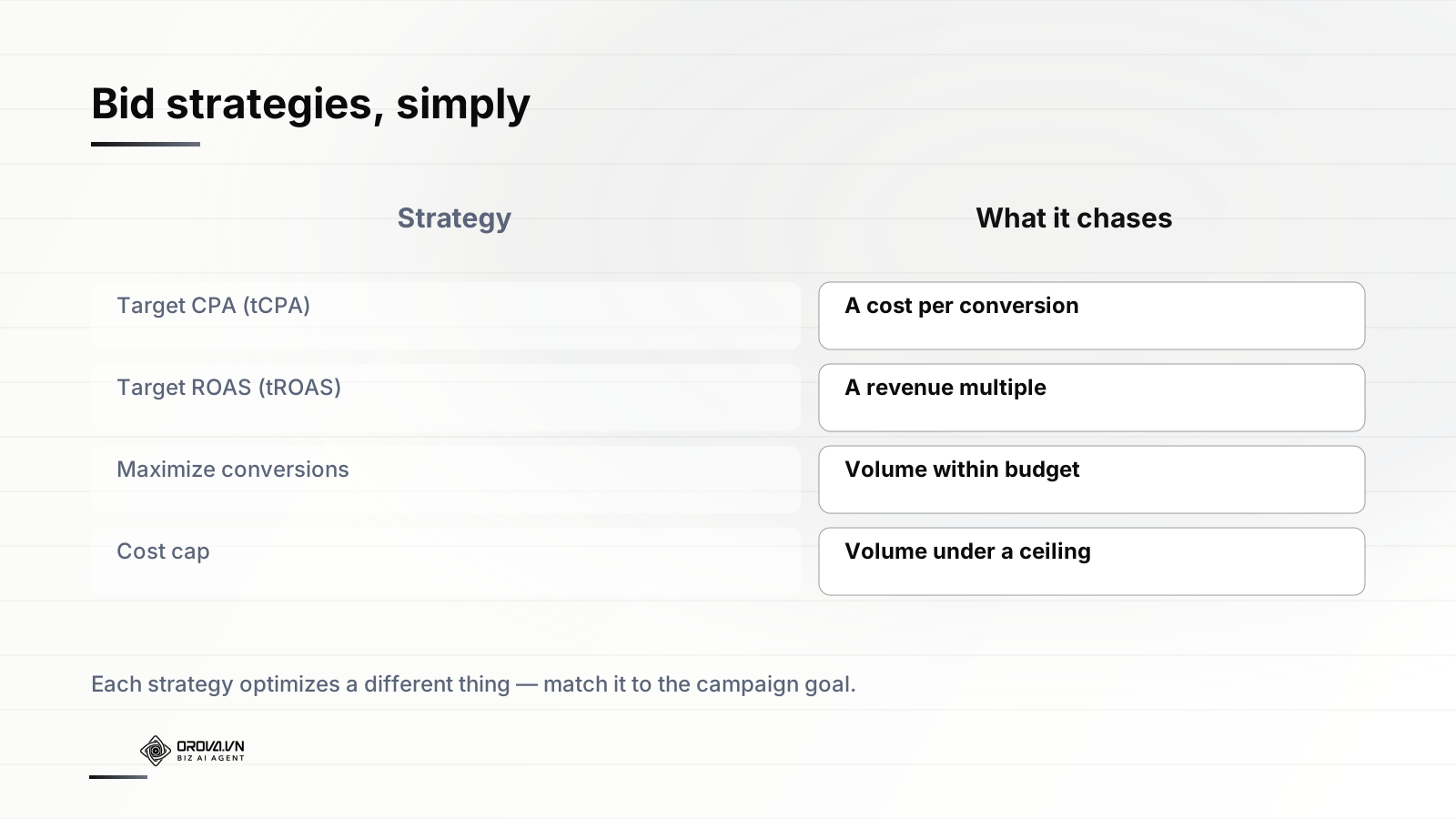
- Target CPA (tCPA) chases a specific cost per conversion. You tell it "get me conversions around $40 each," and it pursues as many as it can find at roughly that average cost. Best when every conversion is worth about the same to you — a demo request, a newsletter signup, a lead form.
- Target ROAS (tROAS) chases a revenue multiple. You tell it "for every $1 I spend, return $4 in revenue," expressed as a 400% target. The system bids more aggressively for high-value purchases and pulls back on cheap ones. Best when conversion values vary a lot — e-commerce where one buyer spends $20 and another spends $600.
- Maximize Conversions chases volume within your budget. No cost target at all — it spends your full daily budget trying to get the most conversions possible, whatever they cost. Useful for new campaigns gathering data, or when you simply want to spend a fixed budget as efficiently as the auction allows.
- Cost Cap (and its cousin, Bid Cap, on Meta) chases volume under a ceiling. It behaves like Maximize Conversions but refuses to let the average cost climb above a line you draw. It's the "grow but don't get reckless" option.
If you remember nothing else, remember this: CPA strategies and ROAS strategies answer fundamentally different business questions, and choosing wrong between them is a more expensive mistake than mis-setting either target. We've written a full breakdown of that decision in CPA vs. ROAS: which metric should actually drive your bids, but the short version is: use CPA-based bidding when conversions are roughly interchangeable, and ROAS-based bidding when the dollar value of a conversion swings widely. A lead-gen business optimizing on ROAS is usually fighting its own data; an e-commerce store optimizing on CPA is usually leaving margin on the table by treating a $600 order the same as a $20 one.
The learning phase, and why it deserves respect
When you launch a new bid strategy — or significantly change an existing one — the system enters a learning phase. This is not marketing fluff or an excuse for poor early results. It's a literal modeling problem. The algorithm has a prediction model with parameters it needs to calibrate against your specific audience, creative, landing page, and conversion action. Until it has gathered enough conversion examples, its bids are educated guesses, and performance is noisy and usually worse than it will be once calibrated.
The rough rule of thumb across platforms is that a campaign needs around 50 conversions in a trailing window — roughly a week or two — to exit learning and stabilize. The exact number varies, but the principle is universal: the model needs data, and data takes time and spend to accumulate. During this window, the campaign is fragile. Its bids are exploratory; it's deliberately testing wider than it eventually will, sampling auctions to learn where conversions hide.
Here is the trap. During learning, results look bad. CPAs spike, ROAS dips, volume is erratic. The untrained instinct is to "fix" it by changing the target. But every meaningful edit you make resets the learning phase. You've now thrown away the partial calibration, and the system starts over, exploratory and expensive again. Marketers who edit reactively can keep a campaign in a permanent state of learning, never letting it stabilize, and then conclude that "automated bidding doesn't work for us." The bidding worked fine. The editing didn't.
The most expensive button in any ads platform is the one that resets the learning phase. It looks free. It isn't.
This is also why the timing of edits matters as much as their content. Changing a target by 10% the day before a campaign exits learning costs you everything it learned. The same change two weeks later, on a stable campaign, is a routine tune-up. The number you type is identical; the consequences are completely different.
Why your targets drift even when you change nothing
A bid target is a fixed number you set once. But the world it operates in is not fixed. This mismatch — a static target against a moving market — is the source of nearly every "why did my campaign suddenly change?" question. Several forces pull your real-world results away from the target without anyone touching a setting.
The auction moves around you
You don't bid in a vacuum. When a competitor launches a campaign, raises their budget, or improves their landing page, the cost to win the same impressions goes up. Your $40 tCPA campaign might quietly start delivering at $52 because the auction got more expensive — not because anything you did was wrong. Conversely, when competitors pause for a holiday or burn through their budget early, your costs fall and you can suddenly hit targets you couldn't before. The target is a line in the sand; the tide keeps moving.
Seasonality and demand shifts
Search and shopping intent rises and falls on weekly, monthly, and annual cycles. Conversion rates climb during high-intent seasons and slump in lulls. A tROAS of 400% that's comfortable in November might be unrealistic in late January, when the same audience is browsing rather than buying. The system is still chasing your target faithfully — it just has to bid down hard to protect the ratio, which means it buys far less volume. You experience this as "my campaign died," when really your fixed target became too aggressive for the current demand.
Conversion tracking lag and reporting holes
Conversions don't all happen the moment someone clicks. A B2B lead might convert 12 days after first contact; a considered purchase might complete a week later. This means today's reported CPA is always partly incomplete — recent days will "fill in" as delayed conversions get attributed back. If you judge a campaign on the last three days alone, you're looking at the most under-reported, most pessimistic slice of data. Many a target has been tightened in a panic over numbers that would have looked fine once attribution caught up.
Creative fatigue and audience saturation
The same ad shown to the same audience for weeks loses punch. Click-through rates decay, conversion rates soften, and the cost to hit your target creeps up — not because of bidding, but because the inputs the bidder relies on are degrading. No target adjustment fixes tired creative. This is a case where the bid dashboard is reporting a symptom of a problem that lives somewhere else entirely.
The practical upshot: when a target stops being met, the first question is never "what should I change the target to?" It's "why did the gap appear?" The right response to a more expensive auction is different from the right response to fatigued creative, which is different again from the right response to a tracking artifact. Treating all three with a target change is how accounts get over-managed into mediocrity.
When to loosen, when to tighten, and when to do nothing
With the drivers understood, the actual decision rules become surprisingly clean. There are really only a handful of states a campaign can be in, and each one has a correct response. The art is in diagnosing the state honestly before acting.
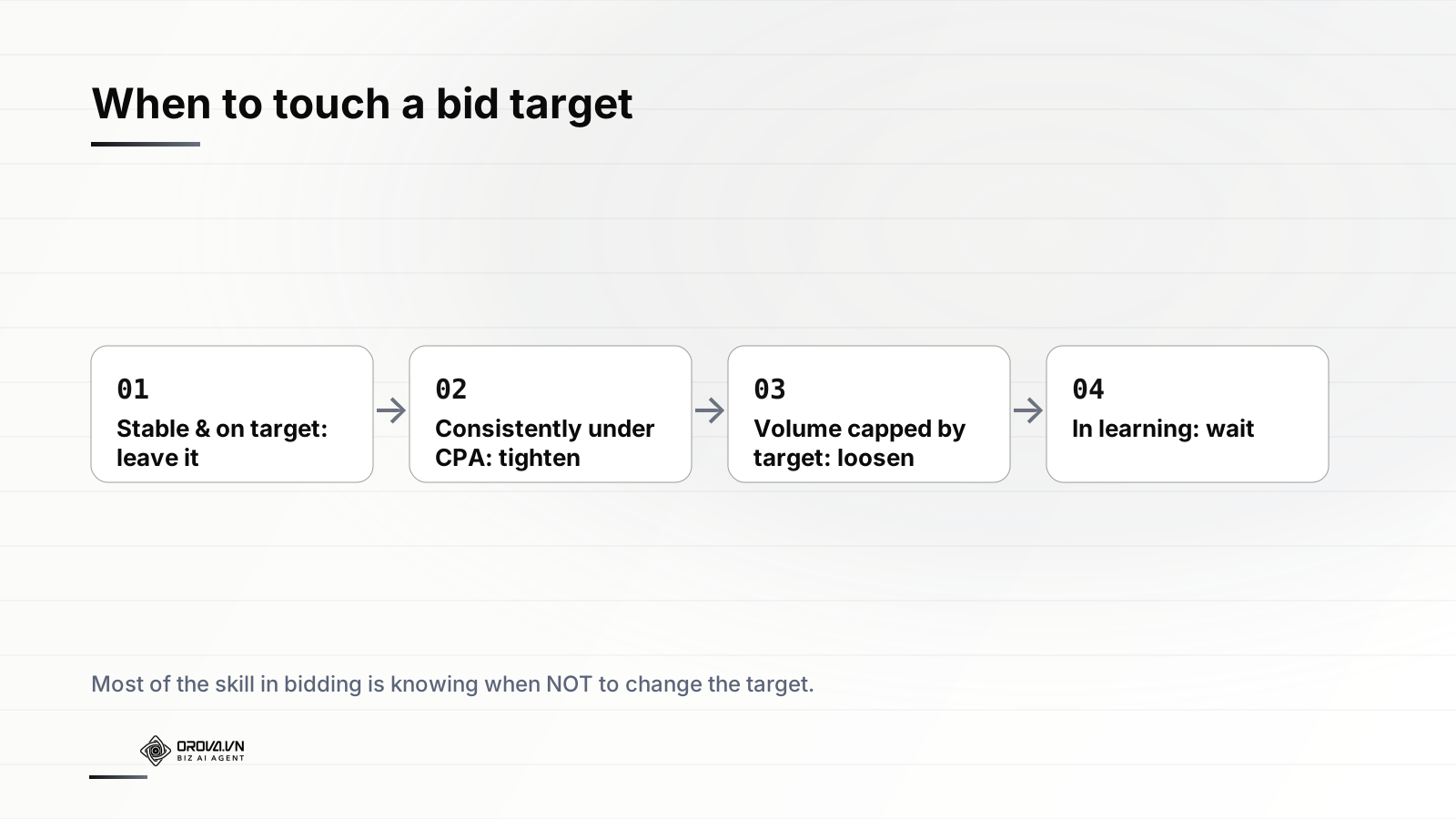
Leave it alone (the most common correct answer)
If a campaign is out of learning, delivering close to its target, and spending its intended budget, the right action is nothing. A tCPA campaign bouncing between $37 and $43 against a $40 target is not "underperforming on Tuesdays" — it's behaving exactly as designed, with normal variance. Reacting to that noise is the single most common way well-meaning marketers degrade their own results. Give automated bidding the boring gift of stability and it will usually reward you.
Tighten the target (carefully)
Tighten — lower the tCPA, or raise the tROAS — only when the campaign is consistently and comfortably beating the current target with room to spare. If you've been hitting $30 against a $40 tCPA for two solid weeks, you genuinely have headroom: you can ask for a lower cost and trade some volume for efficiency. But move in small steps, typically 10–15% at a time, and wait for the campaign to re-stabilize before moving again. Tighten too far and you'll push the target below what the auction can supply, and volume falls off a cliff — exactly the mistake from the opening story. The signal to stop tightening is when volume starts dropping faster than cost improves.
Loosen the target
Loosen — raise the tCPA, or lower the tROAS — when the campaign is volume-capped by the target itself. The tell-tale sign: the system is hitting your target easily but spending well under budget and limiting impressions. That means it can't find enough conversions at the price you've demanded, so it sits on its hands. If you have budget and appetite for more volume, loosening lets the bidder pay a bit more per conversion to unlock incremental scale. This is the right move during a high-demand season when you want to capture more of a growing market, even at slightly higher cost.
Wait (when in learning)
If the campaign is still in learning, the answer to almost any question is wait. Don't tighten, don't loosen, don't swap strategies. Let it gather the conversions it needs to calibrate. The only exception is a campaign that is genuinely broken — spending heavily with near-zero conversions days into learning — which usually points to a problem upstream of bidding: a broken conversion tag, a wildly mistargeted audience, or a landing page that doesn't load. Fix the cause; don't punish the bidder.
The real risk: over-editing
If there's a single failure mode that defines amateur bid management, it's over-editing. The pattern is seductive because it feels responsible. You log in, you see a number that's slightly off, you adjust it, you feel productive. Repeat daily. The result is a campaign that never stabilizes, perpetually relearning, perpetually exploratory, perpetually expensive. You are, in effect, paying the learning-phase tax over and over while believing you're optimizing.
Over-editing does specific, measurable damage:
- It resets learning. Each significant change throws away accumulated calibration, returning the campaign to its least efficient state.
- It chases noise. Day-to-day variance is normal. Editing in response to it means you're reacting to randomness, which on average makes things worse, not better.
- It destroys your ability to learn. If you change three things at once and performance shifts, you have no idea which change mattered. Clean attribution of cause and effect requires patience and isolated changes.
- It compounds. A panic tighten causes a volume drop, which causes a panic loosen, which causes a CPA spike, which causes another panic tighten. Each reaction creates the conditions for the next.
The discipline that separates good operators from busy ones is the willingness to look at an imperfect number and decide, on the evidence, to do nothing. That's genuinely hard, because doing nothing feels like negligence and produces no satisfying sense of control. But in automated bidding, restraint is a skill, and it's the one most people lack.
How an AI agent decides — and why it's structurally better at restraint
Here's the uncomfortable truth about the rules above: they're not complicated, but humans are bad at following them. We're bad at it because the rules require patience under uncertainty, consistency across dozens of campaigns, and immunity to the emotional pull of a scary-looking number. Those are precisely the qualities machines have and people don't. This is where a well-designed AI ads agent earns its keep — not by being smarter than a good marketer, but by being more disciplined than a tired one.
A serious agent doesn't "optimize bids" in the hand-wavy sense. It runs the same diagnostic an expert would, every day, on every campaign, without fatigue or ego. Concretely, a good agent works through a sequence like this:
- Check learning status first. If a campaign is still calibrating, the agent's default action is to wait and protect it from edits — including edits a nervous human might want to make. It guards the learning phase rather than burning it.
- Look at a statistically honest window. Rather than reacting to the last three (under-attributed) days, it evaluates performance over a window long enough to be meaningful, and it accounts for conversion lag so it isn't fooled by data that hasn't finished reporting.
- Distinguish signal from noise. A target being missed by 8% with high day-to-day variance is noise; the same gap held steady for two weeks is signal. The agent uses the magnitude and consistency of a deviation to decide whether it's even worth acting on.
- Diagnose the cause before choosing the action. Is the gap from a more expensive auction, a seasonal demand shift, fatigued creative, or a tracking artifact? The right response differs, and the agent reasons about which one it's seeing rather than reflexively reaching for the target slider.
- Move in measured steps. When a change is warranted, it adjusts conservatively — small percentage moves — and then waits for re-stabilization before considering another move, exactly as a careful human would, but consistently.
The deeper advantage is consistency at scale. A human managing forty campaigns will, realistically, over-attend to the three that are on fire and neglect the thirty-seven that are quietly drifting. An agent applies the same disciplined logic to all forty, every day, and surfaces only the cases that genuinely need a decision. It turns "I'll get to it" into "it's already handled."
The part that keeps you in control
None of this means handing the keys to a black box. The right model is human-in-the-loop: the agent does the relentless monitoring and the disciplined reasoning, then proposes specific actions — "loosen this tCPA from $40 to $46 because it's been volume-capped for nine days while underspending budget by 35%" — with the evidence attached. You approve, modify, or reject. Every change is logged with its rationale, so you can audit exactly what happened and why, and reverse anything that doesn't sit right. You keep the judgment calls and the accountability; the agent absorbs the tedious vigilance and the temptation to fiddle. That division of labor plays to the strengths of both sides: the human supplies business context and final say, the machine supplies patience, consistency, and an unblinking eye on every campaign at once.
The campaigns that perform best over a year are rarely the ones that got the cleverest single optimization. They're the ones that were left alone when they should have been, adjusted decisively when they needed it, and never thrashed into a permanent learning phase by a well-meaning human reacting to noise. Good bidding is mostly good judgment about when to act — and that's exactly the kind of judgment a disciplined agent can apply, faithfully, to every campaign, every day.
Orova Ads is an AI agent that manages your paid campaigns across Google, Meta, and TikTok with exactly this discipline — it reads your data every day, distinguishes signal from noise, and recommends bid, budget, audience, and on/off changes with the evidence laid out, executing them only after your approval and keeping a full audit log of every move. If you're tired of either over-managing your bids or ignoring them, see what an agent that knows when not to touch the target can do for your accounts.
Run your business with AI Agents
Orova is the always-on Biz AI Agent — it plans, runs, and optimizes the work for you. Save time, unlock productivity.
Try it free