
CPA vs ROAS: Which Metric Should Your AI Optimize For?
Two accounts, same product, same budget. One marketer told the platform "keep my cost per purchase under $25." The other said "give me at least $4 in revenue for every $1 spent." Six weeks later the first account had twice the order volume and razor-thin margins; the second had fewer orders but a profit line the finance team actually liked. Neither marketer was wrong. They had simply pointed the optimizer at different goals — and the optimizer, doing exactly what it was told, delivered two very different businesses.
This is the quiet decision that shapes everything downstream in a paid-media account: do you optimize for CPA (cost per acquisition) or for ROAS (return on ad spend)? It sounds like a reporting preference. It is not. It is an instruction about what kind of customer you want more of, how much risk you will tolerate, and where the algorithm is allowed to spend your money. Get it right and the system compounds in your favor. Get it wrong and you will watch a smart bidding strategy or an AI agent confidently optimize your account into a worse place — efficiently, relentlessly, and with a straight face.
This article breaks down what each metric actually measures, when each is the correct target, exactly how they conflict, and how to hand a target to an automated system — whether that's Google's Smart Bidding, Meta's value optimization, or an autonomous agent — so it pulls toward profit instead of away from it.
What CPA and ROAS actually measure
Both metrics are ratios. Both are about efficiency. But they measure efficiency against completely different denominators, and that difference is the whole story.
CPA: the price of a result
Cost per acquisition answers one question: how much did I pay to get one outcome? The math is brutally simple — total spend divided by number of conversions.
If you spend $2,000 and get 80 sign-ups, your CPA is $25. That's it. The metric says nothing about what those 80 sign-ups are worth.
CPA is a cost metric. It lives entirely on the spending side of the ledger. Its great virtue is that it's stable and easy to reason about: you don't need clean revenue tracking, you don't need to know order values, you just need to count conversions reliably. Its great limitation is that it is blind to value. A $25 lead that becomes a $50,000 enterprise contract and a $25 lead that never buys anything cost you exactly the same, and CPA treats them as identical.
ROAS: the return on a dollar
Return on ad spend answers a different question: for every dollar I put in, how many dollars of revenue came back? The math is revenue divided by spend, usually expressed as a ratio or a multiple.
If you spend $2,000 and those campaigns drive $8,000 in revenue, your ROAS is 4.0 — four dollars back for every dollar in. The same spend with $6,000 in revenue is a 3.0 ROAS.
ROAS is a value metric. It sits on the revenue side and cares deeply about how much each conversion is worth. A campaign that produces fewer orders but bigger ones can have a higher ROAS than a campaign drowning in cheap, low-value purchases. Its limitation is the mirror image of CPA's strength: ROAS is only as trustworthy as your revenue data. If your conversion values are wrong, missing, or polluted by returns and refunds, the metric lies — and any system optimizing toward it will chase a phantom.
The relationship between them
These two metrics are not independent; they are linked by a third number — your average order value (AOV). The relationship is roughly:
- ROAS = AOV ÷ CPA (when one conversion equals one order)
So if your AOV is $100 and your CPA is $25, your ROAS is 4.0. This little equation is the key to the entire CPA-versus-ROAS debate. It means that for any fixed order value, a CPA target and a ROAS target are two ways of saying the same thing. The conflict only appears when order values vary — and in the real world, they almost always do. The moment some customers spend $40 and others spend $400, CPA and ROAS stop agreeing about what a "good" conversion looks like.
When CPA is the right target
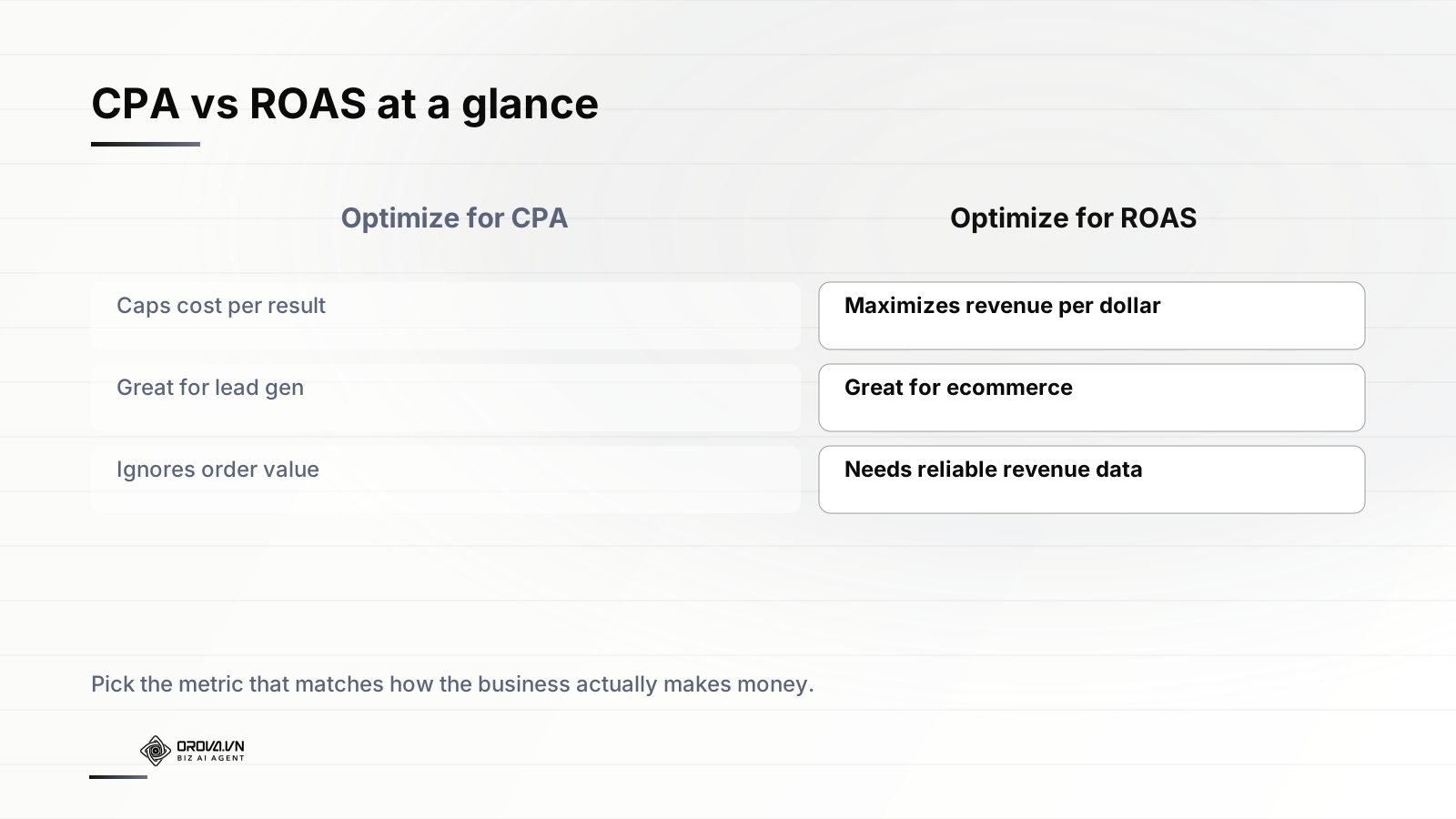
CPA shines whenever the value of each conversion is roughly uniform, or whenever you can't measure value at the moment of conversion. There are several common situations where it is clearly the better instruction.
Lead generation, where revenue happens later
If you sell a B2B SaaS product, a consulting service, an insurance policy, or anything with a sales cycle, the "conversion" your ads platform sees is a form fill or a demo request — not money. There is no revenue to feed a ROAS calculation at the point of the click. You might not know whether a lead is worth $0 or $80,000 for weeks. In this world, telling the system to hit a target ROAS is asking it to optimize on data it doesn't have.
The right move is a CPA target. You decide what you can afford to pay for a qualified lead based on your downstream conversion rate and lifetime value, then you cap the cost per lead. A SaaS company that closes 8% of demo requests at an average contract value of $6,000 can comfortably pay, say, $150 per demo and still be wildly profitable. The CPA target encodes that affordability directly.
Products with consistent price points
If almost everything you sell costs about the same — a single subscription tier, a flat-price course, a one-size service — then AOV barely moves, and CPA and ROAS converge. In that case CPA is simply the easier metric to set and explain. There's no benefit to the added complexity of value-based bidding when every order is worth $49.
When your value tracking is unreliable
This one is underrated. If your purchase values aren't being passed back to the platform correctly — a common situation after a site migration, a checkout change, or a tagging mistake — then ROAS is garbage in, garbage out. Optimizing toward a corrupted ROAS signal is worse than not optimizing at all, because the system will confidently allocate budget based on noise. Until the value data is clean and verified, CPA is the safer, more honest target. Fix the tracking, then graduate to value optimization.
When ROAS is the right target
ROAS earns its keep the moment order values start to spread out and you can measure revenue accurately at conversion. That describes most of ecommerce, and it's why value-based bidding has become the default recommendation for online retail.
Ecommerce with variable order values
Imagine a store that sells both $20 phone cases and $400 noise-cancelling headphones. If you optimize for CPA, the system will fall in love with the phone cases. They convert easily and cheaply, so they drive your blended CPA down and the dashboard looks fantastic. Meanwhile the headphones — the products that actually carry your margin — get starved of budget because each sale "costs more." You will hit your CPA target beautifully and slowly go broke.
ROAS fixes this by teaching the algorithm that a single $400 sale is worth twenty $20 sales. Now the bidding system is willing to pay much more to acquire a headphone buyer, because the return justifies it. The budget flows toward the orders that matter. This is the single most important reason ROAS exists: it lets the optimizer see the size of the prize, not just the cost of the entry ticket.
When margin varies by product
A refinement of the above: not all revenue is equally profitable. A $400 sale with a 10% margin contributes less to the bottom line than a $200 sale with a 50% margin. Sophisticated advertisers don't feed raw revenue into their ROAS signal — they feed profit or margin-adjusted value, often called POAS (profit on ad spend). If you can pass gross profit instead of gross revenue as your conversion value, your ROAS target starts optimizing for the thing your business actually cares about. This is one of the highest-leverage upgrades available to a mature ecommerce account, and almost nobody does it.
When you have repeat purchases and known LTV
If you know that the average first-time buyer comes back and spends three times over the next year, you can build that lifetime value into your value signal. A first purchase of $50 might be worth $150 to your business once repeat behavior is accounted for. Feeding LTV-adjusted values lets a ROAS-targeting system bid aggressively to win customers who look unprofitable on the first order but are gold over time. This is how subscription boxes and consumables brands justify acquisition costs that would terrify a single-purchase retailer.
How the two metrics conflict
Here is the part most guides skip. CPA and ROAS don't just emphasize different things — they actively pull a budget in opposite directions, and the bigger your spread in order values, the harder they pull.
The volume-versus-value tug of war
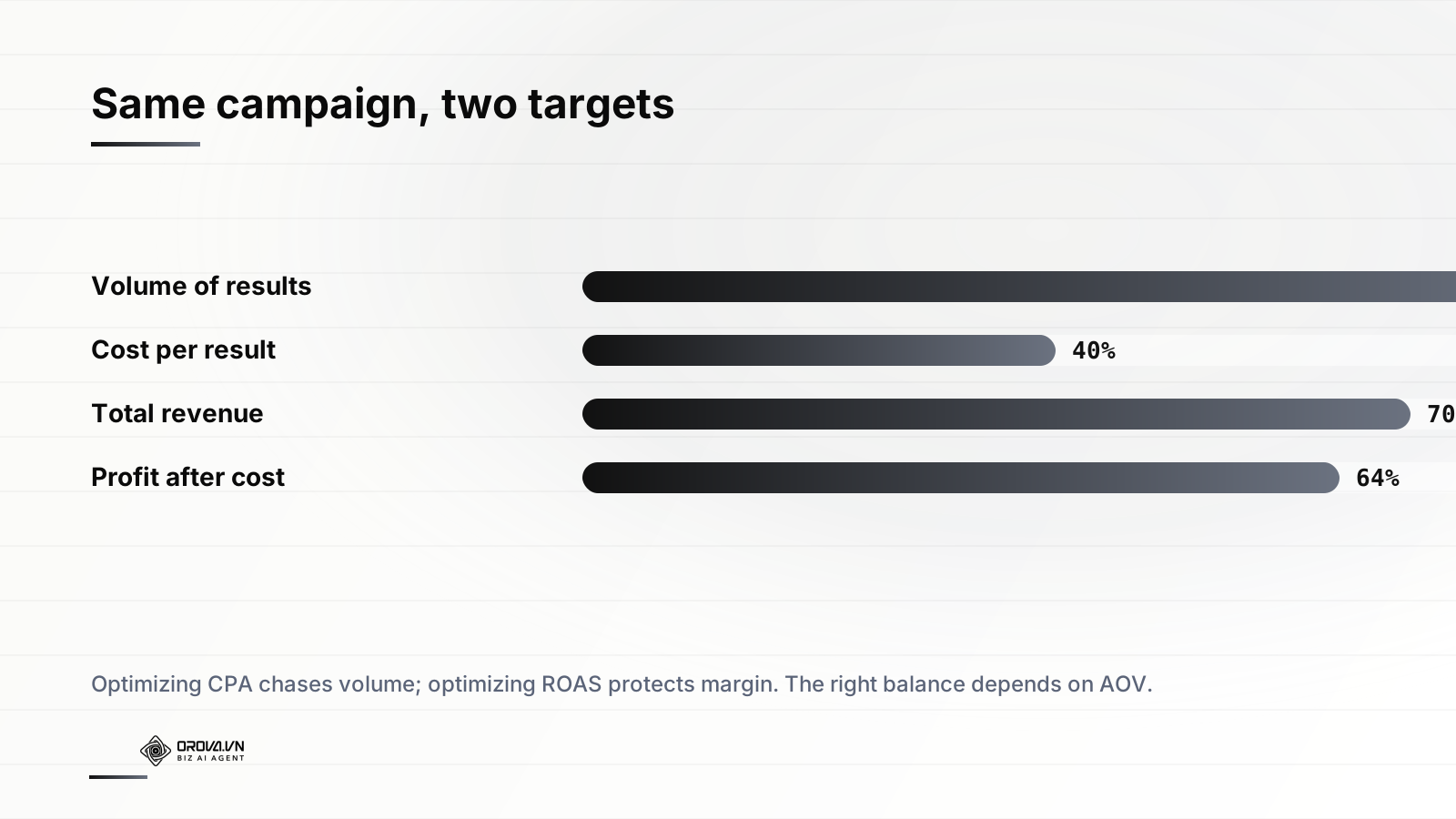
Optimize for CPA and the system chases volume. Its incentive is to find the cheapest possible conversions, which are usually the smallest ones. You get a lot of results, your cost per result looks great, and your total revenue may quietly underperform because the average order shrank.
Optimize for ROAS and the system chases value. Its incentive is to find the most lucrative conversions, even if they're expensive and rare. You get fewer orders at a higher cost per order, but a healthier margin. Push ROAS too hard and the algorithm becomes so selective it strangles volume entirely — it would rather show your ads to three whales than thirty minnows, and your overall growth stalls.
CPA optimization can grow revenue while shrinking profit. ROAS optimization can protect profit while shrinking growth. Both can be the "right" answer — it depends on what stage your business is in.
The chart below shows what happens when you run the same campaign under each target. The volume of results is high but the cost per result and total revenue move in opposite directions depending on which lever you pull. The profit line — the only number that pays salaries — depends on getting the balance right for your specific AOV.
A worked example of the conflict
Suppose you run a store with two segments. Segment A converts at a $20 CPA and a $40 AOV (ROAS 2.0). Segment B converts at a $60 CPA and a $300 AOV (ROAS 5.0). A CPA-targeting system told to stay under $30 will pour everything into Segment A and abandon Segment B entirely — even though Segment B is more than twice as efficient on a return basis. A ROAS-targeting system told to hit 3.0 will do the opposite: it kills Segment A (too low a return) and chases Segment B. Same account, same data, two completely different budget allocations. Neither metric is lying. They're just answering different questions, and you have to decide which question matters.
Setting the target you hand to an automated system
Whether you're configuring Google's Target CPA, Meta's cost-per-result goal, value-based bidding, or an AI agent that manages the whole account, the principle is the same: the target is your instruction, and the system will obey it literally. Vague or wrong targets produce confidently wrong behavior. Here's how to set them well.
Derive the number from unit economics, not from last month's average
The most common mistake is to set a CPA or ROAS target equal to whatever the account happened to do recently. That just locks in past performance. Instead, work backward from what you can afford:
- Find your contribution margin. AOV minus cost of goods, shipping, payment fees, returns. This is the money available to pay for acquisition and still profit.
- Decide your acceptable margin after ad cost. If you want to keep 20% of revenue as profit after advertising, that fixes how much you can spend.
- Translate into a target. A break-even ROAS is 1 ÷ contribution margin. If your margin is 50%, you break even at a 2.0 ROAS, so a profit target might be 3.0 or 4.0. For CPA, multiply your AOV by the share you're willing to spend.
This way the target encodes a business decision, not a historical accident. When you hand "ROAS 3.5" or "CPA $40" to an optimizer, you're handing it a profit constraint, and it will allocate budget to honor that constraint across audiences, placements, and times of day far faster and more granularly than any human could.
Match the target to the campaign's job
Don't use one global target for everything. A prospecting campaign reaching cold audiences should carry a more forgiving target than a retargeting campaign hitting people who already added to cart — the retargeting traffic is warmer and should clear a higher bar. Brand-defense campaigns, lead-gen funnels, and clearance pushes each have different economics. The right setup is usually a portfolio of targets, each tuned to what that campaign is actually for. An AI agent makes this practical because it can monitor and adjust dozens of these targets daily instead of the once-a-month review a human team can manage.
Give the system enough data and enough room
Automated bidding needs conversion volume to learn. A target set on a campaign that gets two conversions a week will thrash — the system can't find a stable pattern in noise. As a rule of thumb, smart bidding strategies want roughly 30+ conversions in a trailing 30-day window before they behave reliably. If a campaign is below that, either consolidate it with others, loosen the target, or optimize toward an upper-funnel action that fires more often. And when you change a target, change it in modest steps (10–20% at a time) and give the system a week or two to re-stabilize. Yanking a ROAS target from 2.0 to 5.0 overnight doesn't make the account efficient; it makes it stop spending while it panics. The same discipline applies to how budgets shift around those targets — there's more on keeping spend smooth in this breakdown of budget pacing on autopilot.
Watch the metric you didn't choose
Even when you optimize for one metric, keep the other on your dashboard as a guardrail. If you're driving CPA, watch ROAS to make sure you're not buying a flood of worthless conversions. If you're driving ROAS, watch CPA and volume to make sure the system hasn't become so picky that growth has flatlined. The metric you optimize is the steering wheel; the metric you didn't choose is the rear-view mirror. You need both to drive safely. This dual view is exactly where an autonomous ads agent earns its place — it can hold a primary target while continuously checking that the secondary metric hasn't drifted into dangerous territory, and flag it before you'd ever notice in a weekly report.
Common mistakes to avoid
After auditing a lot of accounts, the same handful of errors show up again and again. Each one comes from treating the metric choice as cosmetic rather than strategic.
- Optimizing for ROAS with broken value tracking. If your conversion values are missing, wrong, or include refunds and taxes inconsistently, the optimizer chases noise. Verify your values match your actual revenue before trusting a ROAS target.
- Using ROAS for lead gen. There's no revenue at the form fill, so any "value" you assign is a guess. Use CPA, or assign genuine offline-conversion values once you know which leads actually closed.
- Using CPA for high-variance ecommerce. The optimizer will starve your expensive, high-margin products and gorge on cheap ones. Switch to value-based bidding so the system sees order size.
- Setting targets from history instead of economics. "Match last month" locks in mediocrity. Derive the target from contribution margin and the profit you actually want to keep.
- Targets too aggressive for the data. A tight ROAS goal on a low-volume campaign causes the system to stop spending rather than risk missing the goal. Match target ambition to conversion volume.
- Optimizing revenue when you should optimize profit. Raw ROAS ignores that some products are far more profitable than others. If you can, pass profit as your value signal and let the system bid on margin, not sales.
- Never watching the other metric. Tunnel vision on a single number is how accounts quietly break. Always keep the unchosen metric visible as a sanity check.
- Changing targets too violently. Big overnight swings throw bidding systems into a learning crisis. Adjust in small steps and let them settle.
The thread running through all of these is the same: the metric you optimize for is a statement about your business, and the algorithm will take that statement at face value. Choose CPA when results are roughly equal in value or revenue is invisible at conversion. Choose ROAS — ideally profit-adjusted — when order values vary and you can measure them. Derive the actual number from your unit economics, set it per campaign, give the system room to learn, and never stop watching the metric you left out. Do that, and automation becomes a force multiplier instead of a fast route to the wrong destination.
Choosing the right target is step one; holding it across hundreds of campaigns, day after day, is the hard part. Orova Ads is an AI agent that does exactly that across Google, Meta, and TikTok — it reads your account data every day, recommends the budget, bid, audience, and on/off changes that move you toward your chosen CPA or ROAS goal, and executes them with your approval and a full audit trail. You set the destination; it does the driving and shows its work. See how it manages your targets at orova.vn.
Run your business with AI Agents
Orova is the always-on Biz AI Agent — it plans, runs, and optimizes the work for you. Save time, unlock productivity.
Try it free