
Ad Performance Metrics That Actually Matter
You open your ad account and every platform throws a different scoreboard at you: clicks here, views there, some cost number that looks fine until you check your bank account and wonder where the sales went. You end up staring at a wall of numbers, unsure which ones actually tell you whether the money you spent is working. That confusion is exactly why so many business owners feel like they are guessing instead of deciding, even with dozens of ad performance metrics sitting right in front of them.
The old habit is to turn on every column the platform offers and hope one of them jumps out with an answer. That does not work, because your brain cannot compare dozens of numbers at once, so it just latches onto whatever looks biggest or turned green most recently. That number is rarely the one connected to real revenue, which means budget quietly drifts toward whatever looks good on a screen rather than what actually pays the bills. It also does not help that the baseline for organic clicks is shifting under everyone's feet: 68% of US Google searches in the first four months of 2026 ended without a click at all, up from 60% in 2024, according to SparkToro, so the metrics you choose to trust for paid ads matter more than ever.
This article strips that wall down to the handful of numbers that genuinely deserve your attention, explains why the rest are mostly noise dressed up as insight, and shows you a simple way to calculate the ones that matter without tricking yourself. By the end, you will know exactly which figures to check first, which ones to stop worrying about, and how to build a short weekly habit around them.
Why a short metric set beats a comprehensive one
There is a well-documented failure mode in performance marketing called metric thrashing. It happens when a team has no agreed hierarchy of metrics, so different people optimize toward different numbers. The media buyer chases a low cost per click because it makes the campaign look efficient. The creative lead chases engagement rate because it validates the content. The growth lead chases return on ad spend because that is what the dashboard ranks by default. The finance lead, meanwhile, is staring at a cash flow statement that does not reconcile with any of those numbers and quietly concludes that marketing is unaccountable.
Each of those people is being rational within their own frame. The problem is that the frames conflict. A campaign can have a falling cost per click, rising engagement, and a healthy platform-reported return on ad spend while simultaneously losing money on every order once you account for the cost of goods, the share of conversions the platform double-counted, and the fact that half the buyers would have purchased anyway. When everyone is right and the business is still bleeding, the metric set is the culprit.
A tight north-star set solves this by forcing agreement before the spending starts. It says: these four numbers are how we keep score, this is exactly how each is calculated, and any tactic that improves one of them at the expense of another must be argued for explicitly. The narrower the official scoreboard, the harder it is to hide a bad decision behind a flattering chart.
The test a metric must pass to make the list
Before nominating any metric to north-star status, run it through three questions. First, does moving this metric change how much money the business keeps? If a metric can swing 30 percent in either direction without affecting profit, it is not a decision metric. Second, can someone manipulate this metric without creating real value? Cost per click, for instance, can be driven down by chasing cheap, low-intent clicks that never convert, which means it can improve while the business gets worse. Third, is the metric robust to platform self-reporting? Ad platforms have a structural incentive to claim credit for conversions, so any metric pulled straight from a platform without reconciliation is suspect by default.
Metrics that pass all three questions belong on the wall. Metrics that fail any of them belong in a diagnostic drawer you open only when a north-star number moves and you need to understand why.
The four metrics that actually drive decisions
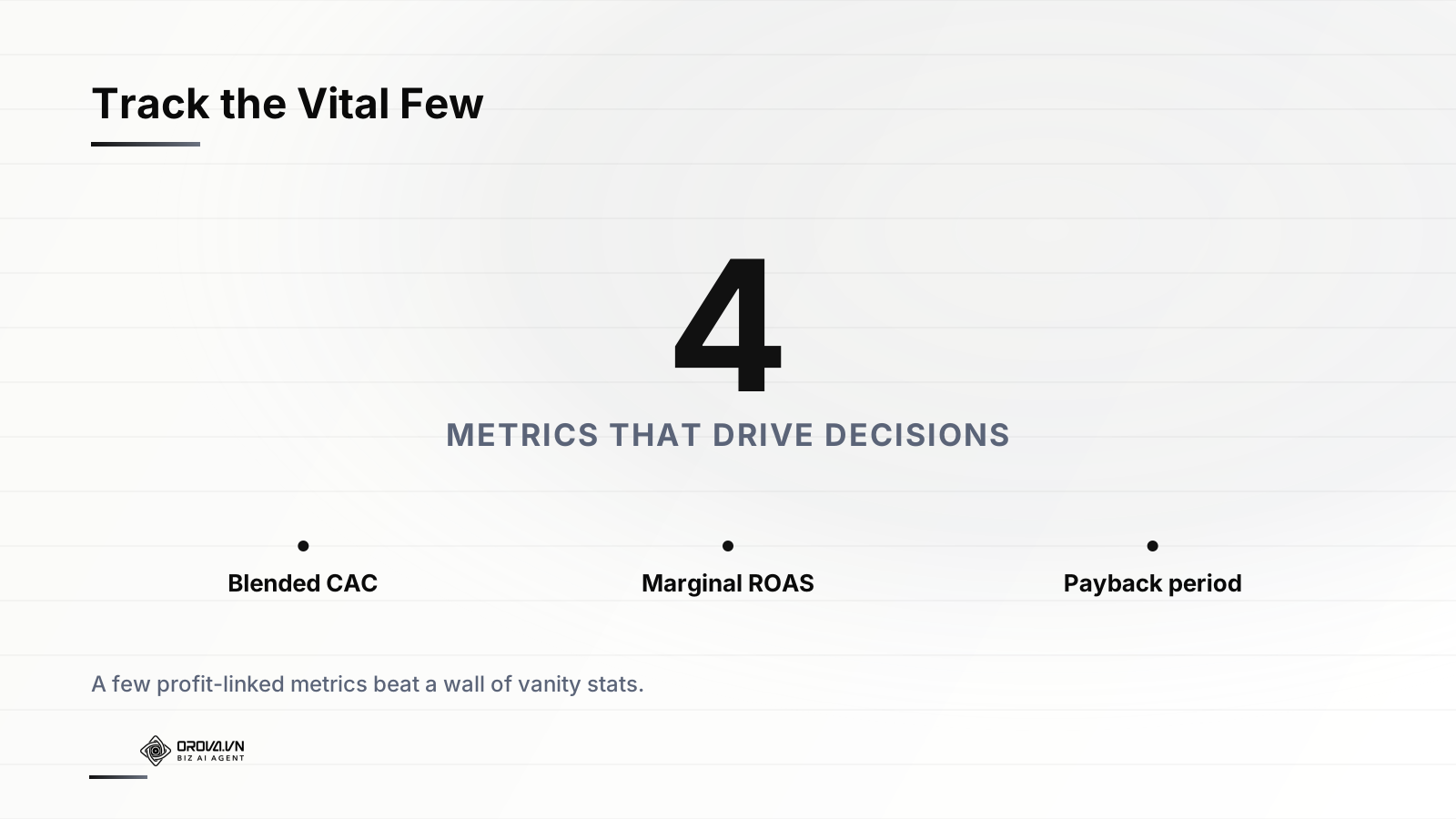
Across categories, business models, and platforms, the same small cluster of metrics keeps proving its worth: blended customer acquisition cost, contribution margin, marginal return on ad spend, and payback period. They are not interchangeable. Each answers a different question, and together they triangulate whether your advertising is building the business or quietly draining it.
Blended customer acquisition cost (CAC)
Blended CAC is your total marketing and advertising spend over a period divided by the total number of new customers acquired in that same period, including customers who arrived through channels you do not directly pay for. The word that does the heavy lifting is blended. Platform-reported CAC tells you what Meta or Google claims it produced. Blended CAC tells you what your whole acquisition engine actually cost, and it is almost always higher than the sum of platform claims because platforms each take credit for the same conversions.
Here is a concrete example. Suppose in a month you spend 40,000 on Meta, 30,000 on Google, and 10,000 on TikTok, for 80,000 in total media plus 20,000 in agency and tooling costs. The platforms collectively report 1,400 conversions. But your back-office system, the source of truth for money received, records only 1,000 genuinely new customers that month. Your platform-blended CAC looks like 100,000 divided by 1,400, or about 71. Your true blended CAC is 100,000 divided by 1,000, or 100. That 40 percent gap is the conversion inflation hiding in your dashboards, and decisions made on the rosy number will systematically overspend.
Blended CAC passes all three tests. It moves profit directly, it is hard to fake because it draws on your own revenue records rather than platform attribution, and it is robust to self-reporting by construction. It should be the single number a media buyer can recite at any moment.
Contribution margin
Contribution margin is revenue minus all variable costs associated with delivering that revenue: cost of goods sold, payment processing fees, shipping and fulfillment, returns and refunds, and the advertising cost to acquire the order. It is the money left over to cover fixed costs and, eventually, profit. The reason it belongs on the north-star list is that it converts every other metric into the same unit, money kept, and it exposes a brutal truth that revenue-based metrics conceal: you can grow revenue and shrink contribution margin at the same time.
Consider a product that sells for 50 with a 20 cost of goods, 3 in processing and shipping, and a 5 percent return rate. Before advertising, each sale contributes roughly 24.50. If your blended CAC on the marginal order is 18, the contribution margin after acquisition is around 6.50 per order. Push spend harder, CAC drifts to 26, and that same order now contributes negative 1.50. Revenue keeps climbing because you are selling more units, but you are now paying for the privilege of each new customer. Contribution margin is the metric that catches this; return on ad spend often does not, because the platform number can still look acceptable while the underlying economics have inverted.
If revenue is up and contribution margin is down, you are not growing a business, you are buying customers at a loss and calling it growth. The distinction is the difference between a fundable company and a cautionary tale.
Marginal return on ad spend
Most teams track average return on ad spend, the total conversion value divided by total spend across a campaign or account. Average ROAS is comforting and almost useless for budget decisions, because budgets are set at the margin. The question that determines whether to add or remove 5,000 from a campaign is not what the average dollar returned, it is what the next dollar will return. That is marginal ROAS, and it is almost always lower than the average because the cheapest, highest-intent demand gets captured first. As you scale, you reach into progressively colder audiences and the incremental return falls.
A worked example makes the gap vivid. A campaign spends 10,000 and returns 40,000 in value, for an average ROAS of 4.0. The team, encouraged, raises the budget to 15,000 and total value rises to 51,000. The new average ROAS is still a healthy-looking 3.4. But the marginal calculation tells a different story: the extra 5,000 of spend produced only 11,000 of additional value, a marginal ROAS of 2.2. If your break-even ROAS given margins is 2.5, that last 5,000 was unprofitable even though the average still looks fine. Teams that budget on average ROAS routinely overspend into the unprofitable margin without noticing, because the average keeps masking the deterioration at the edge.
The relationship between which efficiency metric you anchor on and the decisions it produces is worth understanding deeply. If you want a fuller treatment of how cost-based and return-based metrics differ in practice and when each is the right anchor, the breakdown in our piece comparing CPA versus ROAS as a decision metric walks through the trade-offs with examples.
Payback period
Payback period is the number of days or months it takes for the contribution margin from a cohort of customers to repay what you spent to acquire them. It is the metric that reconciles marketing ambition with cash reality, and it is the one finance teams trust most because it speaks their language. A business can tolerate a high CAC if customers are valuable and pay it back quickly; the same CAC is fatal if it takes 14 months to recover while the bank account empties in three.
Suppose your blended CAC is 100 and your average customer contributes 25 in margin per month after the first purchase. Your payback period is four months. If a competitor in the same category recovers CAC in two months, they can reinvest their cash twice as fast, which means they can afford to bid higher, scale faster, and still stay solvent. Payback period is therefore not just an internal health check, it is a competitive variable. The shorter your payback, the more aggressively you can spend without running out of runway, which is why it deserves a permanent place on the north-star list rather than being buried in a quarterly board deck.
The vanity metrics to demote, and why
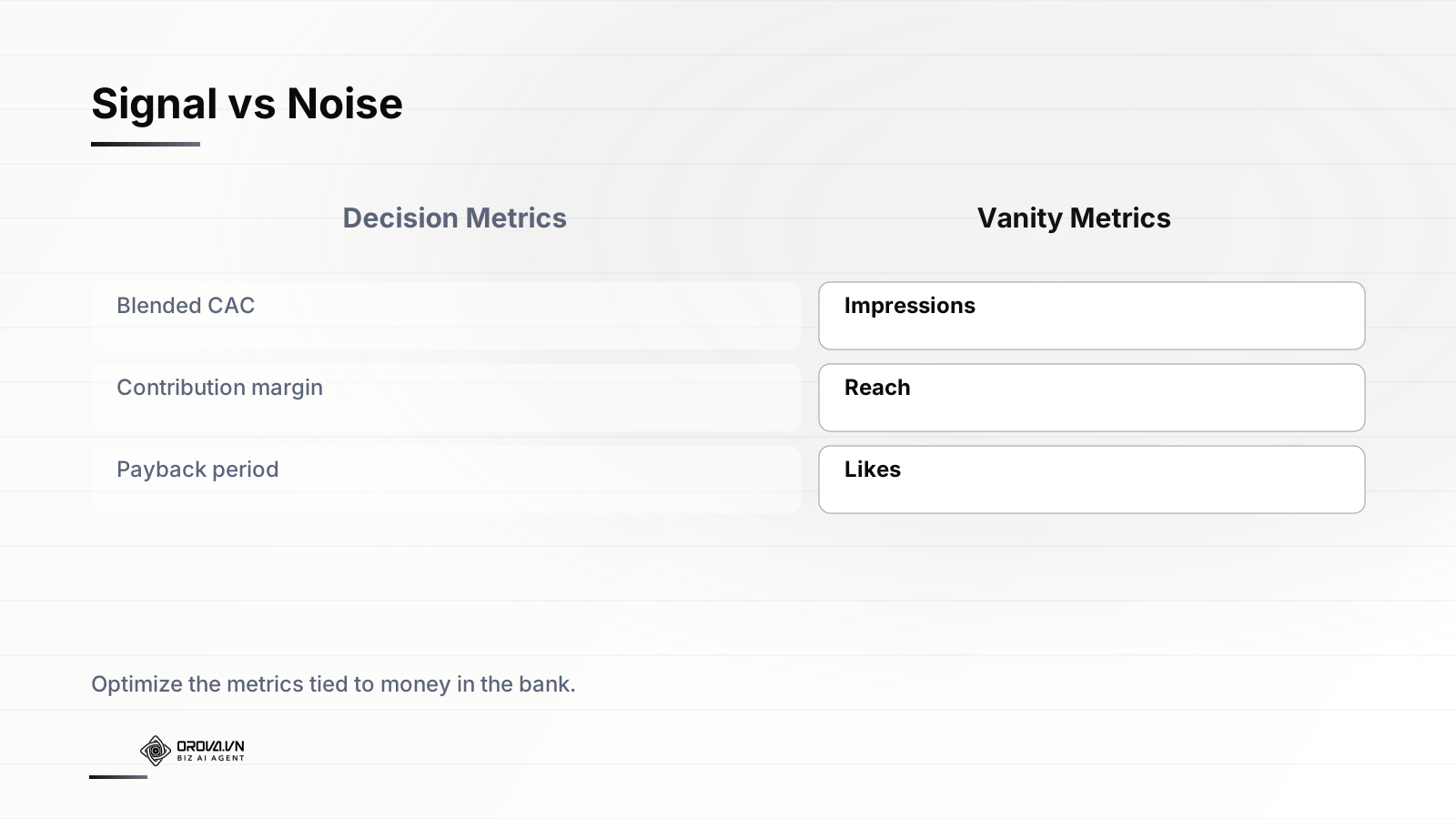
Demoting a metric does not mean deleting it. Impressions, reach, and engagement still have legitimate diagnostic uses. The point is to strip them of their power to drive budget decisions, because every one of them can improve while the business gets worse.
Impressions and reach
Impressions count how many times your ad was served; reach counts how many distinct people saw it. Both feel like progress because bigger numbers feel like more marketing happening. But neither has a stable relationship to profit. You can buy a billion cheap impressions in low-quality placements and move neither revenue nor margin. Impressions and reach matter only as inputs to a funnel whose output is measured in the north-star metrics, and they should be read as diagnostics, never targets. When a media buyer reports impressions as an achievement, that is a signal the metric hierarchy has slipped.
Clicks, click-through rate, and cost per click
These three are the most dangerous vanity metrics precisely because they sound like performance metrics. A high click-through rate and a low cost per click feel like efficiency. But clicks are a means, not an end, and they are trivially gameable. Broad, sensational creative and cheap, low-intent placements can manufacture clicks all day long. The account looks busy and efficient while the customers never arrive. The only honest use of click metrics is to diagnose why a north-star number moved: if blended CAC spiked, was it because clicks got more expensive, or because the click-to-customer rate collapsed? Useful question. Optimizing for cheap clicks as a goal in itself is how accounts drift into profitable-looking unprofitability.
Engagement, likes, shares, and video views
Engagement metrics are the comfort food of marketing reporting. They are abundant, they move easily, and they validate creative effort. They also have the weakest link to money of any metric on a dashboard. A post can rack up thousands of likes and shares and sell nothing; a quiet, unglamorous ad can outsell it tenfold. Engagement has a narrow legitimate role as an early creative diagnostic, a leading indicator that a concept resonates before you have enough conversion data to judge it. But the moment conversion data arrives, engagement should yield the floor. Treating it as a north-star metric is how teams end up optimizing for applause instead of revenue.
Platform-reported ROAS, taken at face value
This one is subtle because ROAS belongs in the north-star set, just not the version the platform hands you unreconciled. Every ad platform reports conversions through its own attribution lens, and those lenses overlap. Run Meta, Google, and TikTok together and each will claim a slice of the same purchases, so the sum of platform-reported ROAS overstates reality. The honest version is blended and reconciled against your own revenue records, ideally with an incrementality lens that asks how many of those conversions would have happened without the ad at all. Accept platform ROAS uncritically and you will scale campaigns that look profitable on the dashboard and lose money in the bank.
How to calculate the north-star set without fooling yourself
A north-star metric is only as trustworthy as the discipline behind its calculation. The same metric, computed two different ways, can tell two opposite stories. Here are the practical guardrails that keep the vital few honest.
Define the customer count from your own records, not the platform
For blended CAC, the denominator must come from your source of truth for money received, your commerce backend or CRM, not from the platforms. The platforms are answering a different question. They are telling you how many conversions their attribution model credits, which is structurally inflated. Your own records are telling you how many new customers actually paid you. Always anchor the denominator to the money.
Separate new from returning
Acquisition metrics must count new customers only. Mixing in repeat purchases flatters CAC and hides whether your advertising is actually growing the customer base or just harvesting people who would have come back anyway. Tag new versus returning at the point of purchase and compute acquisition metrics on the new segment exclusively. The returning cohort deserves its own retention analysis, but it does not belong in the acquisition math.
Compute margin before you compute return
Contribution margin should be calculated first, because it sets the break-even thresholds for every other metric. Your break-even ROAS is simply one divided by your contribution margin rate; your maximum tolerable CAC is your customer lifetime contribution discounted for payback risk. Teams that skip the margin work and jump straight to return metrics end up optimizing toward targets that have no relationship to their actual unit economics, which is how you get campaigns hitting their ROAS goal while losing money on every order.
Measure at the margin, report at the average
For scaling decisions, always reach for the marginal number, the return on the next increment of spend, not the campaign average. A clean way to estimate it without elaborate modeling is to look at how total value changed relative to how total spend changed across two recent periods, then judge that incremental ratio against your break-even threshold. The average is fine for a board slide; the margin is what you budget on.
Reconcile across platforms on a fixed cadence
Because each platform over-claims, you need a regular reconciliation that compares the sum of platform-reported conversions to your actual new-customer count, and then distributes the gap. A weekly or at minimum biweekly reconciliation keeps the blended numbers honest and prevents the slow drift where dashboards and the bank account quietly diverge until quarter-end forces a painful reckoning.
Turning the metric set into a working operating rhythm
Choosing the right metrics is necessary but not sufficient. The metrics only change behavior if they are wired into how the team actually works, week to week.
Put the four on one screen
The literal first step is to build a single view, one screen, that shows only blended CAC, contribution margin, marginal ROAS, and payback period, each with its target line and its trend. No impressions, no clicks, no engagement on this screen. Those live in a separate diagnostic view you open only when a north-star number moves. The physical separation matters more than it sounds, because what is on the main screen is what people optimize, full stop.
Set thresholds, not just targets
Every north-star metric should have a green, amber, and red band tied to unit economics, not to wishful thinking. Marginal ROAS green above break-even plus a buffer, amber within the buffer, red below break-even. Blended CAC banded against your maximum tolerable CAC. When a metric goes red, that is not a discussion item, it is a trigger for a specific action, whether that is pulling spend, reallocating budget, or pausing a campaign. Thresholds turn a passive dashboard into an active control system.
Review the right metric at the right altitude
Not every metric needs the same cadence. Marginal ROAS and blended CAC warrant daily or near-daily attention because budget and bid decisions happen at that frequency. Contribution margin is best reviewed weekly, once enough orders have settled and returns have stabilized. Payback period is a monthly or cohort-based metric because it inherently spans time. Matching the review cadence to the natural rhythm of each metric prevents both over-reacting to daily noise and under-reacting to slow-moving structural decline.
Make the agent report against your metrics, not the platform's
If you use automation or an AI layer to manage spend, the single most important configuration choice is which metrics it optimizes toward. Out of the box, most automated systems chase platform-native objectives, the same self-reported conversions and surface stats this article has spent two thousand words warning against. The leverage comes from pointing the automation at your reconciled, profit-linked north-star set instead, so that it scales the campaigns earning real contribution margin and pulls the ones bleeding it, rather than scaling whatever the platform happens to claim credit for. An automation that optimizes toward vanity metrics will efficiently destroy value; the same automation pointed at the vital few will compound it.
A short checklist to install the discipline this week
- List every metric currently visible on your primary dashboard, then run each through the three tests: does it move profit, can it be gamed, is it robust to platform self-reporting.
- Promote blended CAC, contribution margin, marginal ROAS, and payback period to a single dedicated screen with target lines and trends.
- Move impressions, reach, clicks, click-through rate, cost per click, and engagement to a separate diagnostic view used only for root-cause analysis.
- Anchor every acquisition metric's denominator to your own revenue records, counting new customers only.
- Compute contribution margin first and derive your break-even ROAS and maximum tolerable CAC from it.
- Set green, amber, and red thresholds on each north-star metric, with a defined action for each red trigger.
- Establish a weekly reconciliation comparing platform-reported conversions to actual new customers, and distribute the gap.
- Match review cadence to each metric: daily for marginal ROAS and CAC, weekly for contribution margin, monthly for payback period.
None of this requires new software or a bigger team. It requires the harder thing, which is the discipline to stop measuring everything and start measuring the few things that map to money. The accounts that win over a year are rarely the ones with the most impressive dashboards. They are the ones where everybody, from the media buyer to the finance lead, is looking at the same four numbers and pulling in the same direction.
The payoff of measuring the vital few
When a team aligns on a tight, profit-linked metric set, the second-order effects are larger than the metrics themselves. Decisions get faster because there are fewer numbers to argue about. Cross-functional trust rises because marketing and finance are finally reading from the same page. Spend allocation improves because budgets follow marginal return rather than average comfort. And the slow, invisible drift, where revenue climbs while profit erodes, gets caught in weeks instead of quarters because contribution margin and payback period are on the wall where nobody can ignore them.
The wall of 80 metrics will always be available when you need to diagnose something. But it should never be the scoreboard. Pick the four that move money, calculate them honestly, wire them into your operating rhythm, and let everything else recede into the diagnostic background where it belongs.
If you would rather not hand-build the reconciliation and threshold logic yourself, Orova Ads is an AI agent that manages paid campaigns across Google, Meta, and TikTok against the metrics that actually matter. It reads your account data every day, recommends budget, bid, audience, and on-off changes tied to profit-linked goals, and executes them with human-in-the-loop approval and a full audit log, so the vital few stay in control instead of the vanity stats.
Let the Numbers Watch Themselves
Building this discipline by hand takes real effort: pulling data out of three or four ad platforms, lining it up in a spreadsheet, recalculating it the same way every week, and catching yourself before a vanity metric sneaks back onto your radar. Most business owners start strong and quietly drop the habit within a few weeks simply because it is one more manual task competing for their attention.
Orova Ads is built to take that manual part off your plate, pulling the numbers together and keeping your short metric set consistent so you are not rebuilding the same tracking sheet every week. If that sounds useful, feel free to take a look and see whether it fits how you already work.
Orova Ads optimises campaigns for you
Connect Google, Meta and TikTok in one place. AI reads the numbers, proposes changes and executes under the rules you set.
Explore Orova Ads