
Blended CAC: The Number That Keeps You Honest
Add up what every ad platform claims it cost you to win a customer last month, and the math falls apart. Meta says it acquired 400 customers at $22 each. Google reports 350 at $19. TikTok logs 120 at $15. Add those up and you have 870 new customers for roughly $17,600. But your billing system only processed 610 genuinely new accounts that month, and your finance team wrote checks totaling $31,400 across media, agency fees, and the creative budget nobody attributes anywhere. The gap between those two stories is not a rounding error. It is the difference between a number designed to flatter the channel that produced it and a number that survives contact with your bank statement.
That second number has a name: blended customer acquisition cost. It is the least glamorous metric in your reporting stack and the only one that consistently tells the truth. In the example above, blended CAC is $31,400 divided by 610, or about $51.50 per customer — nearly triple what any single platform was willing to admit. If you have ever wondered why a quarter of "profitable" campaigns somehow produced a shrinking bank balance, blended CAC is where the answer lives.
What blended CAC actually measures
Blended CAC is deliberately blunt. You take every dollar you spent acquiring customers in a period and divide it by every new customer you actually gained in that same period. No attribution windows. No platform pixels. No clever modeling. Total cost over total customers.
Blended CAC = (all acquisition spend in the period) ÷ (all net-new customers in the period)
The power of the formula is in what it refuses to do. It does not ask which channel "deserves" credit for a conversion. It does not care whether a buyer saw a Meta ad, then searched your brand on Google, then clicked a retargeting banner before purchasing. Platform-reported CAC would let all three of those channels claim the same customer, and so the sum of platform-claimed customers routinely exceeds the number of humans who actually bought anything. Blended CAC counts each customer exactly once because it starts from your real customer count, not from any pixel's interpretation of events.
What counts as "spend"
Most teams underestimate the numerator. Honest blended CAC includes more than the media line item:
- Paid media across every channel — search, social, display, video, affiliate, retargeting.
- Agency and management fees, whether a flat retainer or a percentage of spend.
- Creative production — the cost of the photoshoots, video edits, and copy that the ads depend on.
- Tooling directly tied to acquisition: analytics platforms, attribution software, landing-page builders, ad-management subscriptions.
- The fully loaded cost of acquisition staff, if you want a true marketing CAC rather than a media-only number.
There is room for judgment here. Some teams report a "media-only" blended CAC for tactical decisions and a "fully loaded" blended CAC for board reporting. Both are legitimate, as long as you are consistent and you label which one you are quoting. The mistake is quietly switching between definitions so that the number always looks good in the room you happen to be standing in.
What counts as a "customer"
The denominator deserves the same scrutiny. Decide once whether you are counting net-new customers (excluding returning buyers and reactivations) or total new orders, and stick with it. For most businesses, net-new customers is the right denominator, because that is what acquisition spend is supposed to produce. Counting repeat purchases in the denominator deflates your CAC and hides whether your top-of-funnel is actually working.
Why platform CAC always looks better than reality
Ad platforms are not lying, exactly. They are optimizing for a story in which their channel looks indispensable, and the mechanics of attribution make that story easy to tell. Three forces conspire to make platform-reported CAC systematically too low.
1. Overlapping attribution double-counts the same buyer
Every platform claims credit using its own window and its own logic. Meta uses a 7-day click and 1-day view window by default. Google Ads attributes across its own conversion paths. TikTok counts its own attributed conversions. A single customer who interacted with all three before buying gets claimed by all three. None of them is wrong by its own rules, but the rules overlap, so the sum of "platform customers" can easily exceed your real customer count by 40 to 80 percent during periods of heavy multi-channel activity. Divide real spend by an inflated customer count and you get a CAC that is flatteringly, fictionally low.
2. View-through and brand demand get harvested by paid channels
A meaningful share of conversions credited to paid ads would have happened anyway. Someone already intent on buying searches your brand name, clicks the paid result sitting above the organic one, and the platform books a "conversion" at a great CAC — even though you paid to intercept demand you already owned. Branded search and view-through conversions are the most common culprits. They make individual campaigns look efficient while contributing little incremental revenue. Blended CAC is immune to this trick because it never asks the platform what it deserves; it only looks at total spend and total customers.
3. The cost line is incomplete
Platform CAC counts only what you spent on that platform. It ignores the retainer, the creative budget, the attribution tool, and the salary of the person managing the account. Even if attribution were perfect, platform CAC would understate the real cost of acquisition simply because most of the supporting cost lives outside the ad account.
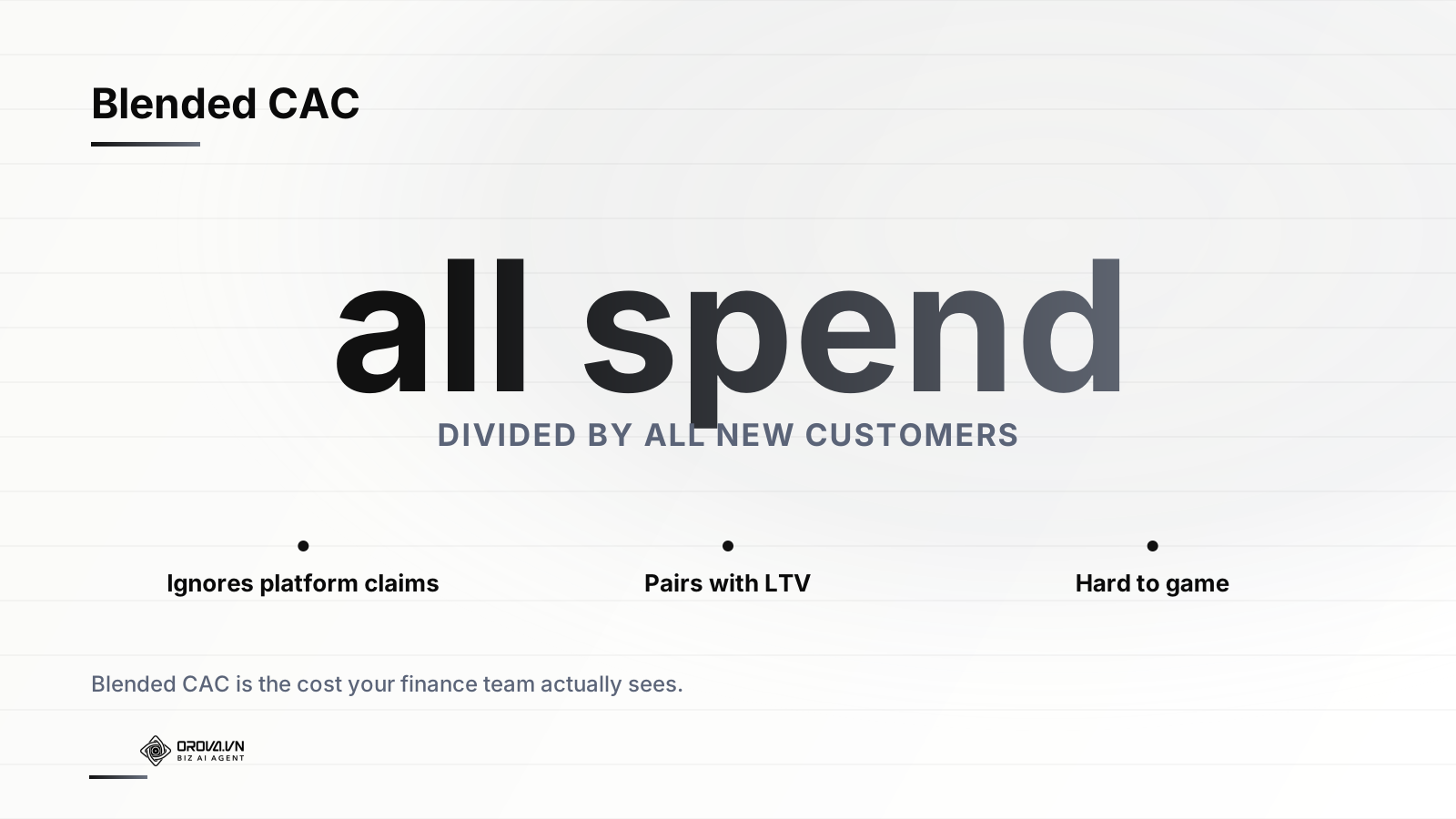
The cumulative effect is predictable. Sum your platform-reported CACs, weight them by spend, and compare the result to your blended CAC. In healthy multi-channel programs the blended figure usually runs 1.5x to 3x higher than the spend-weighted platform average. That multiple is not a sign your team is failing. It is the tax of attribution overlap, branded harvesting, and the costs platforms never see — and it is exactly why you need one honest number sitting above all the channel-level ones.
Blended CAC as your north star, platform metrics as your steering wheel
Here is where teams get the relationship backwards. Some declare blended CAC the only metric that matters and stop looking at channel data entirely. Others live inside the ad managers, optimizing each platform's reported CAC, and never check whether the whole machine is profitable. Both are mistakes. The two layers do different jobs.
Blended CAC answers "are we winning?" It is the verdict. It tells you, across the entire business, whether your acquisition engine is becoming more or less efficient. Because it is hard to game — no attribution choice can move it — it is the number you report to leadership and the one you track as a trend line month over month. If blended CAC is rising while revenue is flat, something is wrong no matter how green every campaign dashboard looks.
Platform CAC answers "where should the next dollar go?" It is the steering input. You cannot allocate budget across channels using a single blended figure, because blended CAC has no opinion about which channel is pulling its weight. For allocation, directional channel-level signals are exactly what you need — which campaigns are scaling efficiently, which audiences are saturating, which creatives are fatiguing. You just have to remember those numbers are relative and self-flattering, useful for comparison within a platform far more than as absolute truths.
The discipline is to let blended CAC adjudicate and let platform metrics guide. When the two disagree — every campaign looks profitable but blended CAC is climbing — trust the blended number and start hunting for the overlap. Usually you will find two channels claiming the same customers, or a branded-search campaign harvesting demand you already had. This is also why the broader debate about which efficiency metric to optimize matters; if you are weighing cost-per-acquisition against return on ad spend, our breakdown of CPA versus ROAS as your primary metric pairs naturally with a blended-CAC north star, because both are attempts to keep channel-level optimization honest about whole-business outcomes.
The number blended CAC is incomplete without: LTV
A CAC of $51 means nothing on its own. Spending $51 to acquire a customer who pays you $40 once and never returns is a disaster. Spending $51 to acquire a customer who will pay you $600 over three years is one of the best investments your company can make. CAC only becomes a decision when you pair it with lifetime value.
The CAC:LTV ratio
The standard health check is the LTV-to-CAC ratio: how much gross profit a customer generates over their lifetime divided by what it cost to acquire them. The commonly cited benchmarks are rough but useful:
- Below 1:1 — you lose money on every customer. Unsustainable without external funding.
- Around 1:1 to 2:1 — thin margins; you may be growing but barely paying for the privilege.
- Roughly 3:1 — the textbook healthy target for many subscription and e-commerce businesses. Enough margin to fund operations and reinvest.
- 5:1 or higher — often a signal you are under-investing in acquisition and leaving growth on the table by being too conservative.
Use LTV measured in gross profit, not revenue. A customer worth $600 in revenue at a 30% margin contributes $180 in gross profit, and that $180 is what your CAC has to come out of. Reporting LTV in top-line revenue is the most common way teams accidentally convince themselves a ratio is healthy when it is underwater.
Payback period: the cash-flow cousin
The ratio tells you whether the unit economics work; payback period tells you whether you can survive the wait. It measures how many months of customer gross margin it takes to recover the blended CAC. A 3:1 LTV:CAC ratio is little comfort if it takes 18 months to recoup the acquisition cost and you are spending the money today. For most subscription businesses a payback period under 12 months is comfortable; under 6 months is excellent and lets you grow largely from recovered cash.
How to actually calculate and operationalize blended CAC
The concept is simple; the operational discipline is where most teams slip. Here is a workable process.
- Define your period and freeze it. Monthly is standard for reporting; weekly works for fast-moving e-commerce. Whatever you pick, use the same window for spend and for new customers so you are not dividing March spend by February customers.
- Assemble total spend from the source of truth. Pull media spend from each platform, then add agency fees, creative costs, and tooling from your finance records — not from the ad accounts. The numerator should reconcile to what your finance team actually paid.
- Count net-new customers from your own system. Your CRM, billing platform, or order database is the authority, never a platform pixel. Exclude returning buyers if you are measuring acquisition.
- Divide, then chart the trend. A single month's blended CAC is noise. The trend over six to twelve months is the signal. Watch the direction, not the decimal.
- Track it beside LTV and payback. Blended CAC alone can mislead — it might rise because you are deliberately acquiring higher-value customers. Always read it next to LTV:CAC and payback period.
Common mistakes that corrupt the number
- Timing mismatches. Spend in one period produces customers in the next, especially for considered purchases. For long sales cycles, use cohort-based CAC — tie spend to the customers it eventually produced — rather than a naive same-month division.
- Quietly shifting the definition. Reporting media-only CAC when you want a low number and fully loaded CAC when you want to justify a budget cut. Pick a definition and document it.
- Mixing revenue and gross-profit LTV. The single fastest way to fool yourself about whether a ratio is healthy.
- Ignoring blended because the platforms look fine. Green dashboards and a rising blended CAC is the most common failure pattern, and it is always attribution overlap or demand harvesting hiding in plain sight.
Why blended CAC is hard to game — and why that matters
Every metric that can be gamed eventually is, especially when bonuses or budgets depend on it. Platform CAC is trivially gameable: shift spend toward branded search, lean into retargeting, extend the attribution window, and the reported number improves while incremental customers do not. None of those moves touch blended CAC. You cannot make blended CAC look better by reallocating credit, because it never asks about credit. The only way to improve it is to genuinely spend less or genuinely acquire more customers. That ungameability is precisely what makes it trustworthy as a north star and as the figure you put in front of investors and leadership.
This is also why blended CAC is the natural objective for automated optimization. When software tunes campaigns toward a platform-reported target, it can chase a flattering number into an unprofitable corner — driving down reported CPA by harvesting branded demand while real, incremental cost per customer quietly climbs. Optimization that respects the blended number, and that reconciles channel activity against actual customer counts and real total spend, is far harder to fool. The honest metric and honest optimization reinforce each other.
Worked example: reading the gap between the two numbers
Abstractions are easy to nod along with and hard to act on, so walk through a concrete month. Imagine a direct-to-consumer brand running three channels. Meta spends $12,000 and reports 545 conversions at a CAC of $22. Google spends $6,650 and reports 350 conversions at $19. TikTok spends $1,800 and reports 120 conversions at $15. Sum the platform-reported customers and you get 1,015, with a spend-weighted average platform CAC of about $20. By the dashboard, this is a triumph.
Now bring in the numbers the dashboards never see. The agency retainer is $4,000. Creative production for the month ran $3,200. The attribution and landing-page tools cost $750. So total acquisition spend is not $20,450 of media — it is $28,400 once you load in the costs finance actually paid. Meanwhile the billing system records 640 genuinely new customers, not 1,015, because the platforms collectively double-counted 375 buyers who touched more than one channel before purchasing.
Blended CAC is $28,400 divided by 640, or $44.40. Against a spend-weighted platform CAC of roughly $20, the blended figure is 2.2x higher. That multiple is the whole lesson in one number. If this brand had set its budgets and its profitability assumptions on the $20 figure, it would have been planning around a cost less than half of what each customer truly costs to acquire. Stretch that error across a year of aggressive scaling and it is the kind of mistake that ends with a board meeting nobody enjoys.
What the gap tells you to do next
A 2.2x gap is not automatically a problem — some overlap is the natural texture of multi-channel marketing. But it is a prompt. Pull the two channels with the most attribution overlap and run a holdout or geo test: pause one in a region and watch whether total customers actually fall or whether the other channel simply absorbs the demand. If pausing TikTok in three test markets barely dents total new customers while platform reporting insisted TikTok was driving 120 acquisitions, you have just learned that much of TikTok's reported CAC was claiming credit for customers other channels would have won anyway. That is incrementality testing, and it is the natural follow-up whenever blended and platform numbers diverge sharply.
Blended CAC across different business models
The formula is universal, but what makes a "good" blended CAC depends entirely on your economics. Holding every business to the same benchmark is how teams either panic over a healthy number or celebrate a dangerous one.
Subscription and SaaS
For recurring-revenue businesses, blended CAC pairs most naturally with payback period, because cash flow is the binding constraint. You are fronting the full acquisition cost today against revenue that arrives in monthly slices. A SaaS company with a blended CAC of $1,200 and a customer paying $150 a month at 80% gross margin recovers that cost in ten months of margin — comfortable, if churn is low enough that the customer stays well past payback. Here the danger is celebrating a low CAC while ignoring a churn rate that means customers leave before they ever turn profitable. Always read blended CAC, payback, and churn as a single picture.
E-commerce and direct-to-consumer
For e-commerce, the first-order purchase often does not cover CAC, and the whole model rests on repeat purchase behavior. A blended CAC of $44 against a $60 average first order at 35% margin means the first purchase contributes $21 in gross profit and loses $23 against acquisition cost. The business only works if a healthy fraction of those customers buy again. This is why DTC teams obsess over second-order rate and 90-day LTV: blended CAC sets the bar, and repeat behavior determines whether you clear it. Reporting blended CAC without a cohort LTV curve beside it is meaningless in this model.
High-consideration and B2B
For long sales cycles — enterprise software, financial services, big-ticket purchases — the same-period division breaks down badly. Spend in January generates pipeline that closes in April. A naive monthly blended CAC will swing wildly and tell you nothing. Switch to cohort-based blended CAC: attribute spend to the customers it eventually produced, even months later, and measure CAC by acquisition cohort rather than by calendar. It is more work and the numbers arrive late, but a late honest number beats a prompt fictional one.
How blended CAC changes the conversations you have
Adopting blended CAC as your north star is not only an analytics change; it changes the politics of marketing. When every channel owner is measured on their own platform's CAC, the incentives push toward whatever inflates that channel's reported numbers — more retargeting, more branded search, longer attribution windows. Each owner can hit target while the business loses ground, and nobody is technically wrong.
Anchoring the team to blended CAC realigns those incentives. Now the question is not "did Meta hit its CAC?" but "is the whole machine getting more efficient?" Channel owners stop competing to claim the same customers and start collaborating on incremental contribution. The metric that cannot be gamed becomes the metric that cannot be argued with, which is exactly what you want when budget season arrives and everyone has a story about why their channel deserves more.
It also reframes the relationship with platform sales reps and agencies. Both have a structural interest in the flattering channel-level numbers. When you lead every conversation with blended CAC and incrementality, you stop being sold to on the basis of attribution artifacts and start making decisions on the basis of what actually moved your customer count. The platforms remain genuinely useful for execution and steering — you simply stop letting their self-reported scorecards set your strategy.
Putting it together
Run two numbers every month. The first is blended CAC: every dollar of acquisition spend divided by every net-new customer, drawn from finance and your CRM rather than from any pixel. The second is your LTV:CAC ratio in gross-profit terms, with payback period beside it. Those two figures are your verdict — they tell you whether the acquisition engine is healthy and whether it is getting better or worse. Keep your platform dashboards too, but demote them to what they are good at: steering the next dollar to the channel showing the strongest relative signal. Let the blended number judge and the platform numbers guide, and you will stop being surprised when a quarter full of "profitable" campaigns ends with a smaller bank balance.
If keeping blended CAC honest across Google, Meta, and TikTok sounds like more reconciliation than your week has room for, that is exactly the work Orova Ads takes on — an AI agent that reads your spend and conversion data every day, recommends the budget, bid, audience, and on/off changes that improve real efficiency, and executes them with your approval and a full audit log so the truthful number, not the flattering one, stays in charge.
Run your business with AI Agents
Orova is the always-on Biz AI Agent — it plans, runs, and optimizes the work for you. Save time, unlock productivity.
Try it free