
SEO Content Outline: A Simple 5-Step Brief Process
You open a blank document, stare at the cursor, and start typing whatever comes to mind. Halfway through, you realize you have no idea what the article should actually cover, so you stop, search for the topic again, skim a few competitor pages, then come back and rewrite what you already wrote. This is what happens when you write without a seo content outline — a simple plan that lists what points the article needs before anyone starts writing.
The old way most small teams work is: write first, fix later. A writer drafts the whole piece, then someone else reads it and says it's missing key points, or it doesn't answer what people are actually searching for, so it goes back for another round of edits. This costs far more time than it looks like on the surface, because every fix means re-reading, re-writing, and re-checking the same article multiple times. That waste matters more than ever now that 68% of US Google searches ended without a click in the first four months of 2026, up from 60% in 2024, according to SparkToro — meaning the content you do publish has to earn its place on the page, not just exist.
This article gives you a straightforward, five-step way to build a content brief before writing even begins. By the end, you'll know exactly what to prepare, what should go into that brief, and how to turn it into an outline any writer can follow — so your team spends less time guessing and fixing, and more time producing content that's actually ready to publish.
Building a house with no blueprint
Imagine hiring a builder and handing over no blueprint — just "build me a nice house". However skilled, they'll build the house in their head, not yours. Walls in the wrong place, rooms with no doors, a crooked staircase. A few demolitions and rebuilds later, you've burned time and money, and it's still off. The whole project is chaos for lack of one cheap thing that decides everything: the blueprint.
Writing an SEO article with no content brief is exactly that. The writer (even if it's you) sits down with a fuzzy topic, writes on instinct, rambles, misses key points — then realizes it's off-intent and rewrites from scratch. A "blueprint" before writing saves you hours of fixing and gets the article on-target the first time.
This article shows how to draw that blueprint: what a content brief is (and how it differs from an outline), why one brief is worth hours of fixing, the 5-step process, the components of a good-enough brief, how to turn the outline into a writeable skeleton, and how a brief lets you delegate to another writer (or AI) and still get what you wanted.
What is a content brief? A short "blueprint" for one article, made before writing a single word. It answers: which keyword this targets, for whom (what intent), which sections it covers (the outline), how long, what competitors are saying, and how yours beats them. With a brief, the writer just "colors in the blueprint" instead of drawing and coloring at once.
Why one brief is worth hours of fixing
A brief sounds like extra work, but it saves more than it costs.
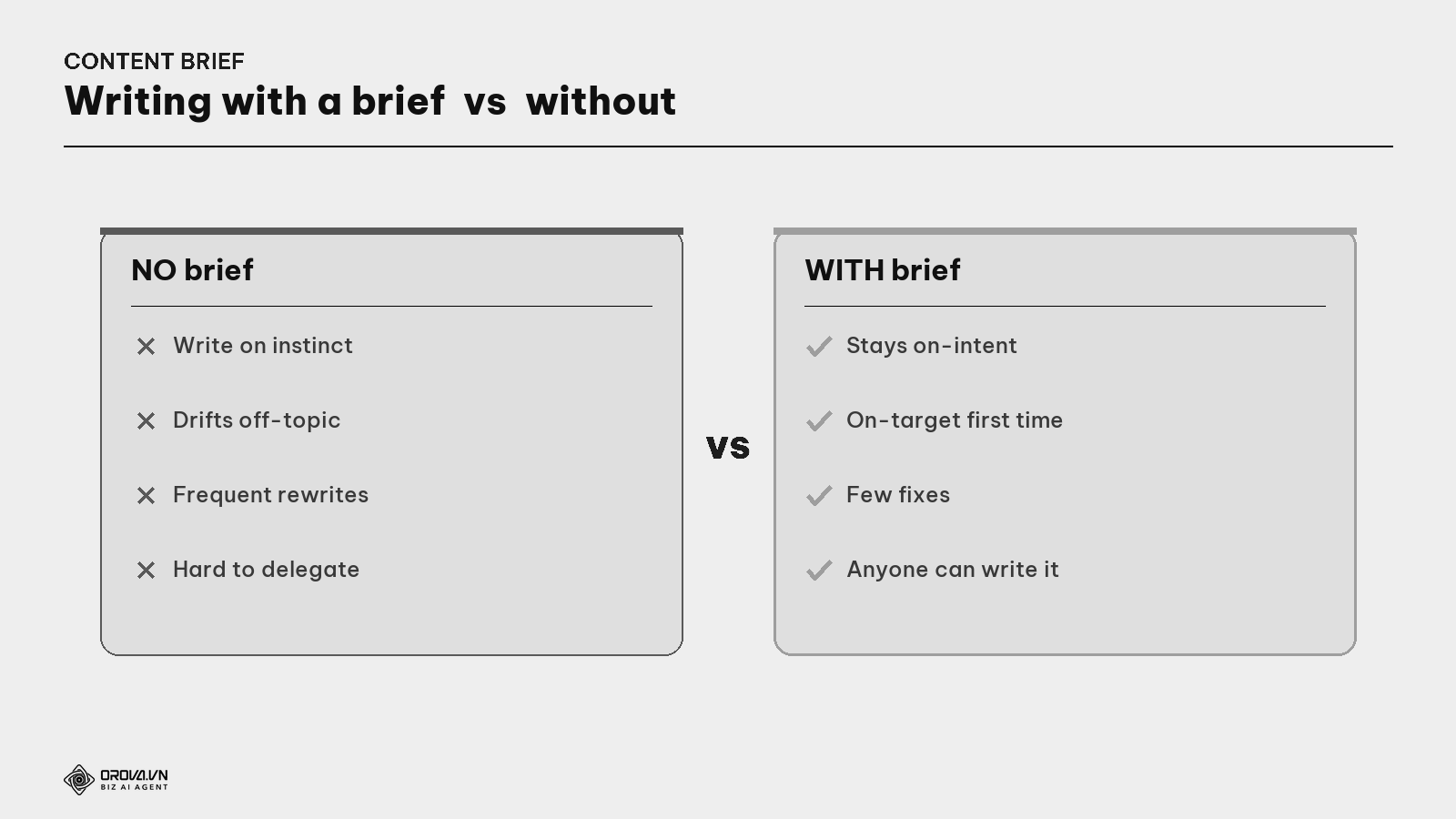
- No drifting off-topic. The brief locks the keyword and intent, so the article stays on the searcher's need instead of wandering with your train of thought.
- No rewrites. Most "rewrite from scratch" comes from not thinking hard enough before writing. A brief moves the thinking up front, where fixing is far cheaper.
- Hand it to anyone. With a clear brief, you can hand the article to another writer (or an AI Agent like Orova) and still get what you wanted — because the blueprint says it all.
How does a brief differ from an outline? The outline is part of the brief — the list of H2/H3 headings (the article's skeleton). The brief is broader: beyond the outline it has the keyword, intent, differentiator, questions to answer, internal links, and call to action. The brief is the whole blueprint; the outline is the skeleton within it.
The 5-step process to build a content brief
A brief isn't a thick document. The core is deciding a few important things up front.
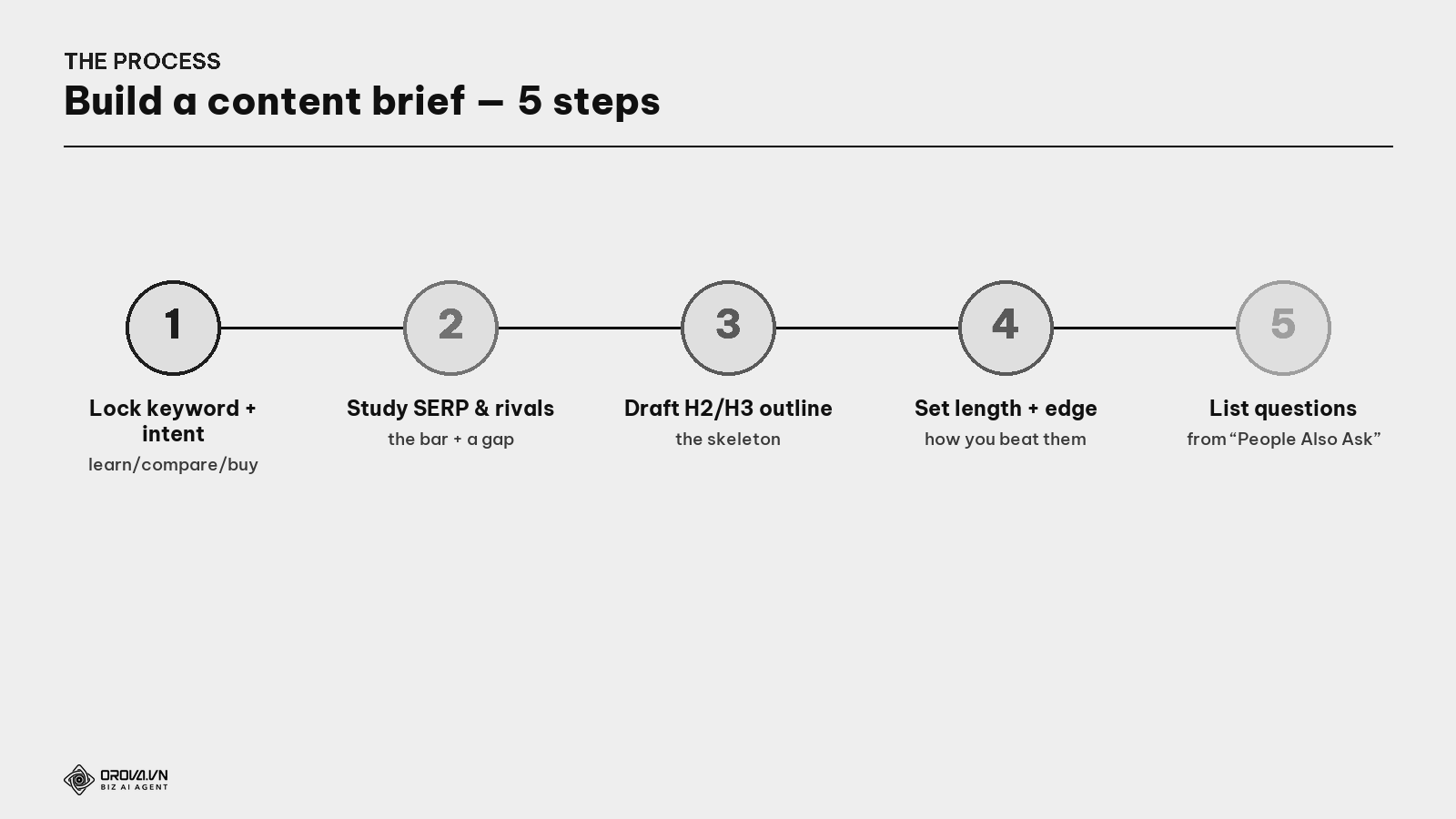
Step 1 — Lock the main keyword + intent. Each brief serves one main keyword + one clear intent (learn/compare/buy — see the Search Intent guide). Intent decides the article format.
Step 2 — Study the SERP & competitors. Search the keyword, look at the top 5–10 results: how long, what sections, what they miss (see the Keyword Gap guide). Not to copy — to learn the "bar" Google rewards, then beat it.
Step 3 — Draft the outline in H2/H3. Based on intent + what competitors cover + the questions people ask, list the article's sections as H2 (main) and H3 (sub).
What are H2 / H3? Heading levels in an article. H2 = main, H3 = sub. An outline is just the list of H2/H3 — the skeleton before you add flesh.
Step 4 — Set length + differentiator. Length matches or slightly exceeds the top pages (enough to fully cover, not padding). More important: write down how yours beats them — a fresh angle, exclusive data, real examples, first-hand experience.
Step 5 — List the questions to answer. Pull from "People Also Ask" and Google suggestions (see the Question Keywords guide). Each question is a potential H2 and a shot at the answer box.
What goes in a content brief?
These are the components of a brief that's lean but complete. No software needed — a table or a note will do.
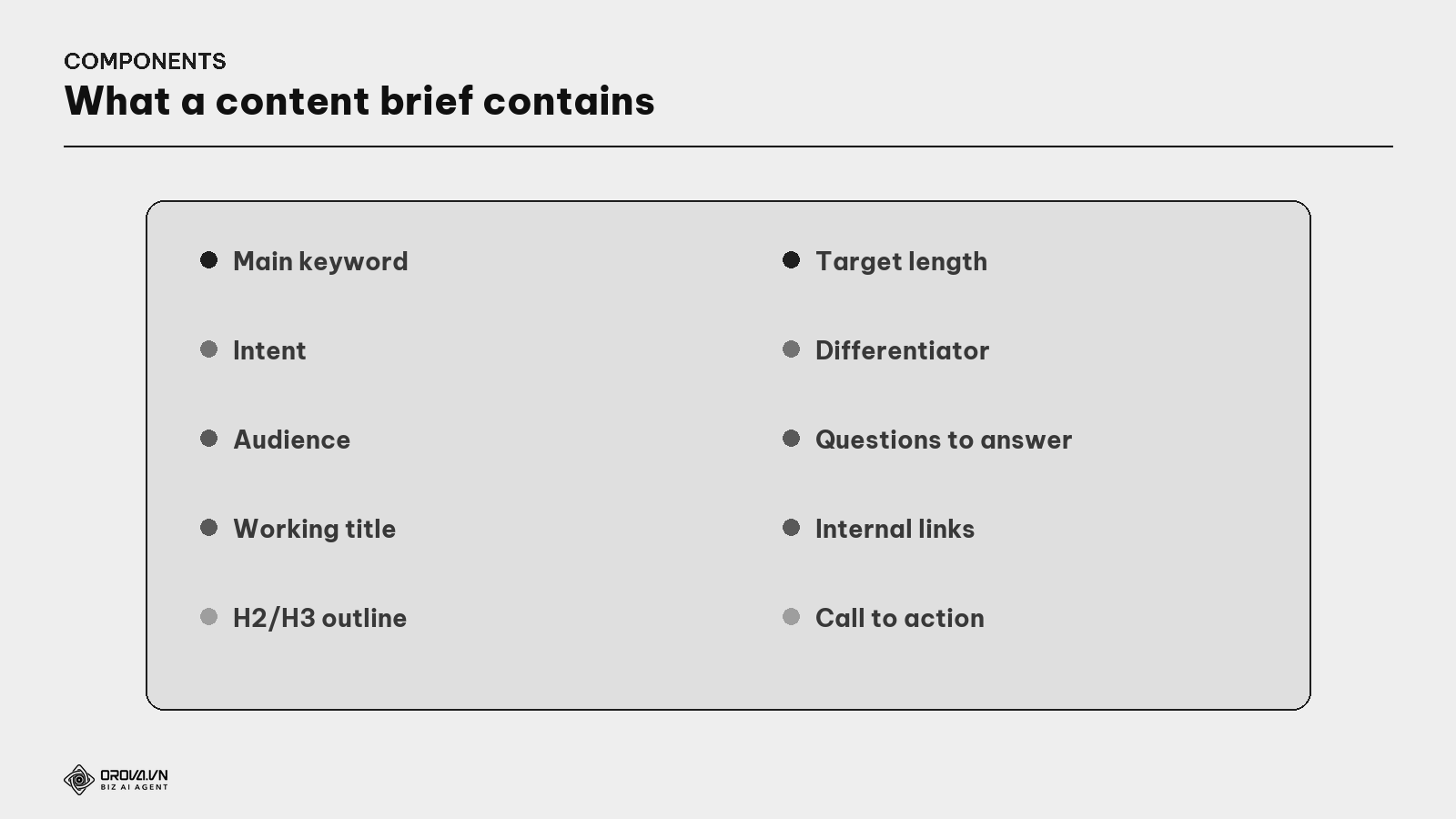
- Main keyword + a few same-intent variations.
- Intent (learn/compare/buy) and audience (beginner or expert).
- Working title (contains the keyword, compelling).
- H2/H3 outline — the skeleton.
- Target length (referenced to the top pages).
- Differentiator — how yours is better.
- Questions to answer (from "People Also Ask").
- Internal links to add (to/from which cluster articles — see the Internal Linking guide).
- Call to action (CTA) at the end.
The clearer these are, the fewer fixes the finished article needs.
Outline: turning the brief into a writeable skeleton
Within the brief, the outline is the most important part — it's what the writer follows line by line.
How to build a good one:
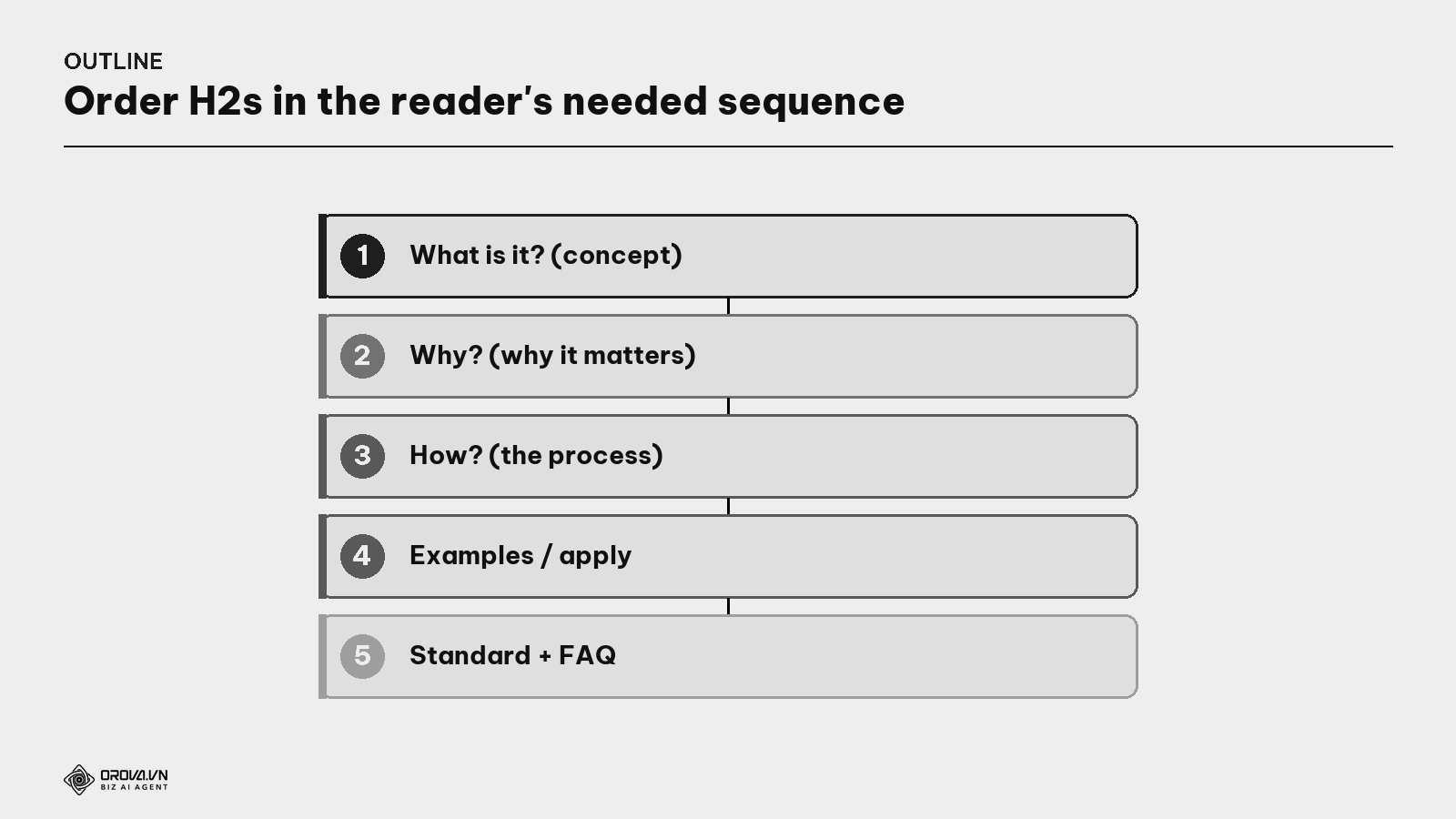
- Open with the core question/need, then order the H2s in the sequence the reader needs — "what is" → "why" → "how" → "examples/apply".
- Each H2 targets one sub-point/question, no overlap (avoid cannibalizing within one article — see the Cannibalization guide).
- Insert PAA questions as H2/H3 to both cover the topic and chase the answer box.
- Mark spots for examples, data, visuals in the outline — so the writer remembers depth.
"Pass" standard for an outline: skimming the H2s, a stranger understands what the article will say and in what order; no two H2s overlap; there's a place for the "differentiator" (new angle/data/example).
The real power of a brief: delegate while staying consistent
This is a benefit many under-use.
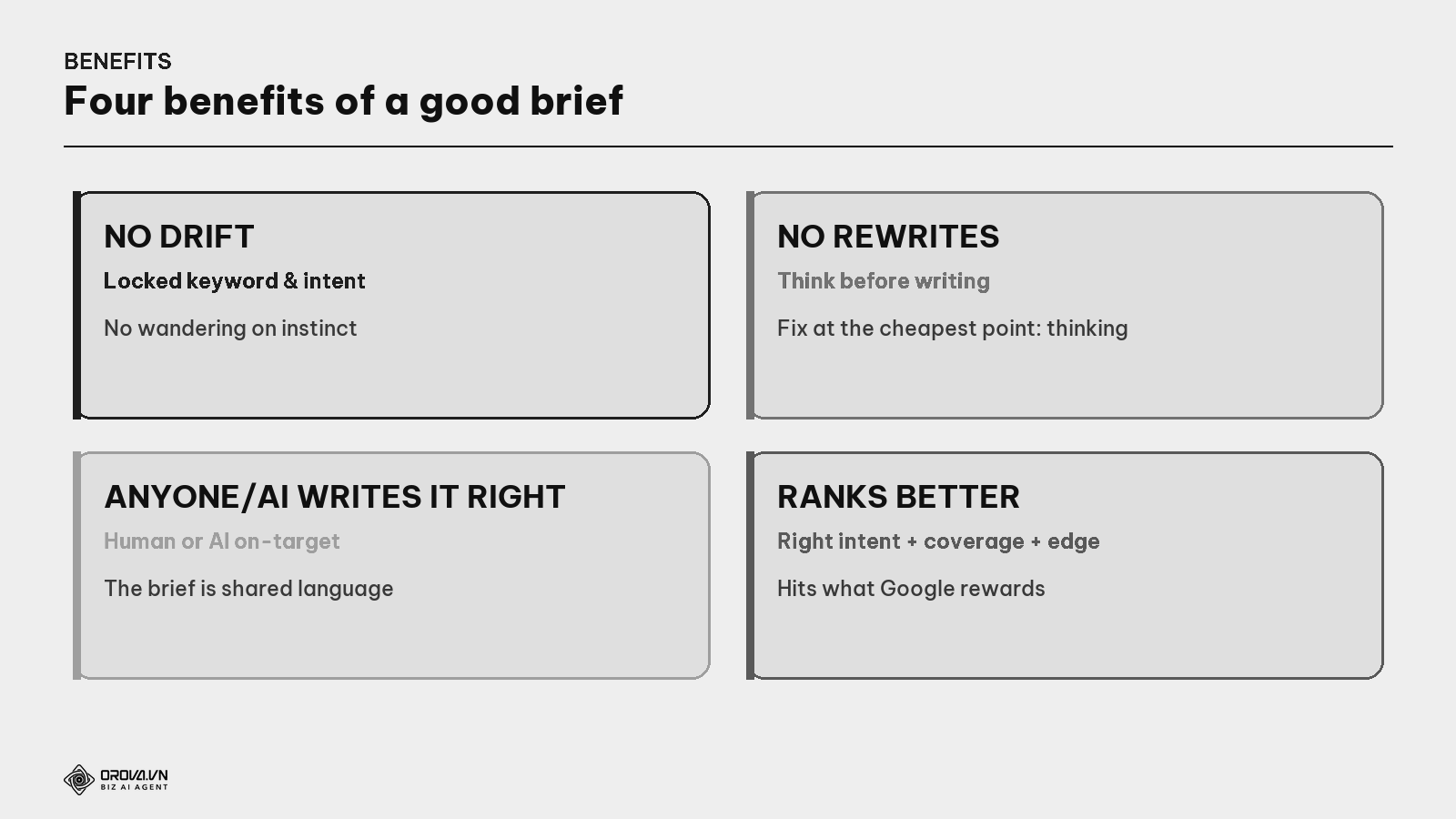
With a clear brief, you can hand the article to several different writers — or an AI Agent — and all produce the same quality, the same direction. This is how a small team (or one person + AI) produces content consistently without chaos: the brief is the "shared language" keeping everyone on one blueprint. Without it, each writer goes their own way and the editor fixes every article — many times the cost.
Process & "pass" standard
Rolled into steps:
- Lock keyword + intent (one article, one intent).
- Study the SERP & competitors for the bar + a gap.
- Draft the H2/H3 outline in the reader's needed order.
- Set length + the differentiator clearly.
- List questions to answer from PAA.
- Add internal links + CTA, then hand off.
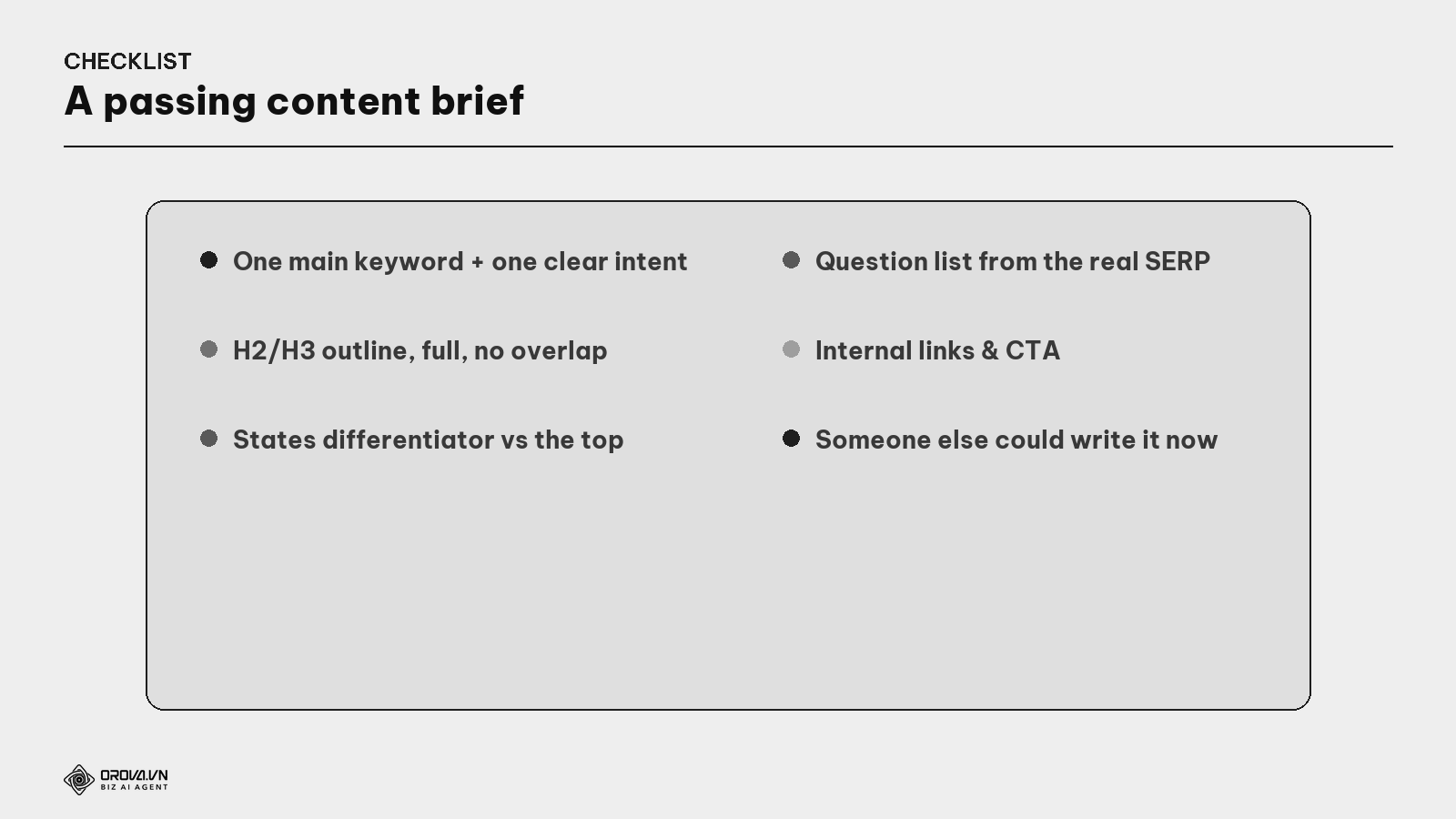
"Pass" standard: the brief has one main keyword + one clear intent; an H2/H3 outline fully covering the topic, no overlapping sections; states the differentiator vs the top; has a question list from the real SERP; has internal links + CTA; and someone else (or AI) could pick it up and write immediately without asking back. Meet these and you've pushed all the "thinking" before the writing — where fixing is cheapest.
Benefit: a brief takes 15–30 minutes but saves hours of fixing and rewriting. It moves the hard part (thinking) up front, where fixing is far cheaper than fixing a finished draft; gets articles on-target the first time; and lets you multiply output by delegating while keeping quality even. It's the difference between "writing as you go" and "producing content like an assembly line with a blueprint".
FAQ
Doesn't making a brief slow down writing? The opposite. A brief takes 15–30 minutes but saves hours of fixing and rewriting. It moves the hard part (thinking) up front, where fixing is far cheaper than fixing a finished draft.
If I write alone, do I need a brief? Yes — even more so. A brief keeps you from drifting mid-article, and is where you "argue with yourself" about the angle before spending effort writing.
How is a brief different from an outline? The outline is part of the brief — the list of H2/H3. The brief is broader: beyond the outline it has the keyword, intent, differentiator, questions, internal links, and CTA.
Do I need software for briefs? No. A table or note is enough. Paid tools (like Semrush's or Frase's content brief features) auto-suggest points to cover, handy at scale — but not required.
How long should a brief be? Long enough that the writer doesn't have to guess, no more. A few lines per component is enough; what matters is clear intent, clear outline, clear differentiator, not a long brief.
Is making a brief for AI-written articles different? Not in components — just clearer and more specific, since AI follows your direction exactly. The clearer the brief, the closer the AI draft to target, the less you fix (see the AI Content guide).
Which step in briefing matters most? Study the SERP + lock the intent. These decide whether the article is the right type of thing searchers want — the foundation of everything. A great outline and perfect length mean nothing if the intent is wrong from the start.
Back to the house with no blueprint
Remember the house built with no blueprint? Skilled builder, good materials, but with no blueprint it was built and rebuilt, costly and still off. One cheap blueprint drawn up front would have avoided it all.
The content brief is that blueprint for each article. Spend half an hour "drawing" first — locking keyword, intent, outline, differentiator — and you save hours of "demolish and rebuild", with the article on-target the first time. More importantly, you turn writing from "sit down and hope" into "build to the blueprint" — consistent, delegable to a person or AI, always producing what you wanted. That's the difference between a lone craftsman and a real content production line.
This article is part of Orova's complete SEO guide series. It's a deep-dive within the cluster — see "Search Intent", "Keyword Gap", "Question Keywords", "Writing SEO Content", and "Using AI to Write Content" for the full picture. Get started with Orova at orova.vn/en/seo.
Sources
Google Search Central (creating helpful content, understanding intent) · Semrush & Frase (content brief guides) · Backlinko (SERP analysis & content length).
Stop Rewriting, Start Delegating
Building a proper brief by hand, every single time, for every single article, takes real effort — pulling together search intent, competitor points, structure, and formatting notes all takes time you probably don't have to spare, especially if you're publishing regularly.
Orova SEO is built to handle this part for you, turning the groundwork of a content brief into something ready in moments instead of hours. If you'd rather spend your time reviewing finished work than assembling briefs from scratch, it's worth taking a look at how Orova SEO can do that groundwork for you.
Let Orova SEO handle the repetitive part
Keyword research, drafting, refreshing old posts and rank tracking — running automatically on your own site.
Explore Orova SEO