
Writing SEO Content That Ranks AND Converts (Complete Guide)
The article that "ranks but nobody buys"
There's a quiet pain many content creators hit: the article reaches Google's first page, the read count looks dreamy — yet at month's end, not a single order came from it. Visitors come, read, leave. Like a shop packed with browsers but an empty checkout: it looks successful, but makes no money.
This is the trap of writing content just to "rank" while forgetting the real goal. A proper SEO article must do two jobs at once: rank (so people see it) and lead the reader to action (so it converts). Without the first, no one sees it. Without the second, crowded but broke.
This guide shows how to write an article that does both: what Google rewards and punishes in 2026, the skeleton of a proper article, how to optimize keywords without stuffing, how to win the "answer box" on top of results, how to add depth to fight "thin content", and why bottom-of-funnel content is where money actually comes from.
What is proper SEO content? Content written to both rank well on Google (right intent, deep enough, clear structure) and serve real readers and lead them to action. Not "writing for the machine" nor "writing well but aimless" — but balancing both.
What Google rewards and punishes in 2026
Before writing a word, know the "rules". Since folding its Helpful Content system into the core algorithm, Google scores quality continuously, and the pattern is clear.
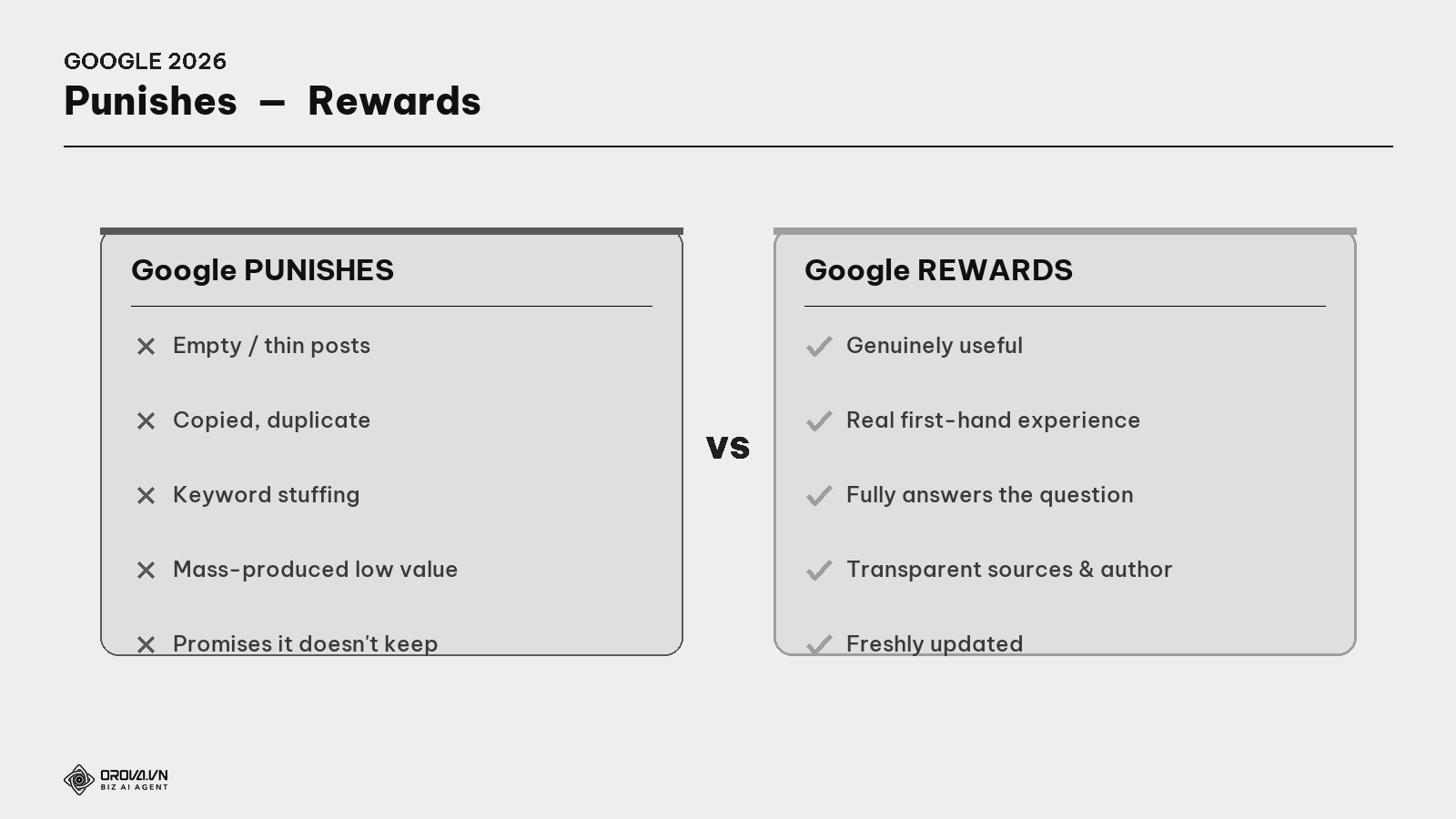
What is Helpful Content? Google's system that favors useful, people-first content and demotes content made just to rank. It's now in the core algorithm, scoring whole-site quality continuously — so a pile of thin articles can drag the whole website down.
The rule behind it all: write for a real human with a real problem, not for a robot you imagine. Every technique below is just a way to serve that rule.
What is E-E-A-T? Four letters Google uses to judge trust: Experience (first-hand), Expertise, Authoritativeness, Trust (the most important). Naming the author, citing sources, showing real experience all feed E-E-A-T (see the dedicated E-E-A-T guide).
The anatomy of a proper article: the skeleton decides everything
A good article isn't a wall of text. It has a skeleton serving both the reader (easy to scan) and Google (easy to understand).
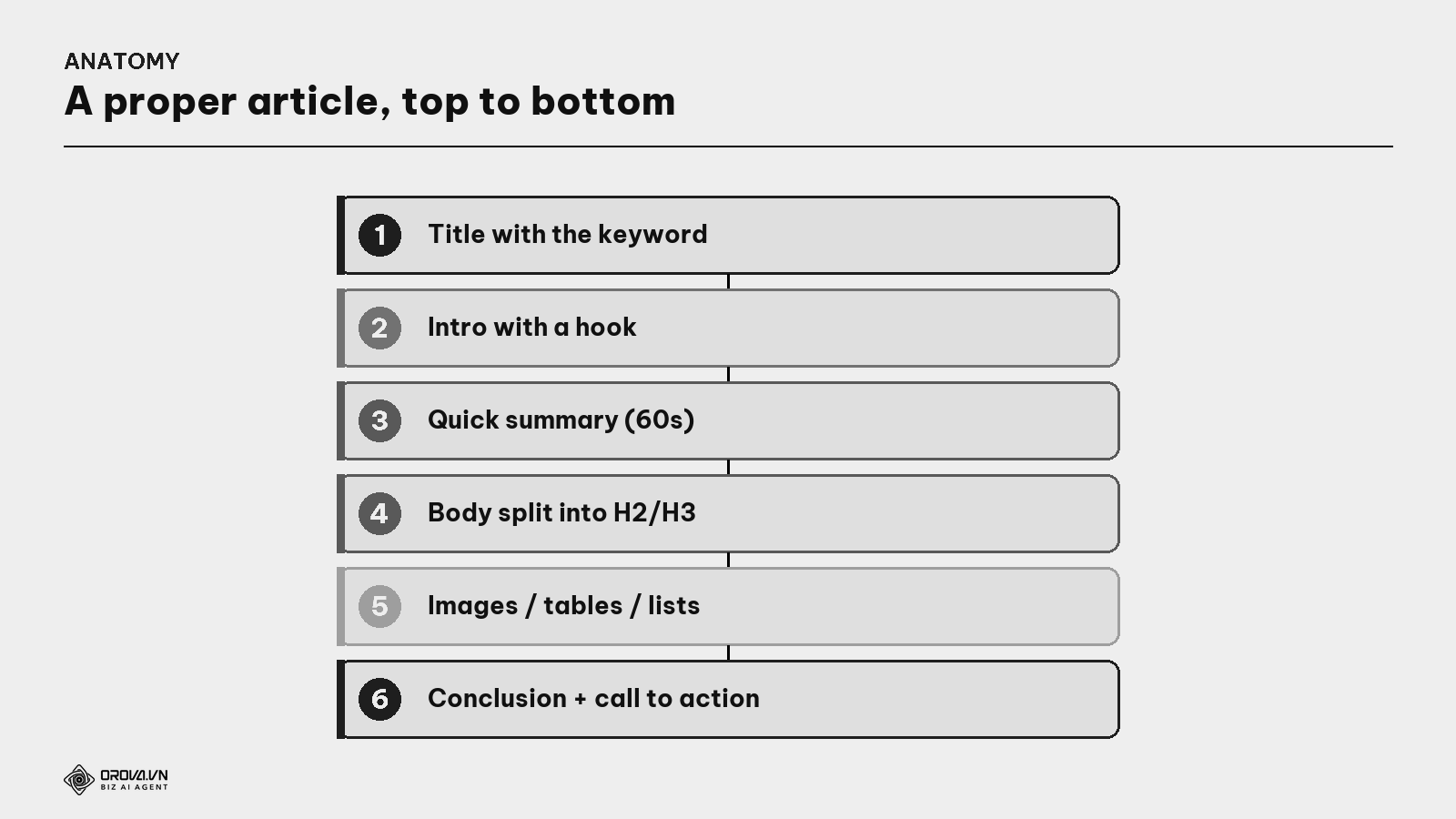
- Title with the keyword. Clear, contains the searched phrase, tempting enough to click.
- An intro that hooks. The first lines must earn the next — a relatable problem, a surprising fact, a promise of value.
- A quick summary. A "read it in 60 seconds" block up top (don't label it with jargon — just call it a quick summary).
What are H2 / H3? Heading levels in an article. H2 = main sections, H3 = sub-points. Like a table of contents, they help readers and Google grasp the structure at a glance.
- Body split into H2/H3. Break content into clearly titled sections to scan and jump.
- Images, tables, lists. Break up text, explain faster than paragraphs, keep readers.
- Conclusion + call to action. End by telling the reader the one next step to take.
Optimize keywords WITHOUT stuffing
What is keyword stuffing? Cramming a keyword into the text over and over to "signal" relevance. It used to work; since 2011 it gets you penalized. Google now understands meaning, not word-count.
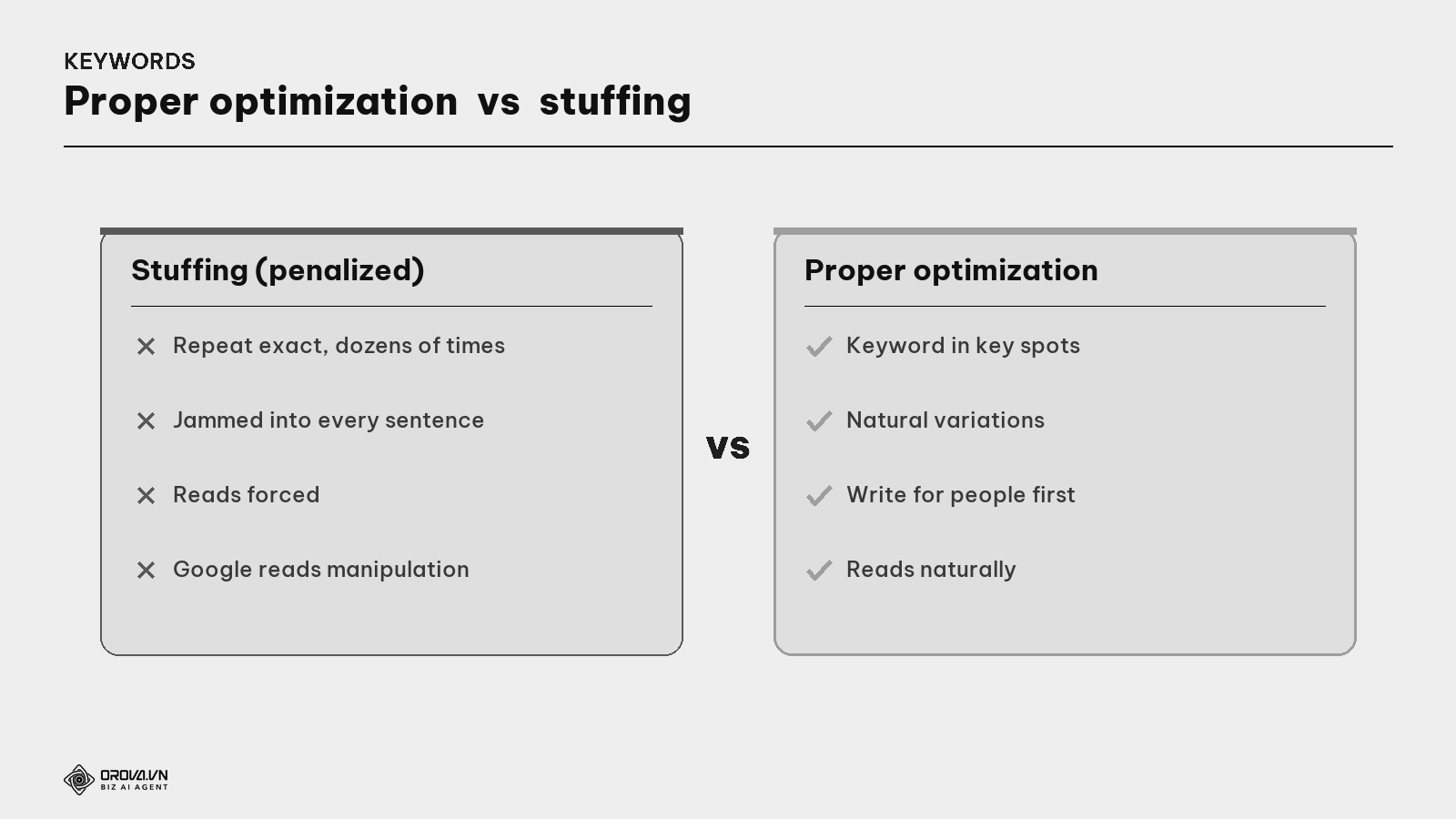
The modern, natural, people-first way:
- Use the keyword where it matters — the title, one H2, the first ~100 words, naturally in the body. Then stop forcing it.
- Use variations and related terms. Instead of repeating "espresso machine" twenty times, naturally bring in "machine", "brewing", "for a small cafe". Google rewards covering the topic, not echoing one phrase.
- Write for the person first. If it reads naturally to a human, keyword placement almost takes care of itself.
Quick standard: read your draft aloud. If the keyword feels forced or repeated unnaturally, you've over-optimized — loosen it.
Write to win the "answer box" (position zero)
Remember the boxes Google shows on top — the AI summary and the Featured Snippet (a quoted answer lifted from one page). You can engineer content to get pulled in.
What is a Featured Snippet? A box quoting the answer straight from a page, shown at the top of results — often "position zero" because it sits above #1. Landing here = standing above rivals with a link back to you.
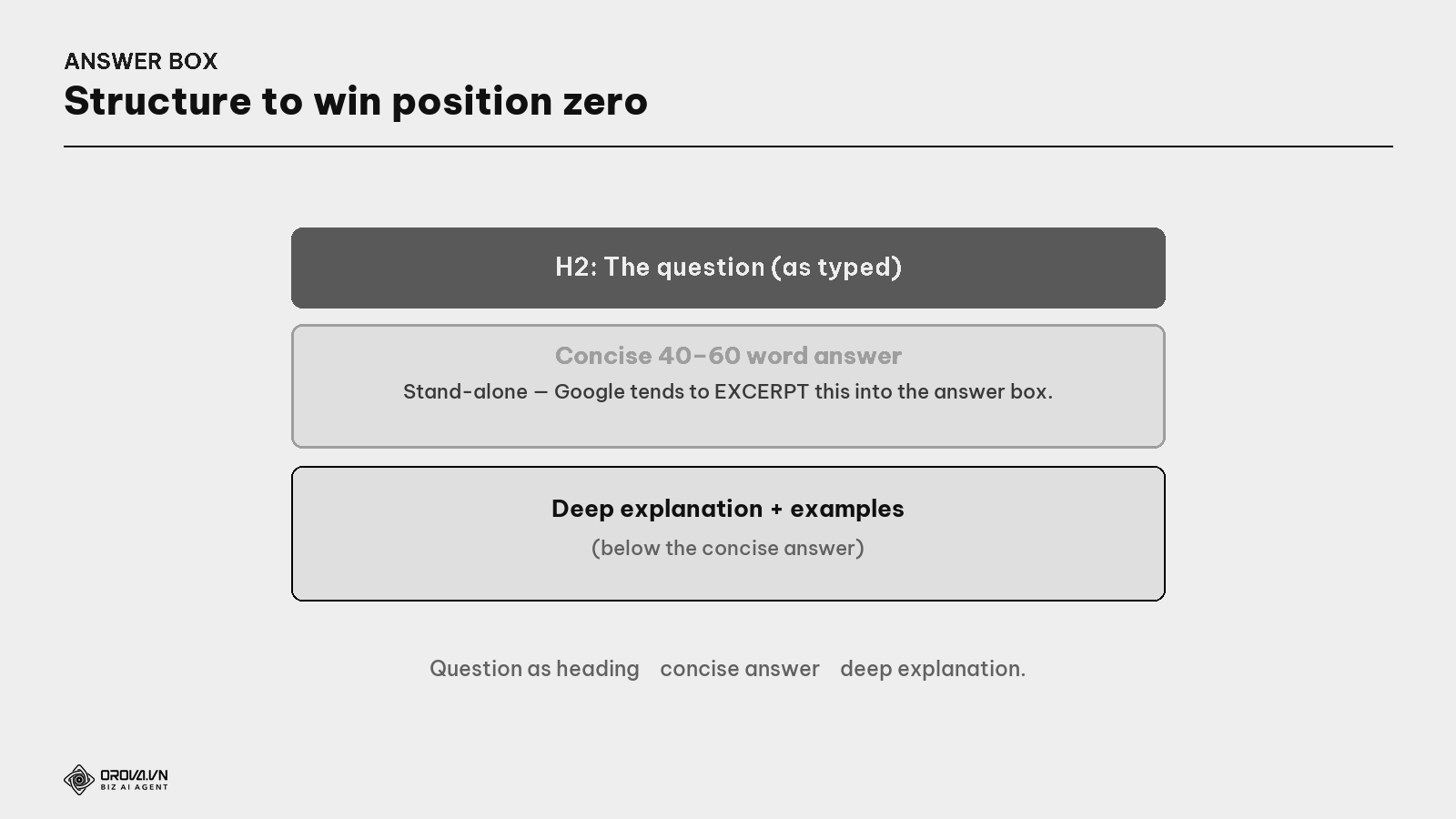
- Turn questions into H2s and answer them directly underneath.
- Give a concise answer first (~40–60 words), then go deep. Google quotes that concise block.
- Use lists and tables for "how to", "best", and comparison content — Google loves to lift these into the box.
Add depth to fight "thin content"
What is thin content? An article that's on-topic but superficial — enough words but no genuinely new info/value. This is what Google demotes and readers bounce from.
How to add depth — what makes Google (and readers) pick you:
- Real numbers and sources — concrete data beats vague claims (and never fabricate).
- Concrete examples — show, don't just tell.
- First-hand experience — the thing AI can't fake and Google increasingly rewards. What did you actually do/see/learn?
- A unique angle — say something the top results didn't.
"Quality over quantity" is a cop-out if it means writing less. The real bar is both: deep and consistent. Depth is what separates a "ranks" article from a "fine" one.
Bottom-of-funnel (BOFU) content is where the money is
Not all content earns equally. Picture customers moving down a funnel from "just curious" to "ready to buy".
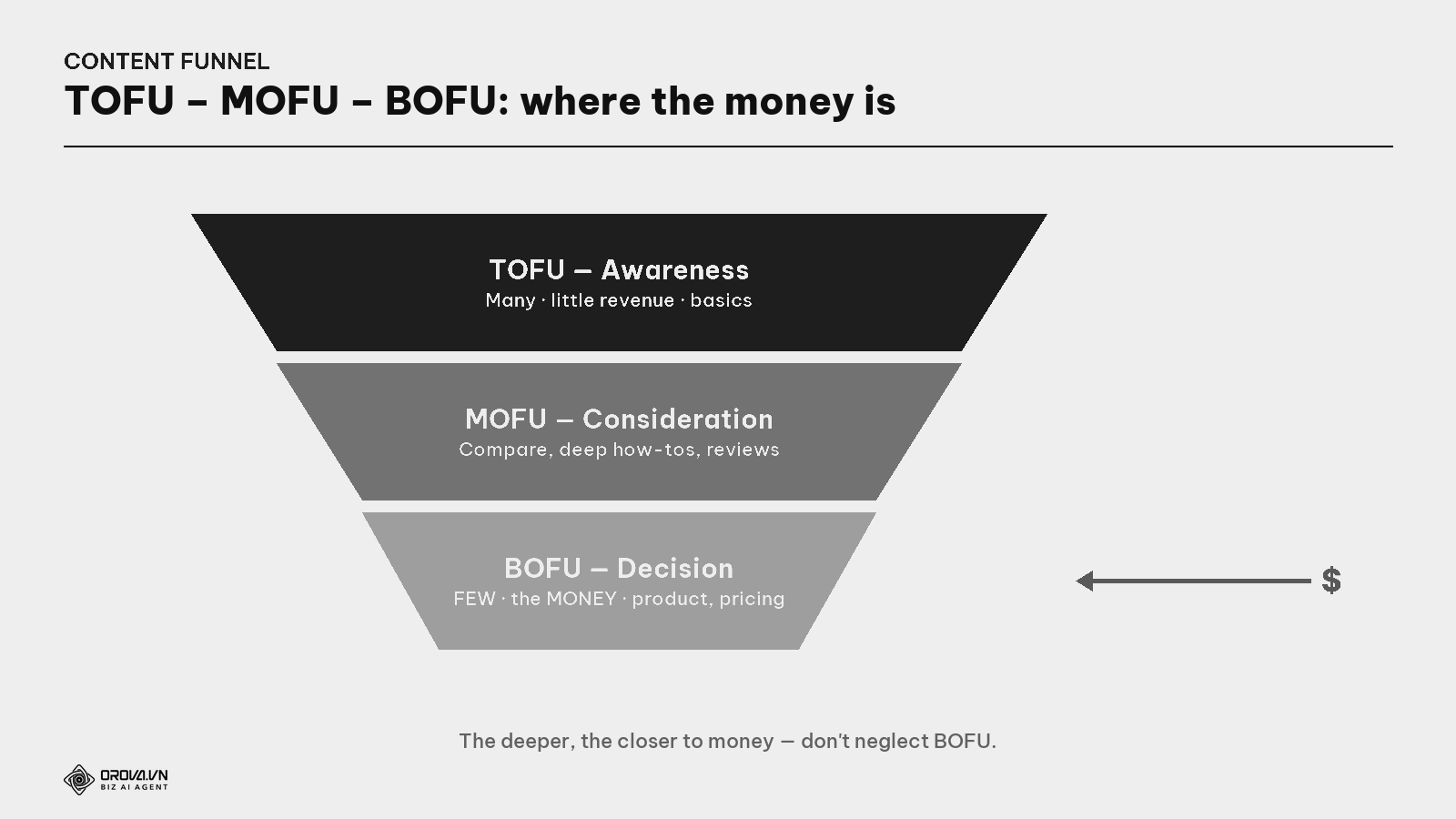
What do TOFU / MOFU / BOFU mean? Top, Middle, Bottom Of the Funnel. TOFU = awareness content (lots of readers, little revenue). MOFU = consideration (comparisons, reviews). BOFU = decision (product/pricing pages — few readers but the money).
The mistake: pouring all effort into "what is" (TOFU) articles for traffic while neglecting "decision" (BOFU) content — where deals close. Balance both: TOFU to attract and build trust, BOFU to convert. For faster revenue, make sure BOFU content exists and is excellent.
The pre-publish checklist + "pass" standard
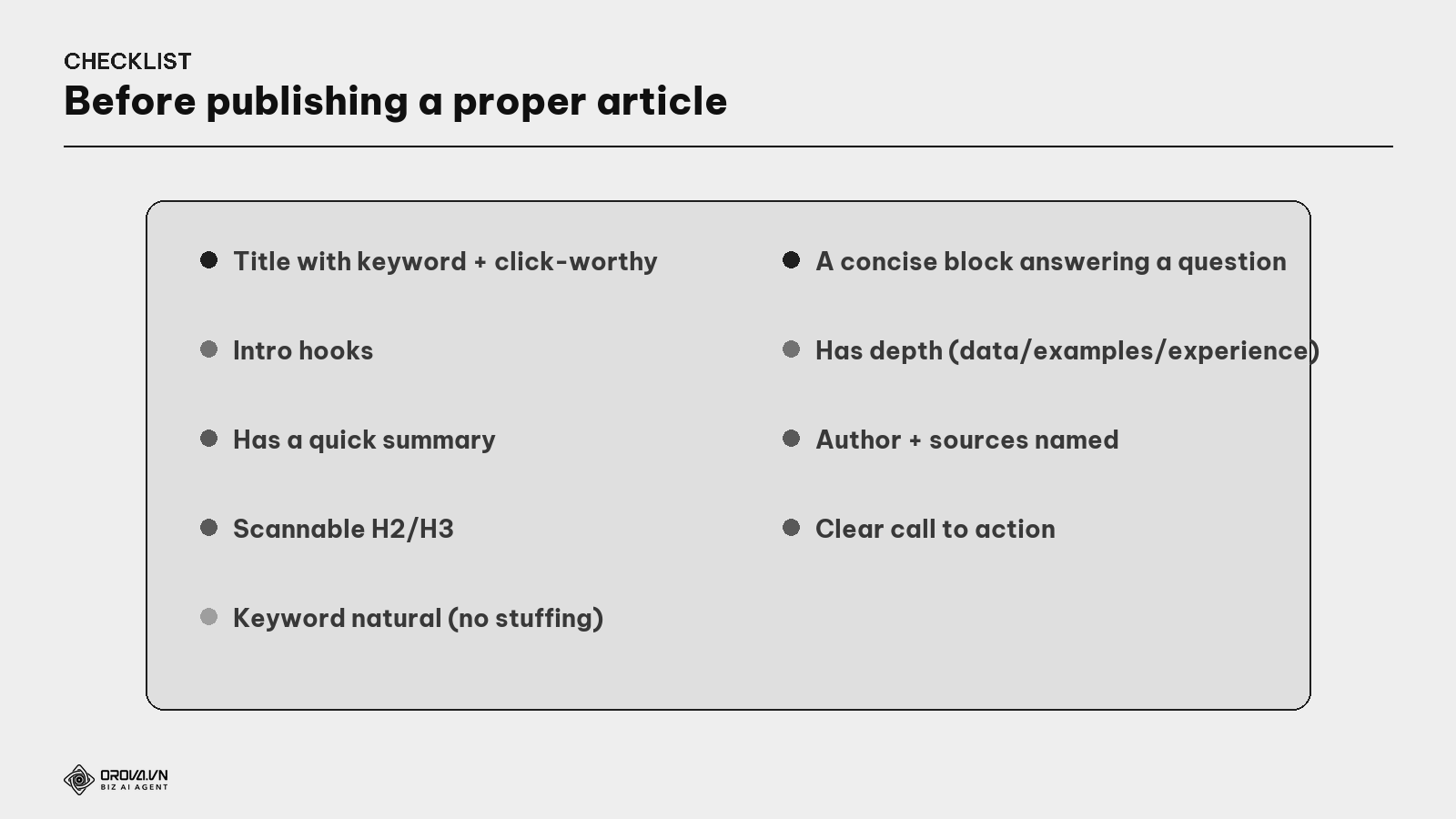
Before you hit publish, run through it: title has the keyword & is click-worthy; intro hooks; a quick summary; body split into H2/H3; keyword natural; a concise block answering a real question; real depth; author + sources named; a call to action at the end.
"Pass" standard: the reader gets a complete answer and needn't open another tab; Google has a clean, quotable structure; and there's an obvious next step leading the reader toward becoming a customer. At this level, your article both ranks and converts — no more "crowded with browsers, empty checkout".
Benefit: writing this way gives three things at once — rankings (right intent + depth + clear structure), trust (E-E-A-T, real experience), and conversion (a structure that leads to action + funnel coverage down to BOFU). Such an article doesn't just "get traffic" — it works for the business.
FAQ
How long should an SEO article be? Long enough to fully answer the topic — no more, no less. Don't pad to hit a word count; don't cut depth to be short. Match the depth of what's ranking, then go one level deeper.
Is AI-written content okay? Google penalizes low quality, not "using AI". AI content that's human-directed, fact-checked, and enriched with angles and real experience is fine. Soulless mass-produced AI text gets buried (see the AI Content guide).
How do I add "experience" if the topic is new to me? Do the thing, even at small scale: test the tool, run the process, take a photo, gather a number. A little real experience beats a ton of paraphrased theory.
Should every article try to sell? No. TOFU articles build trust and shouldn't hard-sell. Save selling for MOFU/BOFU content where the reader is closer to buying. Match the ask to the stage.
Where is "enough" to place the keyword? The title, one H2, the first ~100 words, and naturally in the body — that's enough. Leave the rest to variations and related terms. If you have to force more in, you're stuffing.
How does a quick summary differ from a featured snippet? A quick summary is the "60-second" block for readers at the top. A featured snippet is what Google excerpts to show in results. Writing good concise blocks serves both.
My article ranks but gets no orders — how do I fix it? Usually the conversion side is missing: no clear next step (CTA), or it's pure TOFU with no link to BOFU content. Add a stage-matched call to action and a link to the decision page (see the Tone of Voice & CTA guide).
Back to the shop full of browsers
Remember the shop packed with browsers but an empty checkout? The problem wasn't attracting people — it was not leading them to the till. Writing proper SEO content is the same: ranking only pulls people in the door. A truly proper article also leads them onward — answers the whole question, builds trust, then points out the next step.
Before publishing any article, ask two questions: "Is this good enough for Google to rank?" and "Does it lead the reader to an action?" Answer "yes" to both, and you stop writing articles full of browsers but empty of orders — you write articles that both rank and make money.
This article is part of Orova's complete SEO guide series. It's a deep-dive within the cluster — see the overview "SEO in 2026", "E-E-A-T", "Content Brief", "Tone of Voice & CTA", and "Using AI to Write Content" for the full picture. Get started with Orova at orova.vn/en/seo.
Sources
Google Search Central (Helpful Content & creating helpful content; Featured Snippets) · Google Search Quality Rater Guidelines (E-E-A-T) · Search Engine Journal & Backlinko (content depth and ranking) · TOFU/MOFU/BOFU funnel frameworks.
Let Orova SEO handle the repetitive part
Keyword research, drafting, refreshing old posts and rank tracking — running automatically on your own site.
Explore Orova SEO