
Topic Clusters & Pillar Pages: Content Architecture for SEO
Two bookshops on the same street
Imagine two bookshops on one street. The first stocks books "whatever it can get" — a cookbook, an astronomy text, some comics, a law book, all shelved with no order. Customers walk in and can't tell what this shop is good at, and when they need a serious cookbook, they don't think of it.
The second takes a different path: it specializes in food. A whole wall of cookbooks — from beginner, to each cuisine, to advanced technique, to celebrity chefs. In the middle stands a "food map" desk guiding you to the right shelf. Customers walk in and immediately know this is the most trustworthy place for cooking in the area. And when someone asks "where's a good cookbook shop", the whole street points to the second.
On Google, your website is one of those two shops. Posting scattered articles on unrelated topics each day = the first shop, no one (Google included) knows what you're good at. Building your content into an organized topic cluster = the second shop — Google gradually sees you as an expert in that area and prioritizes you. That organization is the topic cluster, with a pillar page at its heart.
This article dissects it fully: what a topic cluster is, why scattered articles always lose, the three concepts pillar–cluster–hub, how "topical authority" forms, the process to build a cluster from zero, three-way internal linking, common mistakes, and a healthy-cluster checklist.
What is a topic cluster? A group of tightly interlinked articles around one big topic: a central overview article + many sub-articles digging into each branch, all cross-linked. Instead of scattered pieces, you build one systematic block of content — and Google rates that whole block higher than the sum of separate articles.
Why scattered articles always lose to an organized cluster
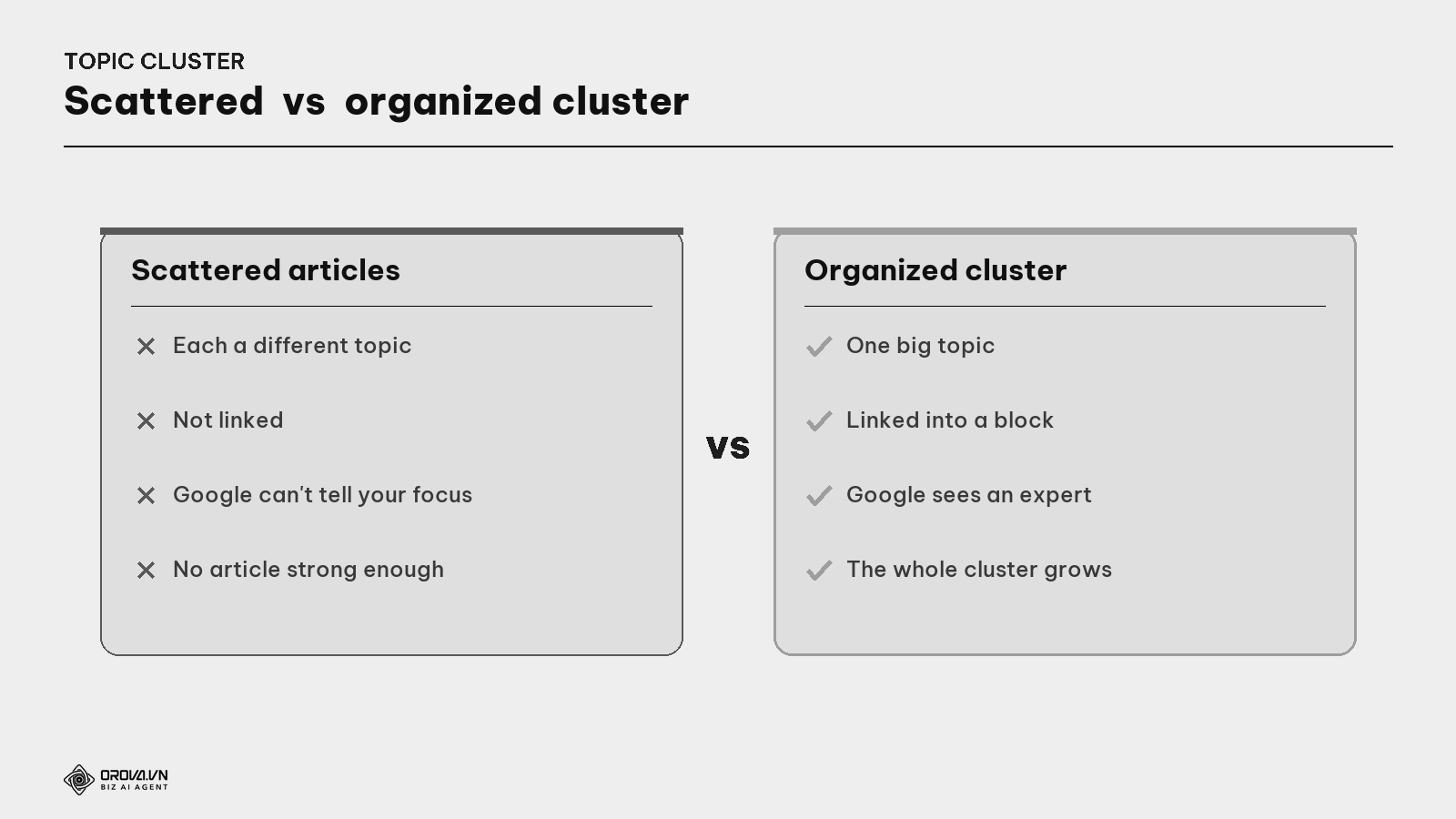
Three reasons clusters win:
- Google understands what you specialize in. When you deeply cover one topic with many linked articles, Google recognizes you as a notable source on it and prioritizes your pages for related keywords.
- Strength flows between articles. Articles in a cluster pass authority to each other via internal links (see the Internal Linking guide). One strong article lifts the whole cluster; a lone article stands alone.
- Full coverage of the reader's needs. A cluster answers every question around the topic, so it keeps readers longer and meets them at every stage (see the Search Intent guide).
Conversely, scattered articles on all sorts of topics confuse Google ("what is this site about?"), and no article has enough context to grow strong.
Pillar, Cluster, Hub-and-Spoke: the three core concepts
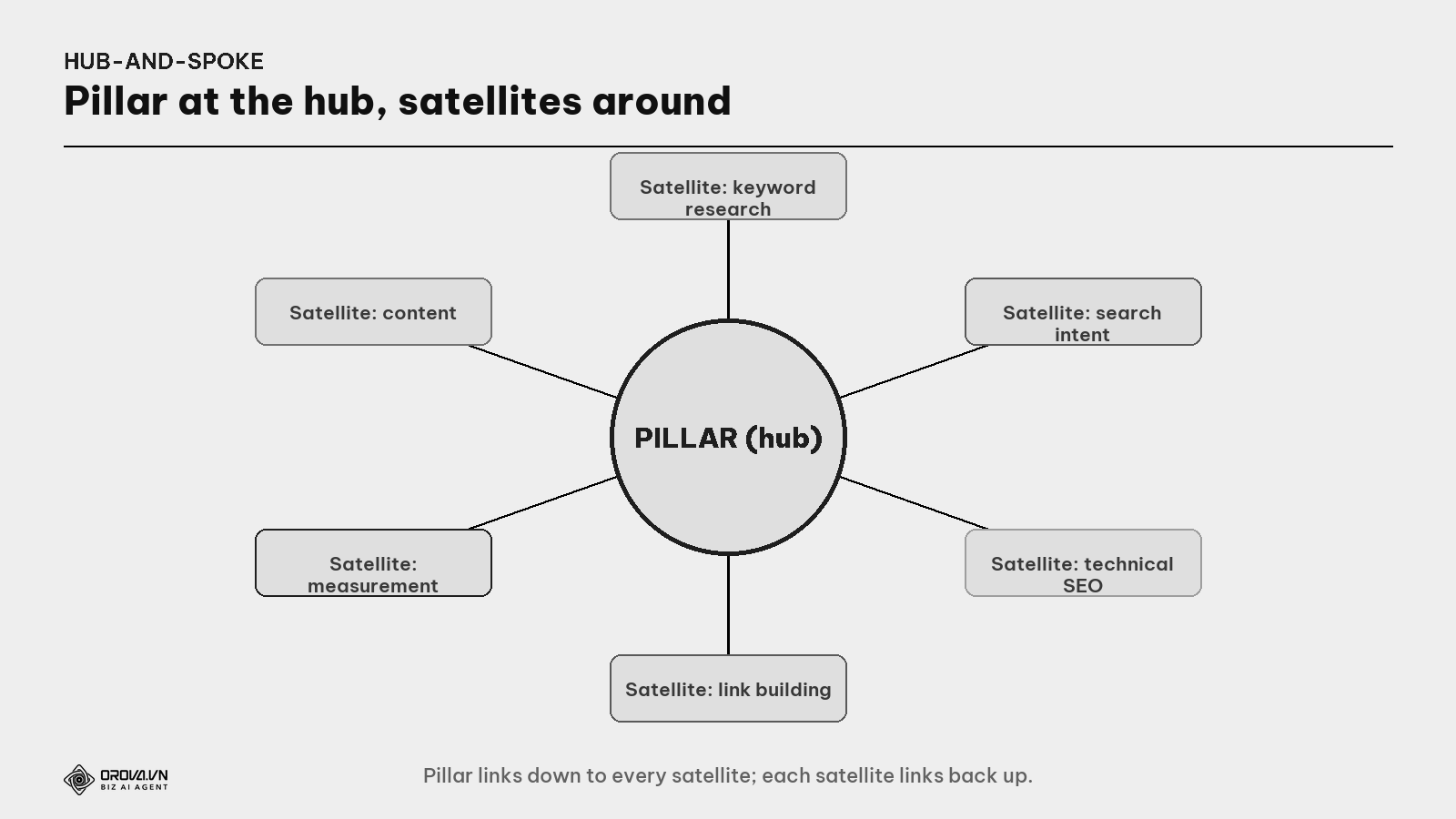
What is a pillar page? A big overview article covering a whole broad topic (e.g., "SEO complete guide"). It introduces every sub-branch at a high level and links down to the deep sub-articles. It's the bookshop's "map desk" — standing in the middle, directing everywhere.
What is cluster content? The articles that dig into each sub-branch of the big topic (e.g., "keyword research", "technical SEO"...). Each sub-article goes deep on an aspect the pillar only mentions, and links back up to the pillar.
What is the Hub-and-Spoke model? The "hub" is the pillar at the center; the "spokes" are the sub-articles radiating out. Like a wheel: hub in the middle, spokes from hub to rim. Every spoke connects to the hub, and the hub connects to every spoke — that's the shape of a topic cluster.
Topical authority: how a cluster builds "expert" credibility
This is the biggest SEO reward of the cluster model.
What is topical authority? How much Google regards your website as an "expert" on a topic area. It's not an on/off number, but forms when you cover a topic deeply and broadly with lots of quality, tightly linked content. A site with high topical authority usually ranks more easily even for new keywords in that area — because Google already "trusts" you on the topic.
This is why a small site deeply specialized in a niche can beat a big but scattered site: the small site has focused topical authority, while the big site's authority is spread thin. For beginners, building one deep cluster before jumping to another topic is wiser than spreading thin.
The process to build a cluster from zero
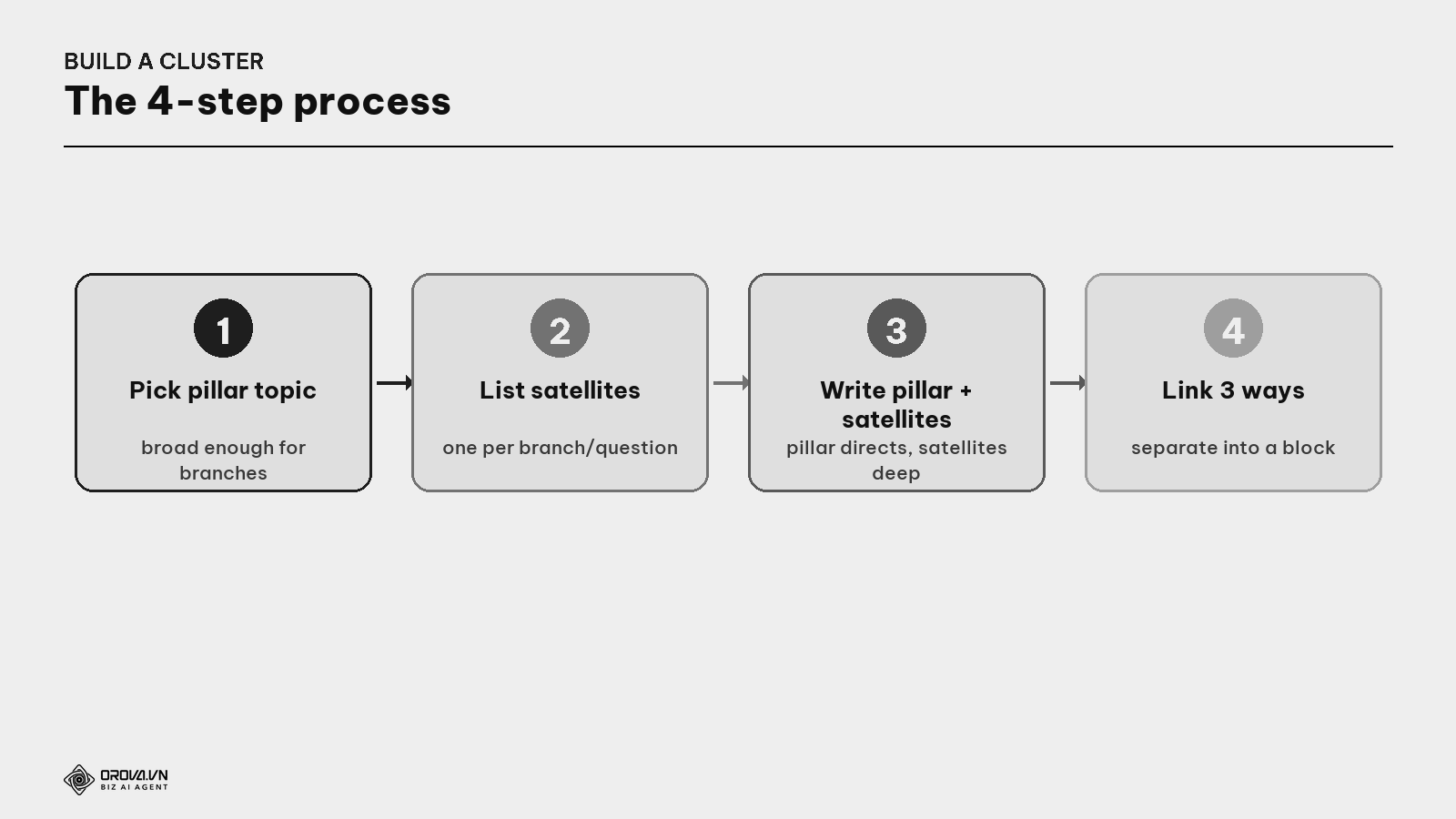
Step 1 — Pick the pillar topic. Choose a topic broad enough to have many sub-branches, but narrow enough that you can cover it deeply. "SEO" may be too broad for a young site; "SEO for coffee shops" fits.
Step 2 — List the satellite articles. Use keyword + question research (see the Keyword Research & Question Keywords guides) to list every branch/question around the pillar topic — each becomes a satellite article, each with its own intent (avoid overlap — see the Cannibalization guide).
Step 3 — Write the pillar and satellites. The pillar covers the overview; each satellite digs into a branch. Don't cram everything into the pillar (it just introduces + directs).
Step 4 — Link three ways (see below) — this is the step that turns separate articles into a cluster.
Three-way linking: the glue of the cluster
Internal linking (see the Internal Linking guide) is what turns separate articles into a real cluster. Three required link directions:
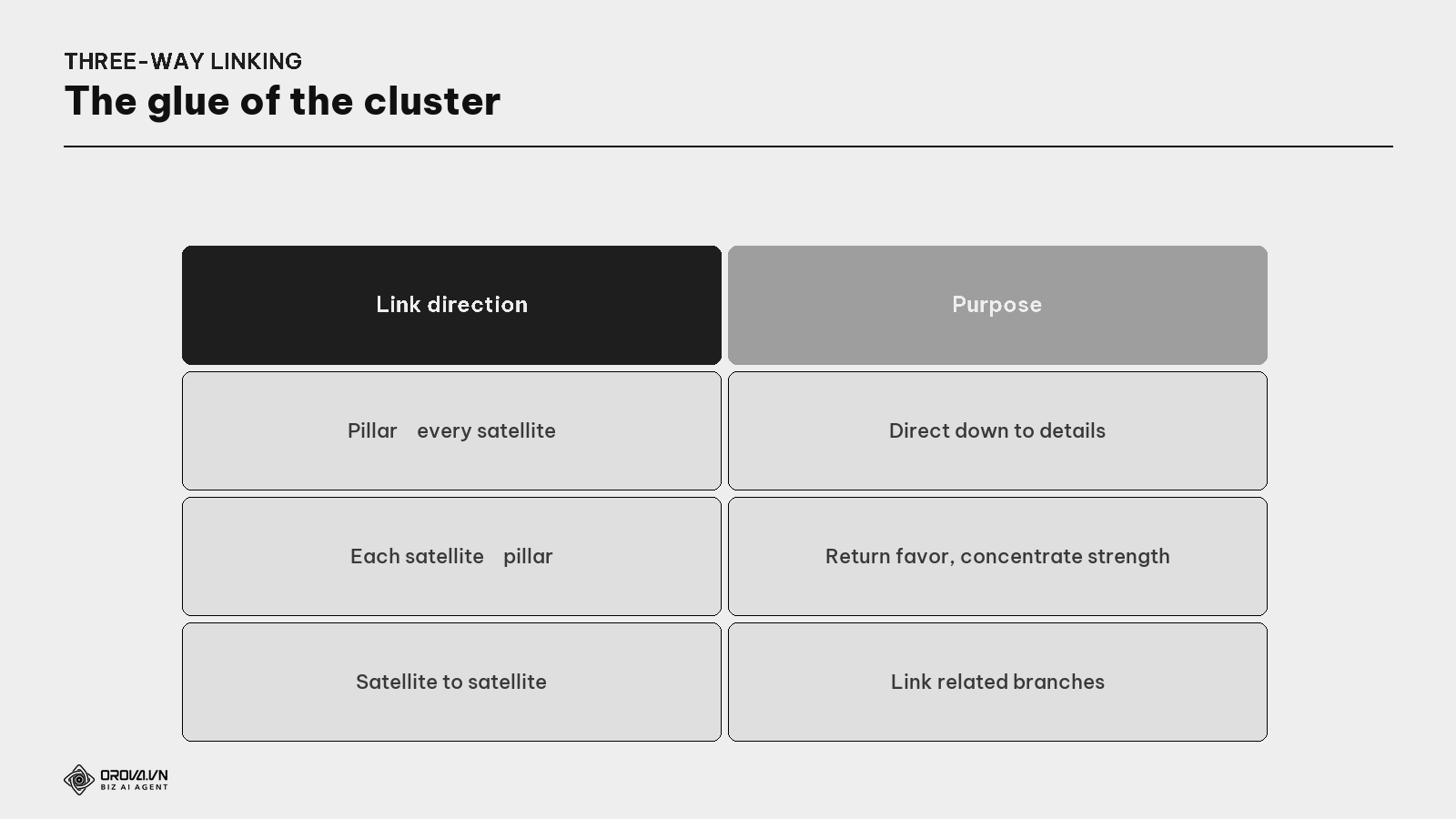
- Pillar → every satellite: the pillar directs down to each detailed article.
- Each satellite → pillar: every sub-article links back up, concentrating strength at the center.
- Satellite ↔ related satellite: same-branch sub-articles link across when relevant.
With all three directions, Google reads "this is an in-depth block about topic X", and authority flows evenly across the cluster.
Clusters tied to intent: cover the whole funnel within one topic
A good cluster covers not just broadly but across the stages a customer passes through (see the Search Intent guide):
- A few informational articles ("what is", "how to") — attract newcomers.
- A few commercial articles ("compare", "best") — catch those choosing.
- A transactional article/page (product, pricing) — close those ready to buy.
So a cluster both earns Google's expert recognition and walks customers from research to purchase — tightly tied to content strategy (see the Content Strategy guide).
Common mistakes when building clusters
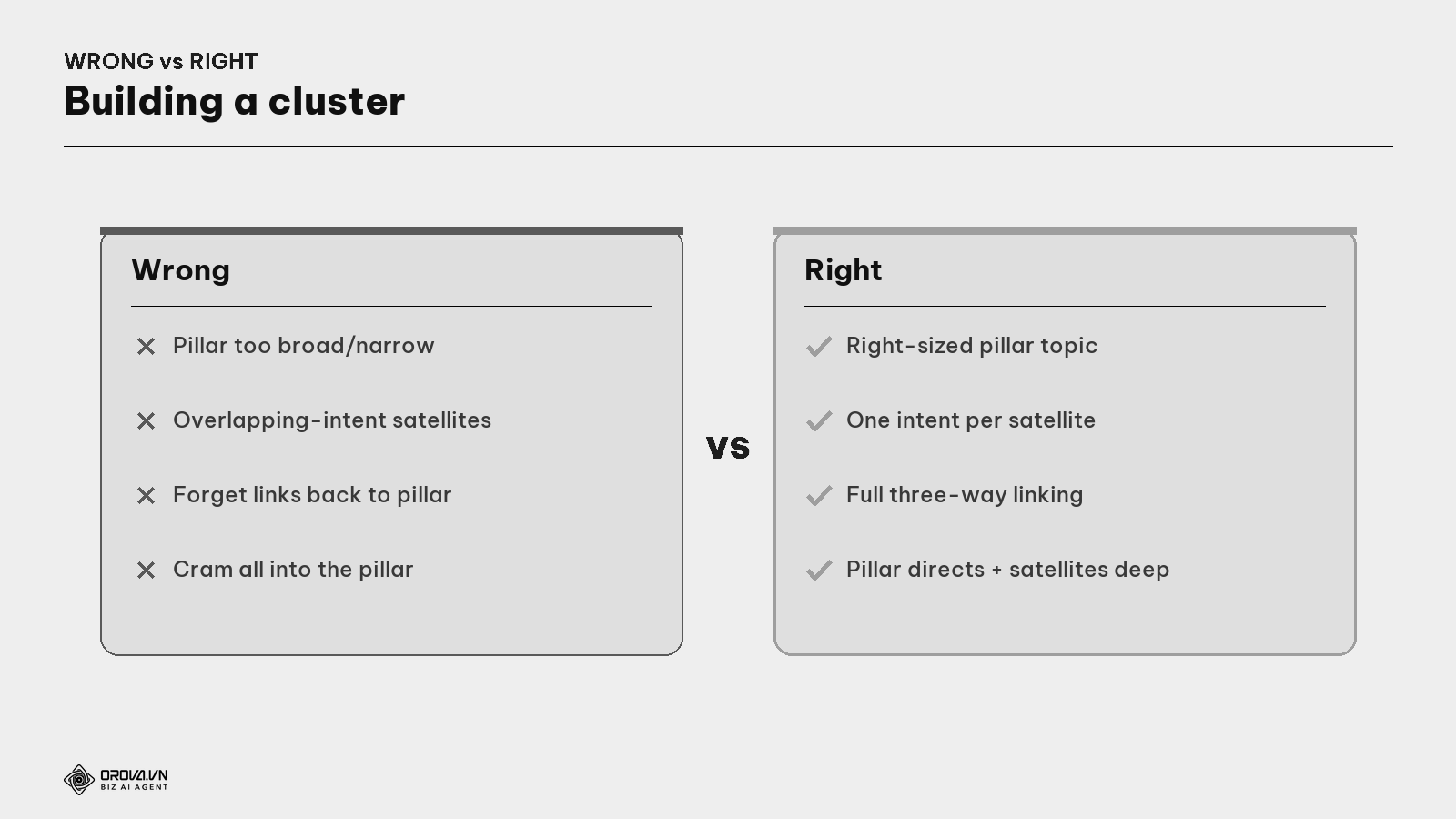
- Wrong-sized pillar topic. Too broad → can't cover deeply; too narrow → not enough branches for a cluster.
- Overlapping-intent satellites. Two sub-articles targeting one intent → self-cannibalize (see the Cannibalization guide).
- Forgetting links back to the pillar. The cluster is "open-circuit", strength doesn't concentrate at the center.
- Cramming everything into the pillar. A bloated pillar with no satellites isn't a cluster — just one long article.
Apply to your website + healthy-cluster checklist
The practical way to start: don't try to build 5 clusters at once. Pick one most important pillar topic, build it really well (pillar + 5–10 satellites, full three-way linking), reap results, then move to the next.
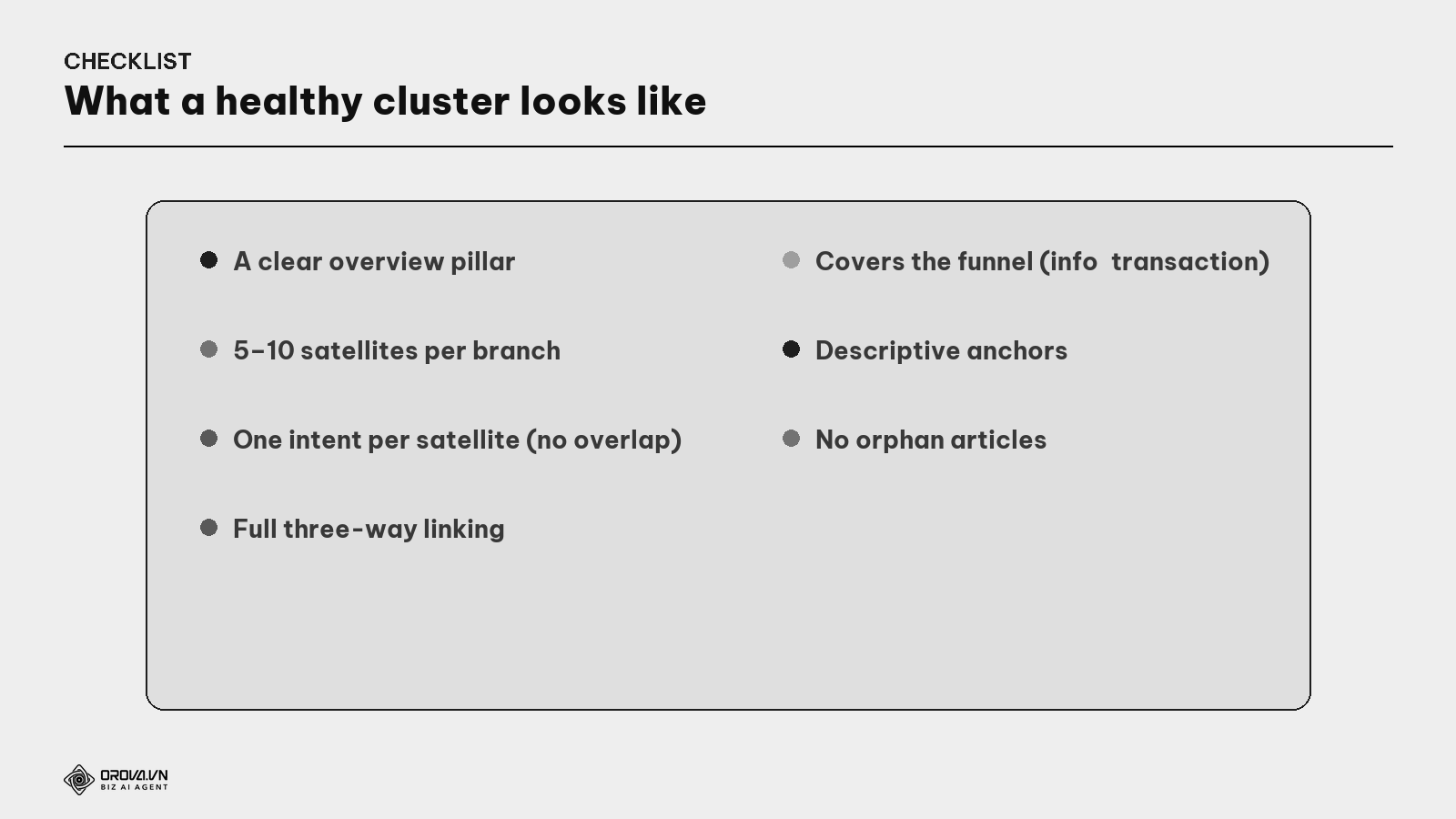
"Pass" standard: a healthy cluster has an overview pillar + 5–10 satellites, each satellite with its own intent (no overlap), full three-way linking (pillar↔satellite, satellite↔related satellite), coverage across the funnel from information to transaction, descriptive anchor text, and no orphan articles. At this level, Google reads the whole cluster as an expert block — and lifts you even for new keywords in the area.
Benefit: the cluster model gives you three things at once — topical authority (Google sees you as an expert, easier ranking), even internal-link strength (the whole cluster grows together), and a complete reader experience (covers every question, leads them to buy). It's one of the most durable "moats": a competitor can copy one article, but copying a whole deep, tightly linked cluster is extremely hard.
FAQ
How does a topic cluster differ from just writing many articles? Writing many scattered articles on all topics doesn't make a cluster. A cluster is many articles on one big topic, tightly linked via three-way linking, with a central pillar. It's the focus + linking that builds topical authority, not the article count.
How many satellite articles does a cluster need? No hard number, but 5–10 satellites per pillar is a good starting point for most topics. What matters is covering enough branches and intents around the topic, not hitting a count.
How long should the pillar be? The pillar is an overview, so it's usually long and broad (introduces every branch + links down). But don't cram all the detail into the pillar — save the depth for satellites; the pillar introduces and directs.
How many clusters should a new site build at once? One. Build one strong cluster first (pillar + satellites + full linking), reap results and authority, then move on. Spreading across many clusters while young leaves none deep enough to grow strong.
How are topic clusters and internal linking related? Internal linking is the cluster's glue — without three-way linking the articles are just scattered, not a cluster. The topic cluster decides the content structure; internal linking is how you connect that structure (see the Internal Linking guide).
How long does topical authority take to build? It accumulates over months of deep topic coverage with quality content + tight linking + some backlinks. No shortcut, but a well-built cluster shows results far more clearly than the same number of scattered articles.
I already have many scattered articles — how do I turn them into a cluster? Group same-topic articles, choose/write an overview pillar for them, then link three ways between the pillar and those articles. Merge any overlapping-intent ones (see the Cannibalization guide). You don't need to rewrite from scratch — just reorganize.
Back to the two bookshops
Remember the two bookshops at the end of the street? The "whatever it can get" shop and the food-specialist shop with a map desk. Same number of books, but only one is remembered when needed — because it picked one thing and went deep, then organized so customers (and Google) clearly see what it's good at.
Your website must choose too. Don't be the messy shop posting an unrelated topic each day. Pick a pillar topic, build a directing pillar + deep satellites around it, link them into a block with three-way linking. Do that, and you don't just have many articles — you have a deep library Google recognizes as expert, and readers seek out like the whole street seeks the food bookshop. That's the difference between "posting for the sake of it" and "building an asset".
This article is part of Orova's complete SEO guide series. It's a deep-dive within the cluster — see "Internal Linking", "Keyword Research", "Search Intent", "Cannibalization", and "Content Strategy" for the full picture. Get started with Orova at orova.vn/en/seo.
Sources
Google Search Central (helpful content, topical depth & relevance) · HubSpot (the pillar–cluster model, topic clusters) · Ahrefs & Semrush (topical authority, intra-cluster internal linking).
Let Orova SEO handle the repetitive part
Keyword research, drafting, refreshing old posts and rank tracking — running automatically on your own site.
Explore Orova SEO