
Keyword Gap Analysis: How to Find Gaps in 4 Simple Steps
You know the shop across the street is pulling in more traffic than you, and you have no idea why. You check their site, you see they rank for terms you never even thought to target, and you're left guessing which ones actually matter. This is exactly the problem a keyword gap analysis solves: it shows you the search terms your competitors rank for that you don't, so you stop guessing and start acting.
The usual way people try to fix this is by dumping competitor URLs into a tool, staring at a spreadsheet with thousands of rows, and giving up halfway through. It's not that the idea is wrong, it's that most guides make the process feel like a data science project instead of a business decision. You end up with a long list and no clue which items are worth your time first. That's especially costly now that SparkToro reports 68% of US Google searches end without a click, meaning the few terms that still send visitors are worth picking correctly.
This article strips that down to a simple, four-step process anyone running a business can follow. By the end, you'll know exactly how to find the gaps, tell the useful ones apart from the noise, and turn the whole list into a content plan you can actually act on this week.
The treasure map of the shop across the street
Imagine you open a new coffee shop, and right across the street is one that's been packed for years. One morning, instead of guessing "what do customers want", you pull up a chair and watch that shop: what customers ask for, what they order, why they come back, which item always sells out. After a week you hold a list more valuable than gold — the reasons customers choose them over you. Now you know exactly what to add and do better to win customers back.
In SEO you don't need a week of watching — because every "menu" of your competitors is public. Each keyword they rank for is a dish drawing customers. Finding the keywords competitors have that you don't is called keyword gap analysis. It's one of the fastest, lowest-risk ways to find opportunities — because you're not guessing "maybe someone searches this", you're following keywords already proven to have demand and deliver results for others.
This article dissects it fully: what a keyword gap is, who your real SEO competitor is (often different from your business competitor), the 4-step process to find gaps, the three types of gap, how to do it without spending thousands, and how to turn the gap list into a prioritized content plan.
What is a keyword gap? The keywords your competitors rank for but you don't (or rank far lower). Finding them = finding proven opportunities — real demand, someone can win — instead of guessing from zero.
What is competitor analysis? Researching the websites ranking on top in your field to learn: which keywords they target, how they write, how they're structured, where they're strong or weak — then finding where you can do better or fill a gap they missed.
Why this is the fastest way to find opportunities
Keyword research "from zero" (see the Keyword Research guide) is necessary, but it has a weakness: you guess which terms are worth doing. Gap analysis flips it — you start from terms already proven.
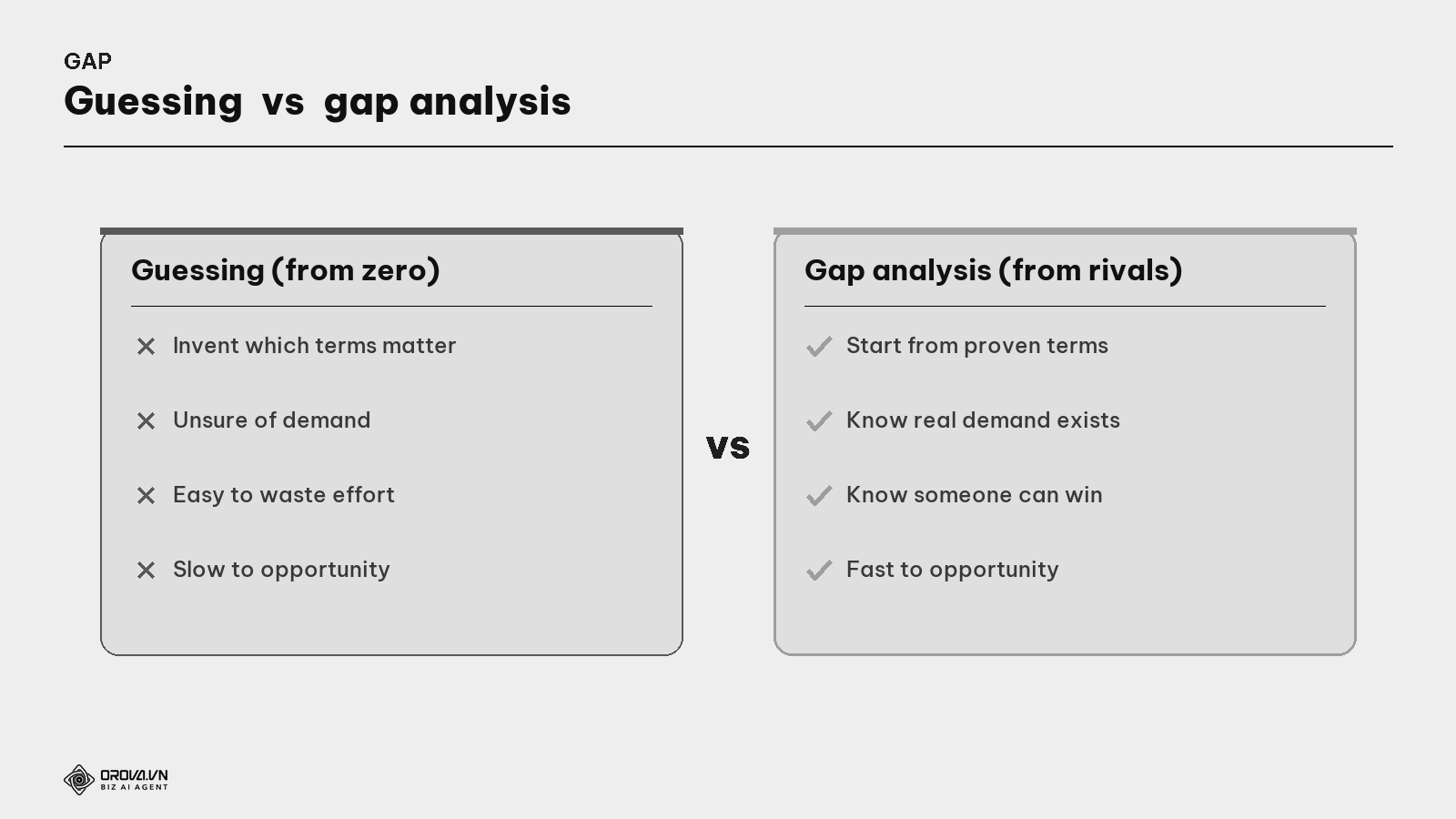
Three benefits:
- Proven opportunities. If a competitor earns traffic from a term, that term definitely has demand — no guessing.
- Fast. Instead of brainstorming from zero, you "borrow" the whole keyword list a competitor painstakingly built.
- Know you have a shot. If a competitor of similar strength ranks, you likely can too (tied to the Keyword Difficulty guide).
Who is your real "SEO competitor"?
This is where many go wrong, and getting it wrong skews the whole analysis.
What is an SEO competitor (vs a business competitor)? A business competitor sells the same product/service in real life. An SEO competitor is any website ranking on top for the keywords you want — even if they sell nothing competing with you. E.g., a newspaper, a personal blog, or Wikipedia can be your "SEO competitor" for a keyword, despite not being a business rival.
Why it matters: if you only analyze a few familiar business competitors, you miss the websites actually occupying your keywords. The right way to find SEO competitors: search your own important keywords on Google and see who's on top — those are who you must analyze.
The 4-step process to find gaps
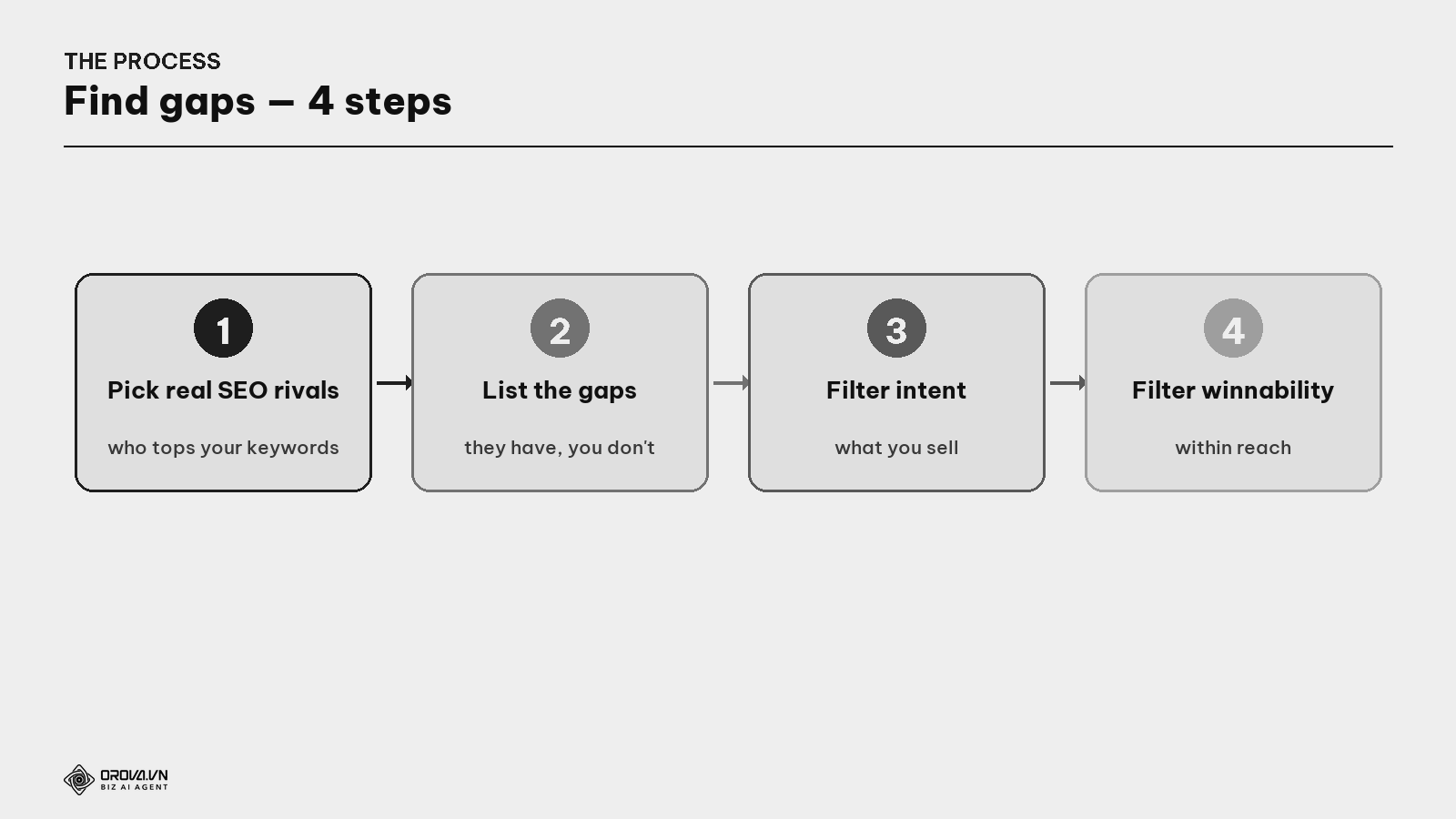
Step 1 — Pick 2–3 real SEO competitors. Search your core keywords, see who consistently shows on top. Pick 2–3 sites of similar or slightly higher strength (don't pick all giants — you learn but can't compete).
Step 2 — List keywords they have that you don't. This is the core: take each competitor's ranking keyword list, subtract what you already have → your "gap" list.
Step 3 — Filter by intent. Not every gap is worth it. Drop terms unrelated to what you sell (see the Search Intent guide). Keep terms right for your niche, your customer.
Step 4 — Filter by winnability. Among what's left, prioritize terms you can actually rank for (see the Keyword Difficulty guide) — don't grab terms only giants can reach.
The three TYPES of gap — and how to exploit each
Not all gaps are alike. Distinguishing three types tells you what to do with each.
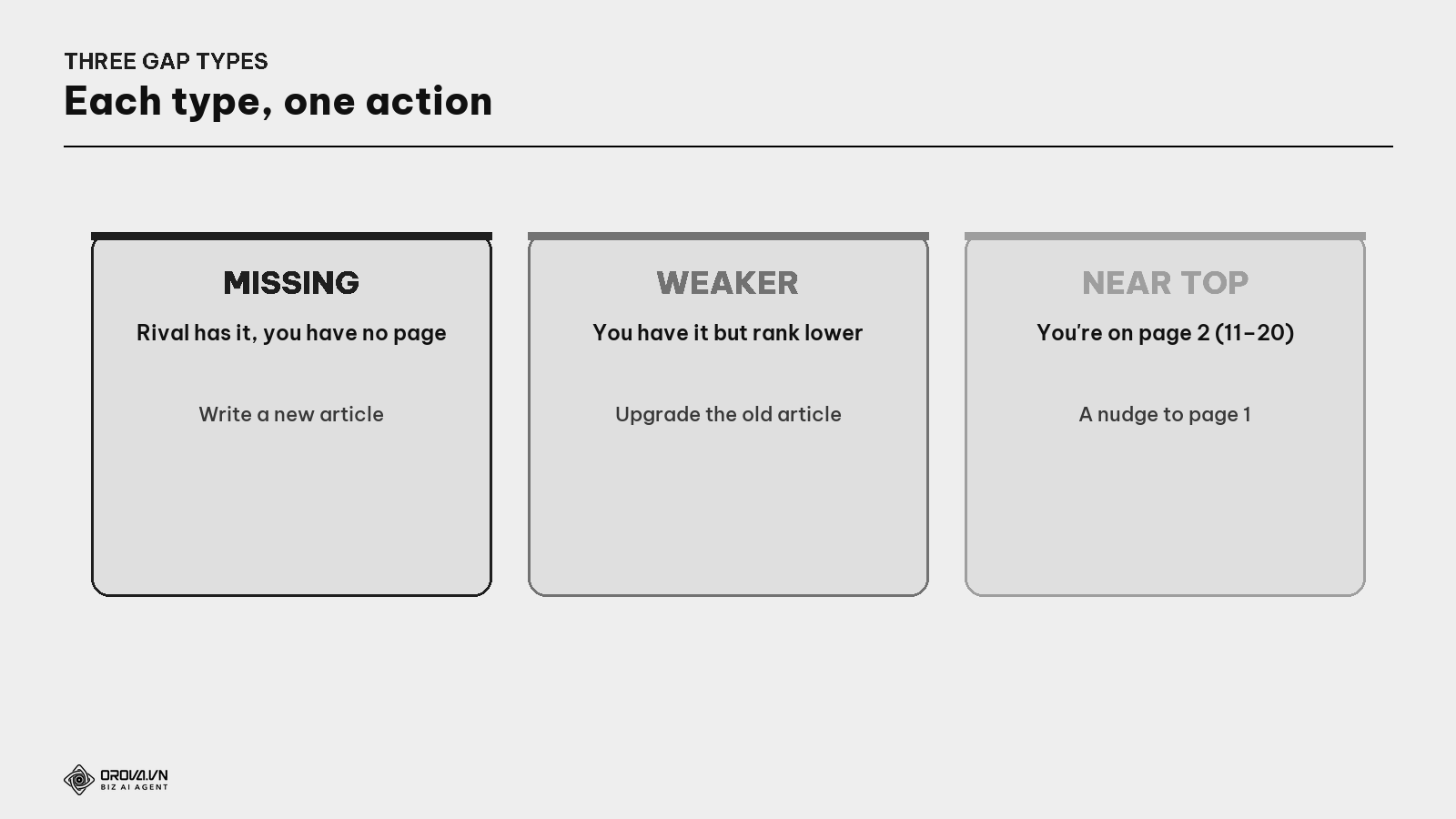
- Missing. The competitor ranks, you have no page targeting it → the clearest opportunity: write a new article.
- Weaker. You have a page but rank lower than the competitor → upgrade/deepen the old article to surpass (see the Content Refresh guide).
- Near top ("striking distance").
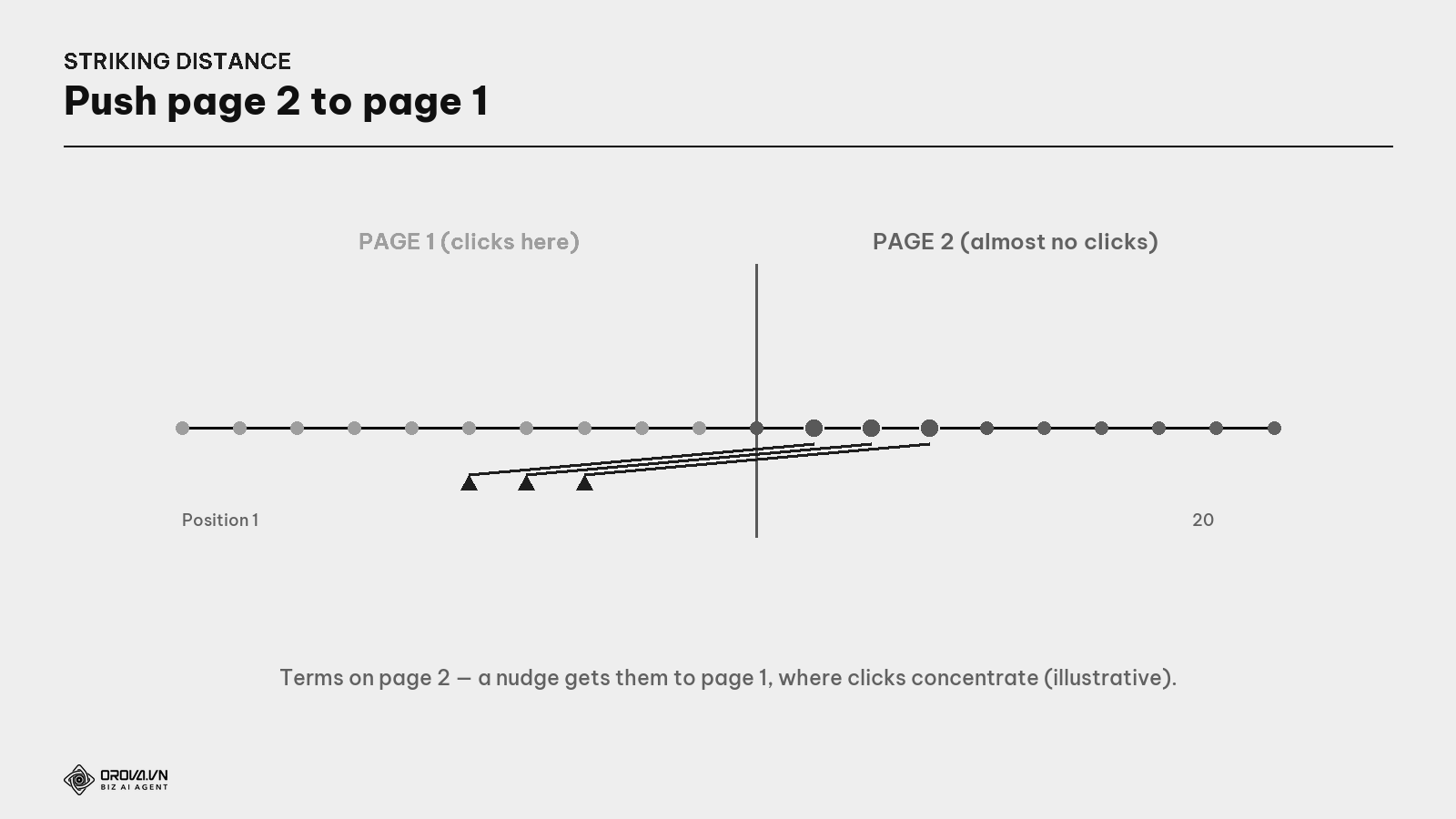
What is a striking distance keyword? A keyword where your page ranks in "striking distance" — usually rank 11–20 (page 2) or the bottom of page 1. A small nudge (extra optimization, internal links, more content) can jump it to page 1 — where nearly all clicks concentrate. This is the gap type that delivers results fastest.
How to do it WITHOUT spending thousands
Paid tools (Ahrefs, Semrush) have handy "Content Gap / Keyword Gap" features, but you don't have to own them.
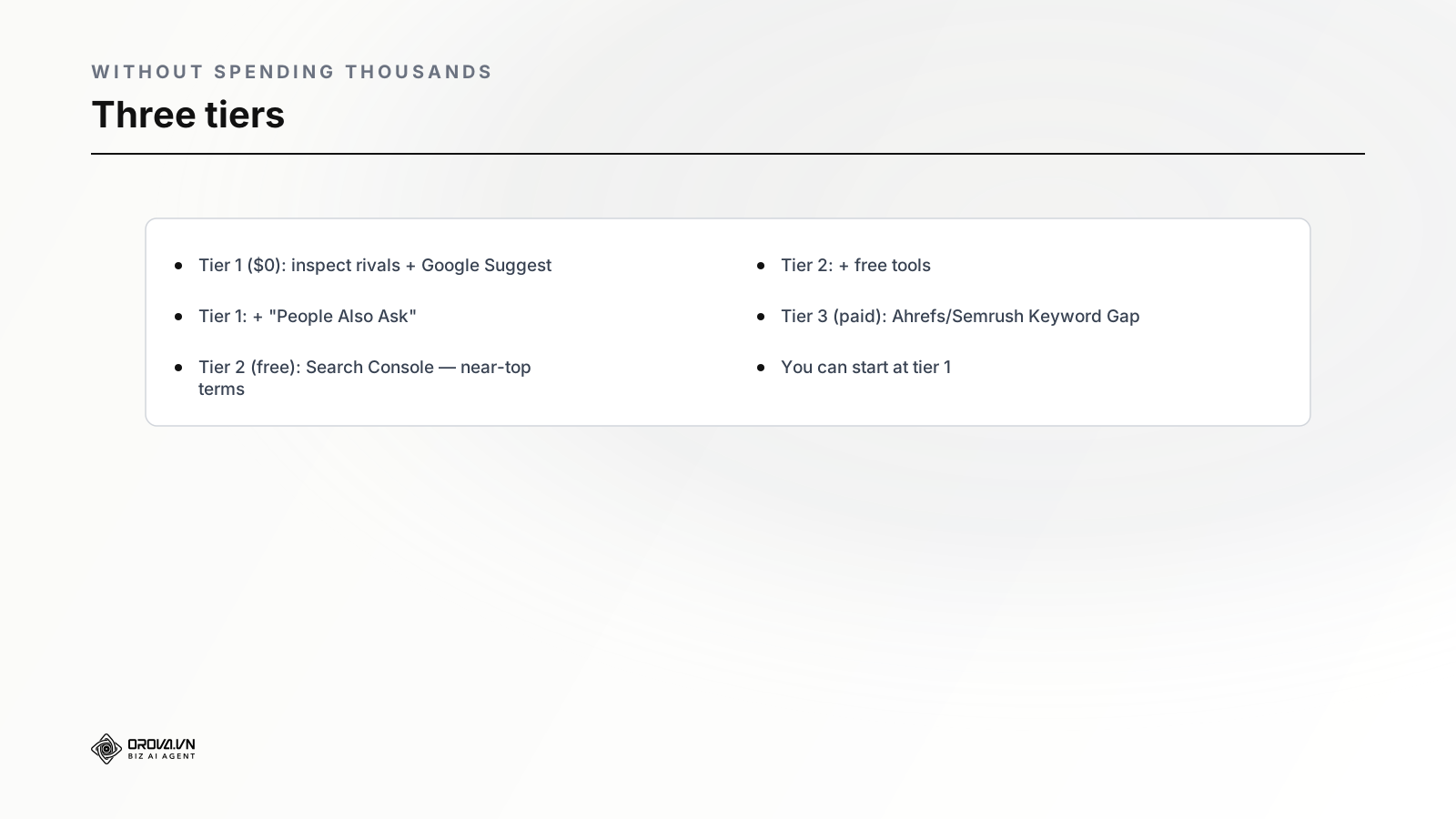
- Tier 1 — manual, $0. Open 2–3 competitor sites, see which articles/topics they have that you don't; search core terms to see Google's suggestions and "People Also Ask". Slower but free and very grounded.
- Tier 2 — Search Console + free tools. Search Console shows which terms you're already near top for (striking distance) — the easiest gap to exploit, completely free.
- Tier 3 — paid tools. Ahrefs/Semrush have a "Keyword Gap" button: enter your domain + a few competitors, it lists every term they have and you don't. Handy at scale, but an accelerator, not a requirement.
Reverse-engineer the competitor's content cluster
Gaps aren't just single keywords — they're also whole topic areas. When inspecting a competitor, look at how deeply they cover a topic cluster (see the Topic Cluster guide):
- Do they have a big pillar article + many supporting articles around it?
- Is there a topic branch they cover that you've left entirely empty?
- How do they internally link between articles?
Reverse-engineering a competitor's cluster gives you not just a few keywords but a whole topic map to build your own — more complete and systematic.
Turn the gap list into a prioritized content plan
You'll have a long list. Don't work it haphazardly — prioritize with the familiar matrix.
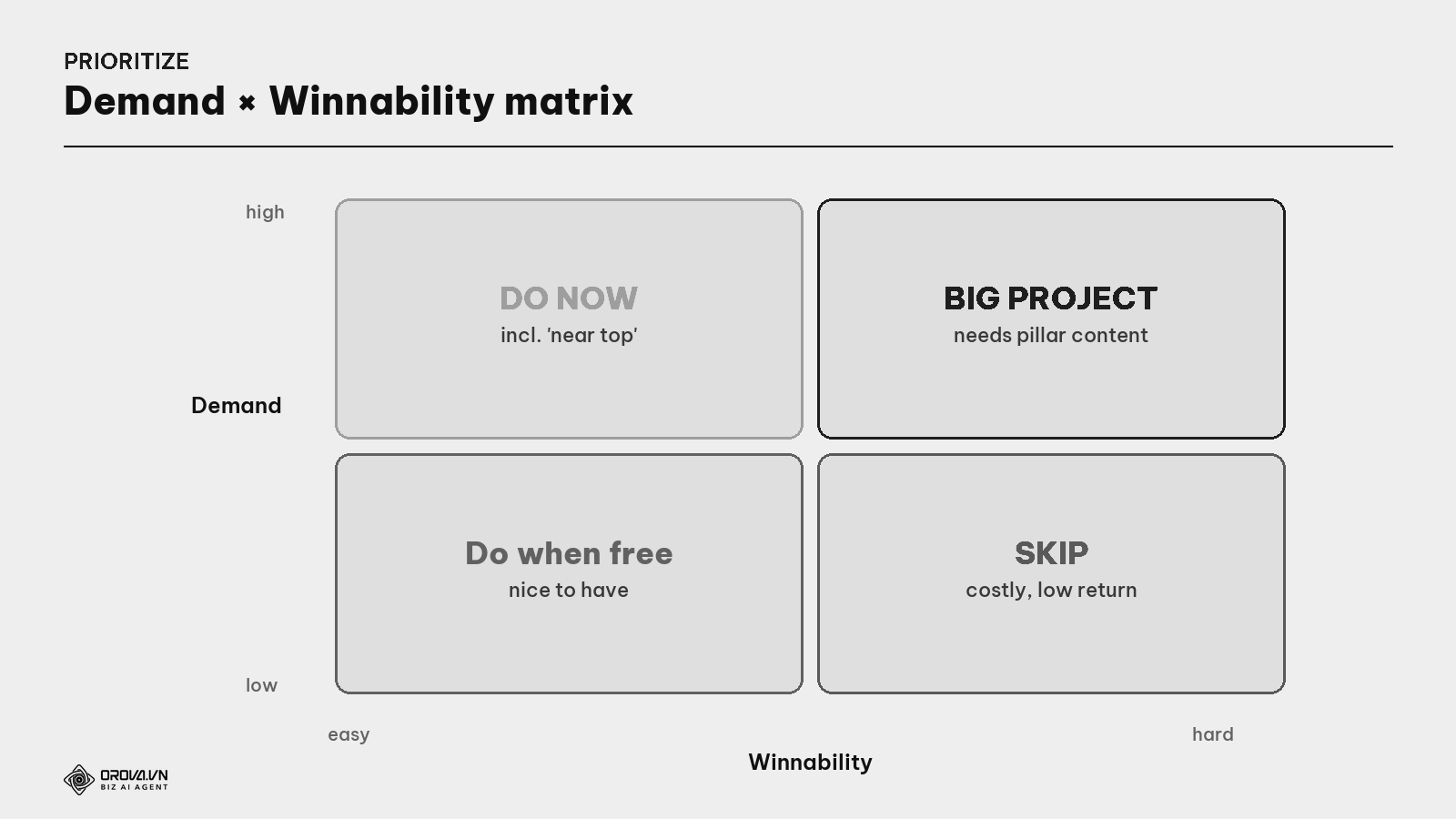
- High demand + easy → Do now. Top priority — especially "near top" (striking distance) gaps, fastest results.
- High demand + hard → Big project. Worth doing gradually, needs pillar content.
- Low demand + easy → Do when free.
- Low demand + hard → Skip.
Benefit: gap analysis turns SEO from "creating in the dark" into "following an existing treasure map". You save hours of brainstorming, reduce the risk of writing for no demand, and — with "near top" gaps — can see rankings climb in weeks instead of months. It's one of the fastest, cheapest levers for both young and established sites.
Process & standard
- Find real SEO competitors — search core keywords, see who's on top (not just business rivals).
- List the gaps — terms they have that you don't/rank lower for (manually or with tools).
- Filter by intent — keep terms right for what you sell.
- Classify the 3 gap types (missing / weaker / near top) to know the action.
- Prioritize with the Demand × Winnability matrix; do "near top" first.
- Feed into the content plan (tied to the keyword map & content brief).
"Pass" standard: you correctly identify SEO competitors (not just business rivals); have an intent-filtered gap list; can classify the 3 gap types and know the action for each; prioritize "near top" terms for fast wins; and turn it all into an ordered content queue. At this level, you always know where the next opportunity is — because you've read the map of whoever's winning.
FAQ
How does keyword gap differ from regular keyword research? Regular research starts from your seeds and expands (easy to guess). Keyword gap starts from competitors' ranking keywords — opportunities already proven to have demand. They complement each other; gap usually surfaces opportunities faster.
How many competitors should I analyze? Usually 2–3 real SEO competitors of similar/slightly higher strength is enough. Too many dilutes; all-giants is informative but uncompetitive. Remember: an SEO competitor = whoever's on top for your keywords, not necessarily a business rival.
How do I do gap analysis without paid tools? Entirely doable: inspect competitor pages by eye + Google Suggest + "People Also Ask" (tier 1), and especially Search Console to find terms you're already near top for (tier 2). Paid tools just make it faster and at scale.
Which gaps should I do first? "Near top" gaps (striking distance — you're on page 2) deliver fastest: a small nudge gets you to page 1. Then "high demand + easy to win". Save hard gaps (only giants reach) for later.
What is striking distance and where do I find it? Keywords where your page ranks 11–20 (page 2) or bottom of page 1 — very near the top. Find them in Google Search Console (filter average position 11–20). The easiest opportunity because you're already near the finish.
Is competitor analysis just copying them? No. The goal isn't to copy, but to learn the opportunity (what topics they cover) then do it better (deeper, fresher, more on-intent, with your own angle). Copying verbatim both violates rules and won't beat the original.
How often should I redo gap analysis? Do one thorough pass when planning strategy, then review periodically (e.g., quarterly) since competitors keep publishing — today's gap may get filled by them, and new gaps open up.
Back to the shop across the street
Remember the morning you sat watching the packed shop across the street? You didn't copy them — you learned what customers needed that you lacked, then went and did it better. That's exactly the spirit of keyword gap analysis: competitors have painstakingly found the "dishes" that draw customers (keywords that deliver), and it's all public on Google's results page. You just read that map, pick the dishes that fit your shop, and make them better.
Instead of fumbling "what should I write", ask: "Which keywords are competitors winning that I've left empty — and of those, which can I do better?" Answer that, and you never run out of ideas, and every article you write aims at an opportunity already proven to be real.
This article is part of Orova's complete SEO guide series. It's a deep-dive within the cluster — see "Keyword Research", "Keyword Difficulty", "Topic Clusters", and "Content Refresh" for the full picture. Get started with Orova at orova.vn/en/seo.
Sources
Ahrefs & Semrush (Keyword Gap / Content Gap, competitor analysis, striking distance) · Google Search Console Help (finding near-top terms via average position) · Google Search Central (content quality & relevance).
Skip the Spreadsheet Headache
Doing this by hand works, but it eats up your time in the messiest part of the job: pulling competitor keyword lists, cross-checking them against your own site, and sorting hundreds of terms into something usable. That manual sorting and prioritizing is where most business owners quietly give up before they ever get to the good part — writing the content.
Orova SEO is built to handle exactly that grind for you, automatically comparing your site against competitors and organizing the results into a clear, ready-to-use list. If you'd rather spend your time writing content than sorting spreadsheets, it's worth taking a look.
Let Orova SEO handle the repetitive part
Keyword research, drafting, refreshing old posts and rank tracking — running automatically on your own site.
Explore Orova SEO