
What is CAC payback period? An advanced cash flow guide

The CAC payback period is the number of months it takes for a new customer's gross profit to repay what you spent to acquire them. Picture the problem it solves: you launched a new marketing campaign, acquired a hundred new software subscribers, and the monthly recurring revenue looks fantastic. But when you check the bank account, the cash balance is dangerously low. You are acquiring customers successfully, yet your business is bleeding capital. This paradox is the reality for countless subscription businesses. The money spent to acquire a user leaves the bank today, but the revenue from that user trickles back in slowly over the next year. If you scale your marketing without understanding exactly when that initial investment will return to your pocket, you will grow your way into bankruptcy.
Understanding the CAC payback period bridges the gap between marketing enthusiasm and financial reality. It tells you the precise moment a new customer stops being a sunk cost and starts contributing to your actual profit margin, allowing you to confidently decide when to press the gas pedal on growth and when to hit the brakes to preserve your runway.
What Is CAC Payback Period?
CAC Payback Period is a financial metric measuring the exact number of months a company needs to recover the sales and marketing costs spent to acquire a single customer. It evaluates cash flow efficiency, differing from Customer Acquisition Cost by factoring in ongoing revenue and gross margin over time.
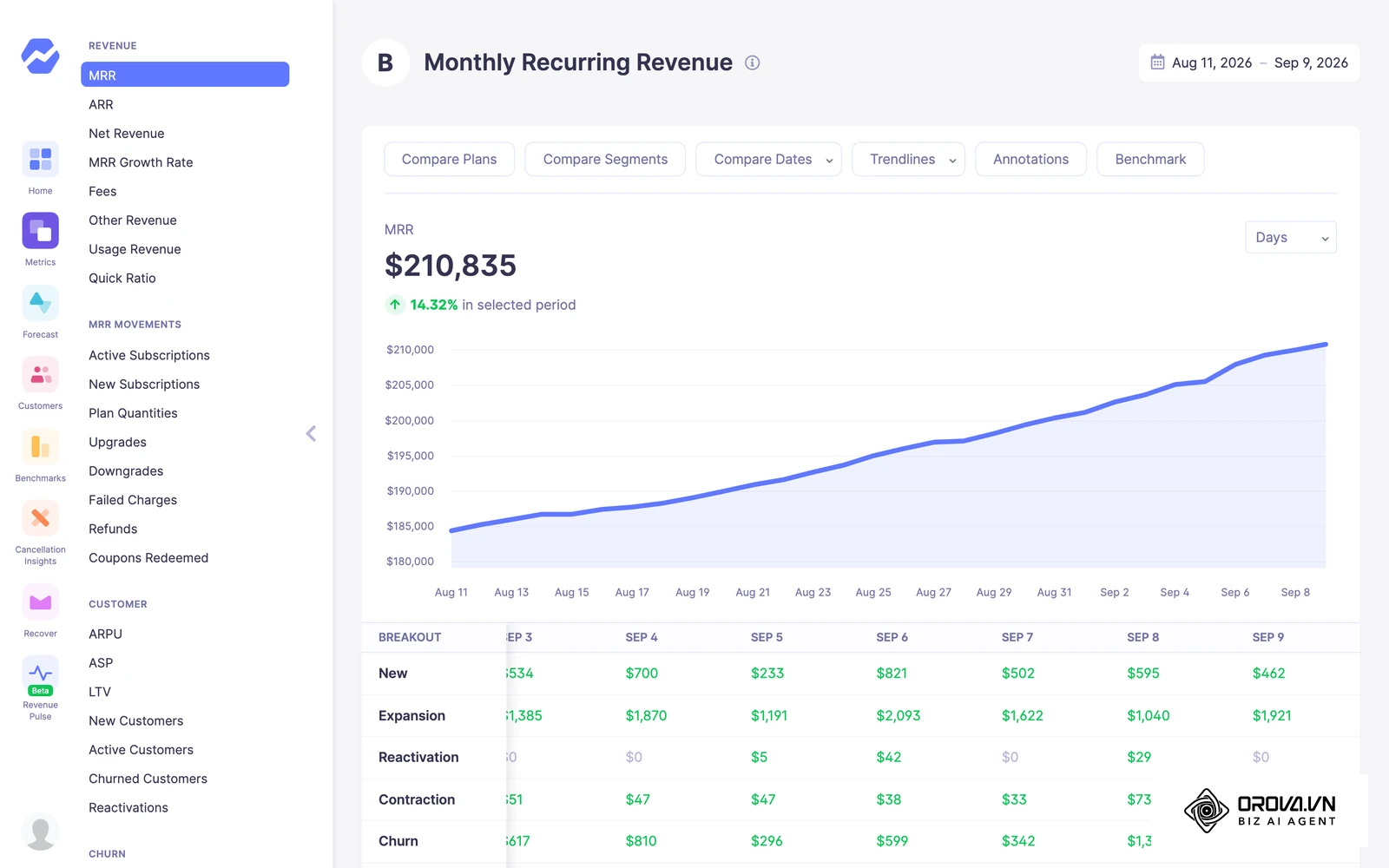
This metric gained prominence during the initial boom of Software as a Service (SaaS). When companies shifted from selling perpetual software licenses (where you get all the money upfront) to subscription models, traditional accounting struggled to measure marketing efficiency. Companies needed a new way to measure the "valley of death"—the period where a customer is actively using the product but hasn't yet paid enough to cover what it cost to get them to sign up.
It is highly common to confuse this metric with other financial acronyms. Here is a clear distinction:
| Concept | Difference from Payback Period | Example |
|---|---|---|
| LTV:CAC Ratio | Measures long-term profitability over the entire lifespan, not the time it takes to break even. | An LTV:CAC of 4:1 is great, but if it takes 36 months to get there, you might run out of cash first. |
| Customer Acquisition Cost (CAC) | Only measures the total upfront expense, completely ignoring how much the customer pays you or how long it takes to recover it. | Spending 500 dollars to acquire a user is the CAC. How fast they pay that 500 dollars back is the payback period. |
| ROI (Return on Investment) | A broad percentage of total return, often ignoring the specific timeline of cash recovery in subscription models. | A campaign yields 150% ROI after two years, but the payback period tells you exactly when you hit 100%. |
To ground this in reality, consider a real-life example outside of software: buying a solar panel system for your house. If the panels and installation cost you 12,000 dollars and they save you 150 dollars a month on your electricity bill, you divide 12,000 by 150. Your payback period is 80 months. Until month 81, you haven't actually generated any new wealth; you are simply recouping your initial expense. The same logic applies to acquiring business customers.
Why Does CAC Payback Period Matter?
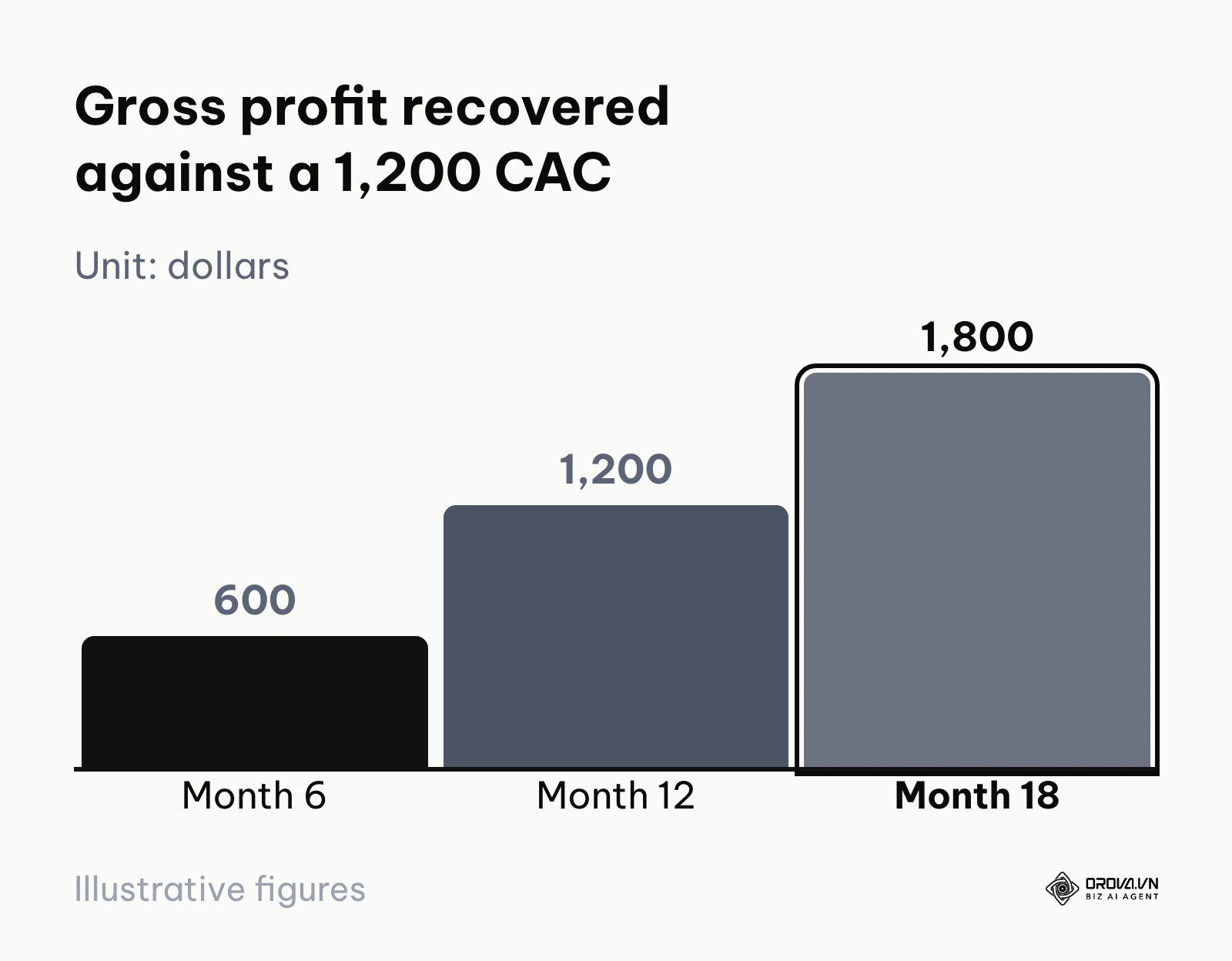
The most critical challenge in any subscription business is cash flow management. You pay your sales team, your marketing agency, and ad networks upfront. However, your customers pay you in small, monthly increments. This dynamic creates a severe cash flow trough. The CAC Payback Period matters because it defines the exact width of that trough. For example, if acquiring a customer costs 1,200 dollars and that customer brings in 100 dollars of gross profit a month, you have recovered only 600 by month 6, you break even at month 12 when the total reaches 1,200, and by month 18 you have recovered 1,800, which puts you 600 ahead.
If your payback timeframe is incredibly long, every new customer you acquire actually increases your risk of insolvency in the short term. You are actively digging a deeper financial hole with every sale, hoping you can survive long enough for those monthly payments to fill the hole back up. When you measure this metric rigorously, it sits precisely between your initial marketing execution and the eventual realization of Customer Lifetime Value (LTV). It acts as the ultimate reality check on your growth rate.
Benchmark surveys of private SaaS companies consistently show that typical payback differs a lot by target market, with SMB and enterprise products landing in very different ranges. If your business sits far outside the norm for its market without a deliberate strategy, you are likely operating inefficiently. If you completely ignore this metric, the consequence is straightforward: you will over-hire in sales, over-spend on marketing, and inevitably fail to meet payroll because your capital is locked up in future, uncollected revenue.
When you don't need CAC Payback Period yet: If you are a pre-revenue startup still strictly focused on product-market fit and beta testing, tracking this metric is a waste of time. Your marketing costs are heavily skewed by early experiments, and you have no stable recurring revenue to measure against. Similarly, if your business operates strictly on multi-year enterprise contracts where 100% of the cash is collected on the day the deal is signed, your payback is effectively zero days. In these specific scenarios, focus on qualitative customer feedback and basic customer acquisition cost rather than complex cash flow models.
The True Value and Benefits of Tracking Payback
The value of understanding your recovery timeframe splits into two distinct layers: the macro value for the entire business, and the micro value for the specific practitioners executing the daily work.
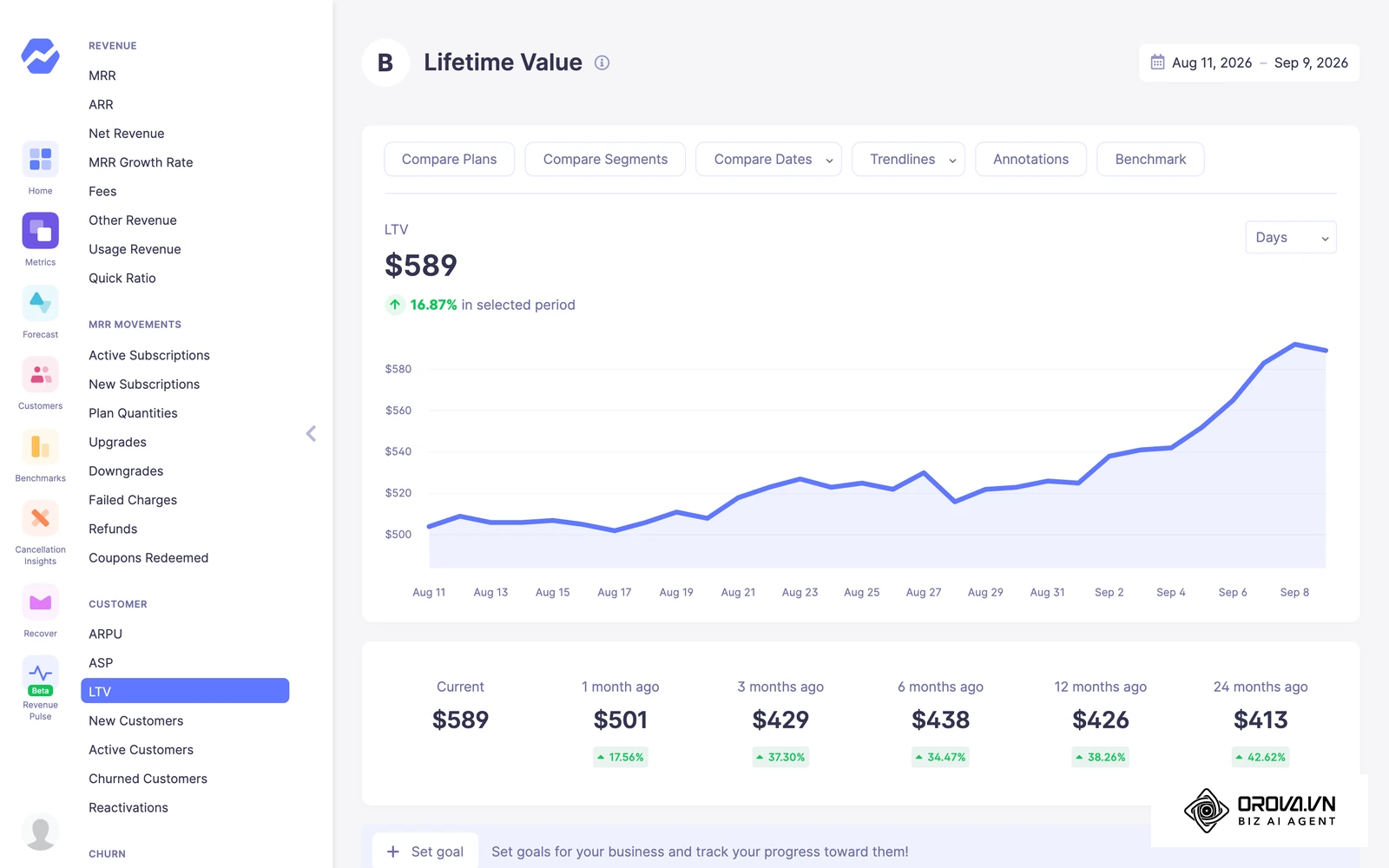
For the business as a whole, the primary value is risk mitigation and runway extension. By knowing exactly when cash returns, the executive team can precisely calculate how much venture capital or debt they need to raise to sustain a specific growth rate. It removes the guesswork from financial modeling.
For the practitioner—specifically marketing and sales leaders—the value lies in granular budget allocation. When a marketer knows exactly which campaigns return cash the fastest, they can confidently request budget increases without fear of endangering the company's financial health.
Protecting the Cash Runway
The most immediate benefit is preventing accidental self-destruction. Fast-growing companies frequently burn through cash faster than slow-growing ones because they are acquiring many customers at a loss.
- Before: A company scales ad spend by 300% because the cost per lead looks good, completely unaware that those leads take 18 months to become profitable. Six months later, they run out of cash.
- After: By tracking the recovery timeline, the company realizes they can only afford to scale ad spend by 50% per quarter to maintain a safe cash reserve, ensuring they survive to see the profits.
Granular Channel Optimization
Not all customers are acquired equally. By tracking this metric, practitioners can stop treating their marketing budget as a single monolithic entity and start operating like an investment portfolio manager. For organic search, the basics of on-page SEO are often what turns content into a fast-payback channel.
- Before: The marketing team optimizes purely for the lowest Customer Acquisition Cost, pushing heavy budget into low-intent display ads that convert to cheap, but highly churn-prone users.
- After: The team shifts budget to high-intent search campaigns. The initial cost is higher, but the users stay longer and upgrade faster, shrinking the recovery time drastically.
Aligning Sales Commissions
Sales compensation can heavily distort cash flow if not aligned with payback realities.
- Before: Sales reps receive massive upfront bonuses for closing monthly subscription deals. The company pays out 2,000 dollars in commission today for a customer who pays 100 dollars a month.
- After: The company institutes a clawback clause or shifts to paying commissions incrementally as the cash is collected, tightly aligning employee incentives with the company's actual cash position.
Illustrative example:
- Context: A 50-person B2B analytics platform with a dedicated marketing lead was heavily investing in both paid social and organic content.
- Steps: The marketing lead extracted the previous year's total ad spend, matched it to the new recurring revenue specifically tagged to those paid channels in the CRM, and applied their standard 75 percent gross margin.
- Hiccup: They discovered their attribution software was broken, incorrectly classifying branded search as organic traffic. This made paid social look artificially expensive and skewed the payback timeline by nearly four full months.
- Result: After implementing server-side conversion tracking to fix the attribution, they accurately recalculated the data. They confidently reallocated budget toward their best-performing ad sets, effectively cutting their actual recovery time from 16 months down to 11 months without spending an extra dollar overall.
| Benefit | Measured By Which Metric | Timeframe to See Results |
|---|---|---|
| Safer Cash Flow Management | Months of Cash Runway | Immediate (upon calculation) |
| Smarter Marketing Spend | Channel-specific Payback Period | 3 to 6 months |
| Improved Pricing Strategy | Average Revenue Per User (ARPU) | 1 to 2 quarters |
OROVA ADS applies AI Agent to automate and optimize ad performance on Google, Meta and TikTok. Scale your budget safely, monitor 24/7 and expand your business quickly.
Experience the solution at orova.vn/ads
How the CAC Payback Period Works (and Where Most Fail)
Calculating this metric seems simple on the surface, but the nuances of how inputs are categorized can drastically alter the outcome. This is where the majority of businesses make fatal miscalculations.
The Standard Formula vs. Gross Margin
The foundational question of how to calculate CAC payback period usually starts with the simplest formula: Total Sales & Marketing Spend divided by New Monthly Recurring Revenue (MRR). However, this formula is fundamentally flawed because you do not get to keep 100% of that MRR.
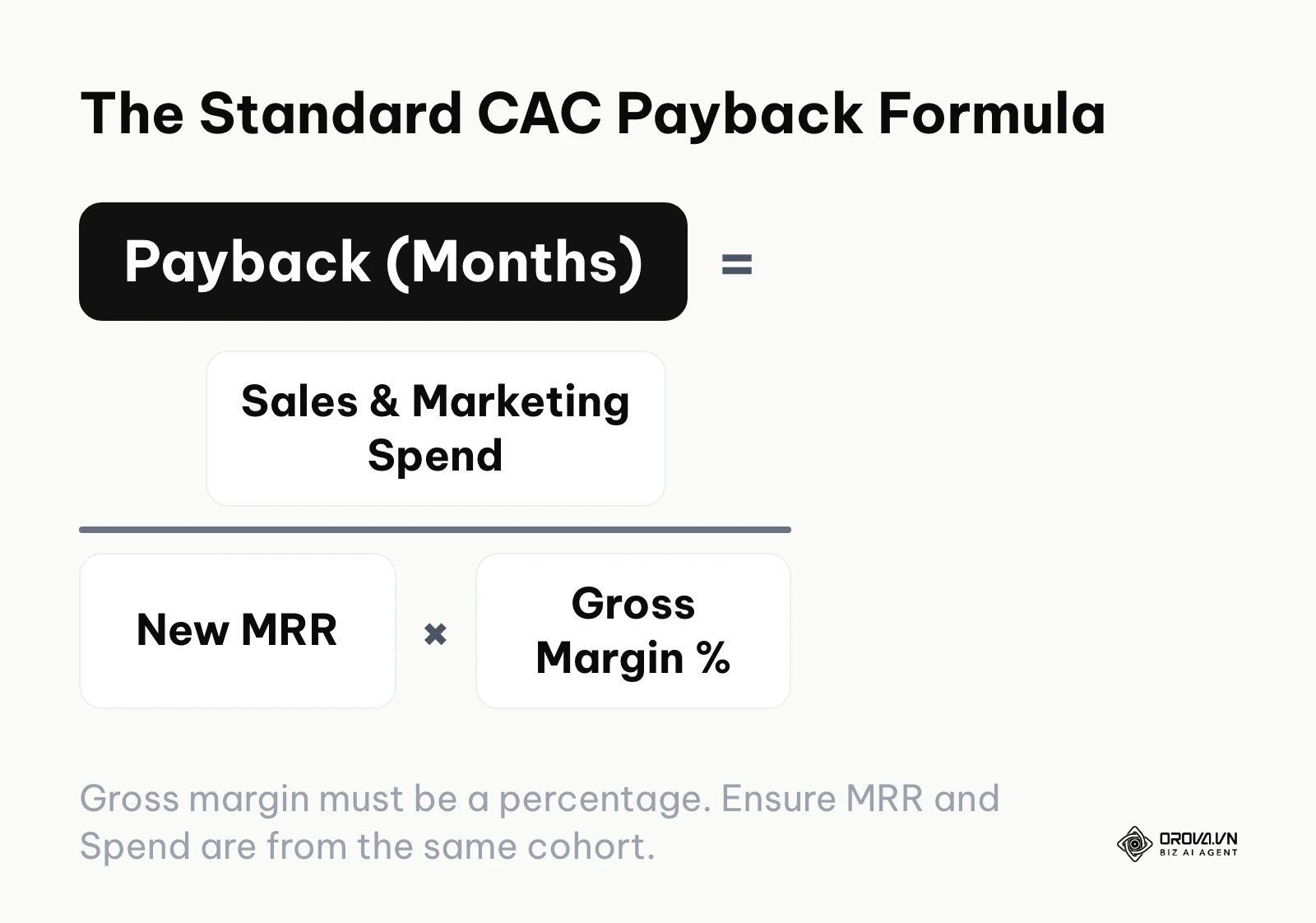
To deliver your software or service, you incur costs. These are your Cost of Goods Sold (COGS). If a customer pays you 100 dollars a month, but it costs you 20 dollars in server hosting and baseline customer support software to keep their account active, your Gross Margin is 80%. You only have 80 dollars left over each month to pay back the initial acquisition cost.
Therefore, the accurate CAC payback period formula with gross margin is: Total Sales & Marketing Spend / (New MRR × Gross Margin Percentage)
- Inputs: To get this right, your Sales & Marketing Spend must be fully loaded. This means not just ad spend, but the salaries of your marketing team, the commissions of your sales reps, the cost of your CRM software, and the travel budget for trade shows. Your Gross Margin must accurately include hosting (AWS/Google Cloud), third-party software licensing necessary for the product to function, and the salaries of the technical support staff handling tickets.
- Outputs: The output is the raw number of months required to break even on a specific cohort of customers.
- Failure Point: The most common mistake is miscategorizing salaries. Many companies exclude the VP of Sales' salary from the S&M spend, or they accidentally include Research & Development (R&D) engineers in their COGS. Getting these accounting buckets wrong will result in a highly inaccurate payback timeline.
The Adjusted Churn Formula
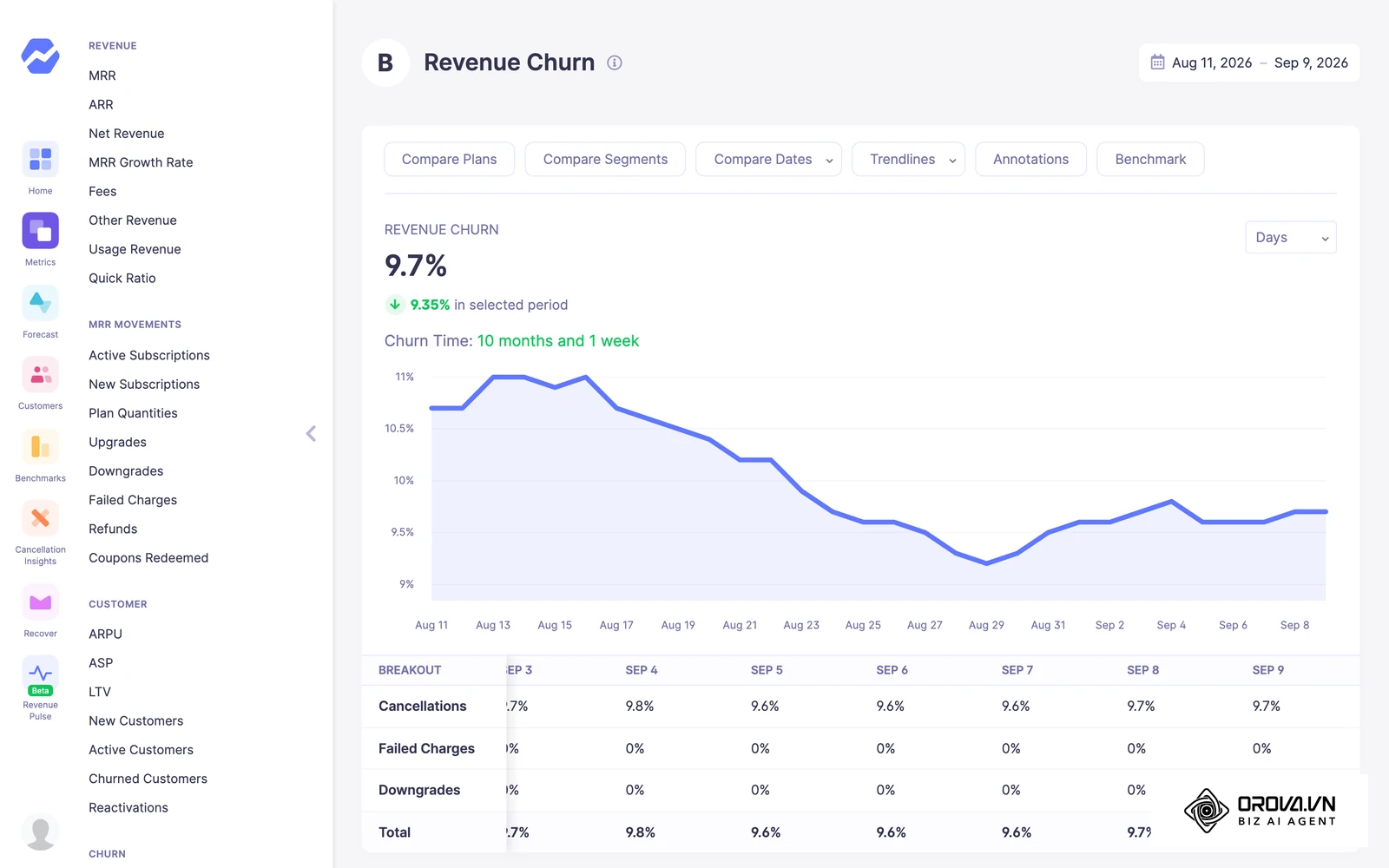
The standard formula assumes that every customer you acquire will stay with you forever. In reality, customers cancel. If your calculated payback period is 12 months, but your average customer cancels in month 6, the standard formula will completely hide the fact that you are losing money on every sale.
To solve this, advanced finance teams use an adjusted formula that factors in the monthly churn rate. If you lose 5% of your MRR every month, the revenue you collect in month 8 is significantly less than the revenue you collected in month 1.
While the exact calculus requires a logarithmic function, a practical approximation used by many operators is calculating the recovery time on a cohort-by-cohort basis. You track a specific group of customers (e.g., everyone acquired in March) and measure their actual cumulative gross profit month over month until that specific cohort crosses the break-even line.
Worked example with numbers: a cohort of 10 customers cost 12,000 dollars in sales and marketing to win. Each pays 125 dollars a month at an 80% gross margin, so the cohort starts out returning 1,000 dollars of gross profit a month. The standard formula says 12,000 / 1,000 = 12 months. Now watch what monthly customer churn does to the same cohort:
| Month | Cumulative gross profit, 0% churn (dollars) | Cumulative gross profit, 5% monthly churn (dollars) | Cumulative gross profit, 10% monthly churn (dollars) |
|---|---|---|---|
| 3 | 3,000 | 2,853 | 2,710 |
| 6 | 6,000 | 5,298 | 4,686 |
| 9 | 9,000 | 7,395 | 6,126 |
| 12 | 12,000 (payback) | 9,193 | 7,176 |
| 15 | 15,000 | 10,734 | 7,941 |
| 18 | 18,000 | 12,056 (payback in month 18) | 8,499 |
At 5% monthly churn, the 12-month payback quietly becomes 18 months. At 10% monthly churn, the cohort can never return more than 10,000 dollars in total, so it never pays back the 12,000 dollars at all. That is the gap the standard formula hides. The churn-adjusted payback in months is LN(1 − CAC × churn ÷ monthly gross profit) ÷ LN(1 − churn); if CAC × churn is equal to or larger than the monthly gross profit, there is no payback point.
Illustrative example:
- Context: The founder of a subscription box software tool noticed cash was constantly tight despite hitting all their growth targets.
- Steps: They calculated their standard payback and felt comfortable with a result of 9 months. However, they decided to pull a cohort analysis to see actual retention behavior.
- Hiccup: They realized that due to a poor onboarding experience, 30% of their new customers were churning by month 4. Because they were using the standard, static formula, they had been blind to this attrition.
- Result: By applying an Adjusted Churn formula, they realized they were mathematically never breaking even on a large segment of users. They immediately shifted their entire pricing model to annual upfront billing, completely eliminating the risk of early churn destroying their capital.
The Google Sheets Template Setup
Building a CAC Payback Dashboard doesn't require expensive enterprise software. You can build a highly accurate tracker in a spreadsheet. Here is the exact structure you need to build:
- Column A (Month/Cohort): List the months (e.g., Jan 2026, Feb 2026).
- Column B (Fully Loaded S&M Spend): Input the total marketing and sales expenses for that specific month.
- Column C (New MRR Acquired): Input the fresh recurring revenue generated strictly in that month.
- Column D (Gross Margin %): Your company's own gross margin percentage (software businesses usually run high margins, but use your real figure).
- Column E (Gross Profit per Month): Multiply Column C by Column D. This is your actual usable cash.
- Column F (Cumulative Profit): This requires a rolling formula tracking the accumulating Gross Profit of the cohort minus the initial S&M spend, factoring in an estimated monthly churn rate deduction. The month this column turns from negative to positive is your payback point.
- Column G (Simple payback, months): =B2/E2
- Column H (Churn-adjusted payback, months): put your monthly churn rate in column I of the same row (for example 5%), then use =IF(B2*I2/E2>=1,"Never",LN(1-B2*I2/E2)/LN(1-I2)). With the numbers from the worked example above (B2 = 12,000, E2 = 1,000, I2 = 5%), column G shows 12 and column H shows about 17.9.
Slicing by Channel and Cohort
Looking at a blended, company-wide payback number is dangerous. It averages out your best and worst performers. A blended payback of 10 months might actually be composed of organic inbound leads paying back in 3 months, and cold outbound sales paying back in 24 months.
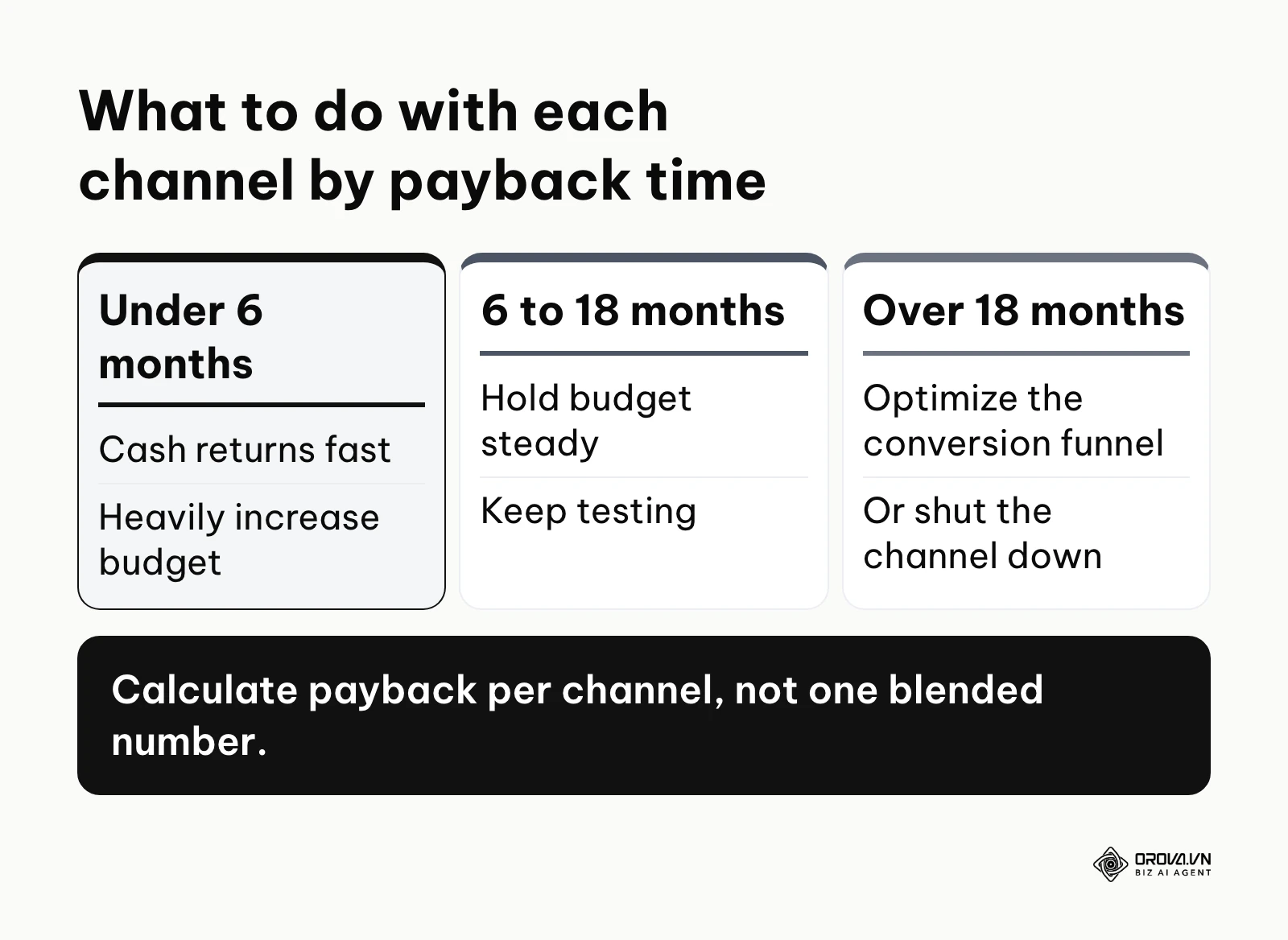
You must slice your data. A strong marketing leader needs to calculate the timeframe for Google Ads independently from LinkedIn Ads. If you want to understand how to better track these distinct ad ecosystems, you can explore how Facebook Ads Manager reports spend and results. By isolating the spend and the specific MRR generated by a single channel, you create a decision matrix. If a channel pays back in under 6 months, you should heavily increase its budget. Between 6 and 18 months, hold the budget steady and keep testing. If it takes over 18 months, you need to either aggressively optimize the conversion funnel or shut the channel down entirely.
Compressing Time with Upfront Billing
The fastest way to optimize your cash flow isn't necessarily by lowering your ad costs; it is by changing how you collect money. If you can collect 12 months of revenue on day one, your payback period on a cash-flow basis drops instantly. To ensure your website is optimized to handle these strategic pricing offers, consider the principles of conversion rate optimization.
Here is a checklist of tactics to force faster cash recovery:
- Incentivize Annual Plans: Offer a strict 20% discount for customers who pay the full year upfront instead of monthly.
- Implement Setup Fees: Charge a mandatory, non-refundable onboarding fee that exactly covers the sales commission and initial account provisioning.
- Delay Commission Payouts: Only pay sales commissions after the customer has successfully paid their third month's invoice.
- Offer Multi-Year Lock-ins: For enterprise clients, offer price protection against future increases in exchange for two years paid in advance.
Calculating for Product-Led Growth (PLG)
Freemium and Product-Led Growth models introduce a massive complication. In these models, traditional sales and marketing spend is incredibly low because the product itself acts as the acquisition engine. However, the costs of hosting thousands of free users and paying the engineers to build viral loops are very high.
If you strictly use the standard formula, a PLG company will look like it has a payback period of one week, which is entirely false. For PLG, you must reconsider what constitutes "marketing." A portion of the R&D budget dedicated specifically to growth features and the hosting costs of the free tier should conceptually be moved into your acquisition cost bucket to get an honest assessment of how efficiently your capital is generating new paying users.
| Type of Tracking | Characteristics | Best Suited For |
|---|---|---|
| Blended Payback | Aggregates all spend and all revenue into one macro number. | High-level board reporting and investor updates. |
| Cohort Payback | Tracks a specific group of users acquired in a specific month over time. | Identifying exactly when churn destroys profitability. |
| Channel Payback | Isolates the spend and revenue of one specific source (e.g., SEO). | Marketing teams allocating quarterly ad budgets. |
How to Start Optimizing Your Payback Period
Adapting your strategy to prioritize cash recovery requires different actions depending on your role within the company. What a founder needs to do is very different from the tactical execution of a marketing manager.
For the Bootstrapped Founder
Bootstrapped founders do not have a safety net of venture capital. Cash preservation is the only priority.
- Shift to Annual Default: Immediately change your pricing page to default to the annual billing toggle.
- Audit Software Subscriptions: Cut any marketing or sales software that isn't directly attributable to closing revenue. A lower baseline S&M overhead instantly improves your metrics.
- Mandate Setup Fees: If your product requires any manual hand-holding to set up, start charging an implementation fee (for example, 500 to 1,000 dollars) today. This instantly offsets early acquisition costs.
- Pause Experimental Channels: Halt any marketing channel that cannot mathematically prove a return within 6 months until your cash reserves are padded.
For the Head of Marketing
Marketing leaders must transition from being measured solely on lead volume to being measured on capital efficiency. Pair payback with return on ad spend: ROAS tells you how much revenue a campaign returns, while payback tells you when the cash actually comes back.
- Demand CRM Integration: Stop relying on ad platform dashboards (which take credit for everything) and mandate that all marketing spend is tied directly to closed-won revenue in your CRM.
- Calculate by Source: Spend this week breaking down your last quarter's spend strictly into Paid Search, Paid Social, and Organic. Calculate the specific return time for each.
- Kill the Losers: Ruthlessly cut the budget of any campaign or channel that takes longer than 15 months to return cash, reallocating those funds to the fastest-returning channel.
- Optimize Onboarding: Work with the product team to ensure new sign-ups reach their "Aha!" moment faster, reducing the chance they cancel before month three.
For the Finance / RevOps Lead
The finance team must be the ultimate source of truth, ensuring the data inputs are immaculate and free from departmental bias.
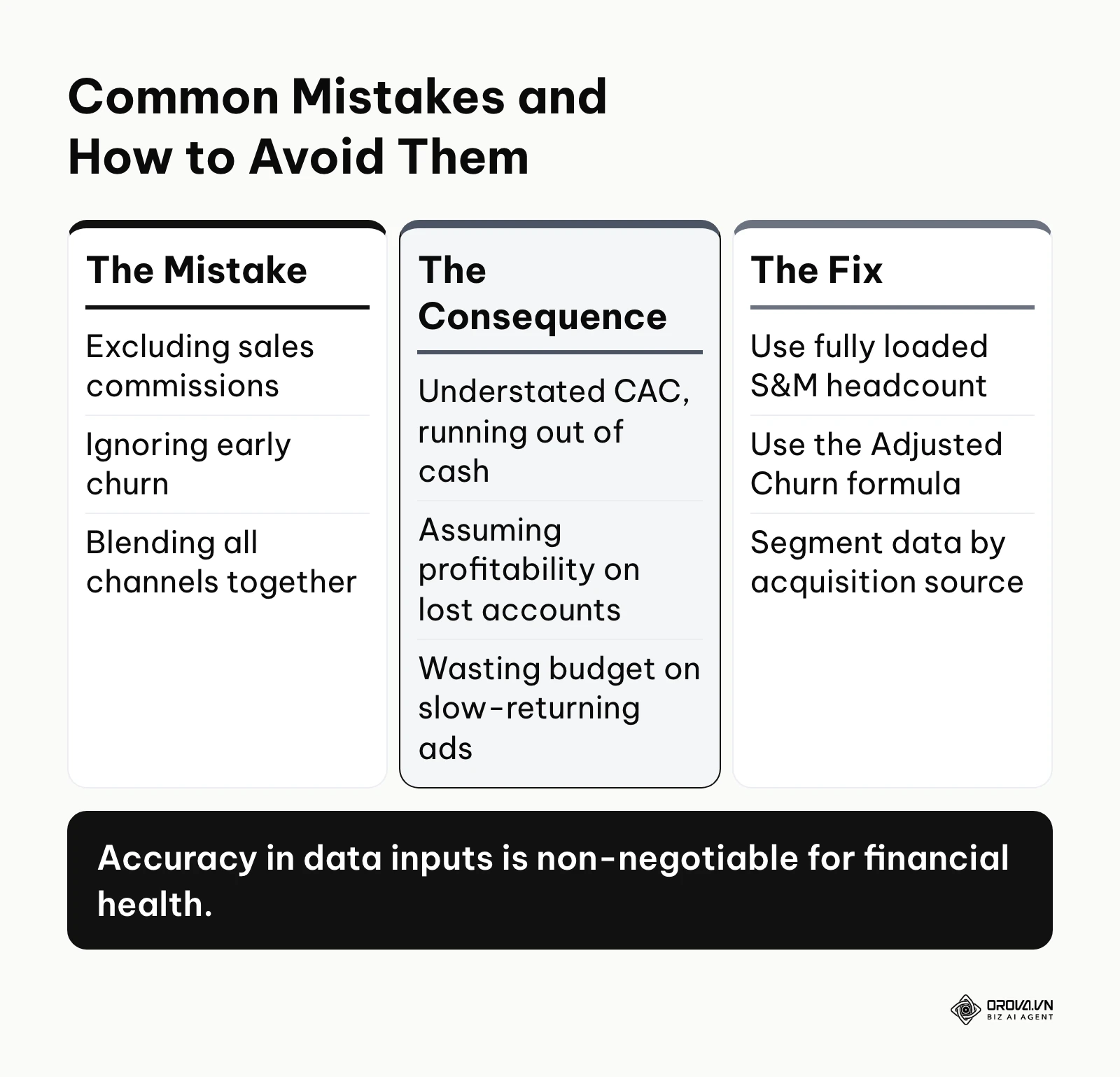
- Define the COGS Boundary: Write a crystal-clear, one-page document defining exactly which salaries and server costs belong in Gross Margin and which belong in Operating Expenses.
- Fully Load the S&M: Ensure that marketing agency fees, software licenses (like HubSpot or Salesforce), and fully loaded salaries (including taxes and benefits) are included in the acquisition cost numerator.
- Establish a Baseline Benchmark: Based on your current cash position, declare a company-wide maximum acceptable payback limit (e.g., "No channel may exceed 12 months").
- Build the Cohort Tracker: Implement the Google Sheets template structure detailed earlier and update it by the 5th of every month.
Illustrative example:
- Context: A RevOps manager at a 200-person SaaS firm needed to justify a massive budget shift for the upcoming year.
- Steps: They painstakingly segmented the historical marketing spend into distinct organic inbound and paid outbound buckets, calculating separate recovery timelines for both.
- Hiccup: They found it nearly impossible to attribute the salaries of the Sales Development Reps (SDRs) accurately, as the SDRs handled both inbound leads and cold outbound calls simultaneously.
- Result: They developed a weighted headcount model based on time-tracking data, accurately splitting the SDR costs. This data proved that inbound leads paid back three times faster, leading the executive team to shift 30% of the outbound budget into content and SEO, drastically improving overall capital efficiency.
Want to scale your budget but afraid of breaking performance?
Integrate OROVA ADS now - an AI Agent that automatically monitors and optimizes Google, Meta, TikTok ads 24/7. Now, expanding and replicating your Performance Ads team is just one click away.
Try it now at: orova.vn/ads
Where CAC payback period is heading in the next few years: the author's take
Based on current market dynamics as of 2026, here is how I see this metric evolving.
AI Will Push Optimal Payback Windows Shorter
I believe that within the next two to three years, the acceptable benchmark for recovering acquisition costs will shrink significantly for lower-tier SaaS products. AI agents are dramatically lowering the cost of creating content, generating code, and executing personalized outreach. Because the barrier to entry is dropping, competition is exploding. With increased competition comes higher churn risk. A payback window that feels safe today may not stay safe, because AI-driven competitors can lure customers away before you have recovered what you spent on them. My advice is to start working now on breaking even noticeably faster than you do today.
Zero-CAC Channels Will Become Mandatory for Early Stage
My read is that early-stage startups will lean far less on paid advertising as their only engine. Rising costs on major ad networks already make it hard for many B2B SaaS products to reach a viable recovery time from paid social or search alone in their first year. Founders must prepare now by building proprietary, zero-CAC acquisition channels—such as deep community building, highly specialized programmatic SEO, or open-source product tiers—where the primary investment is time rather than strictly capital.
The Blurring Line Between S&M and COGS
I think the traditional accounting definitions of Sales, Marketing, and Cost of Goods Sold will keep breaking down. As products become more inherently viral and self-serving (Product-Led Growth), the engineers building the onboarding flow are arguably doing more "marketing" than the ad buyers. I expect that more finance teams will adopt dynamic accounting models that reclassify portions of R&D and hosting costs into the acquisition bucket based on user behavior, in order to get a true picture of how much cash it actually takes to win a customer.
Frequently Asked Questions about CAC Payback Period
Is CAC Payback Period still relevant when we have AI predicting LTV?
Yes, it is arguably more relevant than ever. AI can accurately predict that a customer will have a massive Lifetime Value over five years, but predictive algorithms do not pay your monthly server bills or employee salaries today. AI handles the long-term strategic projection, but the payback calculation manages the immediate reality of your bank account. You need both.
What is a good CAC payback period benchmark for SaaS?
Many SaaS operators treat recovering acquisition costs within about 12 months as a healthy target. However, this varies heavily by target audience. SMB-focused products should aim to recover faster because churn risk is higher, while enterprise software with multi-year contracts and low churn can safely sustain longer payback windows.
Does customer onboarding cost belong in CAC or COGS?
It depends entirely on how your business operates. If your onboarding team is primarily focused on getting the user set up so they don't churn in the first 30 days (defensive), it is generally considered part of COGS. If your onboarding team is actively measured on upselling the customer to a higher tier within the first month (offensive), a strong argument can be made to allocate a portion of that cost to S&M.
How do we track this when sales cycles take 6 months?
When there is a massive time delay between marketing spend and closed revenue, you must use a cohort model based on the close date, but attribute the costs backward. If a customer closes in December, you take the MRR generated in December, but you measure it against the marketing and sales costs that were specifically allocated to the pipeline that generated that lead back in June. It requires meticulous CRM hygiene.
Can negative churn fix a bad payback period?
Yes, highly effective expansion revenue (negative churn) can rapidly accelerate recovery. If you spend heavily to acquire a customer, but they upgrade their account and double their MRR in month three, your payback timeline compresses drastically. This is why cross-selling and upselling are often more effective cash flow levers than simply trying to buy cheaper ads.
Where to Start Right Now?
You cannot fix a cash flow problem you haven't measured. Depending on the current state of your data, your first move should be highly specific. Do not try to build a complex, multi-variable financial model today if you don't even know your basic ad spend. Choose the single step below that matches your current reality and execute it before the week ends.
If you have measured nothing: Your very first step is to establish a basic, company-wide baseline. Do not worry about cohorts or channels yet. Pull your total marketing and sales expenses from your accounting software for the last complete quarter. Pull your total new MRR added in that same quarter. Apply a standardized 80% gross margin assumption and run the basic formula. This single, blended number will immediately tell you if you are in a safe zone (under 12 months) or in the danger zone (over 18 months).
If you have disjointed, siloed data: If marketing has their ad spend spreadsheet and finance has a separate revenue spreadsheet, your first step is forced integration. Mandate a one-hour meeting between the marketing lead and the finance lead. Their sole objective for that hour is to agree on exactly which CRM report will act as the undeniable source of truth for "New MRR Generated." Until both departments agree on the revenue output, any further calculations are useless.
If you have measured everything but take no action: If you already have a beautiful dashboard showing exactly how fast each channel returns cash, your first step is immediate budget reallocation. Identify the single worst-performing marketing channel—the one taking 20+ months to break even. Pause all spend on that channel immediately for the next 30 days. Take half of that budget and manually inject it into the channel that is currently returning cash the fastest. Monitor the cash flow impact at the end of the month.
About the author

Builder of Orova
Nguyễn Đỗ Trọng Ân has 8 years of experience in marketing, including 6 years managing market development across Asia. He builds Orova, a Biz AI Agent that never sleeps: it plans, runs and optimizes work for businesses.
Run your business with AI Agents
Orova is the always-on Biz AI Agent — it plans, runs, and optimizes the work for you.
Save time, unlock productivity.