
Budget Pacing on Autopilot: Stopping Ad Spend Leaks Before They Happen
A media buyer I worked with once set a $9,000 monthly budget across four Meta ad sets on a Monday, felt good about the structure, and went on with his week. By the following Monday, one ad set had quietly consumed $3,100 and returned six purchases. The other three, which were actually profitable, had been starved because the algorithm kept feeding the loser. Nobody did anything wrong in the obvious sense. The campaigns were live, the targeting was reasonable, the creative was approved. The money simply drained through a crack that opened on Tuesday and stayed open until the next check-in. That is the entire problem with how most advertisers manage budget, and it is the reason pacing matters more than almost any other lever you have.
Budget pacing is not glamorous. It does not produce a clever new audience or a viral hook. It is the unsexy discipline of making sure the money you committed gets spent at the right rate, on the right things, before the calendar runs out. Done badly, it is invisible — until you reconcile the month and find that a third of your spend went to delivery that never had a chance. Done well, it is the quiet difference between an account that compounds and one that limps. This piece is about doing it well, and specifically about doing it continuously rather than in the weekly bursts that leave most of the month unsupervised.
What pacing actually means
People use the word "pacing" loosely, so let me be precise. Pacing is the management of how fast and where a fixed budget is spent over a fixed period. It has two faces that most advertisers only think about one at a time.
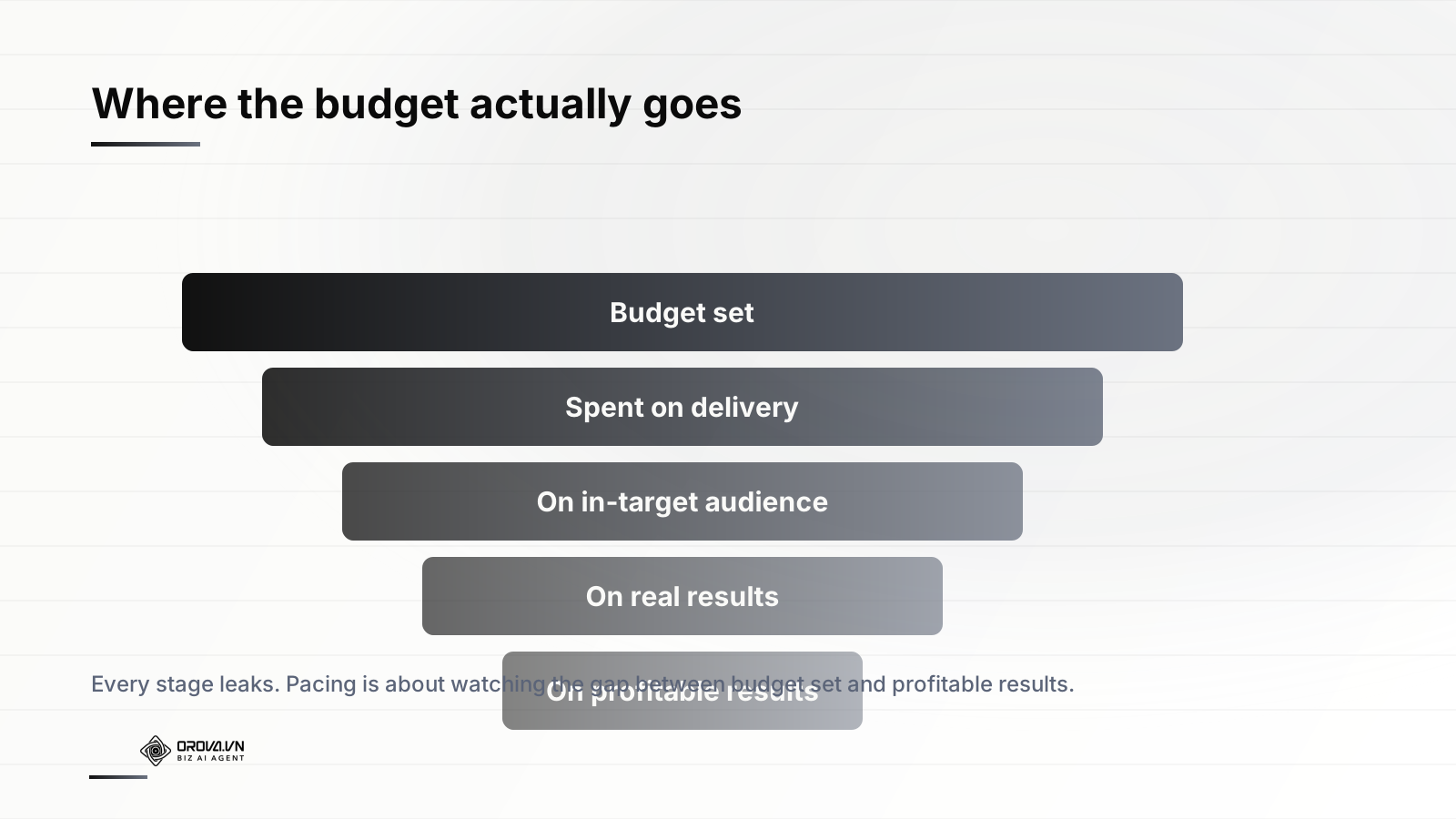
The first face is temporal: are you spending at a rate that will exhaust the budget exactly when the period ends — not on the 22nd, not with $2,000 stranded on the 31st? The second face is allocational: within that spend, is the money flowing toward the campaigns, ad sets, and audiences that produce profitable results, or toward the ones that merely produce delivery? Both faces leak money, and they leak in opposite-looking ways that share the same root cause: the gap between when a problem starts and when a human notices it.
The platforms give you blunt instruments here. A daily budget caps how much an ad set can spend in a day but says nothing about whether that day's spend was worthwhile. A lifetime budget lets the algorithm front-load or back-load delivery according to its own forecasts, which is fine until its forecast is wrong. Campaign Budget Optimization (Meta) and its Google equivalents promise to move money to winners automatically, and they do — but they optimize toward the in-platform conversion signal you handed them, which is often not the same thing as your actual margin. None of these tools watch the metric that matters most to you: profit per dollar at the rate it is currently bleeding.
Why "set it and check it weekly" became the norm
The weekly cadence is not a considered strategy. It is an artifact of human attention. A person can hold maybe a dozen campaigns in their head, and reviewing each one properly — pulling the numbers, comparing to target, deciding to shift budget — takes real time. So the work gets batched into a Monday review, maybe a Thursday spot-check if the account is big enough to warrant it. Everything between those points runs on autopilot in the worst sense: spending continuously, supervised intermittently.
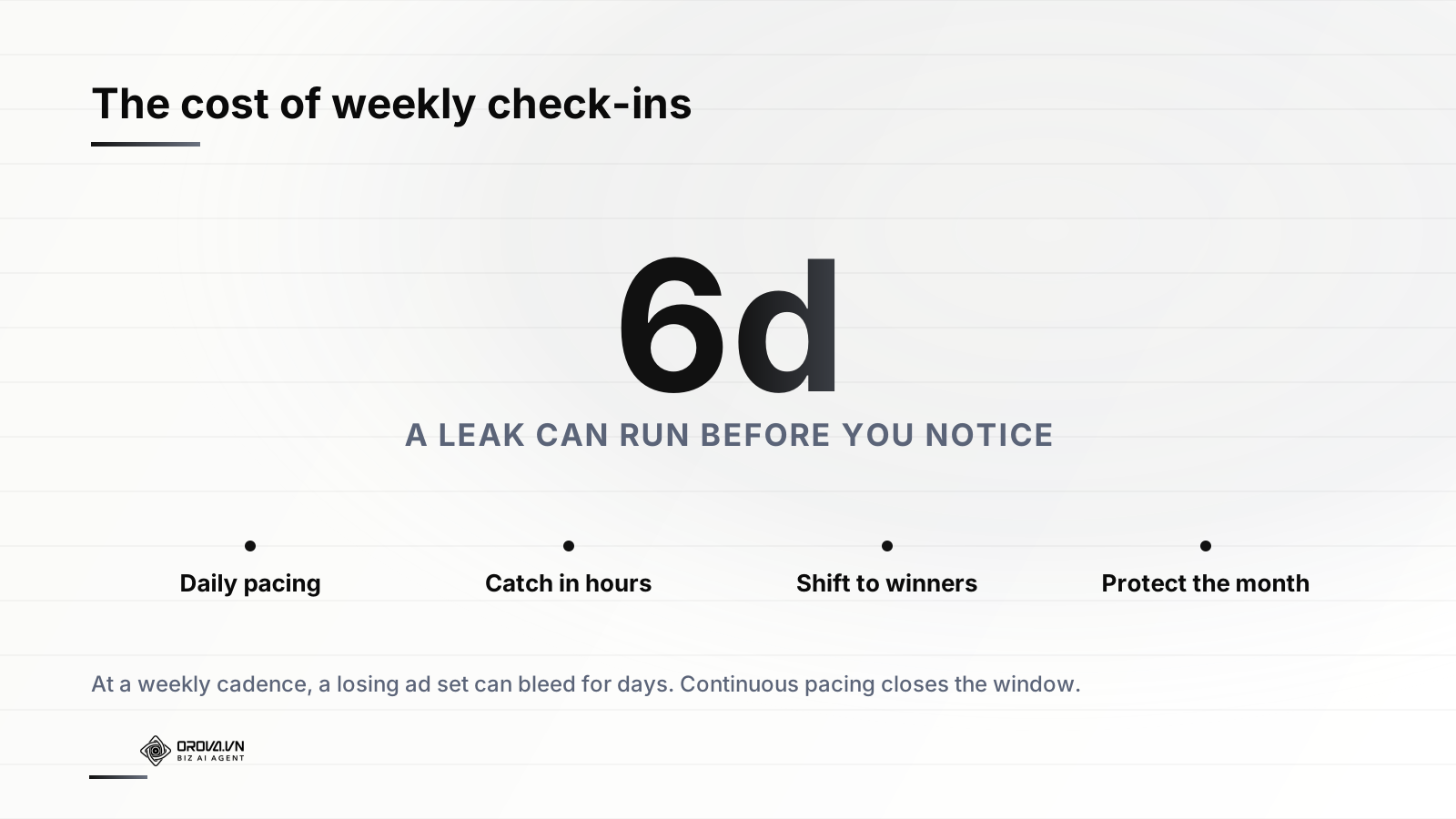
The math of that gap is unforgiving. If you review weekly, the average problem runs for half a week before you see it, and the worst-case problem runs for almost the full week. On a $9,000 monthly budget that is roughly $300 a day in motion. A single misbehaving ad set absorbing 40% of delivery at zero profit is burning $120 a day you will never get back, and at a weekly cadence it burns that for up to six days before anyone looks. That is not a rounding error. Over a year of weekly reviews, the accumulated leak from "problems that ran until the next Monday" routinely reaches 15–25% of total spend in the accounts I have audited.
Overspend and underspend both cost you
It is tempting to think of pacing failures as a single category — "spending too fast" — but underspend is just as expensive, and it hides better because it never shows up as a scary-looking charge.
The overspend leak
Overspend leaks are the ones people imagine: an ad set that the platform decides to favor, pouring budget into an audience that converts cheaply on the in-platform metric but poorly on margin. Classic culprits include broad audiences that capture a lot of low-intent clicks, retargeting pools that are too small and get over-served, and creative that wins the auction on cheap impressions to an audience that was never going to buy. The platform sees engagement and doubles down. You see a healthy-looking CTR and a click cost that is not alarming. Only when you look at cost per profitable result does the leak appear — and by then it has been running for days.
The subtler overspend problem is front-loading. A lifetime budget asked to spend over 30 days may decide, based on early signal, to spend aggressively in the first week. If that early signal was a fluke — a cheap-traffic day, a temporary creative novelty — you have committed a disproportionate share of the month to a moment that will not repeat. The back half of the month then runs lean precisely when you finally have enough data to know what works.
The underspend leak
Underspend feels safe and is anything but. When an ad set that is genuinely profitable cannot exit the learning phase, gets throttled by a daily cap set too conservatively, or loses the internal budget fight to a louder-but-worse competitor in the same campaign, you are leaving margin on the table. Every dollar that should have gone to a profitable ad set and didn't is a dollar of profit you chose not to collect. It does not appear on any report as a loss. It appears as nothing — and nothing is exactly what makes it dangerous.
The most common underspend pattern is the stranded budget at month-end: the account is pacing behind, someone notices on the 28th, and now there is $1,800 to spend in three days. Dumping that into the market in a rush almost always means buying expensive, low-quality inventory, because you have removed the algorithm's ability to be patient. The leak that started as underspend converts into overspend at the worst possible price. Pacing is the discipline that prevents the whipsaw entirely.
Detecting leaks early instead of after the fact
The shift from weekly to continuous pacing is not about staring at dashboards all day. It is about defining what a leak looks like in advance, then watching for it constantly so that detection happens in hours rather than days.
Define the target rate, then watch the deviation
Start with the only number that anchors everything: your target daily spend rate, derived from the budget and the days remaining. If you have $9,000 for the month and 30 days, your baseline is $300 a day. But you should rarely treat that as a flat line. Most accounts have a weekly rhythm — weekends behave differently from weekdays, paydays matter for some verticals, B2B dies on Saturdays. A useful pacing target is a curve that respects that rhythm and still lands the budget on the last day.
Once you have the expected curve, the leak signal is simply the deviation from it, weighted by performance. Spending 20% over target is not automatically bad — if that overspend is going to your most profitable ad set during a high-intent window, you might want it. Spending 20% over target on an ad set whose cost per profitable result has crept above your ceiling is a leak in progress. The two look identical on a spend chart and completely different once you join spend to margin.
The signals worth watching continuously
- Rolling cost per profitable result by ad set. Not lifetime, not yesterday alone — a short rolling window (say the last 24–72 hours) that reflects what is happening now. Lifetime averages hide fresh leaks behind old wins.
- Share of delivery vs. share of profit. If an ad set is taking 40% of spend but producing 15% of profitable results, that gap is the leak, quantified. This single comparison catches most CBO/automated-allocation failures.
- Pacing index. Actual cumulative spend divided by the expected cumulative spend for this point in the period. Above 1.1 and you are running hot; below 0.9 and you are running cold. Track it per campaign, not just per account, because an account can pace perfectly while one campaign overspends and another starves.
- Frequency and audience saturation. A rising frequency on a fixed audience is an early warning that an overspend leak is about to get worse, because each additional impression is reaching a more fatigued, less responsive person.
The point of watching these continuously is not to react to every wiggle. It is to compress the time between a leak starting and someone — or something — deciding to act on it. A leak you catch in four hours costs you a tenth of what the same leak costs at a six-day weekly cadence.
Shifting budget to winners without breaking learning
Here is where pacing gets genuinely tricky, because the obvious fix — yank money from the loser, pour it into the winner — can backfire if you do it carelessly. Every platform has a learning mechanism that resets or destabilizes when you make large budget changes too quickly. Move an ad set's budget by 50% in a day and you may throw it back into the learning phase, where performance is volatile and expensive while the system re-calibrates. The cure becomes a new leak.
Move in increments the algorithm can absorb
The practical rule that holds across Meta and Google is to make budget changes in steps the system treats as continuity rather than disruption. In practice that means adjustments in the range of 20–30% per change, spaced out rather than stacked, and avoiding repeated large swings on the same ad set in a short window. You are nudging the allocation, not jolting it. A winner you want to scale gets fed gradually over several days; a loser you want to defund gets throttled in stages unless its leak is severe enough to justify pausing outright.
This is exactly the kind of judgment that is hard to do well by hand and tedious to do consistently. The discipline of "increase the winner 25%, wait, measure, increase again" is simple to describe and almost impossible for a busy human to execute across twenty ad sets without slipping. It is, however, very easy to encode as a rule.
Decide on the right metric before you reallocate
Reallocation is only as good as the metric you reallocate toward. If you shift budget toward whatever has the lowest cost per click, you will reliably fund cheap traffic that does not convert. If you optimize toward in-platform conversions, you fund whatever the pixel can attribute, which over-credits easy, bottom-funnel touches. The metric that actually protects the month is the one tied to profit — and choosing between cost-based and return-based framings is a decision worth getting right on its own terms. If you have not settled that question, it is worth reading through how CPA and ROAS each shape budget decisions before you build pacing rules on top of either one, because pacing toward the wrong metric just makes you wrong faster.
Protect the learning investment you have already made
An ad set that has just exited learning and is performing represents a sunk investment of the volatile, expensive impressions it took to get there. Defunding it to chase a momentarily cheaper newcomer can mean paying that learning tax twice. Good pacing weighs not just current performance but stability and how much learning capital is already embedded in each ad set. When you must cut, cut the things that have not earned their stability yet; protect the proven performers even through a soft day, because a single soft day is noise, not signal.
Daily caps, guardrails, and the safety net
Continuous reallocation without limits is its own hazard. An automated system — or an over-eager human — chasing the rolling winner can over-concentrate budget, blow past sensible frequency, or react to a statistical fluke as if it were a trend. Pacing needs guardrails as much as it needs responsiveness.
The caps that keep you safe
- Hard daily ceiling per ad set. No matter how good an ad set looks in a rolling window, cap the absolute amount it can take in a day. This protects you from a fluke-driven runaway and keeps any single point of failure from consuming the account.
- Minimum floor for proven performers. Prevent the allocation logic from starving a steady earner during a quiet stretch. Floors keep your reliable engines warm.
- Maximum change velocity. Limit how much any budget can move per day and how many changes hit one ad set in a window, so reallocation stays inside the range the platform's learning can absorb.
- Statistical minimum before action. Require a threshold of spend or conversions before a leak signal is allowed to trigger a change. Acting on three conversions of data is how you mistake noise for a leak and reallocate yourself into a worse position.
- Period-aware throttling. Near month-end, tighten the rules. A leak on the 3rd has time to recover; the same behavior on the 29th does not, so guardrails should grow more conservative as the runway shortens.
Guardrails are what make automation trustworthy
The reason guardrails matter is psychological as much as financial. The thing that stops advertisers from automating pacing is the fear of an unsupervised system doing something dramatic and expensive overnight. Well-designed caps remove that fear by bounding the worst case. If the most an automated decision can do is shift 25% of one ad set's budget within a hard ceiling, and every change is logged, then the downside of being wrong is small and visible, while the upside of catching leaks in hours instead of days compounds every single day. That asymmetry — small bounded downside, daily compounding upside — is the whole case for putting pacing on a continuous footing.
What a continuous pacing routine looks like in practice
Pulling the threads together, here is the cadence I would run on any account spending more than a few thousand dollars a month, whether by hand or with help.
- At period start, set the budget, derive the expected spend curve with weekly rhythm built in, and define the leak thresholds: the cost-per-profitable-result ceiling, the pacing index bands, and the share-of-delivery-vs-profit gap that counts as a problem.
- Multiple times a day, recompute the rolling cost per profitable result per ad set, the pacing index per campaign, and the delivery-vs-profit gap. Flag anything outside its band.
- On a flag, check the statistical-minimum guardrail. If there is enough data, make a bounded adjustment — throttle the leaker, feed the proven winner — within the change-velocity limit. If there is not enough data, wait and keep watching.
- Daily, re-project end-of-period spend. If you are pacing hot or cold, fold the correction into the expected curve gradually rather than slamming budgets to catch up.
- Always, log every change with its reason, so the record shows not just what moved but why — which is what lets you audit the system and trust it.
That routine is entirely doable manually if you have the time and the discipline to run it several times a day across every campaign. Almost nobody does. The work is repetitive, the data is scattered across platforms, and the decisions — while individually simple — are too numerous and too frequent for a human to execute consistently without burning out or cutting corners. This is precisely the kind of bounded, rule-governed, high-frequency work that machines do better than people, not because they are smarter but because they do not get tired, distracted, or busy on a Tuesday.
The bottom line on pacing
Spend leaks do not announce themselves. They do not trip an alarm or send an email. They drip — a few dollars an hour on a losing ad set, a few hundred a day on an over-served audience, a slow drift off the spend curve that ends in a panicked month-end dump. The reason they cost so much is not that they are large at any single moment; it is that they run unsupervised in the long gaps between human check-ins. Close those gaps and the leaks shrink to almost nothing. The structure of your account, the cleverness of your creative, the precision of your targeting — all of it is undermined if the money flowing through it is paced by attention you only pay once a week. Pacing is the floor that everything else stands on, and the cheapest way to defend a budget is to watch it continuously.
If running this routine several times a day across Google, Meta, and TikTok sounds like more than any team should do by hand, that is exactly the problem Orova Ads was built to solve: an AI agent that reads your spend and performance data daily, flags pacing leaks as they form, and recommends or executes the budget, bid, on/off, and audience changes to close them — every move bounded by your guardrails, held for your approval when you want it, and recorded in a full audit log. Put pacing on autopilot at orova.vn and stop discovering your leaks at month-end.
Run your business with AI Agents
Orova is the always-on Biz AI Agent — it plans, runs, and optimizes the work for you. Save time, unlock productivity.
Try it free