
Ad Account Anomaly Detection
On a Friday afternoon a media buyer pushes one harmless-looking change: a broad-match keyword promoted from a test ad group into the main campaign because it was converting well in a small test. Over the weekend, with nobody watching, that keyword starts matching search queries nobody intended. By Monday morning the account has burned through $14,000, the blended cost per acquisition has tripled, and the conversion that looked so promising on Friday turns out to have been a fluke. The money is gone. No human did anything wrong on Saturday or Sunday — that is exactly the problem. Nobody was looking.
This is the single most common way ad budgets get destroyed: not through one catastrophic decision, but through a small change whose consequences unfold while attention is elsewhere. Ad accounts run 24 hours a day, seven days a week. Humans do not. The gap between when a problem starts and when a person notices it is where most wasted spend lives. Anomaly detection — done properly — closes that gap. It is the practice of continuously comparing what an account is doing right now against what it should be doing, and raising a flag the moment the two diverge in a way that matters.
This article is about how to build and reason about anomaly detection for ad accounts: what to measure, how to set baselines that respect seasonality, why statistical thresholds beat fixed rules for this job, how to suppress false alarms so people don't tune out, and what to actually do when an anomaly fires. It is written for practitioners who manage real budgets and have been burned at least once.
Why fixed alerts fail and anomaly detection succeeds
Most accounts start with the obvious safeguard: a fixed alert. "Email me if daily spend exceeds $2,000." "Tell me if CPA goes above $50." These are better than nothing, and you should keep some of them. But fixed thresholds have two failure modes that make them unreliable as your primary defense.
The first is that they are blind to context. A $2,000 daily spend cap is reasonable in January and absurd during a Black Friday push where you've deliberately scaled to $20,000 a day. So you raise the cap for the season — and then forget to lower it, and now your guardrail is useless for the next ten months. Fixed thresholds require constant manual maintenance, and the maintenance is exactly the kind of low-priority chore that never gets done until after the disaster.
The second failure is more subtle: fixed alerts only catch the magnitude you anticipated, not the shape of the problem. A campaign whose CPA quietly drifts from $30 to $42 over two weeks may never trip a $50 alarm, yet it is bleeding margin the entire time. Conversely, a sudden 40% single-day CTR collapse — a strong signal that an ad got disapproved or a landing page broke — produces no spend spike at all and trips no spend alarm, even though it's an emergency.
Anomaly detection asks a different question. Instead of "is this number above a line I drew?" it asks "is this number behaving differently from how it normally behaves?" The "normally" is the key word, and computing it correctly is most of the work. An account that understands its own normal can flag the slow drift, the sudden collapse, and the weekend runaway — all without anyone updating a threshold.
A fixed alert tells you when a number crosses a line you drew last quarter. Anomaly detection tells you when a number stops behaving like itself. The second is far harder to fool and far less work to maintain.
The mental model: baseline, deviation, confirmation, response
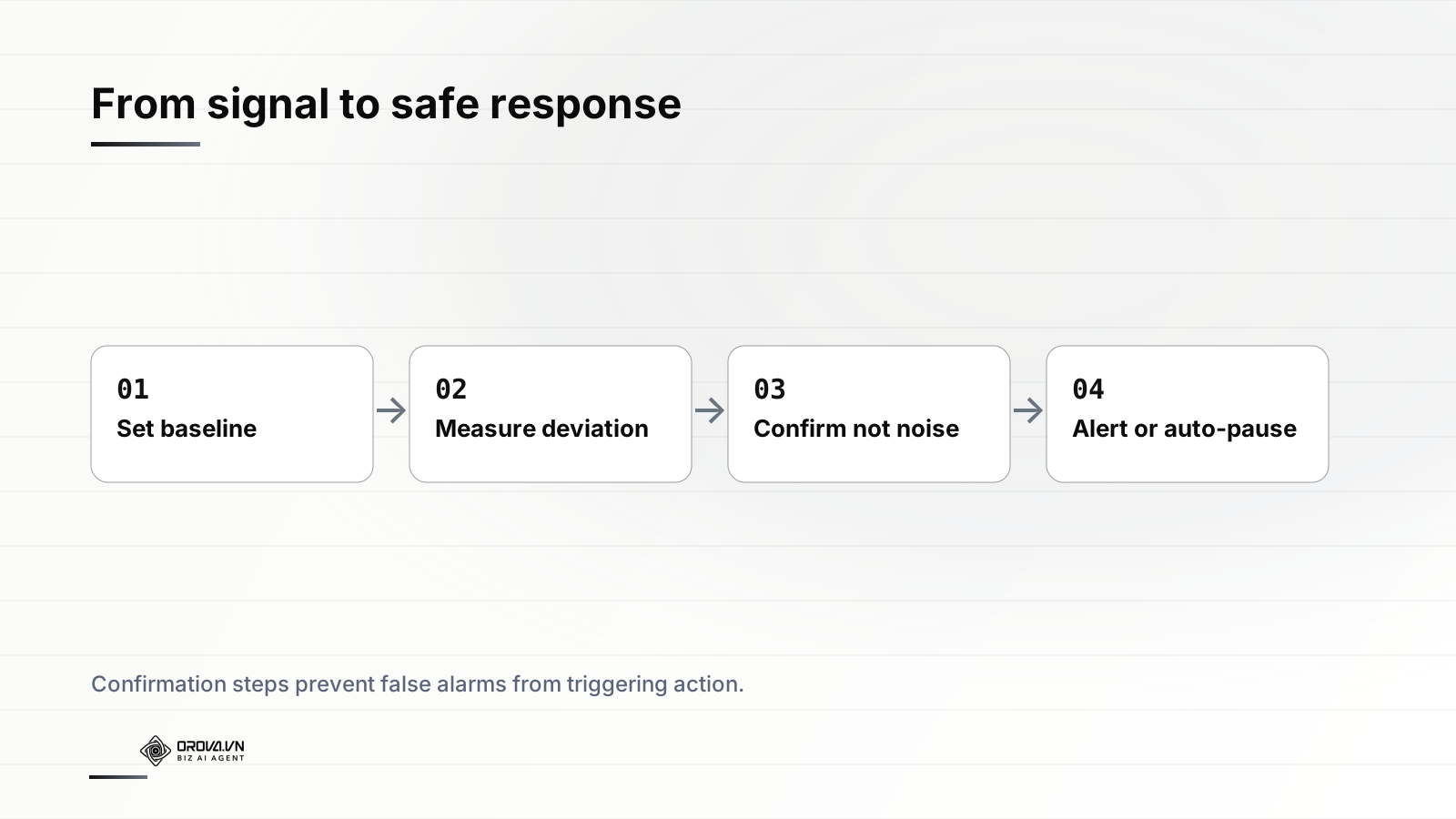
Every robust anomaly detection system, whether you build it by hand in a spreadsheet or run it inside an AI agent, follows the same four-step logic. First, establish a baseline — what this metric normally looks like for this account, at this time of day, on this day of week. Second, measure the deviation between the current value and that baseline, expressed not in raw dollars but in how unusual the gap is. Third, confirm it isn't noise — a single weird data point at 3 a.m. is usually nothing; a sustained shift is something. Fourth, choose a response proportional to severity: log it, alert a human, or, for the clearest emergencies, pause spend automatically. Keep those four steps in mind; they recur throughout everything below.
The five signals that catch most emergencies
You could monitor dozens of metrics. You shouldn't. Monitoring everything produces noise, and noise produces alert fatigue, and alert fatigue means people ignore the one alert that mattered. The discipline is to watch a small set of well-chosen signals that, between them, catch the vast majority of real account emergencies. Five signals do most of the work.
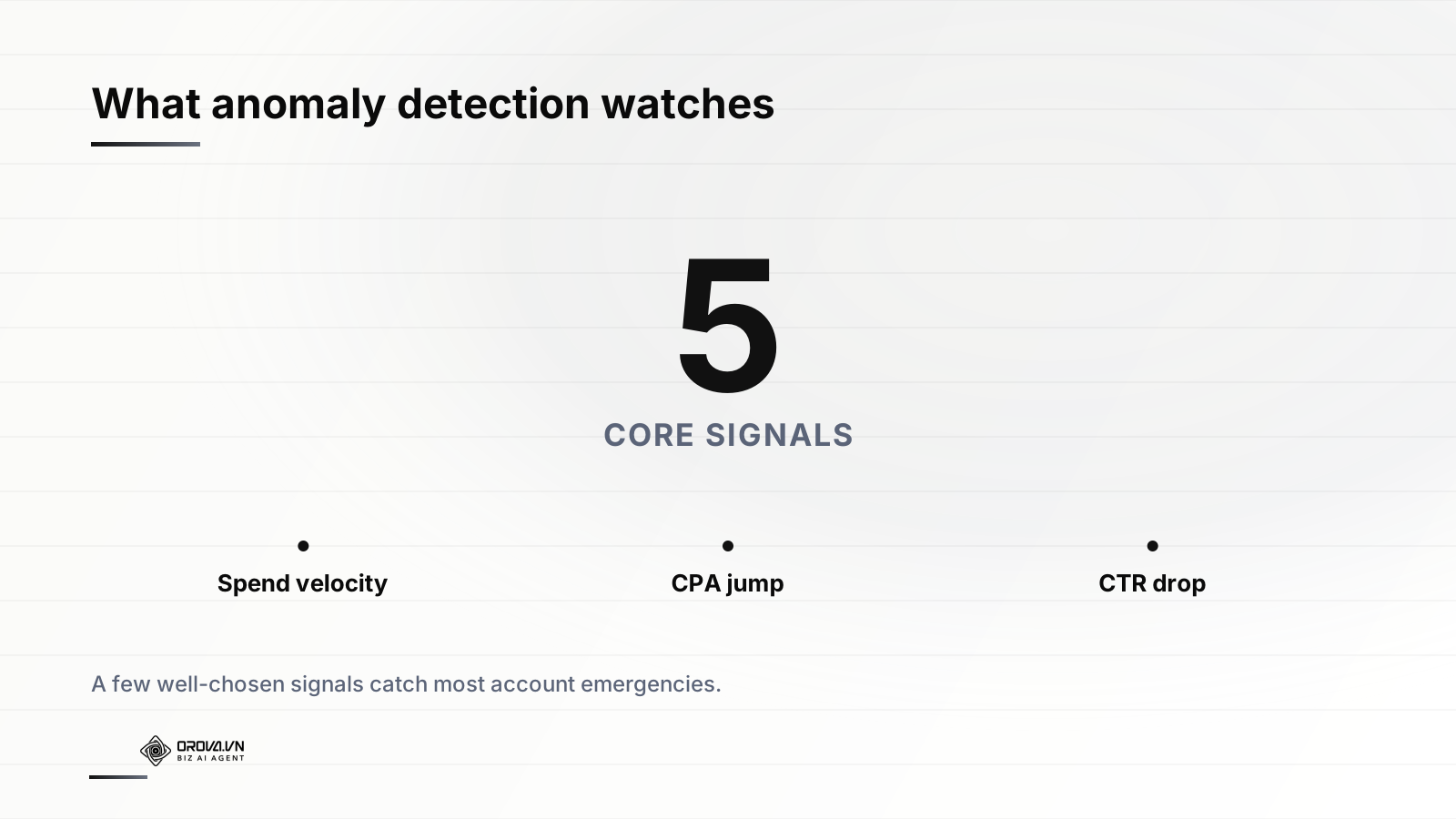
1. Spend velocity
Spend is the signal that turns into real money fastest, so it deserves the tightest watch — and watching it well means watching its rate, not just its daily total. By the time a daily total looks alarming, half the damage is done. Spend velocity asks: at this hour, are we pacing far above where we normally would be? An account that has spent 60% of its typical daily budget by 10 a.m. when it usually spends 25% by then is accelerating, and acceleration is the early warning. Velocity-based monitoring can catch a runaway four to six hours before the daily-total alarm would, and on a high-budget account those hours are thousands of dollars.
2. CPA jump
Cost per acquisition is the metric most directly tied to whether the account is profitable. A sudden CPA jump means you are paying more for each result than the business can sustain. CPA is also a composite — it can rise because clicks got more expensive, because conversion rate fell, or because spend scaled into worse inventory — so it works as a high-level health signal even when you can't yet see the cause. The nuance is that CPA is noisy on low-conversion days; a campaign that gets three conversions a day will show a wild CPA swing from normal randomness. That's why deviation must be measured against the account's own volatility, a point we return to below.
3. CTR drop
Click-through rate is your cheapest early warning because it reacts before spend does. A sharp CTR drop almost always means something concrete broke: an ad was disapproved, a competitor outbid you into worse positions, ad fatigue set in, or the creative rotation served a dud. CTR collapses rarely cost you money directly in the moment — but they predict the CPA jump that arrives a day later, when the same budget buys fewer, worse clicks. Catching the CTR signal early is how you get ahead of the cost problem instead of reacting to it.
4. Conversion rate (CVR)
Conversion rate is the signal that most often reveals problems outside the ad account entirely. When CVR collapses while CTR and CPC hold steady, the ads are working fine — the breakdown is downstream. A broken checkout, a form that stopped submitting, a tracking pixel that got removed in a site deploy, an out-of-stock product, a price change that scared buyers off. CVR is your tripwire for the failures that ad-platform dashboards alone will never show you, because the platform sees the click leave and never sees what happened next.
5. Impression share and impression volume
The first four signals tell you when something is going wrong with the traffic you're getting. Impression share tells you when you've stopped getting traffic at all, or started getting far too much. A sudden impression-share collapse can mean a billing failure paused your campaigns, a bid got slashed, or a competitor flooded the auction. A sudden impression surge often precedes a spend runaway — it's the leading edge of that broad-match nightmare from the opening paragraph. Watching impression volume alongside share catches both the "we disappeared" and the "we're everywhere suddenly" failures.
There are other useful signals — quality score shifts, frequency on Meta, audience saturation on TikTok — and mature systems add them. But if you can only watch five, watch these five. They span money (spend), economics (CPA), engagement (CTR), downstream health (CVR), and reach (impression share), which together cover the failure surface of almost any account.
Building baselines that respect reality
The hardest and most important part of anomaly detection is the baseline — the model of "normal" that everything is compared against. A bad baseline is worse than no baseline because it generates confident-looking nonsense. Here is how to build one that holds up.
Seasonality is not optional
Ad accounts breathe in predictable rhythms, and any baseline that ignores those rhythms will fire constantly on normal behavior. There are at least three layers of seasonality that matter.
- Time of day. A B2B account that does most of its converting during business hours will look "anomalously" quiet every night if you compare 2 a.m. to a 24-hour average. The baseline for any hour should be built from the same hour on comparable past days.
- Day of week. Most accounts convert differently on Sunday than on Tuesday. Lead-gen often dips on weekends; ecommerce sometimes spikes. Comparing today against a flat seven-day average smears these patterns together and produces false alarms every Monday and Saturday. Compare Mondays to Mondays.
- Calendar events. Paydays, holidays, your own promotions, and industry events (a trade show, a product launch, a competitor's outage) all shift normal. These can't be learned from rhythm alone — the system needs to know they're happening, which is why the best setups let a human mark known events so the detector raises its tolerance during them.
A practical baseline for an hourly metric often looks like: the median of the same hour, on the same day of week, over the trailing four to eight weeks, with a band around it derived from how much that hour normally varies. That single sentence encodes time-of-day and day-of-week seasonality and a measure of normal volatility — and it's enough to dramatically cut false alarms versus a flat average.
Statistical thresholds versus fixed rules
Once you have a baseline, you need to decide how far is "too far." This is where statistical thresholds earn their place. Rather than "alert if CPA > $50," a statistical threshold says "alert if CPA is more than three standard deviations above its normal range for this slot." The number $50 never appears. The system adapts automatically to each campaign's own scale and noisiness.
The advantage is dramatic for accounts with mixed campaign types. A brand campaign with a $5 CPA and a prospecting campaign with a $45 CPA can share the exact same detection logic, because each is judged against its own normal rather than a one-size-fits-all dollar line. Standard deviation, z-scores, or more robust equivalents like median absolute deviation (which resists being skewed by the very outliers you're hunting) let you express "unusual" in a way that's portable across every campaign in the account.
That said, statistical and fixed approaches are not enemies — the strongest systems combine them. You might use a statistical threshold to catch unusual behavior and a hard fixed ceiling as a final backstop ("no matter what the model thinks, never let daily spend exceed $25,000"). The statistical layer catches the subtle and the situational; the fixed layer is the circuit breaker you can reason about at 2 a.m. without a statistics degree. Pairing anomaly detection with deterministic guardrails is the same philosophy behind well-designed condition-action rules for automating ad ops: let the smart layer find the surprises and let the simple layer enforce the non-negotiables.
The cold-start problem
Statistical baselines need history. A campaign that launched yesterday has no normal yet, and a detector that fires on everything for a brand-new campaign is just noise. Sensible systems handle cold start by widening tolerances for young campaigns, by borrowing baselines from similar campaigns in the same account, or by falling back to conservative fixed guardrails until enough data accumulates — typically two to three weeks for daily patterns, longer if you need weekly seasonality. The mistake is to either trust a baseline built on three days of data or to leave new campaigns entirely unwatched. Both happen constantly; both are avoidable.
From signal to safe response
Detecting an anomaly is only useful if it leads to the right action at the right confidence. The failure mode here is overreaction: a system that pauses campaigns on every blip trains people to disable it within a week. The path from a raw signal to a safe response runs through confirmation.
Confirm before you act
A single anomalous data point is, more often than not, noise — a reporting lag, a momentary platform hiccup, a handful of bot clicks. The confirmation step is what separates a mature detector from a trigger-happy one. Confirmation can take several forms, and good systems use more than one.
- Persistence. Does the anomaly survive across multiple consecutive intervals, or did it vanish on the next read? A CPA spike that holds for three hours is real; one that's gone in fifteen minutes was probably a data artifact.
- Corroboration. Do multiple signals agree? A spend spike that coincides with an impression-share surge and a CTR drop tells a coherent story — broad matching is pulling in cheap junk traffic. A spend spike with no supporting signal is more likely a reporting glitch.
- Magnitude scaling. The bigger and more sudden the deviation, the less confirmation you should demand before acting. A 3x overnight spend spike doesn't need three hours of patience; a 15% drift can wait for the daily review.
Match the response to the severity
Not every anomaly deserves the same reaction. A tiered response keeps the system both safe and trusted. A reasonable ladder looks like this.
- Log only. Minor deviations that are interesting but not actionable get recorded so patterns can be reviewed later, without bothering anyone. Most detected anomalies should land here.
- Alert a human. Clear, confirmed anomalies that need judgment — a CVR collapse that might be a broken checkout or might be a bad traffic day — go to a person with the context attached: what changed, when, by how much, and against what baseline.
- Recommend a specific fix. Better than a bare alert is an alert that proposes the action: "Prospecting campaign CPA is 3.4x baseline and spend is pacing 80% above normal; recommend pausing and reviewing the broad-match terms added Friday." Now the human is approving a decision, not starting an investigation from scratch.
- Auto-pause, with a log. For the narrow set of unambiguous emergencies — runaway spend pacing many multiples above normal, a campaign clearly spending into a tracking outage — the safest action is to stop the bleeding immediately and notify afterward. This is reserved for cases where waiting for human approval would itself cause the harm.
The art is in calibrating which anomalies fall into which tier. Set the auto-pause threshold too aggressively and you'll pause healthy campaigns and erode trust; set it too conservatively and you'll get the Monday-morning surprise the whole system was supposed to prevent. Most teams start conservative — alerts and recommendations only — and graduate specific, well-understood failure types to auto-pause once they trust the detector's track record.
Why anomaly detection belongs to an always-on agent
Everything above can in principle be done by a diligent human with good dashboards and a lot of discipline. In practice it almost never is, for one structural reason: the work is continuous and the human is not. Anomaly detection is valuable precisely in the hours when no one is looking — overnight, on weekends, during the all-hands meeting, on the day the account manager is out sick. A safeguard that only operates during business hours misses most of the emergencies it was built to catch, because emergencies don't respect business hours.
This is the natural home for an AI agent. An agent reads the account on a tight loop — every hour, not every morning — maintains the seasonal baselines without anyone remembering to update them, measures deviation against each campaign's own volatility, applies confirmation logic before it raises a flag, and routes each anomaly to the right tier of response. It does this across Google, Meta, and TikTok simultaneously, which matters because the same broken landing page tanks CVR on all three at once, and a per-platform human watcher might catch it on one and miss it on the others.
The non-negotiables for trusting an agent with this
Handing detection-and-response to an agent is only safe under a few conditions, and they're worth stating plainly.
- Human-in-the-loop for consequential actions. The agent can watch continuously and recommend freely, but anything that changes spend, bids, or campaign status should require approval unless it falls into the narrow, pre-agreed auto-pause emergency tier. You decide where that line sits.
- Full audit logs. Every detection, every recommendation, every executed change must be recorded with its reasoning, the baseline it was measured against, and the data that triggered it. When you review what happened over the weekend, you need to see exactly what the agent saw and why it acted. An action you can't audit is an action you can't trust.
- Explainable flags. "CPA anomaly detected" is useless. "CPA on this campaign is 3.4 standard deviations above its Tuesday baseline, driven by a CVR drop that started at 2 a.m., consistent across all three platforms" is a flag a human can act on in thirty seconds.
- Conservative defaults. A new agent on a new account should start in alert-and-recommend mode and earn the right to auto-pause specific failure types over time, the same way you'd onboard a new team member.
When those conditions hold, the agent becomes the thing a human team structurally cannot be: awake, consistent, and patient at 3 a.m. on a Sunday, watching the same five signals it watched at 3 p.m. on Tuesday, with the same baselines and the same judgment, never tired, never distracted, never on vacation.
A practical starting checklist
If you're setting this up for a real account, you don't need to build the whole thing at once. Start narrow and expand as you build trust. A reasonable sequence:
- Pick the five signals — spend velocity, CPA, CTR, CVR, impression share — and nothing else at first.
- Build baselines that respect time-of-day and day-of-week seasonality, using at least four weeks of history. Don't trust baselines on campaigns younger than two to three weeks; give them wider tolerances.
- Express thresholds statistically (deviation from each campaign's own normal), and add a small number of hard fixed ceilings as circuit breakers.
- Require confirmation — persistence and corroboration — before any alert fires, so you don't train yourself to ignore it.
- Start in alert-and-recommend mode. Log everything. Review weekly. Only promote specific, well-understood failure types to auto-pause once the detector has earned it.
- Tell the system about known events — sales, holidays, launches — so it widens tolerance instead of screaming through your own Black Friday.
Do this much and you'll catch the weekend runaway, the broken checkout, the disapproved ad, and the slow margin drift — the failures that, between them, account for most of the budget that ad accounts quietly lose. The goal isn't a system that never lets anything go wrong; it's a system that ensures nothing goes wrong for very long before someone — or something — notices.
If watching five signals across Google, Meta, and TikTok every hour sounds like more than your team can sustain, that's exactly the job an agent should hold. Orova Ads reads your accounts daily, learns each campaign's normal, flags spend spikes and CPA jumps the moment they start, and can execute the fix — budget, bids, on/off, audiences — with your approval and a full audit log of everything it touched. See how it watches your accounts so you don't have to at orova.vn.
Related reading: What Is an AI Ads Agent? Autonomous Ad Management Explained
Orova Ads optimises campaigns for you
Connect Google, Meta and TikTok in one place. AI reads the numbers, proposes changes and executes under the rules you set.
Explore Orova Ads