
AI Ads Agent Run Schedule: Hourly, Daily or Real-Time
You just turned on an AI ads tool, and now you're staring at a setting that asks how often it should run. Every option looks reasonable, so you either pick the fastest one because "more data must be better," or you leave it on the default and hope. Meanwhile your budget is already spending, and you don't actually know if the schedule you picked is helping or quietly working against you.
Most business owners assume that checking and adjusting more often is always safer, so they set their ai ads agent to react constantly. In practice this backfires: the tool starts responding to ordinary, random ups and downs in performance as if they were real problems, pausing ads and cutting budgets over a single slow hour. This kind of overreaction isn't just a minor annoyance either — roughly a quarter of programmatic ad spend is already wasted on inefficient buying and invalid impressions, according to the ANA Programmatic Transparency Study, and a jumpy, poorly scheduled automation can easily add to that waste instead of preventing it. You end up with a jumpy account, a confusing history of changes, and results that are actually harder to trust than if a person were checking in once a day.
This article walks you through how to set that run frequency correctly, in plain terms, so you're not guessing. By the end, you'll know when daily checks are enough, when you genuinely need faster reactions, and how to build a simple schedule with basic safety limits so your automated ads stay stable while still catching real problems early.
Why "more often" feels right and usually isn't
The instinct toward high frequency comes from a reasonable place. If checking once a day is good, checking once an hour should be twenty-four times better, right? In monitoring, maybe. In acting, almost never. The gap between observing and intervening is where high-frequency automation goes wrong, because every intervention has a cost the dashboard doesn't show you: it resets learning, it adds variance, and it removes the time a metric needs to stabilize before it means anything.
To understand why, you have to accept an uncomfortable truth about ad data: most short-window metrics are mostly noise. A campaign spending $300 a day with a 2% conversion rate produces roughly six conversions daily. In any given hour, the expected number of conversions is a fraction of one. So when an agent looks at the last hour and sees zero conversions on $12 of spend, it is not seeing a problem. It is seeing the normal, expected behavior of a low-frequency event observed over a tiny window. An agent that "optimizes" on that hour is optimizing on a coin flip.
The four ways frequent runs hurt you
When advertisers describe their automation going wrong, the failures almost always trace back to one of four mechanisms. Each gets worse as run frequency increases.
- Overreaction to noise. Smaller time windows have wider relative variance. The fewer conversions a window contains, the more a single event swings the apparent performance. An agent running hourly sees these swings as trends and acts on them, when in fact they would have averaged out by lunchtime.
- Data lag and attribution delay. Conversions do not arrive the instant they happen. View-through windows, offline conversion imports, server-side delays, and platform processing all mean that recent data is incomplete data. An hour-old window might be missing 30–50% of the conversions it will eventually report. The agent treats this incomplete picture as final and punishes campaigns for sales that simply haven't been counted yet.
- Learning-phase resets. Google and Meta both run a learning phase whenever you make a significant edit — a budget jump, a bid-strategy change, a new audience. During learning, delivery is less efficient and more volatile. Frequent agent edits keep the campaign perpetually in learning, so it never reaches the stable, optimized state the algorithm is trying to find. You pay the learning tax over and over.
- Whipsaw and oscillation. When an agent cuts a budget because the morning looked weak, then restores it because the afternoon recovered, the net effect is worse than doing nothing. The account oscillates around a target instead of settling on it, and each oscillation carries real spend and real algorithmic disruption.
None of these are exotic edge cases. They are the default outcome of running an agent faster than your data can stabilize. The cure is not a smarter model — a smarter model fed half-baked hourly data still makes confident, wrong decisions. The cure is matching the clock to the data.
The case for the daily run
For the large majority of accounts, a single daily run is the sweet spot, and it is worth being specific about why. A day is long enough that yesterday's data is essentially complete: attribution windows for the previous day have largely closed by the time you wake up, so the agent is acting on numbers it can trust. A day is also a natural unit for advertising — budgets are usually set daily, platforms report on daily boundaries, and human teams think in days. And critically, a daily cadence gives changes time to breathe. When the agent makes an edit at 7 a.m., that edit has a full day to play out before the agent looks again, which is roughly the minimum time a meaningful change needs to escape the learning phase and show its true effect.
The right question is never "how fast can the agent react?" It is "how long does this metric take to become trustworthy?" Your run cadence should be the answer to the second question, not the first.
The daily run also produces something high-frequency automation destroys: a legible history. When your agent acts once a day, your audit log has 30 entries a month, each tied to a clear daily snapshot of why it acted. You can review them in five minutes. When it acts every fifteen minutes, you have nearly 3,000 entries, most of them reversing each other, and no human will ever read them. Reviewability is not a luxury feature. It is how you keep human judgment in the loop and how you catch the agent's mistakes before they compound.
What a single daily run actually does
It helps to demystify what happens inside a well-designed daily run, because "the agent optimizes your account" hides a lot of structure. A good run is a pipeline, and each stage exists to protect you from the failure modes above.
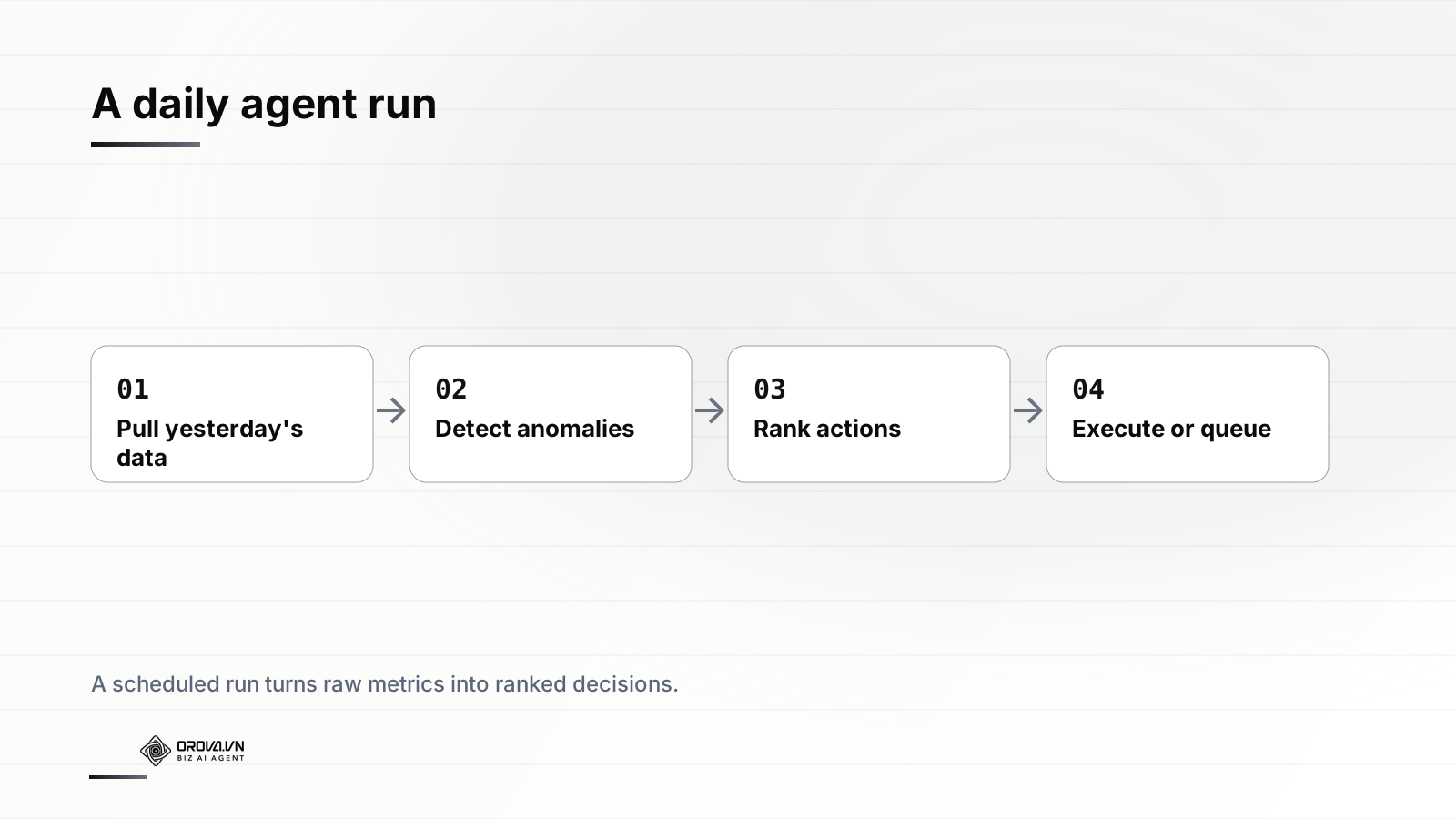
- Pull yesterday's data. The run starts by fetching complete, settled data for the previous day (and often a trailing window of 7 to 30 days for context). Using yesterday rather than today is the whole point — it sidesteps attribution lag.
- Detect anomalies. The agent compares current metrics against expected ranges built from history, not against arbitrary thresholds. A campaign isn't "underperforming" because CPA hit a round number; it's flagged because it fell outside its own statistically normal band given its conversion volume.
- Rank actions. Candidate actions are scored by expected impact and confidence. A budget cut on a campaign with 200 conversions of evidence ranks above the same cut on a campaign with three. Low-confidence actions get filtered out rather than executed on a hope.
- Execute or queue. High-confidence, low-risk actions execute automatically. Bigger or riskier moves get queued for human approval. Either way, every decision is logged with its reasoning.
That last stage is where the human-in-the-loop philosophy lives. A daily cadence makes approval queues practical: a marketer can review a tidy list of proposed changes over morning coffee, approve the sensible ones, and reject the rest. Try that with an agent firing every few minutes and the queue becomes a firehose nobody can drink from, so people either rubber-stamp everything or turn approvals off — both of which defeat the purpose.
When daily isn't enough — and when it's too much
Daily is the default, not a law. The honest answer to "how often should my agent run?" is that it depends on two variables: your spend velocity and your conversion volume. These two numbers tell you how fast your data becomes trustworthy, and trustworthiness is what gates safe action.
Match cadence to spend velocity
Spend velocity is how fast money leaves your account. An account spending $200 a day and an account spending $200,000 a day have very different relationships with time. At $200 a day, an hour of bad performance costs you about $8 — not worth waking an agent for, and not enough data to act on anyway. At $200,000 a day, an hour is roughly $8,000, and a runaway campaign genuinely can do damage before tomorrow's run. High-velocity accounts justify more frequent monitoring, though even they benefit from separating monitoring from acting.
That distinction is the key that resolves most of the cadence debate. You can — and high-spend accounts should — monitor in near real time while optimizing on a slower clock. Continuous monitoring watches for genuine emergencies: a tracking pixel that broke, a feed that emptied, spend pacing 5x above normal, a campaign serving on a sold-out product. Those are not optimizations; they are safety interlocks, and they should trigger instantly. Optimization decisions — should this bid go up, should this audience get more budget — are different and should wait for settled data. Treating these two jobs as one is what leads people to either run everything hourly (and overreact) or everything daily (and miss fires).
Match cadence to conversion volume
Conversion volume sets the floor on how short a window can be before it's meaningful. The rough rule practitioners use is that you want a window containing enough conversions to distinguish a real change from noise — often cited as somewhere around 30 to 50 conversions for a reasonably confident read on a rate. Work backward from that:
- An account generating 500 conversions a day accumulates a statistically usable sample in hours. For this account, more frequent optimization runs are defensible, because even a few hours of data carries signal.
- An account generating 10 conversions a day needs several days to reach the same confidence. For this account, running more than once a day is actively harmful — you're asking the agent to find patterns in samples too small to contain any. Here, even a daily run should lean on multi-day trailing windows rather than yesterday alone.
- An account generating 1 or 2 conversions a day probably shouldn't be optimized on conversion rate at all at the campaign level. It should optimize on leading indicators (click-through rate, cost per click, landing-page engagement) and aggregate conversion signals across the account, with human review carrying more of the weight.
This is why two accounts with identical budgets can need opposite schedules. A high-ticket B2B account spending $300 a day might see two conversions daily and need a patient, multi-day cadence. A low-ticket e-commerce account spending the same $300 might see forty conversions daily and tolerate faster runs. The dollar figure tells you almost nothing; the conversion count tells you almost everything.
Designing a layered schedule
The mature approach isn't picking one frequency. It's layering several cadences, each doing the job it's suited for. Think of it as three loops running at different speeds, with strict rules about what each loop is allowed to do.
The safety loop (continuous or near real-time)
This loop never optimizes. It only watches for breakage and emergencies, and its allowed actions are narrow and defensive: alert a human, pause spend that is clearly malfunctioning, or stop serving against a broken condition. Triggers are unambiguous and don't require statistical judgment — spend exceeding a hard cap, conversion tracking returning errors, a product feed dropping to zero items, a sudden 10x deviation in cost per click. Because these conditions are binary rather than probabilistic, acting on them instantly is safe. You're not interpreting noise; you're detecting a fault.
The optimization loop (daily, for most)
This is the workhorse — the daily run described earlier. It handles the judgment calls: shifting budget toward what's working, adjusting bids, pausing genuinely underperforming ad sets, expanding audiences that converted. It uses settled data, ranks by confidence, and routes anything significant through human approval. For the typical account, this loop does 90% of the value-creating work, and running it once a day is what keeps it from chasing ghosts.
The strategy loop (weekly or biweekly)
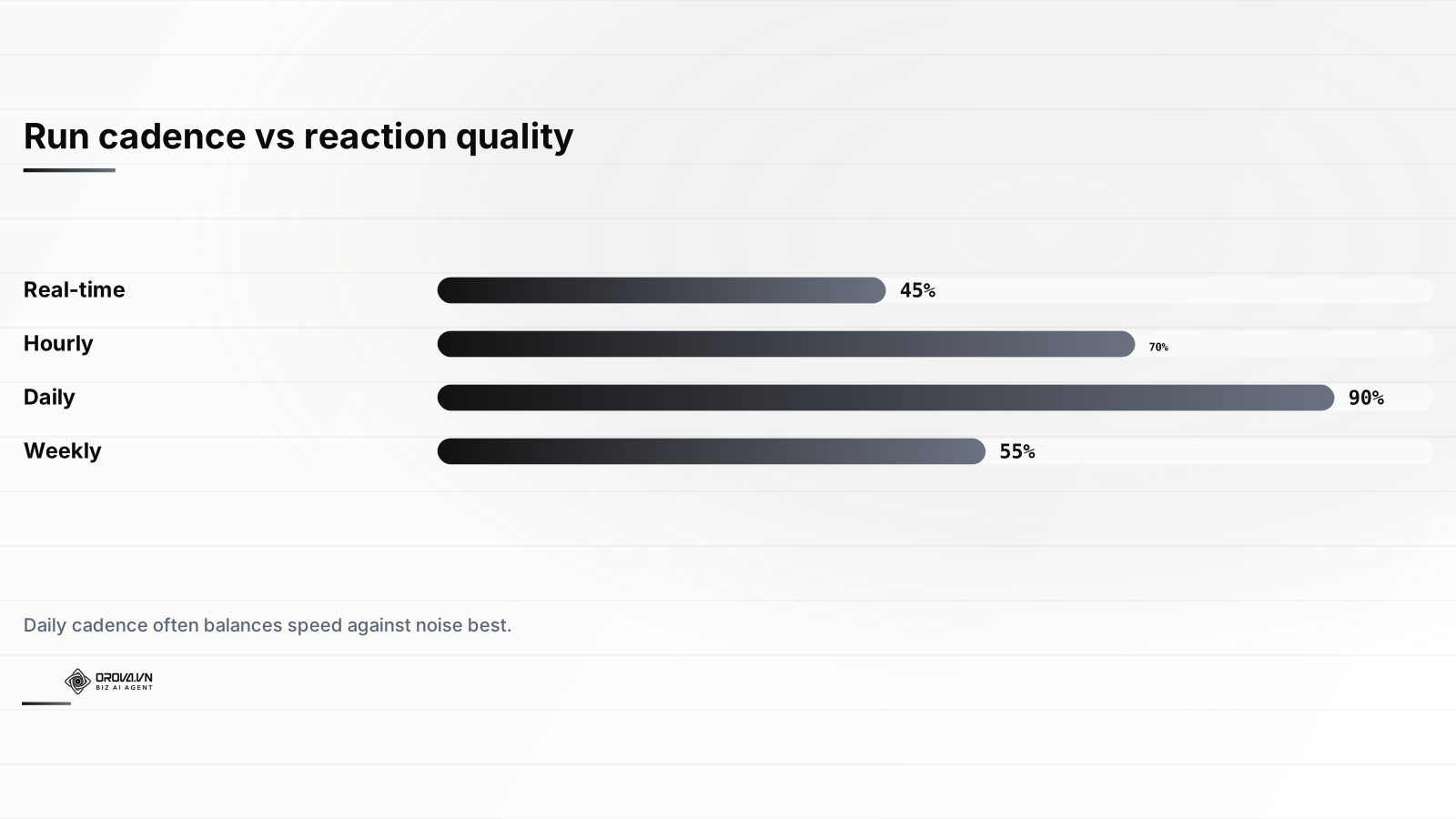
Some decisions need even more data than a day provides. Restructuring campaigns, retiring tired creative, reallocating budget across whole channels, or evaluating whether an audience strategy is working — these are weekly questions. A weekly cadence accumulates enough conversions to judge trends rather than days, and it deliberately resists the urge to thrash. The figure earlier scored weekly below daily on reaction quality, and that's correct for tactical optimization; but for strategic moves, the patience of a weekly window is a feature, not a flaw. The art is routing each decision to the loop that matches its data requirements.
This layered model also clarifies a debate that often gets framed as "rules versus AI." Fixed thresholds work beautifully for the safety loop, where conditions are binary and speed matters. The optimization loop is where genuine agent reasoning earns its keep, weighing context and confidence rather than firing on a single threshold. If you want to go deeper on where each approach fits, the distinction is worth studying in its own right; we cover it in our piece on rule-based automation versus AI agents, which maps neatly onto the loops above — rigid rules for safety, adaptive judgment for optimization.
Avoiding whipsaw: the guardrails that make any cadence safe
Cadence is the biggest lever, but a few guardrails protect you regardless of how often the agent runs. These are the difference between an agent that converges on good performance and one that oscillates around it forever.
- Cooldown periods. After the agent edits a campaign, it should refuse to touch that campaign again for a defined window — often 3 to 7 days — so the change can clear the learning phase and reveal its true effect. Without a cooldown, even a daily agent can whipsaw, undoing yesterday's edit because today hasn't proven it yet.
- Minimum evidence thresholds. The agent should not act on a metric until the underlying window contains enough conversions to be meaningful. "Don't decide on fewer than N conversions" is the simplest, most powerful guardrail there is, and it's the direct antidote to overreacting on noise.
- Change-size limits. Cap how much any single run can move a budget or bid — say, no more than 20–30% in one step. Large jumps are themselves a cause of learning resets and volatility. Several modest moves over several runs reach the same destination with far less disruption.
- Statistical comparison, not magic numbers. The agent should compare performance against the campaign's own historical range, accounting for its conversion volume, rather than against a fixed threshold. A CPA of $40 might be alarming for one campaign and excellent for another; only the historical context tells you which.
- Trailing windows over single-day snapshots. For lower-volume accounts especially, judging on a 7-day or 14-day trailing average smooths out the day-to-day noise while still updating daily. You get fresh data without the whiplash of betting on a single day.
Together these guardrails mean that even if you misjudge your cadence slightly, the agent can't do much harm. The cooldown stops thrashing, the evidence threshold stops noise-chasing, and the change-size cap stops violent swings. Cadence sets the ambition; the guardrails set the safety margin.
A practical starting point
If you're setting up an agent today and want a concrete default rather than a framework, here's a configuration that works for the large middle of advertisers and that you can tune from there.
- Run optimization once daily, early morning, after yesterday's data has settled and before the business day's spend ramps up. This is your main loop.
- Enable continuous safety monitoring for hard faults only — broken tracking, runaway spend, empty feeds — with instant alerts and the ability to pause clearly malfunctioning spend.
- Set a 5-day cooldown on any campaign the agent edits, so changes can clear the learning phase.
- Set a minimum-evidence floor of roughly 30 conversions before the agent acts on a conversion-rate or CPA signal; below that, it monitors and alerts rather than optimizes.
- Cap single-run changes at 20–30% of budget or bid.
- Route a weekly strategy review for structural decisions, with human sign-off.
Then watch your audit log for two weeks. If the agent is constantly being throttled by the evidence floor, your account is too low-volume for daily conversion-based optimization, and you should lengthen the trailing window and lean more on leading indicators. If high-spend campaigns are doing real damage between daily runs, tighten the safety loop's thresholds rather than speeding up the optimization loop. Let what you observe, not your impatience, set the dial.
The mindset shift
The deepest mistake in scheduling an AI ads agent is treating speed as the goal. Speed is only valuable when the thing you're reacting to is real, and most of what moves in an ad account hour to hour is not real — it's the ordinary jitter of low-frequency events observed over short windows. An agent's value comes from acting on signal and ignoring noise, and cadence is the primary tool you have for telling the two apart. Run on a clock that matches when your data becomes trustworthy, give your changes room to prove themselves, and keep a human in the loop on anything consequential. Do that, and a once-a-day agent will quietly beat a twitchy real-time one every time.
The advertiser who set their agent to run every fifteen minutes wasn't wrong to want responsiveness. They were wrong about where responsiveness comes from. It doesn't come from acting faster. It comes from acting on better information — and better information, in advertising, almost always needs a little time.
If you'd rather not hand-tune all of this yourself, Orova Ads is an AI agent that manages paid campaigns across Google, Meta, and TikTok on exactly the layered cadence described here. It reads your data daily, detects anomalies against each campaign's own history, ranks optimizations by confidence, and executes them — budgets, bids, on/off, audiences — with human-in-the-loop approval and a full audit log of every decision. See how a sensible run schedule looks in practice at orova.vn.
Let the schedule run itself
Figuring out the right cadence, testing it, watching for whiplash, and adjusting the safety limits by hand takes ongoing attention — exactly the kind of task that eats into a week without ever feeling finished. Most business owners don't have time to babysit a schedule setting, let alone recheck it every time campaigns change.
Orova Ads is built to handle this kind of pacing and monitoring for you, so your ai ads setup runs on a sensible rhythm without you having to fine-tune it manually. If you'd rather not manage cadence and guardrails yourself, it's worth a look.
Orova Ads optimises campaigns for you
Connect Google, Meta and TikTok in one place. AI reads the numbers, proposes changes and executes under the rules you set.
Explore Orova Ads