
Profit Margin in Ads: Why Volume Without It Is a Trap
Two e-commerce brands ran identical product catalogs, identical creative, and identical landing pages last quarter. One posted a 6.2x return on ad spend and felt invincible. The other ran at 2.8x and looked, on paper, like the weaker operator. Then the numbers settled: the 6.2x brand grew revenue 4% over the period, while the 2.8x brand grew 71% and captured three percentage points of category share that the first brand will spend years trying to win back. Neither team made a mistake in execution. They made different choices about what their campaigns were for. That choice — profitability or volume — is the single most consequential decision in paid media, and most advertisers make it by accident.
The reason this matters so much is that profitability and volume are not two settings on the same dial. They pull against each other through a real economic constraint, and pretending you can max both at once is how good budgets get wasted. If you understand the shape of that constraint, you can set a deliberate goal for every campaign, defend it when someone in finance or growth pushes back, and change it on purpose when your situation changes. This article walks through the mechanics of the tradeoff, the signals that should push you toward one side or the other, and how to keep a campaign honest once you've picked a direction.
Profit Margin: The Number That Decides Everything in Ads
Profit margin is what is left from revenue after costs, expressed as a percentage. Two versions matter and people mix them up.
Gross margin = (revenue − cost of goods) ÷ revenue. Sell for 100, the item cost 60, gross margin is 40%. This is the number that governs advertising. Net margin subtracts everything else — salaries, rent, ad spend itself.
Why it governs advertising: divide 1 by your gross margin and you get break-even ROAS. At 40% margin, break-even is 2.5 — a ROAS of 2 is losing money while the dashboard shows green. At 70% margin, break-even is 1.43 and a ROAS of 2 is healthy.
Which is why "what is a good ROAS" has no universal answer. The same ROAS of 3 makes one business money and bankrupts another.
The volume trap: scaling spend usually raises cost per acquisition and often pushes you toward discounting, both of which compress margin — so revenue climbs while profit falls.
The rest of this article works through where that trade-off sits for your numbers.
The efficiency frontier, in plain terms
Every account has an efficiency frontier — a curve that describes the best volume you can buy at each level of efficiency. It is not a marketing abstraction; it falls directly out of how auctions work. When you set a tight return target, the bidding system only competes for the cheapest, highest-intent impressions: branded searches, retargeting audiences, people already deep in the funnel. Those conversions are profitable but scarce. As you loosen the target, the system is allowed to bid on broader, colder, more expensive inventory — prospecting audiences, generic queries, top-of-funnel placements. Each new slice of inventory converts a little worse than the last, so your blended efficiency drops as volume climbs.
The practical shape is diminishing returns. Going from a very tight target to a balanced one usually buys a large jump in volume for a modest efficiency cost. Going from balanced to wide-open buys less incremental volume for a steeper efficiency cost, because you are now paying for impressions that were never going to convert well. This is why "just spend more" and "just be more efficient" are both lazy instructions: they ignore where you currently sit on the curve and what the next unit of movement actually costs.
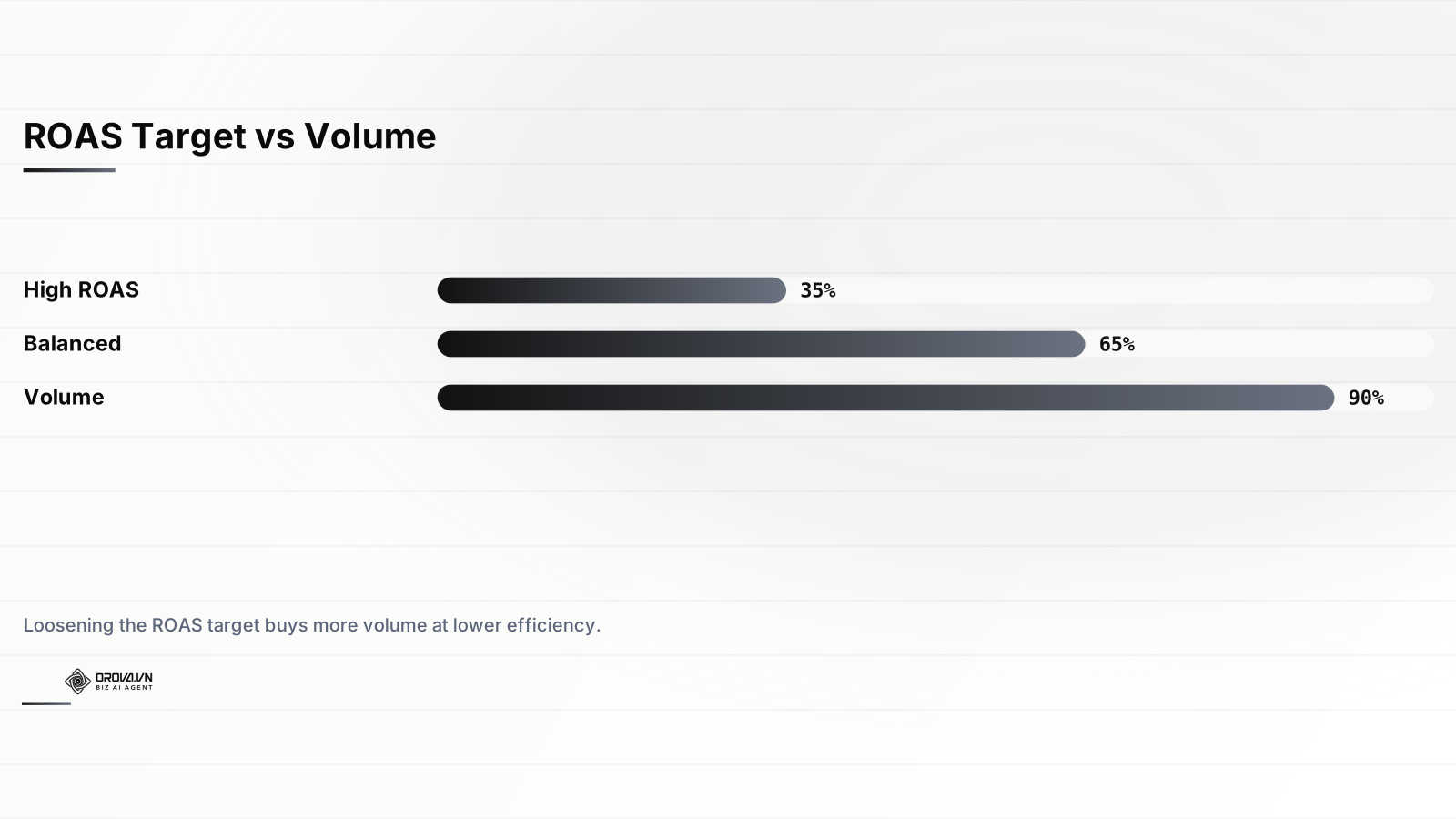
Read that chart as a menu, not a recommendation. A high-ROAS posture harvests the cheapest demand and leaves most of the market untouched. A balanced posture roughly doubles the reachable volume while giving up some efficiency. A volume posture pushes into the expensive tail of the market and accepts a materially lower return per dollar. None of these is "correct" in a vacuum. The correct point depends on what the marginal conversion is worth to your business right now — and that is a function of margin, cash, and stage, not of how the numbers feel.
Why "maximize ROAS" quietly caps your growth
Teams that anchor on ROAS often don't realize they've made a growth decision. If you instruct the platform to maximize return, it will happily oblige by spending less. The cleanest way to hit a 10x target is to bid only on people who were going to buy anyway. Your dashboard glows green, your spend shrinks, and your incremental new-customer acquisition slows to a trickle. You have optimized yourself into a corner where the ad account is mostly taking credit for demand you already had.
This is the central trap: ROAS is a ratio, and ratios improve when you cut the denominator. A campaign can post a beautiful return precisely because it has stopped doing the hard, expensive work of finding new customers. If your goal is genuinely to grow, an improving ROAS with flat or falling spend is not a success — it is a symptom that the campaign has retreated to the easy part of the frontier.
Why "maximize volume" quietly eats your margin
The opposite failure is just as common and more dangerous to cash. When growth or leadership sets volume as the only goal, the bidding system is licensed to chase the most expensive inventory in the auction. Cost per acquisition creeps up conversion by conversion, and because each new customer costs more than the last, blended margin erodes faster than the volume chart suggests. The revenue line looks heroic; the contribution-margin line, if anyone is watching it, is bleeding. Brands that scale on volume without a floor frequently discover months later that they bought a lot of unprofitable orders and trained the algorithm to keep finding more of them.
Tying the goal to margin, cash, and stage
The decision rule is simpler than the debate around it. Your choice between profitability and volume should be driven by three concrete factors: how much margin each sale carries, how much cash you can afford to deploy before it comes back, and what stage of growth the business is in. Vanity metrics, competitor envy, and "we should be more aggressive" hunches are not inputs.
Margin sets the ceiling on how loose you can go
Margin is the hard boundary. A business with 70% gross margin can tolerate a far lower ROAS than a business with 25% margin, because each sale leaves more room to absorb acquisition cost. Before you argue about goals, calculate your break-even ROAS: it is simply one divided by your contribution margin. A 40% contribution margin breaks even at 2.5x; anything above that is profit, anything below is a subsidy. High-margin businesses have a long runway to push volume profitably. Thin-margin businesses have almost none, and for them "maximize volume" can be a fast route to losing money on every order. This is also why the metric you optimize matters as much as the target you set — the choice between a cost-based goal and a return-based goal isn't cosmetic, as we cover in detail in our breakdown of CPA versus ROAS and which metric to optimize.
Cash decides whether you can wait for the payback
Cash position is the factor most teams underweight, and it is usually the one that should decide the argument. Volume-led growth is a bet that you can afford to pay for customers today and collect the profit later — sometimes much later, if your model depends on repeat purchase or subscription. If your cash is constrained, that bet is reckless no matter how attractive the lifetime-value math looks on a slide. You cannot pay rent with projected LTV. A profitability posture, by contrast, is self-funding: every campaign returns more than it costs, so growth is slower but the business is never exposed. The blunt rule is this: loose ROAS targets require funded growth; tight ROAS targets are what you run when cash is limited. When in doubt, your bank balance, not your ambition, picks the goal.
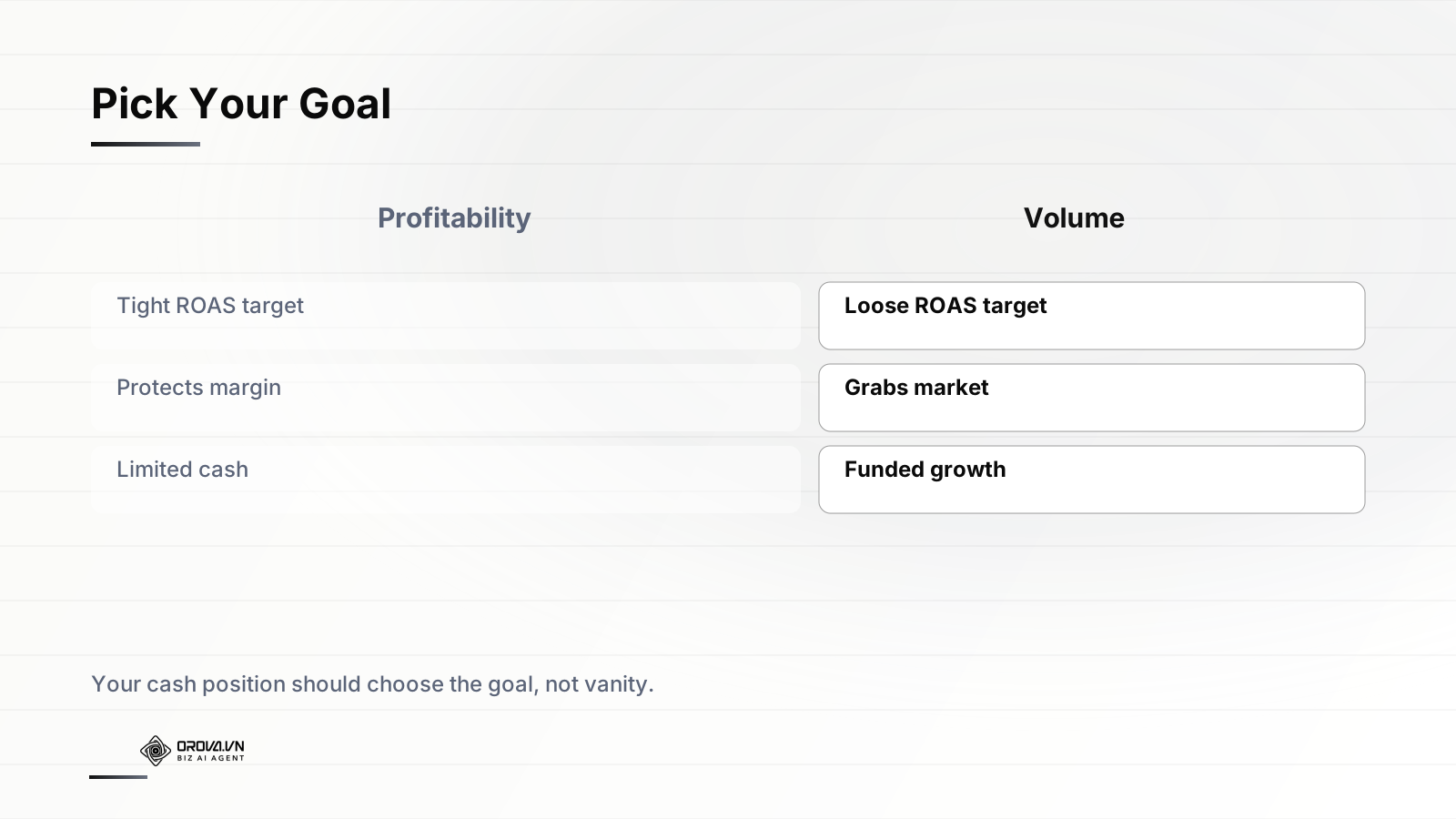
That comparison is worth keeping somewhere visible during planning. The left column — tight target, margin protected, limited cash — describes the right posture for a bootstrapped brand, a business heading into an uncertain quarter, or any account that cannot afford to wait months for a payback. The right column — loose target, market captured, funded growth — describes a brand that has raised money explicitly to grow, a category leader defending share, or a launch where being early to scale is worth more than being efficient. Most accounts contain campaigns that belong in both columns at once, which is exactly why a single account-wide goal is usually wrong.
Stage changes the right answer over time
The third factor is where you are in the business's life, and it is the reason the goal should not be permanent. Early on — at launch, entering a new market, or trying to establish a position before a competitor does — volume is often worth paying for, because the cost of being absent from the market is higher than the cost of inefficient ads. Land-grab moments are real, and they close. Later, when the category is mature and your position is secure, the marginal customer is worth less and protecting margin becomes the smarter play. The same brand should be willing to run loose during a land-grab and tighten up once the grab is over. Treating your goal as a fixed identity — "we're a performance brand" or "we're a growth brand" — is how teams keep fighting the last war.
The question is never "do we want profit or growth?" Everyone wants both. The question is "what is the next customer worth to us this quarter, given our margin and our cash?" Answer that honestly and the goal sets itself.
Setting the goal at the right level: campaign, not account
A frequent and expensive mistake is setting one goal for the whole account. Retargeting, branded search, prospecting, and new-market expansion sit at completely different points on the efficiency frontier, and forcing them under a single target distorts all of them. Apply a tight ROAS goal across the board and your prospecting campaigns starve while your retargeting takes undeserved credit. Apply a loose volume goal across the board and your already-efficient branded campaigns are encouraged to overspend on demand you would have captured for free.
A workable default structure
- Bottom-funnel (retargeting, branded, abandoned cart): run these on a profitability goal with a tight target. This demand is cheap and high-intent; there is no reason to loosen efficiency here, and doing so just inflates cost on conversions you'd win anyway.
- Mid-funnel (warm prospecting, lookalikes, category terms): run these on a balanced goal. This is where the volume-versus-efficiency tradeoff is most live, and where a small loosening typically buys the most incremental growth.
- Top-funnel and expansion (cold prospecting, new markets, new products): run these on a volume goal only if cash allows, with a clear margin floor below which the campaign pauses. This is your growth engine; treat its budget as an investment with a defined risk limit, not as everyday spend.
Structuring this way lets each campaign live at its natural point on the frontier. It also makes reporting honest, because you can see which campaigns are funding the business and which are buying future growth — instead of a blended account number that hides both.
Always set a floor, even on volume campaigns
"Maximize volume" should never mean "spend without limits." Even your most aggressive growth campaign needs a margin floor — a worst-acceptable return or a maximum cost per acquisition below which the campaign stops. A floor is what separates a deliberate growth bet from a runaway. It says: we are willing to buy expensive customers to capture this market, but not customers who cost more than they could ever be worth. Without a floor, a volume goal will faithfully find you the worst inventory in the auction and keep buying it.
The numbers behind a real tradeoff decision
Abstractions are easy to nod along to and hard to act on, so it helps to run a concrete example. Imagine a brand with a 50% contribution margin and a product that sells for $100. Break-even ROAS is 2.0x — every dollar of ad spend needs to return at least two dollars of revenue to keep the order from losing money. The team is debating three postures for its prospecting campaign.
At a tight 4.0x target, the campaign spends $10,000, returns $40,000 in revenue, and acquires 400 customers. Contribution after ad spend is $20,000 minus $10,000, or $10,000 of profit. Beautiful efficiency, but the campaign is only touching the warmest slice of demand and leaving the rest of the market to competitors.
At a balanced 2.5x target, the same campaign is allowed to spend $30,000. It returns $75,000 and acquires 750 customers. Contribution after spend is $37,500 minus $30,000, or $7,500 of profit. Notice what happened: total profit per campaign actually went up in absolute dollars at the tighter end in this illustration, but the balanced posture acquired nearly twice as many customers — customers who may buy again, who build the brand, and who deny share to rivals.
At a volume 2.0x target, the campaign spends $60,000, returns $120,000, and acquires 1,200 customers. Contribution after spend is $60,000 minus $60,000 — exactly zero on a first-order basis. Whether this is brilliant or insane depends entirely on two things the ROAS number cannot tell you: whether you have $60,000 of cash to deploy, and whether those 1,200 customers will come back and buy again. If repeat purchase turns that break-even acquisition into a 3x lifetime return, it's a strong growth play. If they buy once and vanish, you just spent $60,000 to learn a hard lesson.
This is the whole argument in one worked example. The right point on the frontier is not the one with the highest ROAS or the highest customer count. It is the one that matches what the marginal customer is actually worth to you, financed by cash you can actually afford to commit, at a stage where that bet makes sense. Run this math with your own margin before every planning cycle and the goal stops being a matter of opinion.
Don't confuse efficiency with incrementality
One more nuance separates teams that understand the frontier from teams that only think they do: a high reported ROAS often includes conversions that would have happened with no ad at all. Branded search and retargeting are notorious for this — you're frequently paying to put an ad in front of someone already walking toward the checkout. That spend reports as efficient, but its incremental contribution can be close to zero. If you cut a campaign and revenue barely moves, that campaign was decorating demand, not creating it.
This matters for the profitability-versus-volume choice because it changes where the real frontier sits. A profitability posture that leans heavily on non-incremental conversions can look healthier than it is, while a volume posture in genuinely cold prospecting may be doing more real work than its lower ROAS suggests. The discipline is to occasionally test incrementality — hold out a region, pause a campaign, run a geo experiment — and judge campaigns by the demand they actually generate, not the demand they merely intercept.
How an AI agent keeps the chosen goal honest
Picking the goal is the strategy. Holding the line on it, every single day, across dozens of campaigns and three platforms, is the operational problem — and it is where most accounts drift. Targets erode quietly. A campaign set to a tight ROAS slowly loosens as the platform's automated bidding optimizes for the easiest conversions and spend retreats. A volume campaign with a margin floor blows past it on a single high-cost day before anyone checks the report. Goals decay not because anyone decided to abandon them, but because nobody was watching the frontier move in real time.
This is the work that an AI agent is genuinely well suited to, because it is relentless and unglamorous. The agent reads each campaign's performance against its stated goal daily, notices when efficiency or volume is drifting away from the intended point on the frontier, and proposes the specific moves that pull it back — tightening a bid here, raising a budget there, pausing a placement that has slipped below the margin floor, expanding an audience that still has profitable headroom. The point is not to replace the judgment about whether you want profit or volume; the point is to enforce that judgment consistently after you've made it.
What "enforcement" looks like in practice
- Daily reconciliation against the goal. Every campaign is checked against its declared target — tight, balanced, or volume — and flagged when actual performance diverges from the intended position on the curve.
- Floor protection. Volume campaigns are watched against their margin floor continuously, so a bad day gets caught and corrected rather than discovered at month-end.
- Frontier-aware moves. Recommendations account for diminishing returns: the agent pushes budget where the next dollar still buys profitable volume and pulls it from where you're paying for the expensive tail.
- Stage changes on demand. When you decide a land-grab is over and it's time to tighten, the agent can re-pace the whole account toward the new posture instead of you editing settings campaign by campaign.
Human-in-the-loop, with an audit trail
Autonomy without oversight is how budgets get burned, so the right model keeps a person in the approval seat. The agent does the watching, the analysis, and the proposing; you approve the changes that matter, and every action — budget shifts, bid changes, on/off toggles, audience edits — is logged so you can see exactly what moved, when, and why. That combination is what makes a chosen goal durable: the discipline of constant monitoring with the safety of human judgment on the consequential calls. The strategy stays yours; the agent just makes sure the account actually behaves the way you decided it should.
A short checklist before your next planning cycle
- Calculate break-even ROAS. One divided by your contribution margin. This is the floor under every decision that follows.
- Check the bank. If cash is tight, default to profitability. Loose targets are a privilege of funded growth, not a reward for confidence.
- Name your stage. Land-grab and defense call for different postures. Be honest about which one you're in this quarter.
- Set goals per campaign, not per account. Bottom-funnel tight, mid-funnel balanced, top-funnel volume-with-a-floor.
- Put a floor on every volume campaign. A growth bet without a limit is just a leak.
- Decide who enforces it. A goal nobody monitors daily is a goal that quietly disappears.
Do this and the profitability-versus-volume debate stops being a personality clash between finance and growth. It becomes a calculation: here is our margin, here is our cash, here is our stage, here is the resulting goal for each campaign. The frontier doesn't care about anyone's ambition — it just charges more for each additional customer. Your job is to decide, clearly and on purpose, how far up that curve your business can afford to climb today, and to climb back down when the situation changes.
If holding that line across Google, Meta, and TikTok every day sounds like more than your team can do by hand, that's exactly the gap Orova Ads is built to close. It's an AI agent that reads your campaign data daily, recommends the optimizations that keep each campaign on its chosen goal, and executes the budget, bid, on/off, and audience changes for you — with your approval on the decisions that matter and a full audit log of everything it does. Set the goal once; let Orova Ads make sure your account actually keeps it.
Related reading: Google Ads Account: Setup, Access and Structure Basics
Orova Ads optimises campaigns for you
Connect Google, Meta and TikTok in one place. AI reads the numbers, proposes changes and executes under the rules you set.
Explore Orova Ads