
When to Scale or Hold Campaigns
A campaign that returns a 4.2 ROAS on $200 a day will rarely return 4.2 on $2,000. That single fact ruins more accounts than any creative miss or targeting blunder. The performance you see at small spend is real, but it is real for that spend level. The moment you push budget hard, you change the auction you are competing in, the audience the platform reaches, and the data the optimization algorithm was leaning on. Done carelessly, scaling does not amplify a winner. It detonates it.
The opposite failure is just as expensive and far quieter. A campaign sits at a profitable, stable ROAS for three weeks, comfortably under its frequency cap, with obvious audience headroom, and nobody touches it because nobody wants to risk the good thing. That is money left on the table every single day, compounding into a number you never see on a report because the loss is invisible. Holding has a cost too.
The job, then, is not "scale aggressively" or "play it safe." It is to read the specific signals a campaign is sending and decide, with evidence, whether the next dollar belongs here or somewhere else. This article lays out the readiness signals that justify scaling, the warning signs that say hold, the pace that protects what you have built, and the mechanics of growing budget without throwing away the learning the algorithm spent your money to acquire.
Why scaling is harder than it looks
Most marketers think of scaling as a volume knob: turn it up, get more of the same. The reality is that increasing spend changes three things at once, and each one can independently degrade your results.
The auction gets more expensive at the margin
When you bid for more impressions, you are not buying more of the cheap impressions you were already winning. You are reaching deeper into the auction to win impressions you previously lost — the ones that were more expensive or less relevant. Your average cost per result drifts up because your marginal cost is higher than the average you started with. A campaign profitable at the cheap end of demand can become marginal or unprofitable when you force it to chase the expensive end.
This is why a doubling of budget so rarely produces a doubling of conversions at the same efficiency. The first hour of spend captures the easiest, highest-intent demand. Every additional dollar reaches slightly harder-to-convert people. Diminishing returns are not a flaw in the platform; they are the shape of demand itself.
The audience composition shifts
Broad and lookalike audiences are not uniform. At low spend, the algorithm serves your ad to the people it is most confident will convert. As you raise budget, it must reach further into the audience to find enough volume, and those incremental people are, by definition, the ones it was less sure about. Your audience quality dilutes as your spend grows. The creative that crushed it with the top decile of your audience may land with a thud against the median.
The learning phase can reset
This is the trap that turns careful operators reckless and reckless operators broke. Both Meta and Google have a learning period during which the optimization system gathers enough conversion data to stabilize delivery. Make a change large enough and the system re-enters learning, throwing away accumulated signal and delivering erratically until it re-stabilizes — often a window of several days and dozens of conversions. A budget jump that looks harmless on a spreadsheet can trigger this reset, and you pay for the relearning in both wasted spend and lost stability. We cover the mechanics of this in more depth in our guide to scaling winners without breaking learning, but the headline is simple: large changes are not just risky, they are structurally destabilizing.
Scaling is not turning up a volume knob. It is moving a campaign into a more expensive auction, a lower-quality slice of audience, and possibly out of its stable delivery state — all at the same time.
The readiness signals: when a campaign earns the right to scale
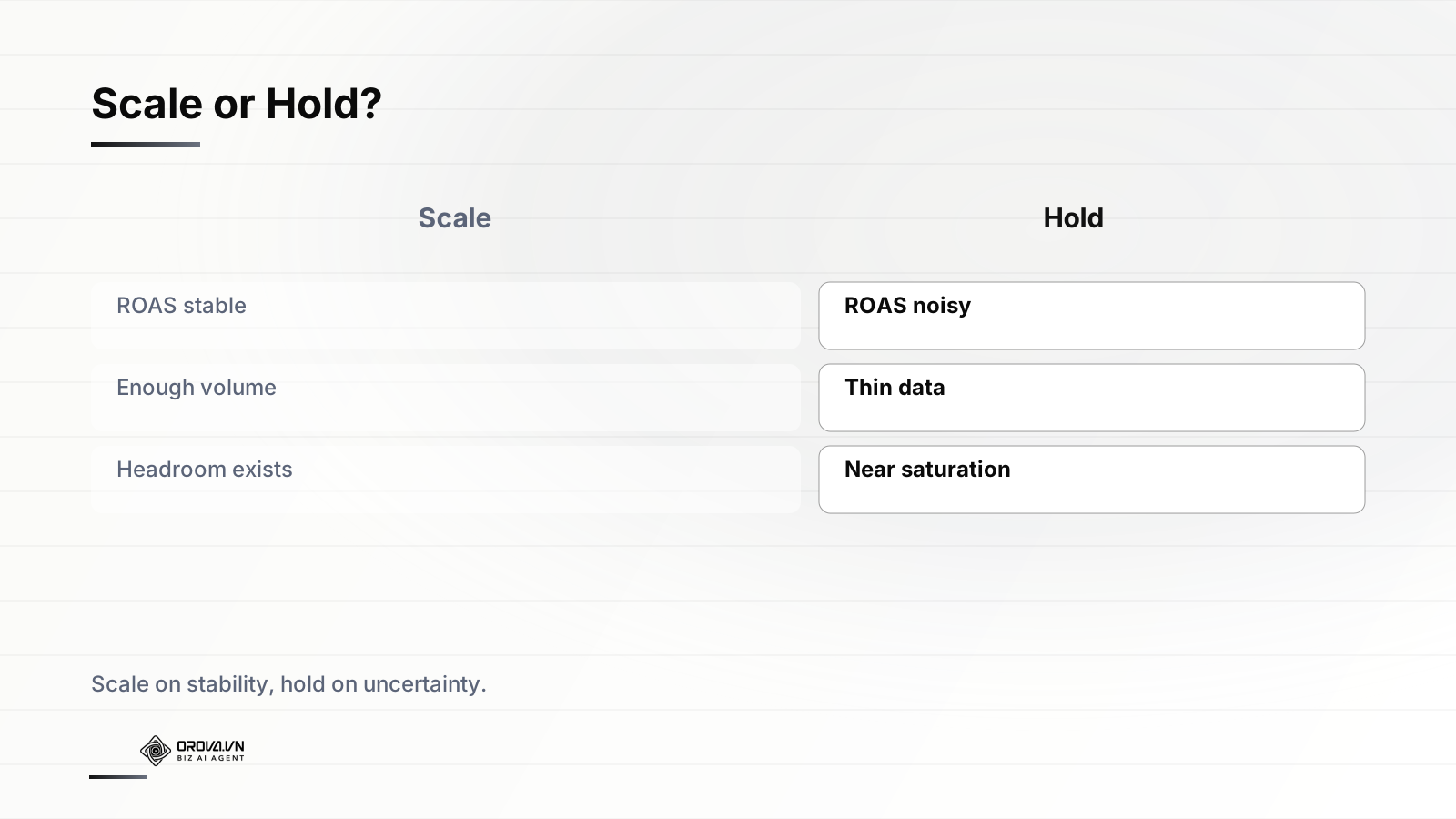
Scaling is a privilege a campaign earns by demonstrating three things: that its performance is stable rather than lucky, that it has enough data to trust, and that there is room to grow into. Miss any one of these and you are gambling, not scaling.
Signal one: ROAS (or CPA) is stable, not just high
A high ROAS on a single good day means nothing. A high ROAS that holds steady across a week — through different days, different times, the normal noise of demand — means something. Stability is the signal, not the peak.
Practically, look at the daily ROAS or CPA over the last 7 to 14 days and ask whether the line is roughly flat or wildly bouncing. A campaign that swings between a 6.0 ROAS and a 1.5 ROAS day to day is not a 3.75 ROAS campaign you can scale; it is an unstable campaign whose average happens to look acceptable. The variance itself is the warning. Scale a noisy campaign and you amplify the noise, often landing on the bad side of it right when you have the most money exposed.
A useful gut check: would you be comfortable if next week looked like the worst day of this week? If the answer is no, the campaign is not stable enough to scale yet. Another lens is to compare the campaign's last seven days against the seven before that. If both weeks land in roughly the same efficiency band, you have two independent samples agreeing with each other, which is far stronger evidence than a single hot week that could be a seasonal spike, a competitor pausing, or pure chance.
Signal two: enough volume to trust the number
A 5.0 ROAS built on 4 conversions is a coin flip wearing a suit. You cannot distinguish a genuinely strong campaign from a fluke without enough events to be confident the result is repeatable. The rough threshold most practitioners use is at least 30 to 50 conversions over the measurement window before treating a ROAS or CPA as a real signal rather than a guess. For lower-volume, high-ticket businesses, you lean on upper-funnel proxies (qualified leads, add-to-carts, strong micro-conversions) to reach a usable sample faster.
The reason this matters for scaling specifically: when you raise budget, you are betting that the historical efficiency will hold. If that history is built on a handful of conversions, you are betting on a number that could easily have been luck. Thin data is the single most common reason a "winner" collapses the moment it gets real money.
Signal three: headroom exists
Even a stable, well-evidenced campaign cannot scale into a wall. If your audience is small, your frequency is already climbing, or your impression share is near its ceiling, there is simply nowhere for additional budget to go except into more expensive, more repetitive delivery. Check three things:
- Audience size relative to spend. A narrow audience that already sees your ad multiple times a week has little room left. Frequency creeping past 3-4 per week on a cold audience is a saturation warning.
- Impression share or coverage. On search, if you are already capturing the lion's share of available impressions for your keywords, extra budget buys you very little incremental volume — you are bidding against yourself.
- The shape of recent spend-vs-results. If small budget increases over the past two weeks already produced disproportionately smaller gains, you are watching diminishing returns set in before you have even pushed hard.
Headroom is the difference between scaling and squeezing. Scaling grows into available demand; squeezing extracts the last drops from an exhausted audience at rising cost.
The hold signals: when standing still is the smart move
Holding is an active decision, not a failure to act. There are specific conditions where the correct move is to leave a campaign exactly where it is, and recognizing them saves you from self-inflicted damage.
The performance is noisy
If daily ROAS or CPA is bouncing around without a clear, stable center, hold. You do not yet know what the true performance is, and scaling will only make the swings more violent and more expensive. Let it run, let the variance settle, and revisit once the line calms down. Sometimes "wait three more days" is the highest-leverage instruction in the account.
The data is too thin to trust
If you are below your confidence threshold on conversions, hold and let volume accumulate at the current budget. Scaling to "get more data faster" is a tempting rationalization, but you are spending more money on a hypothesis you have not yet validated. Patience here is cheap; impatience is not.
The campaign is near saturation
When frequency is high, audience is exhausted, or impression share is maxed, additional budget produces rising costs and falling returns. The right move is not to scale this campaign but to expand the surface — new audiences, new geographies, new creative angles, a new campaign — so there is fresh demand to grow into. Scaling a saturated campaign is paying premium prices to annoy the same people more often.
You are inside a learning or relearning window
If a campaign recently exited learning, or you just made a meaningful change, hold the budget steady and let delivery stabilize before you touch it again. Stacking a budget increase on top of an unsettled campaign is how you trap it in a relearning loop, never giving the optimization system the stable conditions it needs to do its job.
Holding is not indecision. It is refusing to bet more money on a signal you do not yet trust.
How to scale safely: pace, steps, and patience
Once a campaign has earned the right to scale, the question becomes how fast. This is where the most damage gets done, because the instinct — "it's working, push it hard" — is exactly the instinct that triggers learning resets and tanks efficiency. Speed is the enemy. Discipline is the edge.
Move in roughly 20% steps
The widely used rule of thumb is to increase budget by about 20% per step, not to double or triple it. The reason is mechanical: changes under roughly 20% are small enough that most optimization systems absorb them without re-entering learning, preserving the accumulated signal that makes the campaign perform. A 20% step on a $500/day campaign is a $100 increase — modest, but compounding 20% steps every few days reaches $1,000/day inside two weeks without ever shocking the system.
The exact percentage matters less than the principle: each step should be small enough that delivery stays stable through it. If you find a 20% step still rattling performance, go smaller. If the campaign sails through, you have confirmation you can keep going.
Wait 3 to 5 days between steps
After each increase, hold and observe for 3 to 5 days before deciding the next move. This window does two things. First, it lets delivery re-stabilize at the new budget level so you are reading real performance, not the transient wobble that follows any change. Second, it gives you enough conversion volume at the new level to judge whether efficiency held. Scaling faster than the campaign can prove itself is how you end up three steps up before realizing the first step already broke the economics.
The temptation to compress this window is enormous, especially when the early signs look good. Resist it. The campaign cannot tell you whether the new budget is sustainable until it has run long enough at that budget to produce a stable, sufficient sample. Rushing past that point means you are scaling on hope.
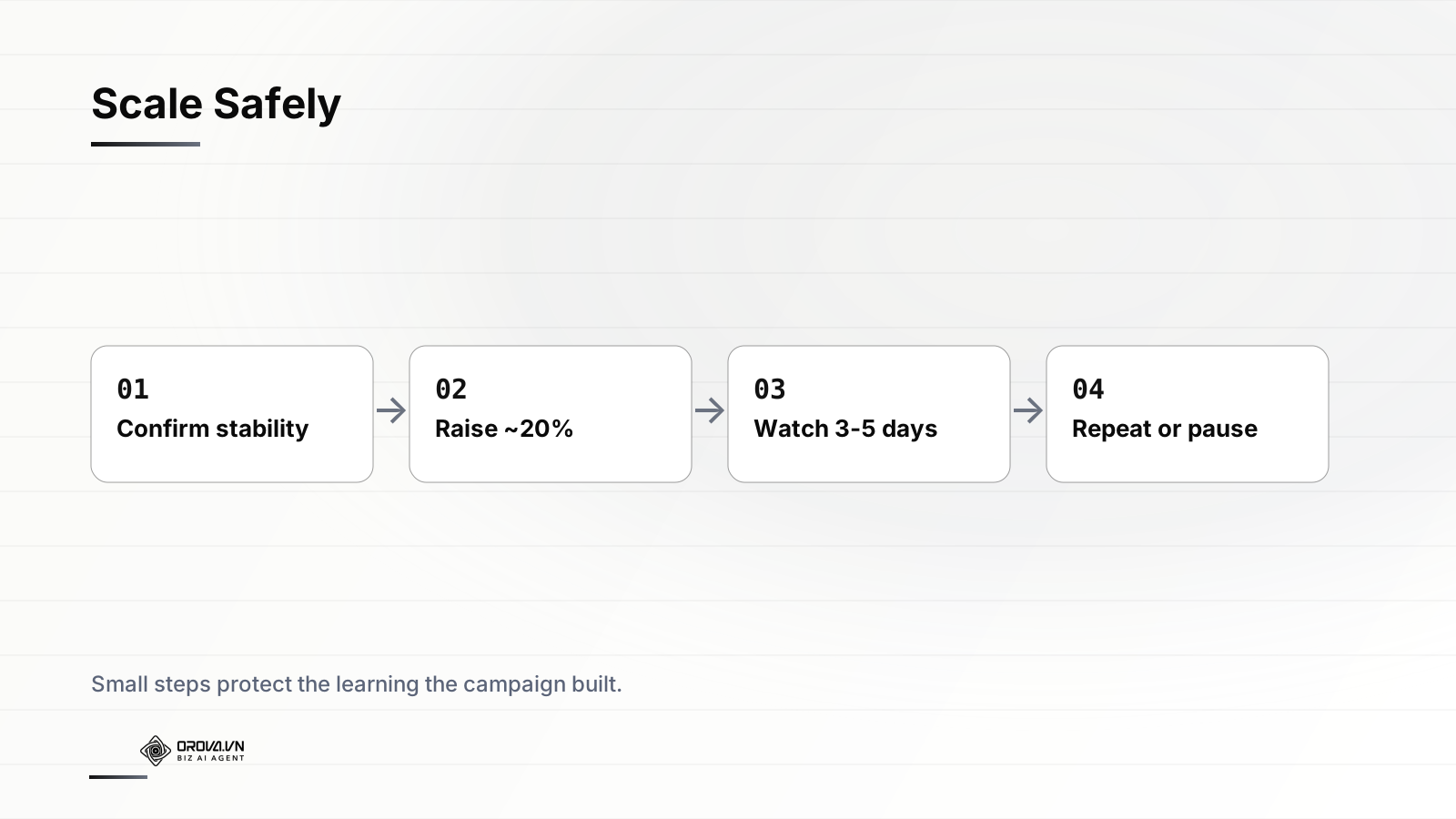
The loop: confirm, raise, watch, decide
Safe scaling is a loop, not a launch:
- Confirm stability. Verify the campaign still meets the readiness signals — stable efficiency, sufficient volume, remaining headroom — at its current budget.
- Raise about 20%. One modest step, small enough to avoid a learning reset.
- Watch for 3 to 5 days. Let delivery settle and accumulate enough data to judge whether efficiency held at the higher level.
- Repeat or pause. If efficiency held, run the loop again. If it slipped, hold at the previous level — or step back down — and find out why before pushing further.
That last branch is the one most people skip. Scaling is not a one-way ratchet. If a step degrades performance, the correct response is to retreat to the last good level, not to push harder hoping the numbers recover. The campaign told you where its ceiling is; believe it. A good operator treats the last profitable budget level as a known-good anchor and is always willing to return to it, rather than treating every increase as a permanent commitment that would be embarrassing to reverse.
One subtle point on timing: the calendar matters. If your business has strong weekly seasonality — heavy weekends, dead Mondays — make sure each observation window spans a full week's worth of pattern, or at least that you are comparing like days to like days. Scaling on a Friday and judging the result on a slow Tuesday will mislead you into thinking a step failed when really you just changed which days you were measuring. Align your steps and your reads with the natural rhythm of your demand.
Alternatives to brute-force budget increases
Raising the budget on an existing campaign is the most obvious way to scale, but it is not the only way, and it is often not the best. The smartest accounts scale across several dimensions so they never lean too hard on any single campaign's diminishing returns.
Horizontal scaling: expand the surface
Instead of forcing more budget into one campaign, open new fronts that share its winning DNA. New lookalike seeds, adjacent interests, additional geographies, or fresh creative angles all create new pools of demand to grow into. Horizontal scaling sidesteps saturation because you are not squeezing harder on the same audience — you are finding new audiences who have not seen you yet. It is slower to set up but far more durable, because each new surface has its own headroom.
Creative as a scaling lever
Creative fatigue is one of the most common reasons a scaling campaign stalls. As frequency rises with budget, the same ad wears out faster, and your costs climb not because demand is exhausted but because your message is. Feeding fresh creative into a scaling campaign extends its runway, sometimes dramatically. If you plan to scale, plan your creative pipeline alongside it — the budget and the creative supply have to grow together or the budget will outrun what the creative can sustain.
Efficiency before volume
Sometimes the best way to "scale" is to improve the economics so the same budget produces more. Tightening targeting, fixing tracking gaps, raising landing-page conversion rate, or cutting wasted spend on poor placements can lift ROAS enough that the campaign can comfortably absorb more budget afterward. Scaling an inefficient campaign just multiplies the inefficiency. Fix the leak first, then pour in more.
The discipline most accounts lack: doing this consistently
Everything above is straightforward to understand and brutally hard to execute consistently, for a simple human reason: scaling decisions are made under emotion. When a campaign is winning, the pull to push too fast is strong. When it is wobbling, the fear of touching it freezes you. Both impulses lead to the wrong call, and both are amplified by the fact that nobody is checking every campaign, every day, against the same objective criteria.
That is the real problem. The readiness signals, the 20% steps, the 3-to-5-day windows — none of it is complicated. What is hard is applying it dispassionately across dozens of campaigns, day after day, without skipping the boring ones, without rushing the exciting ones, and without letting last night's dashboard color today's judgment. Manual scaling decisions drift toward whatever campaign happened to catch your attention, on whatever day you happened to look, in whatever mood you happened to be in.
What good scaling discipline actually requires
- A daily read of every active campaign, not just the ones that are loud. Quiet, steadily profitable campaigns are exactly the ones with unexploited headroom.
- Fixed, objective thresholds for stability, volume, and headroom — written down, not re-litigated in the moment.
- Step sizes and waiting periods that you actually honor, including the discipline to step back when a step fails.
- A record of what you changed and why, so you can tell whether a dip came from your scaling step or from the market — without an audit trail, you are guessing.
This is precisely the kind of work that rewards relentless consistency over cleverness, which is why it is such a natural fit for automation. A system that reads every campaign's data every day, checks it against the same readiness signals, times each increment to preserve stability, and never gets impatient or attached will out-discipline a human operator on the boring middle of the account — the campaigns that quietly determine most of the result.
Bringing it together
Scaling and holding are two sides of the same decision, and both have a cost. Scale too early and you break a campaign before it had proven itself; the auction gets more expensive, the audience dilutes, and a budget shock can reset the learning you paid to build. Hold too long and you leave compounding profit on the table, day after invisible day. The way through is not courage or caution — it is evidence.
Scale when efficiency is stable, the data is thick enough to trust, and there is room to grow into. Hold when performance is noisy, the sample is thin, the audience is saturated, or delivery has not yet settled. When you do scale, move in modest steps of around 20%, wait 3 to 5 days for each step to prove itself, and retreat without ego when a step fails. Layer in horizontal expansion and fresh creative so you never lean too hard on a single campaign's diminishing returns. And above all, apply these rules consistently across every campaign, not just the ones shouting for attention.
The signals are not subtle. The hard part is reading them every day, on every campaign, and acting on them without flinching.
If applying that discipline by hand across an entire account sounds exhausting, that is exactly the gap Orova Ads was built to close. It is an AI agent that manages your paid campaigns across Google, Meta, and TikTok — reading the data every day, spotting which campaigns have earned the right to scale and which need to hold, and executing the budget, bid, audience, and on/off changes for you, with human-in-the-loop approval and a full audit log of every decision. See how it scales winners without breaking learning at orova.vn.
Related reading: AI Marketing Campaigns: From Recommendation to Execution
Orova Ads optimises campaigns for you
Connect Google, Meta and TikTok in one place. AI reads the numbers, proposes changes and executes under the rules you set.
Explore Orova Ads