
Measuring New-Product Launches
The first week of a new-product launch is the only time in a campaign's life when your dashboards tell you almost nothing true. You open the ad account, you see a cost-per-acquisition of $187 against a target of $40, you see two purchases from 4,000 clicks, and every instinct screams to pause everything and start over. Resist that instinct. A launch with three days of spend behind it is not failing — it is simply unmeasured. The numbers on the screen are not measurements yet; they are the raw noise out of which a measurement will eventually condense, if you give the system enough events to work with.
This is the central problem of launch measurement: the metrics you normally trust — cost per purchase, return on ad spend, conversion rate — all depend on a base of historical conversions that, by definition, does not exist on day one. Meta's optimizer wants roughly 50 conversions per ad set per week before it leaves the learning phase. Google's Smart Bidding wants something similar, often 30 conversions in 30 days before it has a stable model. A product that launched yesterday has zero. So the ad platforms are flying blind, and if you judge them on outcome metrics during that blind period, you will make decisions on numbers that are statistically meaningless and you will usually kill campaigns that were about to work.
The fix is not to spend more or wait longer in some vague way. It is to deliberately change what you measure, in what order, with what budget, until the real outcome data accumulates. That is what this piece is about: setting honest targets when you have no baseline, choosing proxy signals that arrive fast enough to steer by, structuring tests so the platform can actually learn, and scaling only when the leading indicators justify it. Most of the expensive launch mistakes I have watched marketers make come from applying steady-state thinking to a system that is not yet in steady state.
Why launch data is structurally different
It helps to be precise about why a launch is hard to measure, because the precision tells you exactly what to do instead. There are three distinct problems stacked on top of each other, and people tend to blur them together into a single feeling of "we don't have data."
The volume problem: too few events to be significant
If your true conversion rate is 2% and you have driven 500 clicks, you would expect about 10 conversions — but the 95% confidence interval around that estimate is roughly 1% to 3.5%. In plain terms, a campaign that is genuinely performing at 2% could easily show you anything from 5 conversions to 18 over those 500 clicks, purely from chance. You cannot tell a winner from a loser at that volume. Any ranking you do between ad sets is mostly reading tea leaves. This is not a flaw in your tracking; it is arithmetic. Small numbers have large error bars.
The optimization problem: the algorithm is also learning
The platform's bidding model is being trained on the same sparse data you are looking at. During the learning phase, delivery is deliberately exploratory and unstable — the system is testing different audience pockets, placements and times of day to find out where conversions come from. Performance during this period is not representative of what the campaign will do once it stabilizes. Editing the campaign — changing budget, swapping creative, adjusting targeting — resets that learning and throws away whatever progress the model had made. So the very act of reacting to bad early numbers tends to perpetuate the bad early numbers.
The reference problem: no benchmark to judge against
For an existing product you know that a $40 cost per purchase is good because last quarter it was $52. For a brand-new product you have nothing. Is $40 good? Is $90 acceptable because the margin is fat? You do not know, and worse, you do not yet know the product's true conversion rate, average order value, or repeat-purchase behavior — all of which determine what an acceptable acquisition cost even is. Launch measurement therefore has to discover the benchmark and hit the benchmark at the same time, which is a fundamentally different task from optimizing toward a known target.
The mistake is treating a launch as an optimization problem when it is first a measurement problem. You cannot optimize toward a target you have not yet established, using a model that has not yet trained, on a sample too small to be significant.
Optimize to proxy signals before you have purchases
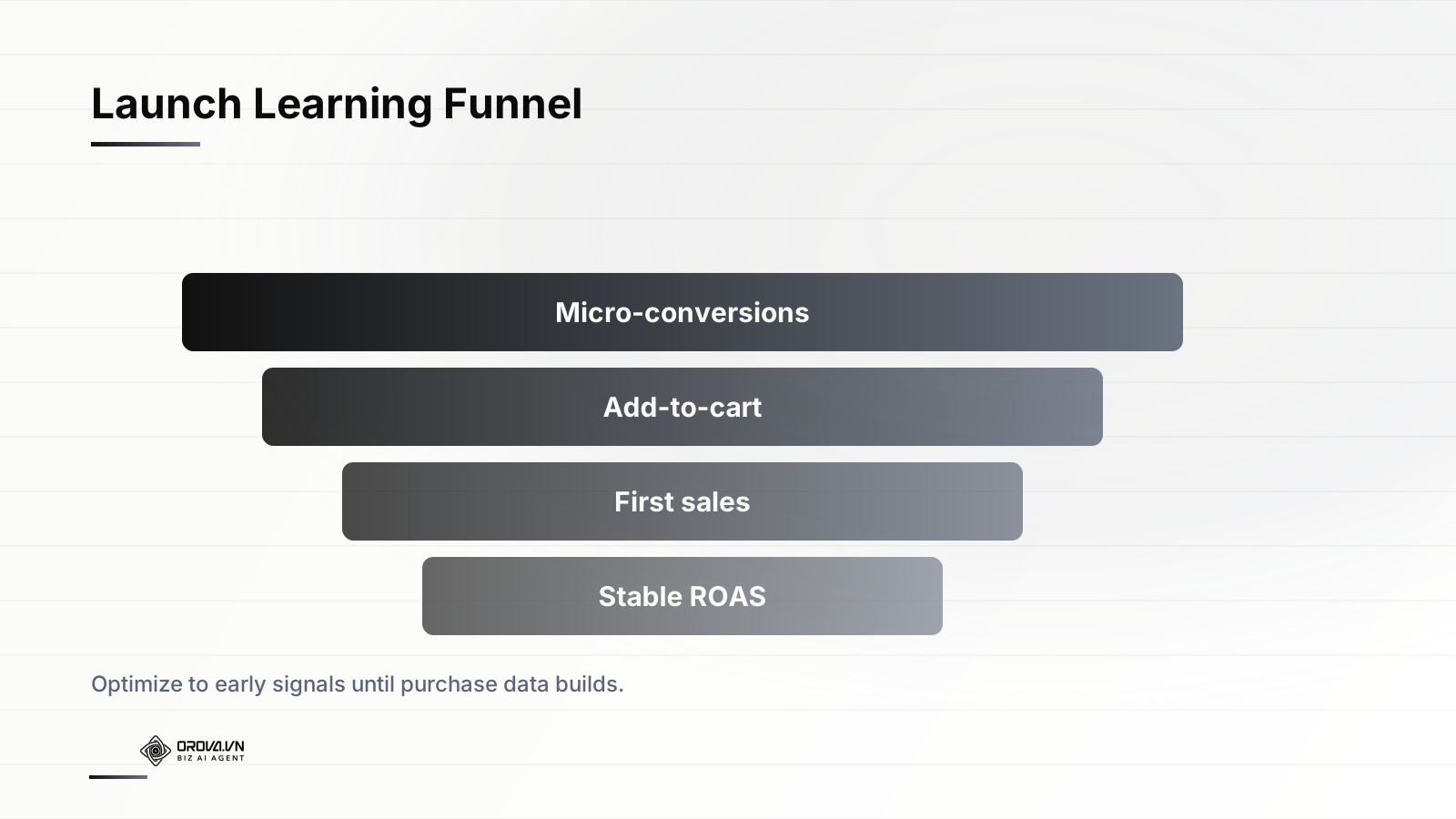
The most useful move at launch is to step down the funnel and optimize toward an event that happens often enough to actually accumulate. Purchases are rare and slow. Earlier-funnel actions — what people loosely call micro-conversions or proxy conversions — are frequent and fast, and a well-chosen proxy is strongly correlated with the eventual purchase. If you can get 50 add-to-cart events in three days when you would have needed three weeks to get 50 purchases, you have just compressed your learning timeline by an order of magnitude.
Choosing a proxy that actually predicts revenue
Not every early action is a good proxy. The test is correlation with the real outcome, not just frequency. A page view is frequent but predicts almost nothing. An add-to-cart is less frequent but predicts a great deal. Useful proxy candidates, roughly in order of how much signal they carry:
- Add-to-cart and begin-checkout — the strongest non-purchase signals for ecommerce; people who reach checkout are within one friction-point of buying.
- Lead-form completion or email capture — for considered purchases and B2B, where the sale happens days or weeks after the click.
- Free-trial start or account creation — for software and subscription products, often a better optimization target than the eventual paid conversion because it arrives weeks earlier.
- High-intent content actions — viewing a sizing guide, using a product configurator, watching 75% of a demo video, requesting a sample. These are weaker but useful when nothing stronger has enough volume.
A practical rule: pick the deepest-funnel event that will reliably produce at least 50 instances per ad set per week at your planned spend. If add-to-cart clears that bar, optimize to add-to-cart. If it does not, step up to begin-checkout's parent or to a content engagement event until you find one that does. You are trading a little predictive accuracy for a lot of statistical power, and early in a launch that trade is almost always worth it.
The handoff: migrating from proxy to purchase
The proxy is scaffolding, not the building. As real purchase volume builds — once an ad set is reliably generating 50-plus purchases a week on its own — you migrate the optimization goal down to the actual purchase event. Do this deliberately and one campaign at a time, because changing the conversion goal restarts learning. The sequence over a launch typically looks like this: optimize to add-to-cart in week one, run both signals in parallel through weeks two and three while purchase volume climbs, and switch primary optimization to purchase once the data supports it, usually somewhere between week three and week six depending on traffic.
One caution that bites people: optimizing to a proxy can over-deliver on the proxy at the expense of the real goal. If you optimize to add-to-cart, the algorithm will happily find people who love adding things to carts and never buying. Watch the ratio between the proxy and the eventual purchase. If add-to-carts triple but purchases stay flat, the proxy has decoupled from revenue and you need to either tighten it or move down faster. The proxy is a means; the cash register is the end.
Broad first, then narrow: let the platform find the buyers
The second launch instinct worth overriding is the urge to hyper-target. When you do not know who your buyers are, narrow targeting is a bet — and at launch you do not yet have the information to bet well. You are guessing which interests, lookalikes and demographics matter, and a wrong guess at launch is doubly expensive because it both wastes spend and starves the algorithm of the diverse data it needs to learn from.
Seed broad to discover the audience
Start wider than feels comfortable. Broad targeting at launch is not laziness; it is a discovery mechanism. You are asking the platform's machine learning, which has seen billions of conversions across millions of advertisers, to tell you where your buyers actually cluster. Give it room to explore — a broad age range, minimal interest stacking, automatic placements — and let conversion (or proxy conversion) data, not your assumptions, reveal the pockets that respond. Modern optimizers are genuinely good at this when you feed them a clean conversion signal and enough budget to explore; the constraint is almost always too-narrow inputs, not too-weak algorithms.
This is also where your measurement foundation matters more than at any other time. The algorithm can only find buyers if it receives accurate conversion events to learn from. A launch built on broken or duplicated tracking will teach the optimizer the wrong lessons at the exact moment those lessons are being baked in. It is worth treating clean conversion data as the prerequisite for everything else here — broad targeting amplifies whatever signal you feed it, including a wrong one.
Narrow toward what the data revealed
Once the broad phase has run long enough to show patterns — typically one to two weeks, or whenever you have a few hundred proxy conversions to look at — you narrow. But you narrow toward what the data showed, not toward what you assumed at the start. Pull the breakdowns: which age bands, regions, placements and devices produced conversions at acceptable cost? Build your next round of ad sets around those revealed winners. This broad-then-narrow rhythm replaces guessing with finding, and it is the difference between a launch that discovers its market and one that merely confirms the launcher's biases.
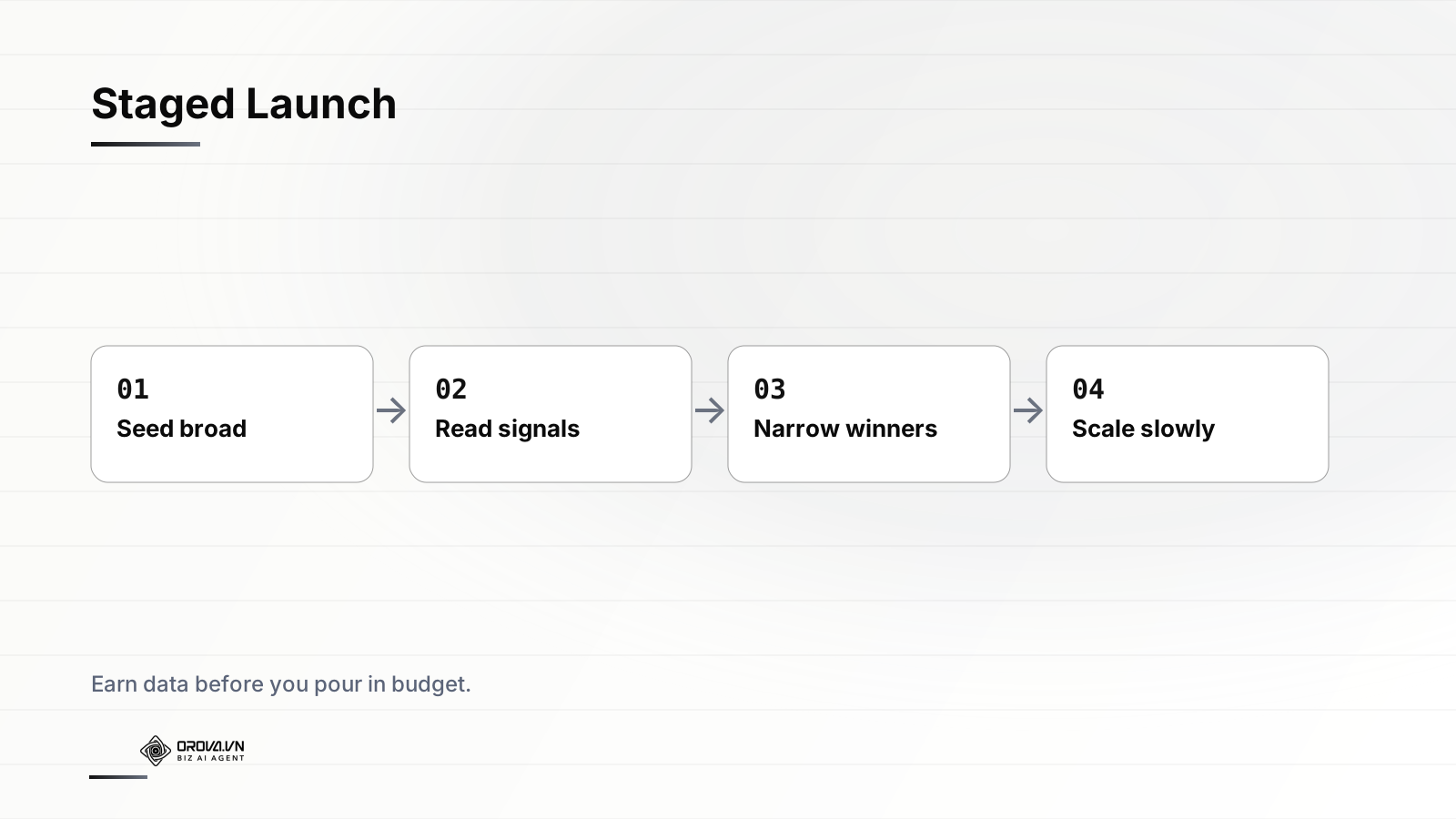
- Week 1-2 (seed broad): wide audiences, automatic placements, optimize to a high-volume proxy, deliberately accept higher cost per result as the price of learning.
- Week 2-3 (read signals): hold edits to a minimum, let learning complete, collect breakdowns by audience, placement, geography and device.
- Week 3-4 (narrow winners): build new ad sets around the segments that converted, shift budget toward them, retire the dead pockets.
- Week 4+ (scale slowly): raise budgets on proven winners in small increments, migrate optimization to the real purchase event.
Respect the learning phase — patience is a tactic
The learning phase is not a delay to be endured; it is the campaign doing exactly what you need it to do. During it the optimizer is mapping the relationship between your audience, your creative and your conversion event. That map is what produces stable performance later. Every time you edit a significant lever — budget by more than about 20%, the conversion goal, the audience definition, the creative set — you wipe the partially drawn map and start over. The single most common cause of a launch that "never stabilizes" is an anxious operator who keeps editing it back into learning every few days.
What counts as a learning-resetting edit
Knowing which changes reset learning lets you make the safe ones freely and avoid the costly ones. The edits that typically restart the learning phase include changing the optimization goal or conversion event, altering the audience or targeting, changing placements, swapping out or significantly editing creative, and large budget swings. Edits that generally do not reset learning include small budget nudges within roughly 20%, adjusting bid caps modestly, and editing ad set names or schedules at the margins. When you must make a resetting change, make several at once rather than one every few days — you pay the learning cost once instead of repeatedly.
Set a do-not-touch window in advance
Decide before launch how long you will leave the campaign alone, and write it down where you will see it when the panic hits. A reasonable default for a new conversion campaign is seven days or 50 conversions per ad set, whichever comes first, with no structural edits in that window. This sounds trivial and it is the hardest discipline in launch management, because the early numbers will look bad and the dashboard refreshes every time you load it. Pre-committing to the window protects the campaign from your own day-three reaction to day-three noise.
A campaign in learning is not underperforming. It is paying tuition. The cost of the learning phase is the price of admission to stable performance, and interrupting it means paying that tuition again without ever graduating.
Patience is not passivity, though. There is a real failure mode where a campaign genuinely cannot exit learning because the budget is too low to generate 50 conversions a week, and it churns indefinitely. The fix there is to either raise the budget, broaden the conversion event to a higher-volume proxy, or consolidate ad sets so the available conversions concentrate into fewer of them. The judgment call is distinguishing "this needs more time" from "this can never get enough volume at this structure" — and that call should be made against the volume math, not against the cost-per-result number.
Stage your budget: earn the right to spend more
The cleanest way to keep launch losses bounded is to refuse to spend big until the data has earned it. Front-loading a large budget into an unproven launch is the worst of both worlds: you spend the most money precisely when you understand the least, and the large budget does not even help you learn faster past a certain point — it just buys more of the same noisy, unsegmented data. Staged budgeting ties each increase in spend to a corresponding increase in confidence.
A workable staging model
Think of the budget in tranches, each unlocked by hitting a leading-indicator milestone rather than by the calendar alone. A typical structure:
- Stage 1 — Learn (minimum viable budget): spend enough to clear the learning-phase volume threshold on your chosen proxy, and no more. The goal is data, not revenue. Acceptable outcome is hitting 50 proxy conversions per ad set in the planned window, even at uncomfortable cost.
- Stage 2 — Validate (modest increase): once proxy signals look healthy and the proxy-to-purchase ratio holds, increase budget 20-30% to confirm the early winners repeat at slightly higher volume. You are checking that the pattern was real, not a small-sample fluke.
- Stage 3 — Scale (deliberate increments): with validated winners and accumulating purchase data, raise budgets in steps of roughly 20% every few days on the proven ad sets, watching that efficiency holds as volume grows. Scaling too fast here re-enters learning and undoes the stability you bought.
The discipline is that money moves only after a signal moves. If the proxy conversions are not appearing, you do not advance to Stage 2 by spending more — you fix the proxy, the creative or the targeting first. Staged budgets convert an open-ended gamble into a series of small, cheap bets where each one funds the information needed for the next.
What "healthy early signals" actually look like
The leading indicators worth watching during the early stages, before purchase volume is meaningful, are the ones that move first and predict the rest:
- Click-through rate trending up or stable — early read on whether the creative and offer resonate; a collapsing CTR after the first day is the earliest sign the creative is wrong.
- Proxy conversion rate — the share of clicks that take the early-funnel action; this is your fastest honest measure of landing-page and offer quality.
- Cost per proxy conversion trending down — as learning progresses, this should improve even before purchases arrive, signaling the optimizer is finding better pockets.
- Proxy-to-purchase ratio holding — confirms the proxy is still predicting revenue and has not decoupled.
- Frequency staying low — at launch you want fresh reach; rising frequency early means your audience is too narrow and you are repeating yourself.
Notice that none of these is "ROAS on day two." Return on ad spend is a lagging, low-volume, high-variance number at launch, and treating it as your day-two steering signal is the surest way to kill a campaign that was working. ROAS becomes your primary metric only once purchase volume is high enough to make it stable — which is the very last stage, not the first.
Reading early signals without fooling yourself
Even with the right metrics chosen, launch data invites two specific cognitive traps, and naming them helps you avoid them. The first is over-reacting to noise; the second is anchoring on the wrong reference point.
Distinguish signal from noise with simple volume gates
Before you draw any conclusion from a comparison — this ad beats that ad, this audience beats that one — check whether either side has enough events to support the claim. A rough working gate: do not declare a winner on fewer than 30-50 conversion events per variant, and do not declare a loser on fewer than that either. Below those thresholds, what you are seeing is mostly variance. This single habit prevents the most common launch error, which is reallocating budget toward whichever ad set happened to get lucky in its first 200 impressions, thereby starving the one that would have won over a real sample.
Anchor on contribution margin, not on a borrowed benchmark
Because you have no historical benchmark, you must build one from first principles, and the right foundation is unit economics rather than someone else's industry average. Work out the most you can pay to acquire a customer and still make money: your average order value, your gross margin, and crucially your expected repeat-purchase value if the product has any retention at all. A product with strong repeat purchase can rationally accept a first-order acquisition cost above its first-order margin, because the customer's lifetime value pays it back. Set your true target from that math, then judge the launch against it — not against a competitor's reported ROAS or a generic benchmark that assumes a different margin structure entirely.
This is also why launch measurement should always run alongside a deliberate effort to learn the product's real economics fast: early cohort retention, refund and return rates, and actual average order value once promotions wash out. Those numbers reset your acquisition target, sometimes dramatically. A launch that looked like a failure against an assumed $40 target can be a clear success once you discover the true sustainable target is $95 because customers buy three times a year.
Where an always-on AI agent changes the launch math
Everything above is doable by hand, and disciplined teams do it. But the launch is the worst possible time for the work to depend on a human remembering to check the right metric at the right cadence, because launches are chaotic, attention is fragmented, and the leading signals move daily while the temptation to react to noise is constant. This is precisely the kind of work that benefits from a system that watches continuously, applies the volume gates without emotion, and waits for the right signal before acting.
An agent watching the launch can do several things a busy operator routinely misses. It can read the leading indicators every day rather than whenever someone logs in, so a collapsing proxy conversion rate is caught on day two instead of day six. It can enforce the do-not-touch window mechanically, flagging an edit that would reset learning before it is made. It can monitor the proxy-to-purchase ratio for decoupling, watch frequency for early audience exhaustion, and hold budget increases until the milestone that justifies them has genuinely been hit — applying the staged-budget discipline consistently rather than by mood. And it can do the significance arithmetic continuously, so it never declares a winner on a sample too small to support the claim.
Human judgment on the things that need judgment
What it should not do is replace the strategic calls — the choice of proxy, the unit-economics target, the decision that a product's retention justifies a higher acquisition cost. Those are business judgments. The right division of labor is to let the agent handle the relentless, mechanical, daily vigilance — the part humans do poorly under launch pressure — while the human sets the targets and approves the meaningful moves. That keeps the patience and the discipline in place precisely when human nerves are most likely to break them, without surrendering the judgment that a launch genuinely requires.
If you want that always-on vigilance for your next launch, Orova Ads is an AI agent that manages paid campaigns across Google, Meta and TikTok — it reads your data every day, watches the leading signals that matter during a launch, and recommends and executes optimizations to budgets, bids, targeting and on/off state with your approval and a full audit log, so you get the patience and the discipline of a perfect launch operator without having to be one yourself.
Related reading: Marketing Metrics That Matter — and the Vanity Ones Wasting Your Time
Orova Ads optimises campaigns for you
Connect Google, Meta and TikTok in one place. AI reads the numbers, proposes changes and executes under the rules you set.
Explore Orova Ads