
LTV-Based Bidding: Optimizing for Customers, Not Clicks
Two e-commerce brands run the same Meta campaign, target the same audience, and report the same 3.2x return on ad spend in their dashboards. One is quietly going broke. The other is compounding profit every quarter. The difference is not the creative, the budget, or the bidding algorithm. It is what each brand told the algorithm to optimize for. The first counted the first order. The second counted the customer.
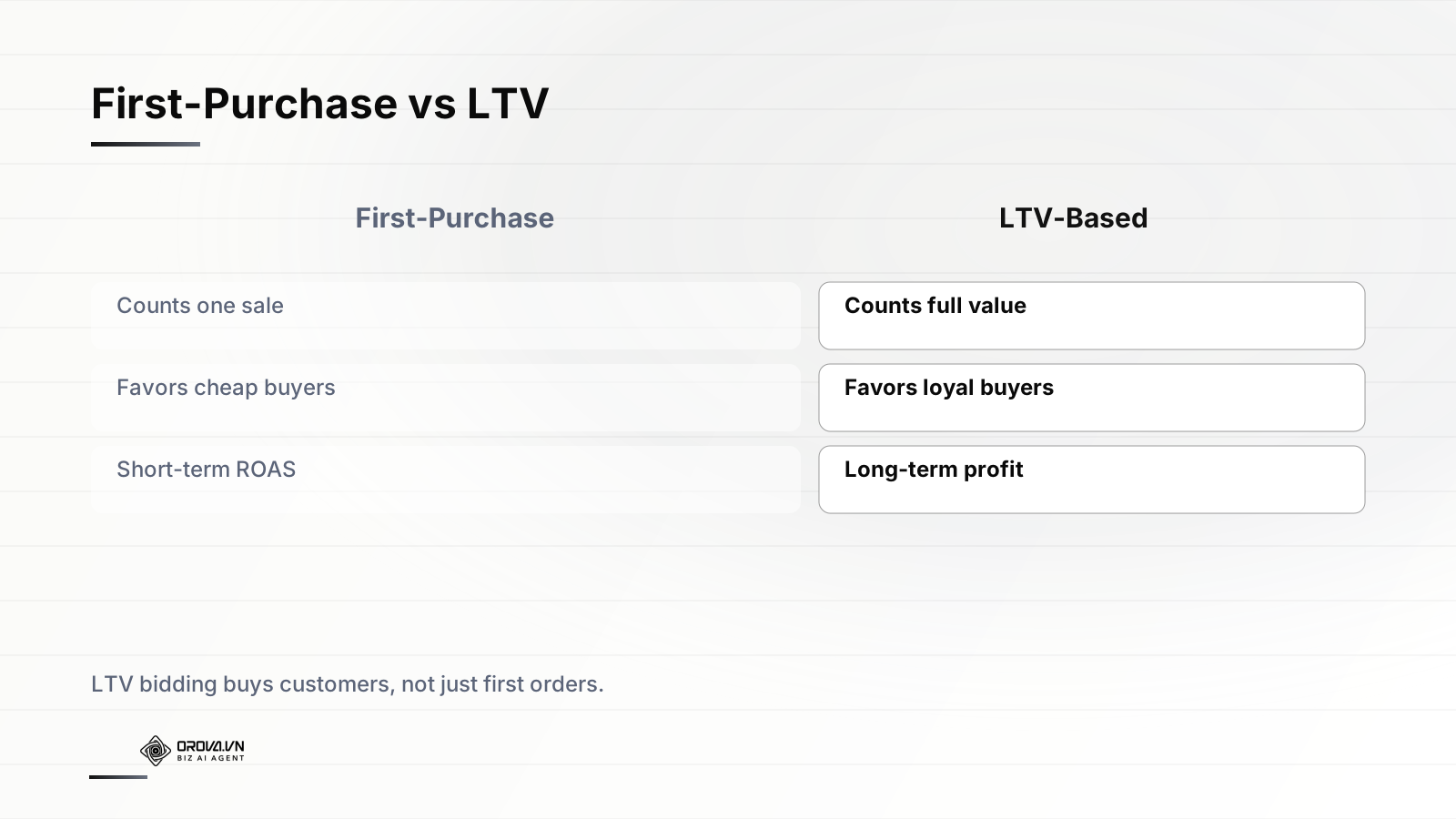
This is the gap that lifetime-value bidding closes. When you bid to first-purchase revenue, you are paying the platform to find the cheapest possible sale right now. The algorithm obliges with ruthless efficiency: it finds discount hunters, one-time gift buyers, and people who churn before the second email. When you bid to predicted lifetime value, you are paying the platform to find the customer who will still be paying you in eighteen months. Those are completely different people, and the auction will spend your money completely differently to reach them.
If you sell anything with repeat purchases, a subscription, a renewal, or even a meaningfully different margin profile across customer types, first-purchase optimization is silently mispricing every bid you make. This article walks through why that happens, how to model and pass lifetime value to Google and Meta, and how an always-on system reallocates spend toward the cohorts that actually pay you back.
Why First-Purchase ROAS Lies to You
The promise of value-based bidding on Google and Meta is that you stop optimizing for conversion count and start optimizing for conversion value. Most advertisers take that step and then stop. They send the order total as the conversion value, switch on target ROAS, and assume they are now optimizing for value. They are optimizing for value, but only the first three minutes of it.
Consider a meal-kit company. A customer who signs up with a 60%-off first-box coupon generates $20 in first-purchase revenue. A customer who pays full price for their first box generates $59. To a first-purchase ROAS model, the full-price customer looks roughly three times more valuable, so the algorithm bids up for audiences that resemble them. But the discount customer who stayed nine months is worth $430 in cumulative revenue, while the full-price customer who cancelled after one box is worth exactly $59. The signal the platform learned from is inverted relative to the truth.
This is not a rare edge case. It is the default behavior of any business where acquisition cost and retention behavior vary across segments, which is to say almost every business. The mechanism that makes it dangerous is the feedback loop. Smart bidding does not just spend against the values you send; it builds a model of which users produce those values and then goes looking for more of them. Feed it first-purchase revenue and it becomes an expert at finding people who buy once and disappear. The campaign will look healthy on a 7-day window and erode your margin on a 12-month one.
The four ways first-purchase optimization misleads
- Discount sensitivity. First-purchase value rewards the audiences most responsive to promotions, who are also the audiences least likely to pay full price later.
- Category mix. A customer whose first order is a low-margin loss-leader (printer, razor handle, trial subscription) can be your most profitable account over time, but reads as a weak conversion on day one.
- Repeat and subscription revenue. Any recurring or replenishment revenue is invisible to a model that only sees the acquisition order, so the platform never learns which signups actually renew.
- Refunds and chargebacks. First-purchase value counts revenue at checkout; it cannot see the return three weeks later or the cohort with a 30% refund rate.
The fix is conceptually simple and operationally demanding: send the platform a value that approximates what the customer will be worth, not what they paid at the door. To do that you need a defensible estimate of lifetime value at the moment of conversion, long before the lifetime has actually happened.
Modeling Predicted LTV You Can Actually Bid On
The objection most teams raise is reasonable: we cannot know a customer's lifetime value on the day they convert, so how can we bid on it? The answer is that you do not need the realized lifetime value. You need a predicted value that is directionally correct and consistently calculated, because bidding algorithms care far more about relative ordering than absolute precision. If your model reliably ranks a likely high-LTV customer above a likely low-LTV one, the auction will allocate correctly even if every individual number is somewhat off.
There are three tiers of sophistication, and you should start at the lowest one that beats first-purchase value.
Tier 1: Historical cohort averages
The simplest model assigns each new customer the average realized LTV of a cohort they resemble, based on attributes known at conversion. You already have the data: pull customers acquired 12 to 24 months ago, group them by the handful of signals you can observe at checkout, and compute the average cumulative revenue (or contribution margin) per group. Useful grouping dimensions include:
- First product or category purchased
- Discount level applied to the first order
- Acquisition channel and campaign type
- Plan tier selected (for subscriptions)
- Geography or currency, where retention differs
If your full-price first-box meal-kit customers historically reach $310 average LTV and your deep-discount customers reach $180, you send $310 and $180 as the conversion values respectively, instead of $59 and $20. That single change reorders the entire auction. It costs nothing but a SQL query and an afternoon, and it captures most of the benefit for businesses with stable retention curves.
Tier 2: Predictive scoring models
Cohort averages assume everyone in a group is identical, which leaves value on the table. The next tier predicts an individual LTV score from richer features using a regression or gradient-boosted model. Inputs that improve prediction include on-site behavior before conversion (pages viewed, session count, cart composition), early engagement signals, RFM-style features for returning visitors, and the same demographic and channel attributes from Tier 1. The output is a continuous predicted value per customer that you map to the conversion event.
The discipline that matters here is not algorithmic exotica; it is using only features available at the moment you fire the conversion. It is easy to build a beautiful model that uses second-order data the platform will never have when it bids, which produces a score you cannot operationalize. Train on what you can send.
Tier 3: Probabilistic LTV with survival and margin
The most rigorous approach separates the problem into components: the probability the customer is still active over time (a churn or survival curve), the expected spend per active period, and the contribution margin on that spend. Buy-till-you-die models such as BG/NBD paired with a Gamma-Gamma spend model are the classic toolkit; subscription businesses can model expected tenure directly from renewal curves. The reason to graduate to this tier is that it lets you bid on profit rather than revenue, and to discount future cash flows so a dollar in month one is not treated identically to a dollar in month twenty.
Whichever tier you choose, three modeling principles protect you from common failures.
Decide between revenue and margin early. Bidding to revenue when margins vary across products quietly funnels spend toward high-revenue, low-profit lines. If your gross margin ranges from 20% to 70% across the catalog, you almost certainly want to send contribution margin, not topline revenue, as your value. The platform will treat whatever number you send as the thing worth maximizing, so make sure it is the number you actually care about.
Cap and floor your predictions. A handful of whale customers with five-figure predicted LTV can dominate the algorithm's learning and push it toward chasing rare outliers. Winsorize the top of your distribution and set a sensible floor so that a near-zero prediction does not zero out the conversion signal entirely. Bounded, smooth value distributions train more stable bidders.
Recalibrate on a schedule. Retention curves drift as your product, pricing, and customer mix change. A model trained on 2024 cohorts will gradually mispredict 2026 behavior. Re-estimate cohort averages or retrain scoring models at least quarterly, and watch for divergence between predicted and realized LTV as cohorts mature. The classic foundations of value-based bidding, including the target ROAS and target CPA mechanics that consume these values, are worth revisiting as you tune; our explainer on how tCPA and tROAS bid strategies actually work covers how the platform translates your value signals into auction-time bids.
Passing Value Signals to Google and Meta
A predicted LTV that lives in your data warehouse changes nothing. The value has to reach the bidding engine in a form it can optimize against. There are two broad delivery methods, and mature programs use both.
Real-time value at conversion
The fastest path is to attach your predicted LTV as the conversion value at the moment the conversion fires. On Google, this means populating the value parameter in the conversion tag or, more reliably, sending it through the Enhanced Conversions and offline conversion import pipeline. On Meta, it means setting the value parameter on the Purchase or relevant standard event, ideally through the Conversions API rather than only the browser pixel, so the value survives ad blockers and cookie loss.
The advantage of real-time value is immediacy: the platform learns the corrected signal as conversions happen, with no lag. The constraint is that your prediction must be computable at conversion time from data you already hold. Tier 1 cohort lookups and Tier 2 scoring models that use only pre-conversion features fit naturally here.
Offline conversion and value adjustment uploads
The more powerful pattern, especially for considered purchases and lead-generation businesses, is to send conversions and their values from your own systems on a delay, when you know more. A SaaS company can import the conversion when a trial converts to paid, with a value reflecting predicted account LTV. A business with refunds can send the initial value at purchase and then upload a value adjustment when a return processes, so the platform learns to deprioritize the audiences that drive returns. Google supports conversion value adjustments and uploads keyed on a click identifier (GCLID) or hashed customer data; Meta accepts offline events and CAPI events with order identifiers for deduplication.
This is where lead-gen businesses make their biggest gains. If you optimize toward form fills, the platform finds people who fill out forms, not people who become customers. By importing the downstream value, qualified lead, opportunity, closed deal, with a predicted LTV, you redirect the algorithm toward the leads that close and the deal sizes that matter.
Operational details that decide whether this works
- Identity stitching. Offline uploads only work if you can tie the customer back to the ad click. Capture and store the GCLID and Meta click ID (fbclid) or use hashed email matching, and verify your match rates. A 20% match rate means you are training the bidder on a biased fifth of your customers.
- Conversion windows and lag. If your true value is known 30 days after the click but your conversion window is 7 days, the platform never connects the value to the ad. Align windows with your sales cycle, and use predicted value at conversion when the real value arrives too late.
- Currency and consistency. Send one consistent unit, ideally a single currency of contribution margin, across every channel. Mixing revenue in one campaign and margin in another makes cross-campaign comparison meaningless.
- Smart Bidding learning volume. Value-based strategies need enough conversions to learn. If splitting by predicted value starves individual campaigns of volume, consolidate, and give the algorithm a few weeks before judging results.
From Value Signals to Daily Reallocation
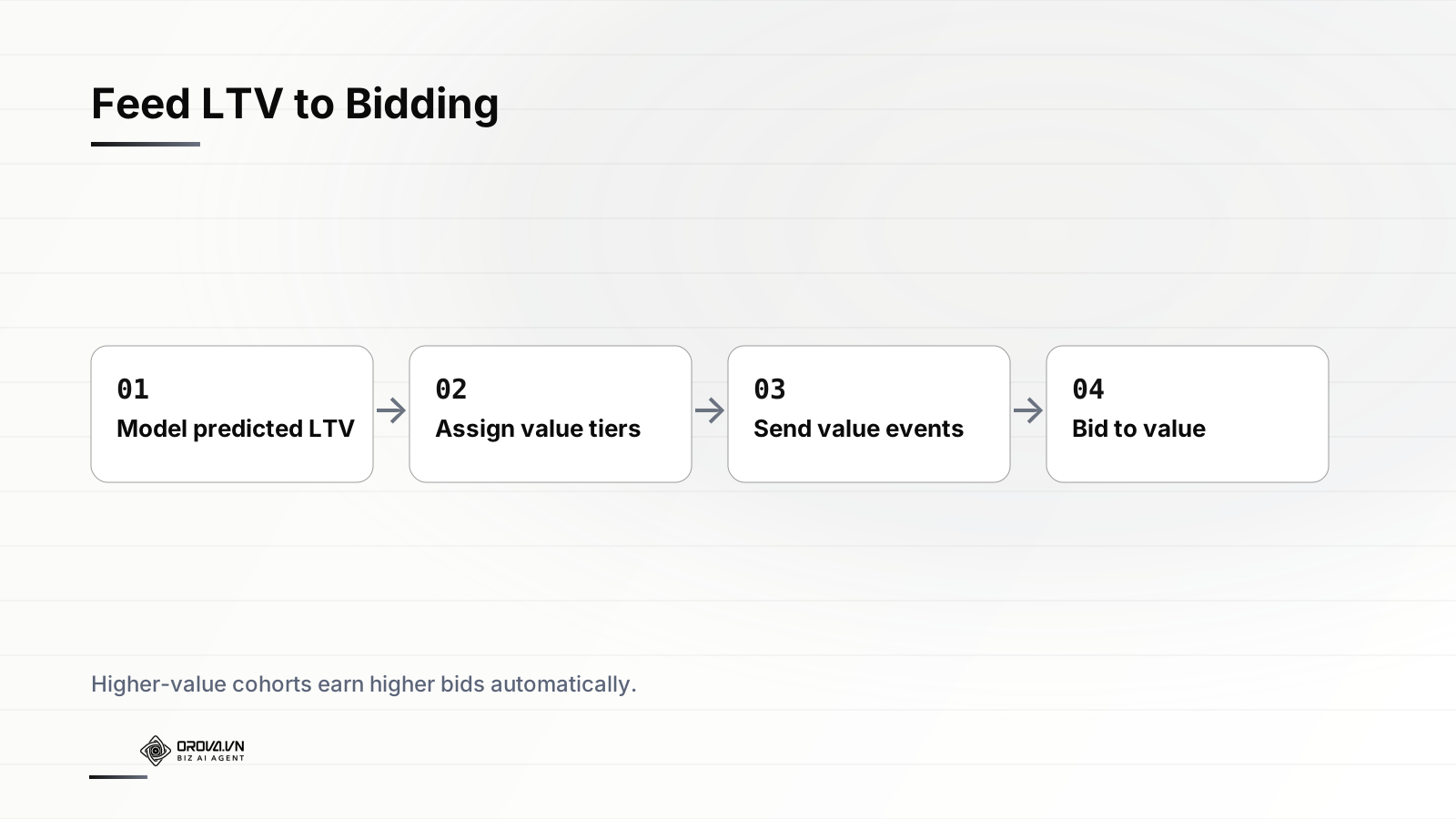
Sending corrected values is necessary but not sufficient. The platforms optimize within their own boundaries, but they do not know your business goals across channels, they cannot read your refund data unless you feed it, and they will happily over-invest in a high-LTV cohort until it saturates and returns collapse. The real work of LTV-based bidding is continuous reallocation: moving budget toward the cohorts and campaigns producing genuine long-term value and pulling it from those that only look good on a first-purchase window.
Building cohort-level visibility
Before you can reallocate, you have to measure value at the level you act on. That means stitching ad spend to realized and predicted LTV per cohort, where a cohort can be a campaign, an audience, a creative theme, or an acquisition month. The diagnostic question is always the same: among customers this campaign acquired, what is their cumulative value over time relative to what we paid to acquire them?
This reframes how you read performance. A campaign at 2.1x first-purchase ROAS that acquires customers reaching 4.5x by month six is a winner you would have killed under first-purchase rules. A campaign at 4.0x first-purchase ROAS whose customers never repeat and refund at 25% is a loser you would have scaled. LTV cohort tracking surfaces both, and it is the only honest way to compare channels with different retention profiles.
Where automation earns its keep
The reason LTV-based bidding stays theoretical at most companies is operational load. Modeling LTV, mapping it to value events, monitoring match rates, watching for cohort decay, recalibrating models, and shifting budget across dozens of campaigns is more than a weekly human review can sustain. The signals also move faster than a weekly cadence: a cohort can saturate, a refund spike can appear, or a value pipeline can silently break in days, not weeks.
This is the natural home for an autonomous optimization layer. A system that ingests your conversion and value data daily can do several things a person cannot do at the same frequency:
- Detect value-pipeline breaks. If offline uploads stop or match rates drop, bidding silently reverts to whatever stale signal remains. Automated monitoring catches the break the same day instead of a month later in a margin report.
- Reallocate toward high-LTV cohorts. When one audience or campaign shows durably stronger lifetime value, the system shifts budget toward it and trims the cohorts whose first-purchase shine fades over time, within guardrails you set.
- Adjust targets as cohorts mature. As realized LTV data confirms or contradicts predictions, target ROAS settings can be raised or lowered per campaign to keep spend aligned with true profitability.
- Catch saturation early. High-LTV pockets are finite. The system watches for the point where pushing more budget into a winning cohort starts dragging incremental value down, and holds spend before efficiency erodes.
The goal of LTV-based bidding is not a clever model. It is a closed loop: predict value, send it to the platform, measure realized value by cohort, and feed that truth back into both the model and the budget, every single day.
A Practical Rollout Sequence
You do not need the full apparatus on day one. The path that works in practice is incremental, with each step validating the next.
- Measure before you bid. Build cohort LTV reporting first, even if you keep bidding to first-purchase value for now. You cannot trust an LTV bidding change you cannot measure.
- Switch to Tier 1 values. Replace first-purchase revenue with historical cohort-average LTV (or margin) as your conversion value. This is the highest-leverage single change and the easiest to ship.
- Fix the value pipeline. Verify click-ID capture, match rates, conversion windows, and CAPI or offline import reliability. A correct value that does not arrive is worthless.
- Add offline value adjustments. Begin uploading refunds and downstream value events so the platform learns from net, post-return outcomes and true downstream conversions.
- Upgrade to predictive scoring. Once Tier 1 is stable and measured, move to individual predicted LTV for finer allocation, and recalibrate on a schedule.
- Automate the loop. Hand the daily monitoring, reallocation, and target adjustment to a system that can run at the cadence the signals demand, with human approval on the moves that matter.
A worked example makes the sequence concrete. Suppose a subscription skincare brand spends $40,000 a month on Meta and reports a 3.0x first-purchase ROAS, which everyone is happy with. They build cohort reporting and discover something uncomfortable: their best-performing prospecting campaign on a first-purchase basis acquires customers who churn after a single box and refund 18% of the time, landing at 1.6x by month four. Meanwhile a campaign they nearly paused, at a mediocre 2.1x first-purchase ROAS, acquires customers who subscribe and reach 5.2x by month four. After switching to Tier 1 cohort-average values and letting the algorithm relearn for three weeks, blended first-purchase ROAS dips to 2.7x while four-month cohort value climbs roughly 35%. On the dashboard it looks like a small step back. In the bank account it is a large step forward. That divergence, short-term metric flat or down, long-term value up, is the signature of LTV bidding working correctly, and it is exactly why you need cohort measurement in place before you make the switch.
Throughout, resist the temptation to judge LTV bidding on short windows. The entire point is that value accrues over months, so a strategy that improves long-term profit will often look flat or slightly worse on a 7-day ROAS chart for the first few weeks while the algorithm relearns and early cohorts mature. Hold the line, measure on the horizon that matches your customer's actual lifetime, and let the cohort data render the verdict.
The Shift in Mindset
Underneath the tooling, LTV-based bidding asks for a different definition of a good campaign. A click is an action. A first purchase is a transaction. A high-LTV customer is a relationship that pays compounding returns. When you bid to the relationship instead of the transaction, you stop competing for the cheapest possible sale and start competing for the customers your competitors are mispricing, the ones who look unremarkable on day one and turn out to be your best accounts on day three hundred.
The brands that win at paid acquisition over the next few years will not be the ones with the lowest cost per acquisition. They will be the ones whose bidding engine understands which acquisitions are worth paying more for, and acts on that understanding fast enough to matter. First-purchase ROAS got you a seat at the auction. Lifetime value tells you what each seat is actually worth.
If you want LTV-based bidding running without building the data pipeline, the monitoring, and the daily reallocation by hand, Orova Ads is an AI agent that manages paid campaigns across Google, Meta, and TikTok for you. It reads your performance and value data every day, recommends the optimizations that shift spend toward your highest-value cohorts, and executes the budget, bid, audience, and on/off changes with human-in-the-loop approval and a full audit log, so you stay in control while the optimization loop runs continuously.
Run your business with AI Agents
Orova is the always-on Biz AI Agent — it plans, runs, and optimizes the work for you. Save time, unlock productivity.
Try it free