
Setting ROAS Targets by Profit Margin, Not Guesswork
Two e-commerce brands run identical Meta campaigns. Both hit a 3x return on ad spend. One is printing money and the other is quietly going broke. The difference has nothing to do with creative, audience, or bidding strategy. It is the margin sitting underneath the revenue. The first brand sells software with a 78% gross margin, so a 3x ROAS leaves a fat cushion after the cost of fulfilling the sale. The second sells consumer electronics with a 22% margin, where 3x ROAS does not even cover the product cost plus the ad spend. Same number on the dashboard, opposite outcomes for the business.
This is the single most common mistake I see when teams set return targets: they borrow a benchmark from a podcast, a competitor, or a "good ROAS is 4x" blog post, and they apply it to a business with completely different economics. A return target copied from someone else's spreadsheet is a guess wearing a suit. The real number you should be chasing is computable, specific to your margins, and it changes the moment your costs or prices move. This article walks through exactly how to derive it, why low-margin businesses need dramatically higher ROAS than high-margin ones, how to translate that into a platform target ROAS (tROAS) setting, and how to keep the target honest as the business evolves.
Why generic ROAS benchmarks are a trap
ROAS is a ratio of revenue to ad spend. A 4x ROAS means every dollar of ad spend produced four dollars of revenue. That sounds healthy until you remember that revenue is the top of the funnel, not the bottom. Out of those four dollars, you still have to pay for the product or service you delivered, the platform fees, the shipping, the returns, and a long tail of variable costs. What is left after all of that is the only money the ad actually contributed to the business.
The reason a universal benchmark cannot exist is that the share of revenue eaten by cost of goods varies enormously across business models. A digital product, a SaaS subscription, or a high-end service might keep 70 to 90 cents of every revenue dollar. A drop-shipped gadget or a grocery item might keep 15 to 25 cents. When you copy a "3x is the goal" rule from a high-margin business into a low-margin one, you are unknowingly setting a target that loses money on every order.
There is a second, subtler problem with benchmarks. Even within one company, different products carry different margins, and treating them all to the same ROAS target distorts where you spend. Your highest-margin SKU can profitably absorb a much lower ROAS, which means you should be willing to spend more aggressively to win those sales. Your thinnest-margin SKU needs a higher ROAS just to break even, so it deserves tighter, more conservative spend. A flat target across the catalog systematically underfunds your best profit drivers and overfunds your worst.
A ROAS target you did not calculate from your own margins is not a target. It is a wish that happens to look like a metric.
The one equation that anchors everything: break-even ROAS
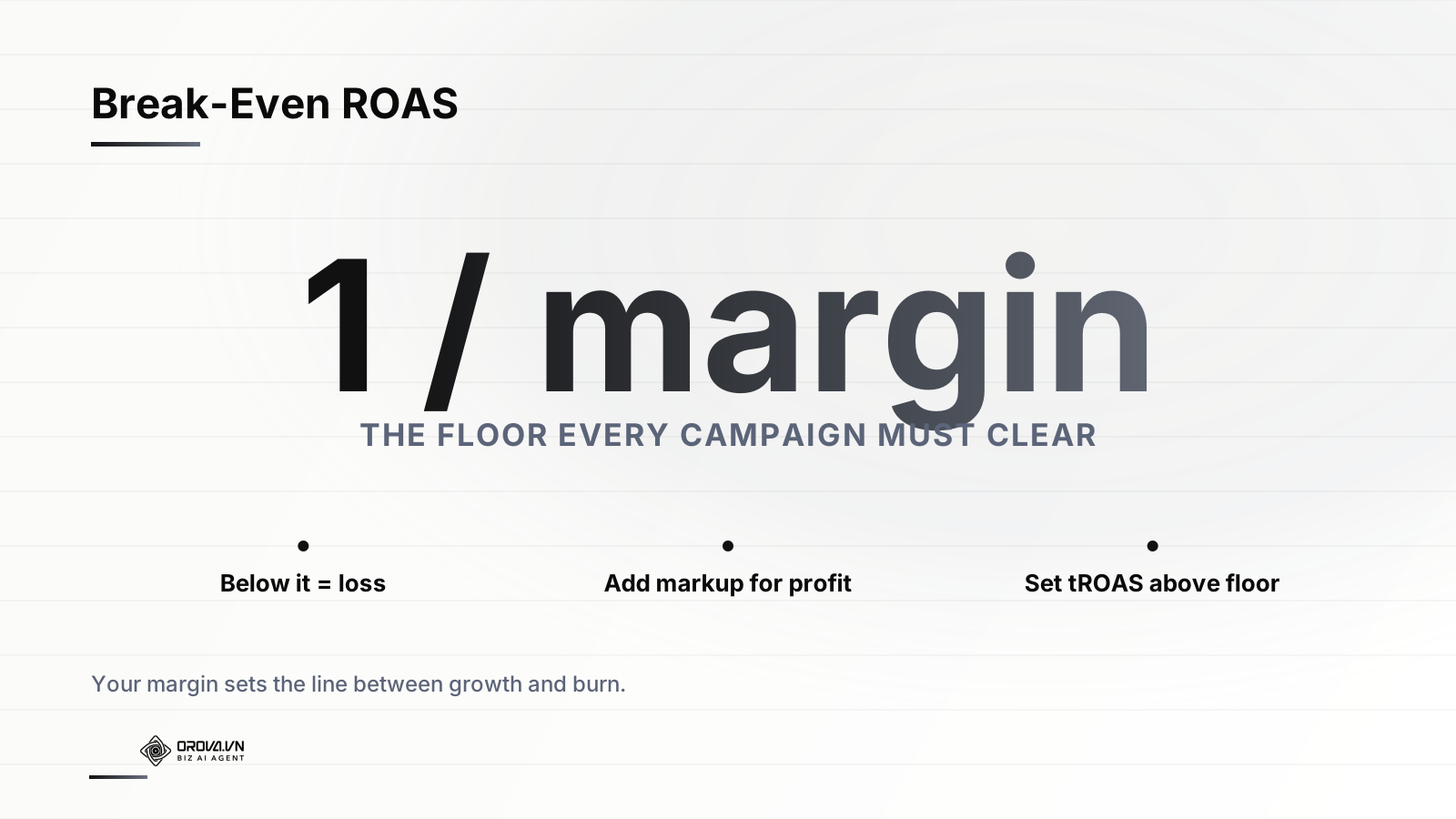
Strip away the jargon and the entire discipline reduces to a single formula. The minimum ROAS that lets a campaign cover its own costs, your break-even point, is the inverse of your gross margin:
Break-even ROAS = 1 / gross margin
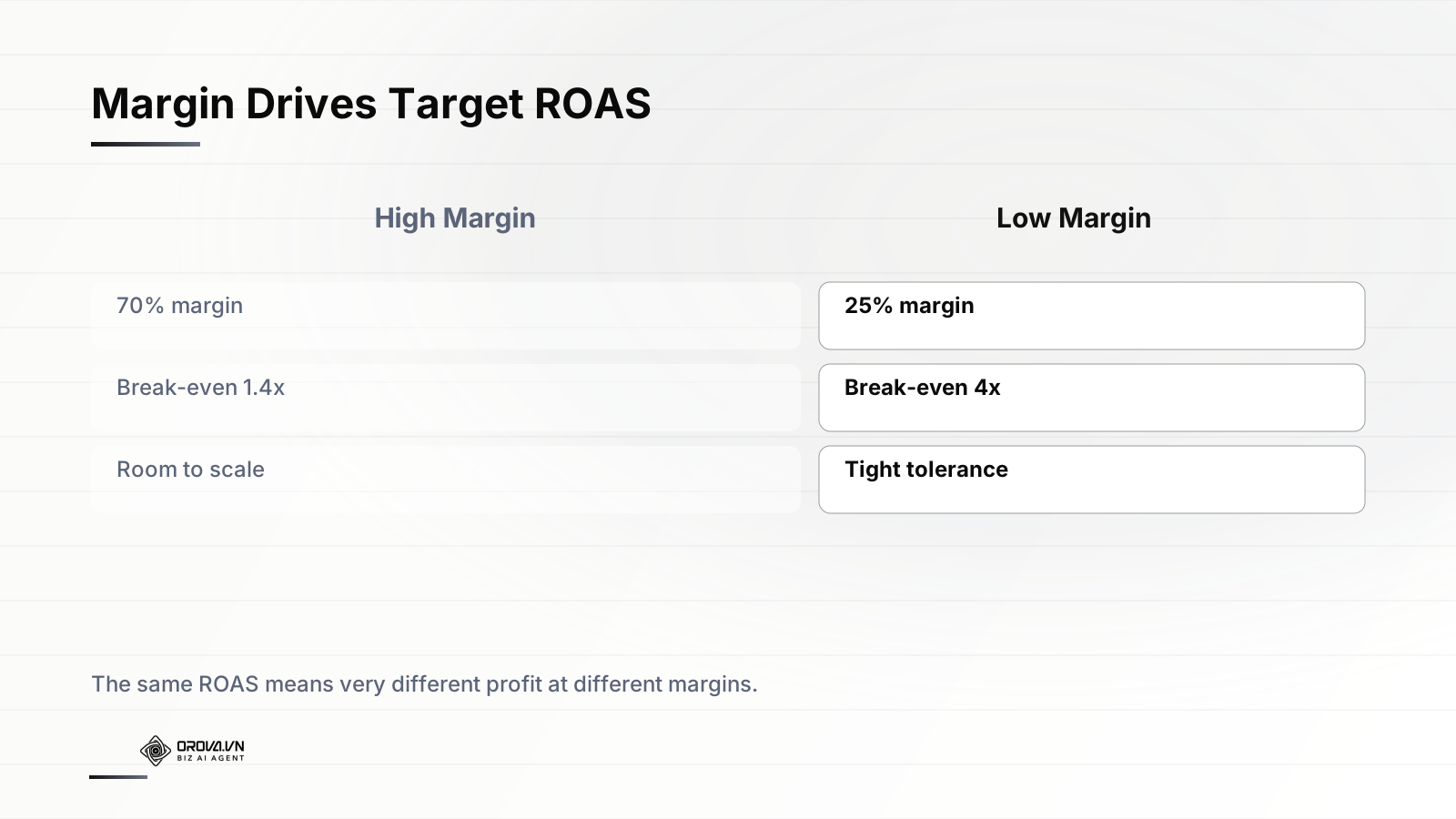
Gross margin here is expressed as a decimal: the fraction of revenue you keep after the direct, variable cost of delivering the product or service. If your gross margin is 50% (0.5), your break-even ROAS is 1 / 0.5 = 2.0x. If your margin is 25% (0.25), your break-even ROAS jumps to 1 / 0.25 = 4.0x. If your margin is 70% (0.7), break-even falls all the way to 1 / 0.7 = roughly 1.43x.
The logic is simple once you see it. Suppose your gross margin is 25%. For every $100 in revenue, you keep $25 to cover everything else, including ad spend. To break even on advertising, the ad spend that generated that $100 in revenue cannot exceed $25. Spend $25 to make $100 and your ROAS is $100 / $25 = 4x. Any ROAS below 4x means you spent more than $25 to capture that $25 of margin, and you are losing money on every order even though the dashboard shows positive revenue.
Working through real numbers
Let me make this concrete with two businesses. Brand A sells a $200 piece of software. The cost to deliver one more license, payment processing, hosting, and support, is about $30. Gross margin is ($200 - $30) / $200 = 85%. Break-even ROAS is 1 / 0.85 = 1.18x. Brand A can run campaigns at a 1.5x or 2x return and still be comfortably profitable, which gives it enormous room to bid aggressively and outspend competitors.
Brand B sells a $200 espresso machine. The unit cost is $120, shipping is $18, and the average return rate adds another $12 of cost per order spread across all sales. Total variable cost is $150, so gross margin is ($200 - $150) / $200 = 25%. Break-even ROAS is 1 / 0.25 = 4x. Brand B must clear a 4x return just to avoid losing money, and it needs something higher to actually earn a profit. If Brand B had copied Brand A's "we run at 1.5x, it's fine" attitude, it would be hemorrhaging cash on every machine sold.
This is the heart of the whole topic: low margins demand high ROAS, and high margins permit low ROAS. The relationship is inverse and it is unforgiving. Halving your margin doubles the ROAS you need just to stand still. This is also why margin-thin categories like fashion, food, and commodity electronics are so brutal to advertise in, and why software, education, and premium services have so much more breathing room.
Getting gross margin right before you trust the formula
The break-even formula is only as good as the margin you feed it. The most frequent source of error is not the equation, it is an inflated, optimistic margin that ignores real costs. If you plug in a 40% margin when your true contribution margin is 28%, you will set a break-even ROAS of 2.5x when reality requires 3.6x, and you will profitably scale a campaign that is actually bleeding.
What belongs in the margin calculation
For advertising decisions, you want contribution margin, the revenue left after every variable cost that scales with each additional sale. Include all of the following:
- Cost of goods sold (COGS): the landed product cost, including manufacturing and inbound freight.
- Payment processing fees: usually 2 to 3% of the transaction, easy to forget but real.
- Outbound shipping and fulfillment: the part you pay, net of any shipping the customer covers.
- Returns and refunds: spread the cost of your return rate across all orders, including restocking and write-offs.
- Marketplace or platform commissions: if you sell through channels that take a cut.
- Variable transaction costs: packaging, inserts, gift wrapping, and anything else that increases with volume.
What to leave out
Do not subtract fixed costs like rent, salaries, software subscriptions, or the ad spend itself when computing the margin you feed into the break-even formula. Those are either fixed regardless of the next sale, or, in the case of ad spend, the exact thing you are sizing against. Mixing fixed overhead into the per-unit margin will make your break-even ROAS unreachably high and you will starve campaigns that are genuinely profitable at the contribution level. Overhead gets covered by the aggregate contribution margin across all sales, not by loading it onto each individual order's ROAS target.
One nuance worth flagging: if you operate a subscription or repeat-purchase model, the margin on the first order understates the true economics, because the lifetime value of the customer includes future purchases at near-zero acquisition cost. In those businesses, you may deliberately accept a first-order ROAS below break-even because the second and third orders make the relationship profitable. That is a legitimate strategy, but it must be a conscious decision based on measured repeat rates, not an excuse to ignore the math. If you are unsure whether to optimize for the immediate sale or the longer relationship, it is worth thinking through whether cost per acquisition or ROAS is the better metric for your goals before you lock a target.
From break-even to a target you can actually run
Break-even ROAS is the floor, not the goal. Running at exactly break-even means advertising contributes zero profit, which is pointless. You advertise to make money, so you need a target ROAS above the floor that bakes in the profit you want the channel to generate, plus a margin of safety for the costs the simple formula does not capture.
Layering profit on top of the floor
Decide how much of your contribution margin you are willing to spend on acquisition versus how much you want to keep as profit. A common framework: if you want advertising to deliver, say, a 30% profit margin on the revenue it generates after ad cost, you work backward from the break-even floor. Suppose your margin is 40%, so break-even ROAS is 2.5x. If you want to keep half of your contribution margin as profit and spend the other half on ads, your target ROAS roughly doubles the floor to 5x. The exact multiplier depends on how aggressively you want to grow versus how much you want to bank, but the principle is constant: target ROAS is always break-even plus a deliberate profit buffer.
Why aggressive growth deliberately accepts a lower target
There is a strategic reason a healthy business might run closer to break-even on purpose. When you are capturing market share, defending against a competitor, or feeding a retention engine that monetizes customers over months, a lower ROAS target means more volume. Every business has to decide where it sits on the spectrum between maximum profit per order and maximum total profit. Setting tROAS very high maximizes the efficiency of each dollar but caps your scale, because the platform will only spend where it can hit that demanding number. Setting it just above break-even unlocks far more volume at thinner per-order profit. Neither is wrong; what is wrong is doing it by accident because you never calculated where break-even actually is.
Translating your target into platform settings
Once you have a margin-derived target ROAS, the platforms make it easy to enforce, at least mechanically. Both Google and Meta offer bidding strategies that let you specify a target ROAS, often labeled tROAS, and the algorithm then tries to find conversions that meet or exceed that return. The trick is feeding the platform the right number and the right conversion value.
Setting tROAS in Google Ads
In Google Ads, Target ROAS is available on Search, Shopping, Performance Max, and Display campaigns that have enough conversion history. You enter the target as a percentage: a 4x target is entered as 400%. The platform uses your conversion value data to bid up or down on each auction so that, on average, the campaign returns the target ratio. Critically, this only works if your conversion values are accurate. If you are passing static, generic conversion values instead of real order revenue, the algorithm is optimizing against fiction. Make sure dynamic, transaction-specific revenue flows into your conversion tracking before you trust tROAS.
Setting target ROAS in Meta
Meta offers a ROAS goal within its value optimization bidding. To use it, you must send purchase events with accurate value parameters through the Conversions API or pixel. You then set a minimum ROAS goal, and Meta optimizes delivery toward higher-value conversions that hit that bar. The same caveat applies even more forcefully on Meta, where value data quality is often weaker. If your purchase values are unreliable, a ROAS goal can choke delivery or chase the wrong customers. Start with a target slightly above break-even, give the campaign enough conversions to learn, then tighten toward your profit target.
Practical cautions when enforcing a target
- Give the algorithm room to learn. Setting a tROAS far above what the campaign can realistically achieve will simply throttle spend to near zero. Start achievable, then ratchet up.
- Account for the gap between reported and true ROAS. Platform-reported ROAS often overstates reality due to attribution windows and view-through credit. If you know your platform tends to over-report by 20%, set your in-platform target 20% higher than your true margin-derived number.
- Remember tROAS is an average, not a floor. A 4x target means the campaign averages 4x; individual conversions will land above and below. If your true break-even is 4x, set the platform target above 4x so the average leaves profit.
- Feed accurate, dynamic conversion values. Every ROAS bidding strategy is only as good as the revenue data behind it. Garbage values produce confident, profitable-looking nonsense.
Keeping targets honest as the business changes
Margins are not static, and neither should your ROAS targets be. The moment your supplier raises prices, your shipping carrier adds a surcharge, your return rate creeps up, or you run a promotion that cuts your effective selling price, your real margin shifts and your break-even ROAS moves with it. A target you calculated in January can be quietly wrong by March, and a campaign that looks profitable on the dashboard can be losing money because the underlying margin eroded while the target stayed frozen.
The discount trap
Promotions deserve special attention because they hit margin twice. A 20% discount does not reduce your margin by 20 percentage points; it reduces your selling price, which compresses margin far more sharply because your costs stay fixed. Take a product sold at $100 with $60 of cost, a 40% margin and a 2.5x break-even ROAS. Discount it to $80 and your margin collapses to ($80 - $60) / $80 = 25%, pushing break-even ROAS up to 4x. If you run a sale and keep the same 2.5x target, you will scale a campaign that is now well underwater. Every promotional period needs a recalculated, temporary break-even ROAS.
The seasonal and mix shift problem
If your product mix shifts, say a low-margin accessory starts dominating your sales during a holiday push, your blended margin drops even if no individual product's margin changed. A single campaign-wide ROAS target cannot see this. The cleaner approach is to segment campaigns or product groups by margin tier and assign each its own target derived from that tier's true margin. High-margin products get aggressive, low-target campaigns that scale; low-margin products get conservative, high-target campaigns that protect profit.
Build a margin-to-target routine
Practically, you want a lightweight recurring process:
- Recompute true contribution margin per product or product group monthly, or immediately after any cost or price change.
- Convert each margin into a break-even ROAS using 1 / margin.
- Layer on your profit buffer to get a target ROAS for each group.
- Update the platform tROAS settings, adjusting upward for known reporting inflation.
- During any promotion, swap in the discounted-price break-even before the sale goes live, and swap it back after.
Done by hand, this is tedious and easy to neglect, which is exactly why so many accounts drift onto stale targets. The math is trivial; the discipline of doing it consistently across dozens of product groups, every time a cost moves, is where teams fall down.
Common objections and edge cases
Whenever I lay out the margin-first approach, a few objections come up reliably. They are worth addressing directly, because each one contains a grain of truth that, taken too far, leads people back to guesswork.
"My margins are too messy to pin down a single number."
This is real for businesses with hundreds of SKUs at varying cost structures. The answer is not to give up and use a benchmark; it is to group products into a handful of margin bands. You rarely need a precise margin for every individual item. Three or four tiers, high, medium, low, and clearance, are enough to assign sensible break-even ROAS targets that are far more accurate than one blended number applied to everything. Even a rough banding beats a borrowed benchmark, because it at least respects the direction of the relationship between margin and required return.
"Attribution makes my real ROAS unknowable, so why bother with precise targets?"
Attribution is genuinely imperfect, but that argues for more rigor, not less. If you accept that platform-reported ROAS overstates reality, you simply discount it by a measured factor before comparing it to your margin-derived floor. Run periodic incrementality or holdout tests to estimate how much the platforms over-credit themselves, then bake that haircut into your in-platform targets. The margin floor is the one number in this whole exercise that attribution cannot distort, because it comes from your own accounting, not the ad platform. That makes it the most trustworthy anchor you have.
"We need to grow, so profit targets feel premature."
Growth and margin discipline are not opposites. Knowing your break-even ROAS is what lets you grow responsibly. It tells you exactly how far below your profit target you can push before each new customer costs you money, and it lets you make that trade-off on purpose rather than discovering it in a year-end loss. The fastest-growing brands I have worked with were not the ones ignoring margin; they were the ones who knew their floor precisely enough to spend right up to the edge of it without falling over.
Where automation earns its keep
This is precisely the kind of work that benefits from an always-on system rather than a quarterly spreadsheet review. The break-even formula never changes, but the inputs do, constantly, across every campaign and product group. A system that reads your margin data and your campaign performance every day can flag the moment a campaign's actual ROAS drops below the break-even your current margins require, instead of letting it bleed unnoticed until the monthly report. It can hold each campaign to a margin-aware target rather than a blanket benchmark, raise targets automatically when a promotion compresses margin, and relax them when you have room to scale your highest-margin products.
The advantage of enforcing margin-aware targets continuously is not just catching losses faster. It is being able to spend more confidently where the math says you can. When a high-margin product can profitably absorb a 1.5x ROAS, an automated system can push budget there aggressively while simultaneously throttling a thin-margin line that has slipped below its 4x floor, all in the same account, on the same day. That kind of per-product, margin-sensitive allocation is nearly impossible to maintain manually at scale, and it is where most of the profit hides.
If you would rather have an AI agent enforce margin-derived ROAS targets across Google, Meta, and TikTok than rebuild a spreadsheet every month, take a look at Orova Ads. It reads your campaign data daily, recommends and executes the budget, bid, audience, and on/off changes needed to hold each campaign to a profit-first target, and keeps a human in the loop with approvals and full audit logs so nothing moves without your sign-off. Set the target your margins actually require, and let the agent do the daily enforcement.
Run your business with AI Agents
Orova is the always-on Biz AI Agent — it plans, runs, and optimizes the work for you. Save time, unlock productivity.
Try it free