
Ad Testing Strategy: A Repeatable Process for Winning Ads
You are pouring the same budget into ads every month, and the results still swing wildly for no reason you can point to. Some months the cost per customer looks fine, other months it quietly creeps up, and when you ask your team why, the answer is usually a shrug or "the algorithm is just doing its thing this month." Meanwhile the bidding and targeting are handled automatically by the ad platform itself, so that is not where the difference is coming from. What is actually driving the gap between accounts that perform and accounts that drain money is ad creative testing: whether you are deliberately trying out different ad concepts to see what actually works, or just uploading whatever the design team sent this month and hoping.
Most businesses "test" creative by throwing a few ad versions into a group and checking back later to see which one has more clicks. That is not a real test, it is a guess dressed up as a process. It tells you nothing about why one ad worked, whether the winner will keep winning next month, or which specific part of the ad, the image, the headline, the offer, actually made the difference. Without a structured approach, you end up repeating the same lucky-guess cycle every month instead of building on what you learn.
This article walks through a repeatable way to test ad creative so results stop depending on luck. By the end, you will know how to set up a real test instead of a coin flip, how to fund it so the results actually mean something, and how to build an ongoing rhythm of testing that keeps improving your numbers instead of resetting to zero every campaign.
Why Creative Is the Last Real Lever
It helps to be precise about what the machine has taken over, because that defines what is left for you. On Meta, Google and TikTok, the auction and the delivery system now do an enormous amount of the work that media buyers used to do by hand. When you choose a cost-per-action goal, the system decides in real time how much to bid for each impression based on its prediction of conversion probability. When you set broad targeting, the system finds the people most likely to act, often outperforming the hand-built audiences buyers labored over a few years ago. Placements, devices, time of day, the order in which it shows your ads, all of it is optimized by a model you do not control and cannot fully see.
What you feed that model is the creative, and the creative is the single largest input the model cannot generate for you. The algorithm can decide who sees your ad and how much to pay for the impression, but it cannot decide what the ad says, what it shows, what emotion it triggers in the first 1.5 seconds, or what promise it makes. Those decisions belong to humans, and they move performance more than anything else still on the table. In account after account, the gap between the best-performing creative and the median is two to four times on cost per acquisition. No bid adjustment you are allowed to make produces a swing that large.
The economics of a creative edge
Consider what a creative edge is actually worth. If your account spends $50,000 a month and your average cost per acquisition is $40, you are buying 1,250 conversions. Suppose a disciplined testing program shifts more of your spend onto winning creative and pulls your blended CPA down to $32, a 20 percent improvement that is entirely realistic over a quarter. You are now buying 1,562 conversions for the same money. That is 312 extra customers a month, roughly 3,750 a year, with no budget increase and no new platform. The cost of producing the test creative that got you there might be $8,000 over the quarter. The return on that production spend is not measured in percentages; it is measured in multiples.
This is why the framing matters. When creative testing is an afterthought, it competes with other priorities for attention and usually loses. When you accept that creative is the number one lever left after the machines took the rest, testing stops being a chore you do when you have time and becomes the core operating discipline of the account.
Start With a Hypothesis, Not an Ad
The most common failure in creative testing is starting from assets instead of ideas. A designer makes five ads, you run them against each other, one wins, and you have learned almost nothing transferable. Why did it win? Was it the headline, the opening shot, the offer framing, the format, the music, the person on screen? You cannot say, because you changed everything at once. Next month you start from scratch.
A hypothesis-led approach inverts this. You begin with a claim about your audience that the test can prove or disprove. Good hypotheses sound like sentences, not adjectives:
- "Buyers in our category care more about time saved than money saved, so a creative that leads with hours-per-week reclaimed will beat one that leads with discount."
- "Our audience does not believe generic ROI claims, so showing a real customer's dashboard will outperform a stock testimonial."
- "The first frame determines everything on TikTok, so opening on a person mid-sentence will beat opening on a logo."
- "Skeptical B2B buyers respond to specificity, so a headline with a precise number will beat a round number."
Each of these is a bet about how your particular customers think. When you test it, you do not just learn which ad won; you learn whether the underlying belief is true. And beliefs transfer. If "time saved beats money saved" proves out, that insight shapes your landing pages, your email subject lines, your sales scripts and your next twenty creatives. The ad was disposable. The insight compounds.
Concepts versus iterations
It helps to distinguish two kinds of tests, because they answer different questions and deserve different budgets. A concept test asks whether an entirely new angle works at all: a new value proposition, a new format, a new emotional register. These are high-variance bets, and most of them fail, which is exactly why you run them small and frequently. An iteration test takes a concept that already works and tries to make it better: a sharper hook on a proven format, a different first frame on a winning video, a tighter headline on a strong static. Iterations are lower-variance and they are where you spend most of your testing budget once you have found a vein, because polishing a winner is far more reliable than discovering a new one.
A healthy account runs both. The rough split many practitioners settle on is something like 70 percent of test budget on iterating proven winners and 30 percent on swinging for new concepts. The exact ratio matters less than the principle: you need a steady supply of new concepts to refresh the account, and you need disciplined iteration to extract full value from the concepts that hit.
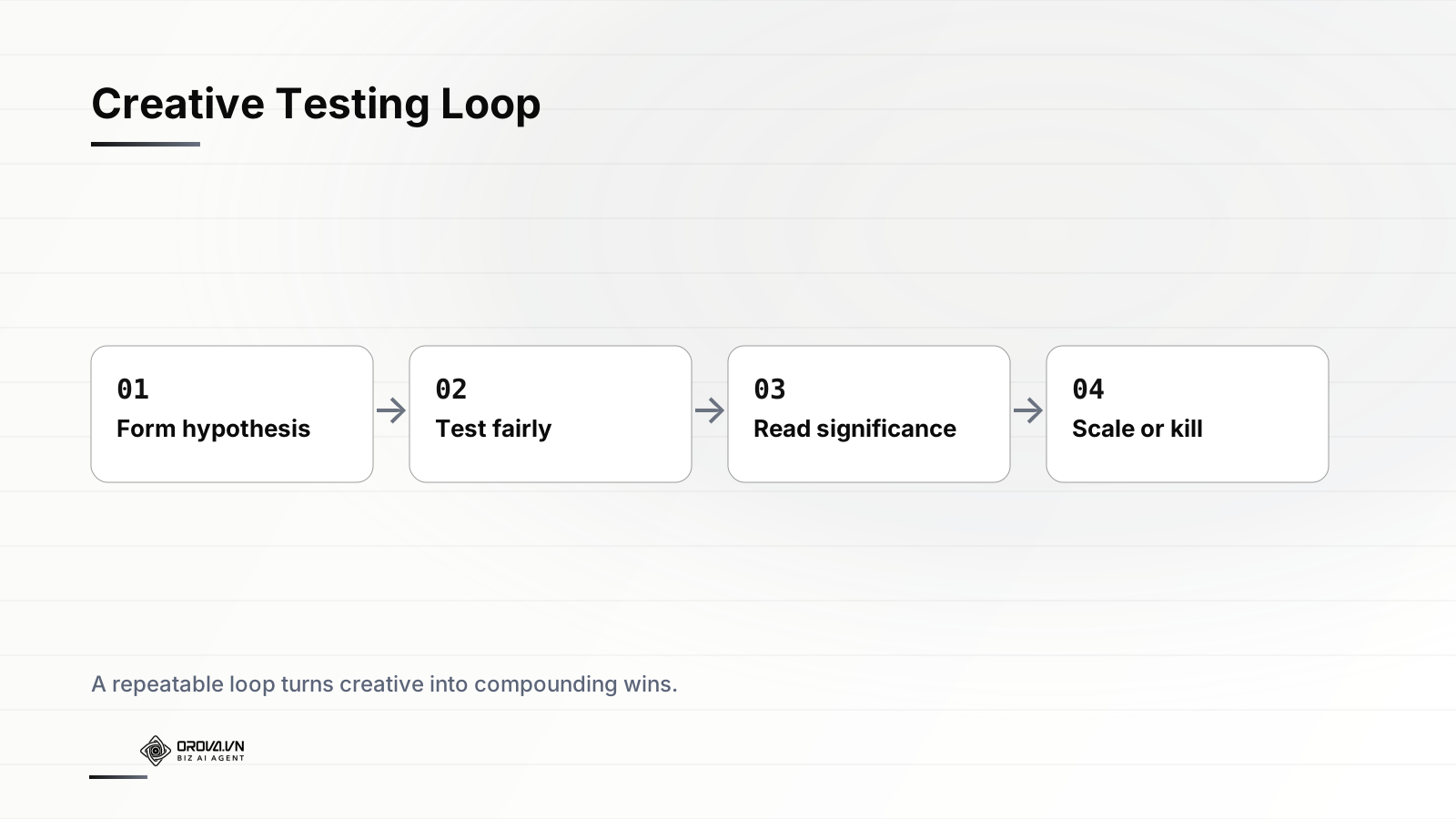
Isolate the Variable You Are Actually Testing
If a hypothesis is the soul of a test, variable isolation is the body. The whole point of testing is to attribute a result to a cause, and you can only do that if exactly one thing differs between the versions you compare. This sounds obvious and is violated constantly, because changing one thing is slower and less fun than changing five.
Suppose your hypothesis is about the hook. The clean test holds everything else constant, the same body footage, the same call to action, the same format, the same audience, and varies only the first three seconds. If version A opens on a problem and version B opens on the outcome, and A wins by a meaningful margin, you have learned something you can use: lead with the problem. If instead you also changed the music, the captions and the offer, you have a winner but no knowledge.
Where to draw the line on isolation
Strict isolation has a cost. Testing one variable at a time is slow, and creative has many variables, so a purist approach can take quarters to work through a single concept. There are two pragmatic responses. The first is to prioritize ruthlessly: test the variables you believe move performance most, which is almost always the hook and the core message, and stop sweating the ones that rarely matter, like which of two similar background colors performs better. The second is to use the platform's own multivariate machinery deliberately. If you genuinely want to find the best combination of three hooks and three bodies, you can run all nine and let the system tell you which combination delivers, accepting that you are optimizing for the best combination rather than learning the isolated effect of each part. That is a legitimate strategy as long as you choose it on purpose and do not confuse it with a clean A/B read.
The cardinal sin is the accidental confound: changing two things because you were in a hurry, then drawing a confident conclusion from a dirty comparison. Every conclusion you store as "knowledge about our audience" should be earned from a test where you knew, before it ran, exactly what a win would prove.
Fund the Test Fairly
A test that is starved of budget is worse than no test, because it produces a number that looks like a result and is actually noise. This is where most testing programs quietly fail. The team runs four creatives in a single ad set with a $40 daily budget, the algorithm immediately funnels almost all of that spend to whichever creative caught an early lucky conversion, the other three never get enough impressions to prove themselves, and a week later someone declares a winner based on three conversions versus zero. That is not a fair test. That is the delivery system's exploration bias masquerading as a verdict.
Fairness in creative testing means two things: each contender gets enough budget to reach a meaningful sample, and the budget is allocated in a way that does not pre-decide the outcome.
Give each contender enough volume
The blunt rule is that a creative needs enough conversions, not enough impressions or clicks, before you trust its cost per acquisition. Conversions are what you are paying for and what you are comparing, and they are the scarce, high-variance number. Many practitioners will not call a creative test until each contender has produced at least 50 conversions, and they are more comfortable at 100. Below that, a single fluky day can flip the ranking. Work backward from this: if your target CPA is $25 and you want 50 conversions per creative to read it, each creative needs roughly $1,250 of spend. Four creatives is $5,000 of test budget for one round. If your account cannot support that, you should test fewer creatives at a time, not give each one a tenth of the budget it needs and pretend the result means something.
Stop the algorithm from picking the winner before you do
The second fairness problem is structural. When you put several creatives in one ad set and let the system optimize, it does its job, which is to spend money where it predicts the best return, and it makes that prediction on tiny early samples. The result is that the creative that happened to convert first gets fed, and its rivals get starved before they have a chance. To run a fair test you either give each creative its own ad set with its own budget so the system cannot rob Peter to pay Paul, or you use the platform's dedicated experiment tool that splits the audience and budget evenly by design. Both approaches cost more discipline than dumping everything in one ad set, and both produce results you can actually believe.
Read Significance Like an Adult
The moment a test produces a leader, the temptation is to declare victory and move on. Resist it. Early leads in advertising tests are mostly noise, and acting on noise is how teams convince themselves of false lessons that pollute every decision afterward.
You do not need a statistics degree to read a test responsibly, but you do need three habits. First, look at confidence, not just the point estimate. Platforms increasingly report a probability that one variant beats another, and a serious read waits for that probability to clear a threshold you set in advance, commonly 80 to 95 percent, before acting. A creative that is "winning" at 60 percent confidence is, in plain terms, barely better than a guess. Second, respect sample size over elapsed time. A test is ready when each contender has enough conversions, not when a week has passed. Third, and most important, decide your stopping rule before you launch. Peeking at a test repeatedly and stopping the instant it crosses your threshold inflates your false-positive rate dramatically, because with enough peeks random noise will eventually wander across any line. Commit to a sample size or a fixed window up front and honor it.
The goal of reading significance is not to be right about this one ad. It is to make sure the lessons you carry forward are real, because those lessons compound across hundreds of future decisions.
Practical significance versus statistical significance
There is a second question beyond "is the difference real?" and it is "is the difference big enough to matter?" A test can be statistically significant and commercially irrelevant: with enough volume you can prove that creative A's CPA is genuinely 2 percent lower than creative B's, but a 2 percent edge does not justify the operational cost of swapping out a whole campaign, and it will be swallowed by creative fatigue within weeks anyway. Set a minimum effect size you care about, perhaps a 15 or 20 percent improvement, and treat smaller-but-real differences as ties. This keeps you focused on creative that moves the account, not creative that wins a rounding error.
Build a Cadence, Not a Campaign
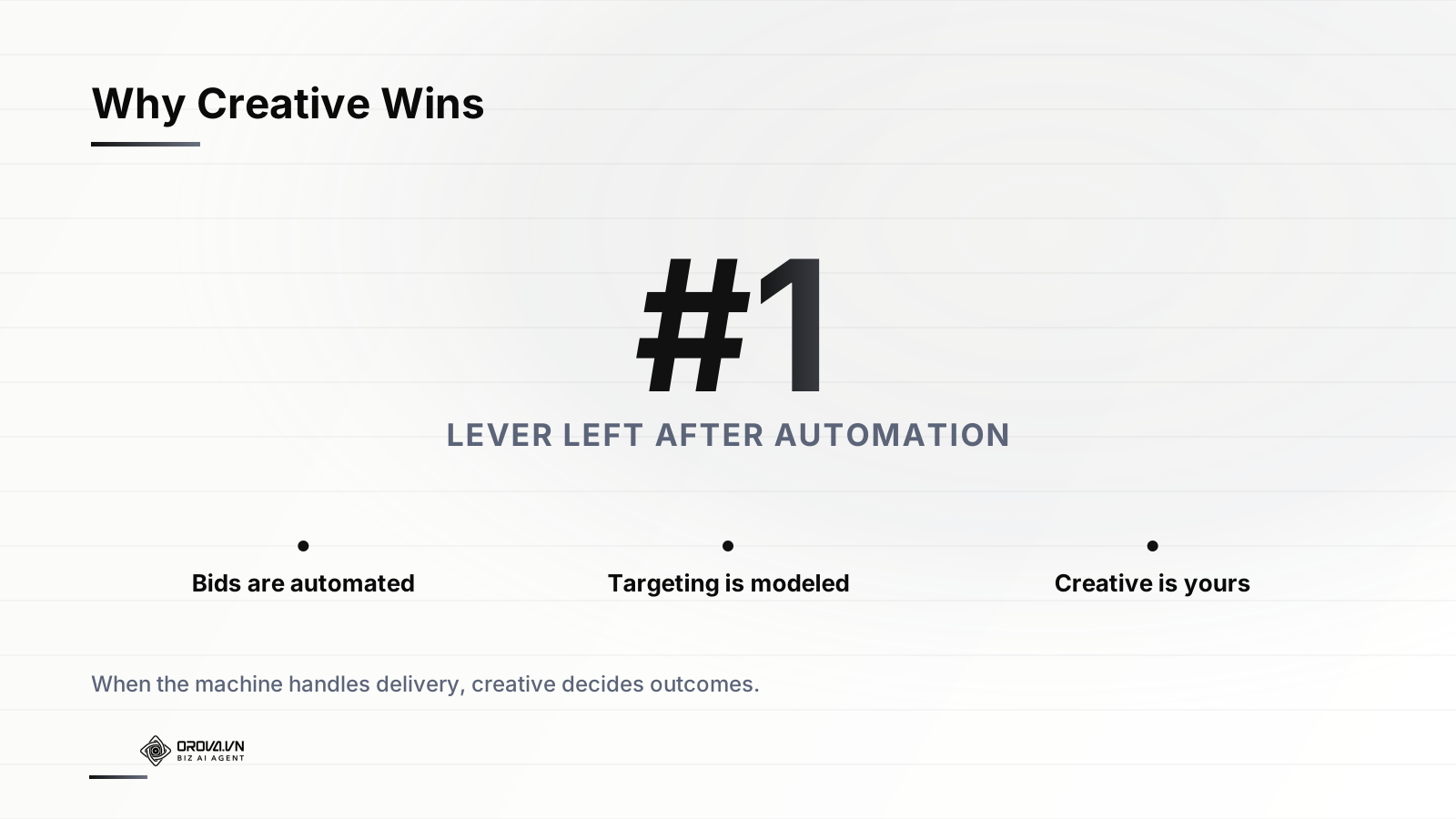
Everything above describes a single test. The strategy is what happens when you run tests continuously, on a rhythm, so that the account always has fresh winners entering as old ones fatigue. Creative does not last. Even an excellent ad decays as your audience sees it repeatedly, frequency climbs, response falls, and the winner you celebrated last month becomes the underperformer dragging this month's numbers. A testing cadence is your defense against that decay: a pipeline that produces new contenders fast enough to replace winners before they collapse.
What a weekly rhythm looks like
A workable cadence for a mid-sized account might run on a weekly clock. Early in the week you review last week's tests, declare winners that cleared your confidence and effect-size thresholds, and kill the rest without ceremony. You promote the new winners into the scaling campaign and document what each one proved about the audience. Mid-week you brief the next batch of creative against fresh hypotheses, drawing on the insights the account has accumulated. By the end of the week the new batch is built and launched into the test structure, and the loop begins again. The exact tempo depends on your budget and your conversion volume, since you cannot test faster than your account can generate the conversions to read tests, but the principle holds at every scale: testing is a standing process with a heartbeat, not an event you schedule when results dip.
Separate the testing structure from the scaling structure
Operationally, the cleanest accounts keep testing and scaling in separate campaigns. The testing campaign exists to produce fair reads on new creative at controlled budgets. The scaling campaign exists to pour money into proven winners with stable delivery. Mixing them corrupts both: you cannot read a fair test inside a campaign that is also trying to maximize spend on a known winner, and you do not want your reliable scaling campaign re-entering the learning phase every time you slot in an unproven ad. Once a creative graduates from the test structure, the discipline of moving it into scaling without disrupting the system the platform has already learned is its own skill, and it is worth getting right, since a clumsy promotion can reset the very performance you fought to find. We cover that handoff in depth in our guide to scaling winners without breaking learning, which pairs naturally with this one.
Where the AI Agent Fits, and Where It Does Not
It would be easy to read all this as an argument for more human labor, and partly it is, because the ideas, the hypotheses and the actual creative still come from people. But the operational burden of running a disciplined testing program at scale, monitoring dozens of contenders, catching fatigue early, promoting winners cleanly, killing losers without sentiment, is enormous, and it is exactly the kind of work that drowns teams and causes the discipline to slip. This is where an automated layer earns its place.
What the machine does well
The machine is excellent at vigilance and at execution. It can watch every active creative every day and flag the moment frequency climbs and cost per acquisition starts drifting, surfacing fatigue weeks before a human scanning a dashboard would notice. It can track each test against its predefined sample-size and confidence thresholds and tell you the instant a read is ready, rather than letting a winner sit untested or a loser bleed budget. It can promote a graduated winner into the scaling campaign and reallocate budget away from a decaying ad in seconds. None of this requires creativity; all of it requires consistency, and consistency is precisely what humans are worst at sustaining over months.
What stays with the human
What the machine cannot and should not do is invent the creative or decide what to believe about your customers. The hypothesis that "buyers care more about time than money" is a human insight, drawn from talking to customers and reading the market. The video that proves it is made by a human. The judgment that a statistically real 3 percent edge is not worth acting on is a human call about your business. The right division of labor is clear once you name it: humans create and decide, the machine watches and executes. That is the model behind Orova Ads, and it is also just good practice regardless of what tools you use. Keep the strategy in human hands. Hand the relentless, repetitive operational work to something that never gets tired or sentimental.
A Practical Starting Sequence
If your account does not yet have a testing strategy, you do not need to overhaul everything at once. Build the habit in order:
- Write down three hypotheses about your customers. Real sentences, not adjectives. These are the bets your first tests will settle.
- Pick the highest-leverage variable to test first. For almost every account that is the hook or the core message, not colors or button copy.
- Decide your fairness rules before you launch. How many conversions per contender, what confidence threshold, what minimum effect size counts as a win, and what your stopping rule is.
- Separate testing from scaling. One campaign to find winners fairly, one to scale them reliably.
- Set a cadence and protect it. A standing weekly rhythm of review, brief, build, launch. The cadence is the strategy; a single brilliant ad is luck.
- Document every insight. When a test proves a hypothesis, write the lesson somewhere durable. That growing library of what is true about your audience is the real asset you are building, worth far more than any individual ad.
Do this for a quarter and the change in how the account feels is unmistakable. You stop guessing. You stop relearning the same lessons. Every round of creative starts from a stronger base than the last, because you actually know more than you did a month ago. The wins compound, not because any single ad was a masterpiece, but because the system that produced it gets smarter every week. That is what it means to treat creative testing as a strategy rather than an afterthought: not working harder on ads, but building a machine for learning that pays off long after any individual creative has fatigued and died.
A related read: TikTok Creative Hooks: The First Three Seconds That Decide Your CPA examines the opening seconds that decide whether a TikTok ad gets watched at all.
If you want the relentless operational half of that machine handled for you, watching every creative for fatigue, catching tests the moment they reach significance, and promoting winners and reallocating budget across Google, Meta and TikTok automatically, while you keep full control through human-in-the-loop approval and a complete audit log of every change, see how Orova Ads runs the daily grind so your team can spend its time where it matters: forming sharper hypotheses and making better creative.
Let the Testing Run Itself
Doing this properly by hand takes real time every single month: coming up with new creative angles, setting up clean tests, waiting for enough data, reading the results correctly instead of jumping to conclusions, and then doing it all again next cycle. Most business owners do not have a spare person whose whole job is running this loop with discipline, so it either gets skipped or done halfway.
Orova Ads is built to take over the repetitive parts of this process, so the structure and discipline happen automatically instead of depending on someone remembering to do it right every month. If you would rather have this running quietly in the background than manage it by hand, it is worth taking a look.
Orova Ads optimises campaigns for you
Connect Google, Meta and TikTok in one place. AI reads the numbers, proposes changes and executes under the rules you set.
Explore Orova Ads