
Scaling Winning Campaigns Without Breaking Learning
A media buyer I worked with once turned a single Meta campaign from $80 a day to $600 a day over a weekend because the numbers looked unbeatable: a $9 cost per acquisition, a 4.1 return on ad spend, and a conversion rate that had held steady for nine days. By Tuesday the same campaign was producing a $31 cost per acquisition and the algorithm had quietly slipped back into a fresh learning phase. Nothing about the offer, the creative, or the audience had changed. The only thing that changed was how fast the budget moved. That weekend cost roughly $1,400 in wasted spend and, worse, a week of momentum.
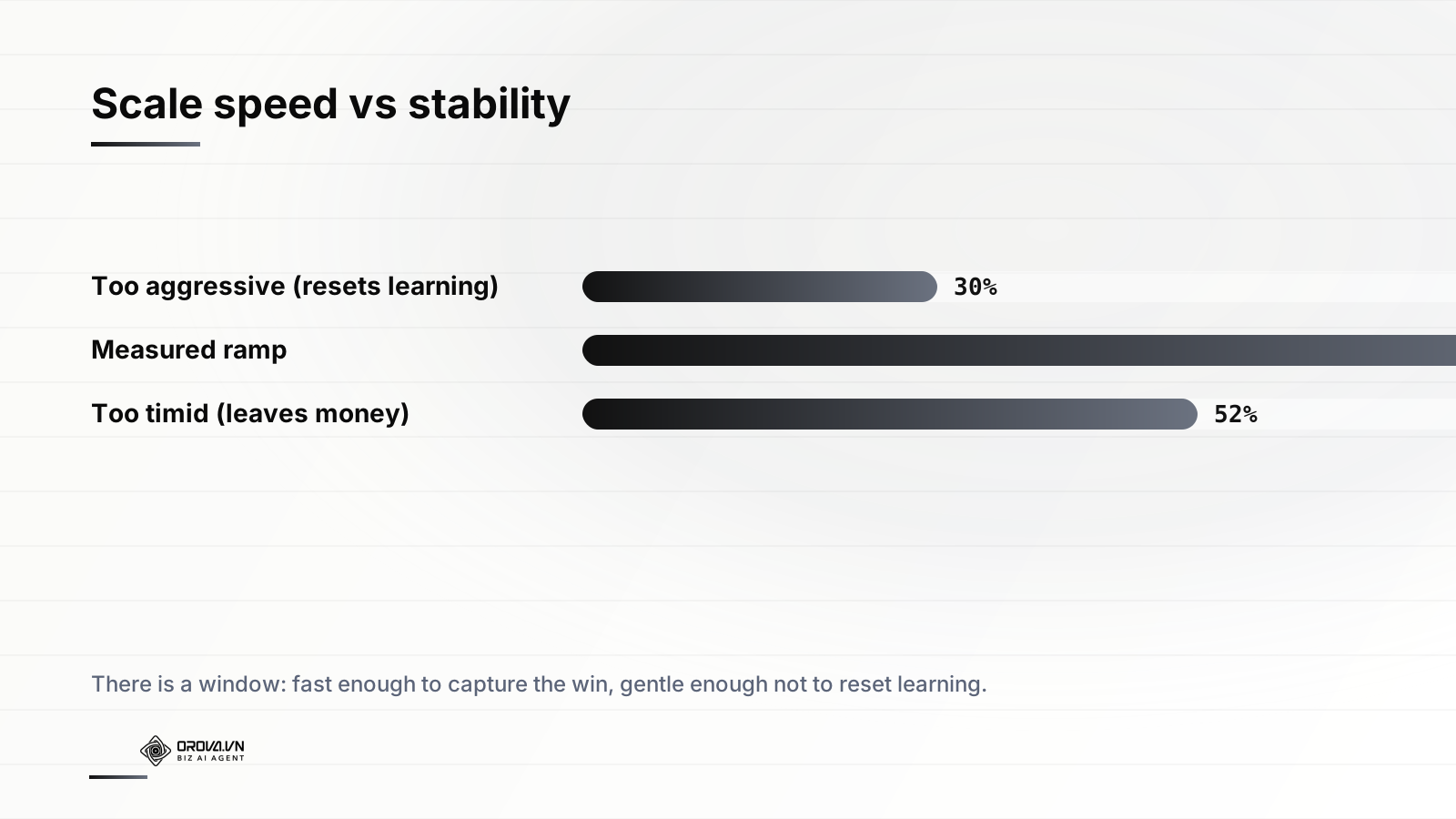
This is the trap nobody warns you about. Finding a winning campaign is hard, but it is a problem of patience and testing. Scaling a winner is a different kind of problem entirely: it is a problem of restraint. The instinct, once you see profit, is to pour fuel on the fire. The reality is that the systems running Google, Meta, and TikTok ads are statistical engines that punish sudden change. Push too hard and you reset the very stability that made the campaign profitable. Push too timidly and you leave real money on the table while a competitor scales into the same demand. The skill is finding the narrow window in between.
What the learning phase actually is
Every major ad platform runs an optimization model that decides, auction by auction, which impression to buy for which person at which price. That model is not magic; it is a prediction system that needs data to calibrate. When a campaign or ad set is new — or when something material about it changes — the platform enters what it openly calls the "learning phase." During this period it is deliberately exploring: testing different audience segments, placements, times of day, and bid levels to figure out where your conversions actually come from.
The learning phase is expensive by design. Performance is typically unstable and often worse than what the campaign will eventually deliver, because the system is spending money to gather information rather than to maximize results. On Meta, an ad set is generally considered to exit learning once it accumulates roughly 50 optimization events (conversions, in most cases) within a seven-day window. Google's bidding algorithms have an analogous calibration period, usually cited as about a week, during which Smart Bidding recalibrates after a significant change. TikTok runs the same conceptual playbook under different labels. The exact thresholds differ, and platforms revise them, but the principle is identical across all three: the algorithm needs a stable target and enough conversion volume to learn, and it needs both to remain reasonably constant.
Here is the part that catches people out. The learning phase does not only happen when a campaign is brand new. It re-triggers — partially or fully — whenever you make a "significant edit." A large budget change qualifies. So does swapping the optimization event, materially altering the audience, changing the bid strategy, or editing the creative in a meaningful way. The moment you make one of those changes, you are telling the algorithm: the assumptions you spent days calibrating may no longer hold. The system responds by exploring again, and your stable $9 cost per acquisition becomes a volatile mess until it re-stabilizes.
That is why scaling is dangerous. A budget increase is one of the most common significant edits there is. The very action you take to capture more of a good thing is the action most likely to break the thing.
Why budget changes specifically reset learning
It helps to understand the mechanics rather than treat this as a superstition. When you raise a budget significantly, you are not just buying more of the same impressions. You are forcing the system to reach further down its quality curve. The first $80 a day was spent on the highest-probability conversions the model could find. To spend $600, it has to bid on lower-probability impressions, expand into adjacent audience segments, and enter auctions it previously skipped. Those new auctions are, by definition, less proven. The model has to learn whether they convert — and that learning happens on your dime, at the worse efficiency that always accompanies exploration.
A modest budget increase nudges the model down its quality curve gently, giving it room to validate the next tier of impressions while still leaning on what it already knows. A violent increase shoves it into territory it has no data for, all at once. The math of why "20% at a time" works is really the math of keeping each step inside the region the model can still reason about.
The increment rule of thumb: why ~20% works
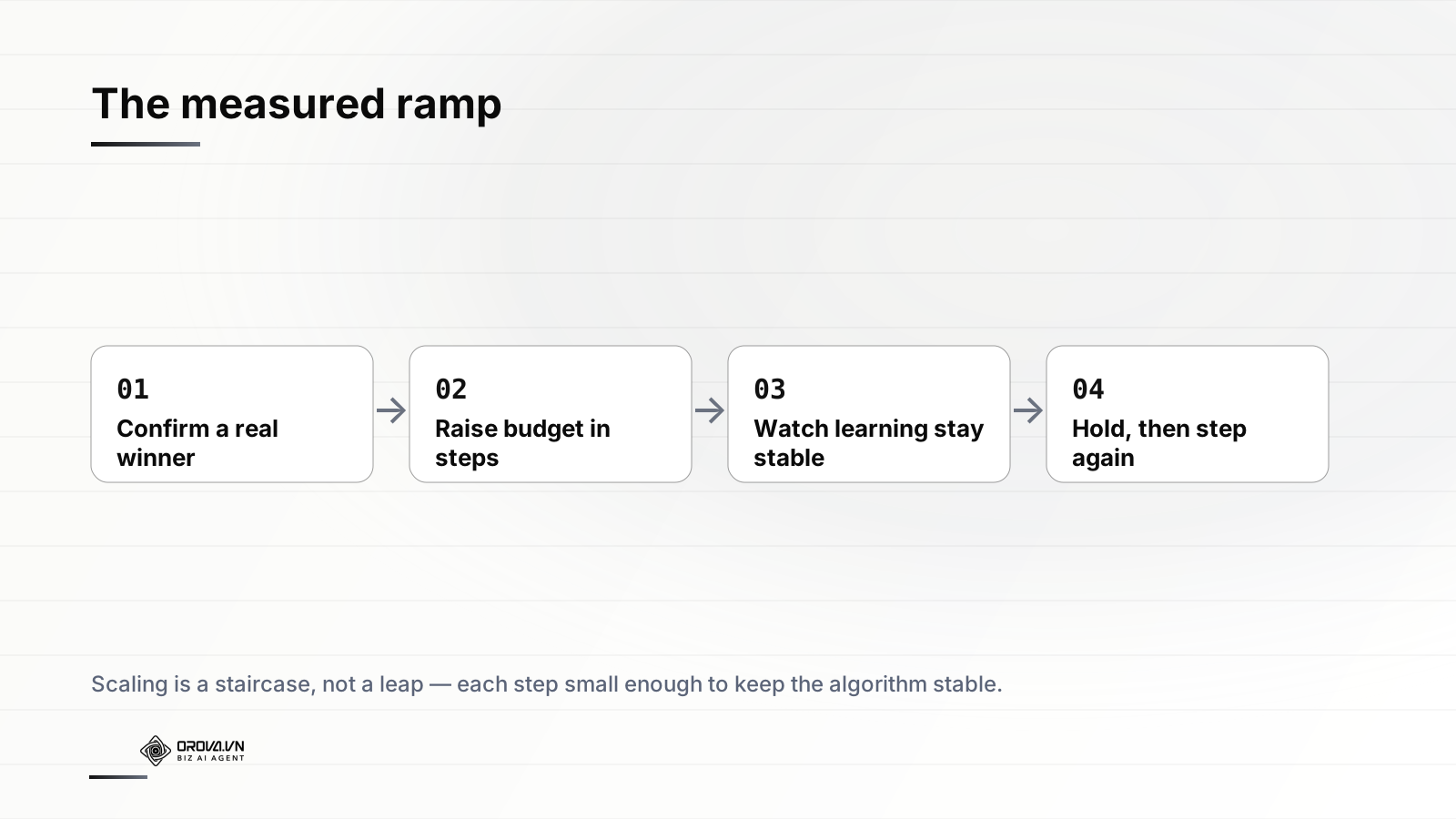
The single most useful heuristic in scaling is to raise budget in increments of roughly 20%, then wait before raising again. It is not a law of physics and you will find practitioners who argue for 15% or 25% or for daily versus every-other-day cadence. But the logic behind the number is sound and worth internalizing rather than memorizing.
A 20% increase is large enough to matter — over a week of compounding steps it adds up fast — but small enough that the algorithm rarely treats it as a "significant edit" that fully resets learning. You are widening the funnel by a margin the model can absorb without abandoning what it already knows. Think of it as asking a runner to speed up gradually rather than sprinting from a standstill; the body (and the algorithm) adapts when the change is incremental.
Consider the compounding. Starting at $100 a day and increasing 20% every two days, assuming performance holds, the trajectory looks like this:
- Day 1: $100
- Day 3: $120
- Day 5: $144
- Day 7: $173
- Day 9: $207
- Day 11: $249
- Day 13: $299
In under two weeks you have roughly tripled spend without a single jarring jump. Compare that to the weekend buyer who went from $80 to $600 in 48 hours — a 650% increase — and reset everything. Slow is not the opposite of aggressive here. Slow, compounded, is aggressive; it just does not break anything.
A few practical notes that separate people who use this rule well from people who quote it:
- Base the percentage on the current budget, not the original. Twenty percent of $200 is $40, not the $20 you started with. The steps get bigger in absolute terms as you climb, which is exactly right — a larger campaign can absorb a larger absolute change.
- Do not stack edits. If you are raising budget, that is the only significant change you make that day. Do not also swap creative or expand the audience. Isolate the variable so that if performance wobbles, you know why.
- Give each step time to express itself. The mistake is raising budget at 9am and judging it at noon. Conversion data, especially with longer consideration windows, lags. Most steps need at least 24–48 hours, and campaigns with multi-day conversion paths need longer.
- Respect the conversion floor. If your ad set is barely clearing 50 conversions a week, it is fragile. Scaling it splits attention across more impressions and can actually push it below the volume it needs to stay out of learning. Sometimes the right move is to consolidate before you scale.
Vertical versus horizontal scaling
The 20% rule is about vertical scaling: taking one winning campaign or ad set and pumping more budget through the same structure. It is the most direct path, and when it works it is the cleanest, because you are amplifying a known quantity. But vertical scaling has a ceiling. Every audience has a finite number of people worth reaching at a profitable cost. As you climb, you exhaust the highest-intent slice and start paying more to reach progressively colder prospects. Your cost per acquisition drifts up not because anything broke, but because you have simply run out of cheap demand. This is audience saturation, and no pacing discipline can cure it — it is a wall, not a wobble.
When you hit that wall, the answer is horizontal scaling: instead of forcing more budget through one door, you open new doors. The main horizontal moves are:
- New audiences. Build fresh lookalikes from your best converters, target adjacent interests, or expand into new geographies. Each new audience is its own pool of demand with its own profitable ceiling.
- New creative angles. The same offer framed differently can unlock people the original creative never resonated with. Creative diversity often extends a campaign's runway more than any bidding tweak.
- New placements and platforms. A winner on Meta feeds often has untapped room in Reels, Stories, or on entirely different platforms. The audiences overlap less than you would expect.
- Duplication. Copying a winning ad set into a new campaign — sometimes with a fresh audience, sometimes nearly identical — is a classic horizontal tactic.
The duplication debate
Duplication deserves its own discussion because it is the most argued-about tactic in scaling and the most frequently misused. The appeal is obvious: copy your winner, double your spend, and in theory you have two winners. In practice, duplication carries real risks that the people advocating it loudest tend to gloss over.
The first risk is auction overlap, sometimes called audience cannibalization. If you duplicate an ad set targeting the same audience, your two ad sets now bid against each other in the same auctions. You are competing with yourself, driving up your own costs. Platforms have built some protections against this, but they are imperfect, and the more overlap there is, the more you pay to outbid your own other campaign.
The second risk is the one this entire article is about: a duplicated ad set starts from zero. It has no learning history. It re-enters the learning phase fresh, with all the volatility and inefficiency that implies. So the choice between "raise the budget on my proven winner" and "duplicate it" is really a choice between "nudge a calibrated system" and "spin up a new, uncalibrated one." Raising budget on an existing winner preserves the learning you have already paid for. Duplication throws it away and starts the meter over.
When does duplication still make sense? When you have genuinely exhausted vertical scaling and want to test a meaningfully different audience or placement, a duplicate gives you a clean slate to learn on without disturbing the original. The mistake is reaching for duplication first, as a shortcut to fast scale, when raising budget on the existing structure would have been both safer and more efficient. As a rule: scale vertically until performance flattens, then scale horizontally with intent — not as a reflex.
Reading stability while you ramp
Scaling without measurement is just gambling with extra steps. The whole point of a measured ramp is that each step gives you a signal, and you only take the next step if the signal is green. So what are you actually watching?
The headline metric people fixate on is cost per acquisition, and it matters, but it can mislead during scaling. Whether you should be optimizing toward cost per acquisition or toward return on ad spend depends on your business model — a distinction worth getting right, which we cover in detail in our breakdown of CPA versus ROAS and which metric to scale on. For now, the key insight is that whichever north-star metric you choose, you read it for stability, not just level, while ramping.
The metrics that tell you it is safe to step again
- Cost per acquisition trend. A small uptick after a budget increase is normal — the model is re-exploring slightly. What you want to see is that it settles back down within 24–48 hours. A CPA that keeps climbing step after step is the audience saturating, telling you to scale horizontally instead.
- Conversion volume and consistency. Are conversions actually increasing in proportion to spend? If you raised budget 20% and conversions rose 20% at a stable cost, that is a clean step. If spend rose and conversions stayed flat, you bought worse impressions — do not step again.
- Frequency. On Meta and TikTok especially, watch how often the same person sees your ad. Rising frequency with falling performance is the textbook signature of saturation. It means you are showing the same ads to the same people more often because you have run out of fresh ones to reach.
- Learning status. Check whether your ad sets are sitting in "Active" or have dropped back to "Learning" (or worse, "Learning Limited," which means they are unlikely to ever exit because they lack the conversion volume). If a budget change kicked you back into learning, that is your answer: you moved too fast.
- Click-through and engagement rates. These are leading indicators. They move before conversion data fully matures, so a softening CTR after a budget jump can warn you that efficiency is eroding before the CPA confirms it.
The discipline is to treat each step as a small experiment with a clear hypothesis: "if I raise budget 20%, conversions will rise roughly 20% at a stable cost." If the data confirms it, you have earned the next step. If it does not, you hold — you do not push harder hoping it sorts itself out. Pushing harder into deteriorating signals is exactly how the weekend buyer turned a winner into a write-off.
Hold periods are part of scaling, not a pause from it
People think of the "wait" between steps as downtime — the boring bit between the exciting bits. It is the opposite. The hold period is where the value is created. It is when the algorithm consolidates the new budget level, when the data matures enough to be trustworthy, and when you gather the evidence that justifies the next move. A buyer who raises budget every day without holding is not scaling faster; they are scaling blind, stacking unvalidated changes on top of each other until the whole thing destabilizes and they cannot tell which step broke it.
The hardest skill in scaling is doing nothing while a campaign is performing well. The temptation to "lock in" a good day by raising budget immediately is precisely the impulse that resets learning. Patience is not the absence of strategy; it is the strategy.
Confirming a real winner before you scale anything
Everything above assumes you are scaling an actual winner. A startling amount of wasted scaling spend goes into campaigns that were never winners — they were lucky. Before you touch the budget, confirm the win is real:
- Sufficient volume. A campaign that produced 5 conversions at a $7 cost per acquisition has told you almost nothing. Small samples produce extreme numbers in both directions. You want enough conversions — ideally past that ~50-per-week learning threshold — before you trust the figure.
- Sustained performance. One great day is noise. Three to seven days of stable, profitable performance is signal. Look for consistency across days, not a single spike that flatters your averages.
- Profitability at the margin, not the average. The relevant question is not "is this campaign profitable overall" but "will the next dollar I spend be profitable." A campaign averaging a 4 return on ad spend might be returning 2 on its marginal spend because the cheap conversions are already captured. Scaling commits you to the margin, so judge the margin.
- A real mechanism, not a coincidence. Can you explain why it is winning? A specific creative angle resonating, a tightly matched audience, a seasonal tailwind? If you cannot articulate why it works, you cannot predict whether it will keep working as you scale into new impressions.
Scaling magnifies whatever is true about a campaign. If it is genuinely profitable, scaling multiplies the profit. If it was a fluke, scaling multiplies the loss. The pre-scale audit is not bureaucracy; it is the difference between compounding gains and compounding mistakes.
Where an AI agent changes the picture
Read back over everything above and notice what it actually demands of a person. Watching cost-per-acquisition stability across 24-to-48-hour windows. Checking frequency and learning status before each step. Sizing every increment off the current budget rather than the original. Holding when every instinct says push. Doing all of this across multiple campaigns, on three platforms, every single day, including the weekends when the weekend buyer got burned. The rules are not complicated. The discipline of executing them consistently, on time, without emotional interference, is where humans fall down — because we get excited by good numbers and impatient with hold periods.
This is precisely the kind of work an automated agent does better than a person, not because it is smarter but because it is tireless and unemotional. An agent can read campaign data every day, detect when a winner has genuinely stabilized enough to take another step, calculate the right increment, and pace the ramp so that each increase stays inside the window that keeps learning intact. It can watch frequency creep and CPA drift across every ad set simultaneously and flag the moment vertical scaling has hit its ceiling and horizontal scaling should begin. It does not get euphoric on a good Friday and triple the budget. It does not forget to check on Sunday.
The important nuance is that pacing the ramp is a judgment-heavy task with real money attached, which is why automation here should keep a human in the loop rather than running fully unattended. The right model is an agent that proposes the next step — "this campaign has held stable for 48 hours, here is a recommended 20% increase, here is the data behind it" — and acts on it under your approval, leaving an audit trail of exactly what changed and why. That combination, machine consistency plus human oversight, captures the upside of disciplined scaling without surrendering control of your spend.
Putting it together
Scaling a winner well comes down to a handful of disciplines that all point the same direction. Confirm the win is real before you commit. Raise budget in measured steps of around 20%, sized off the current budget, with one change at a time. Hold between steps long enough for the data to mature, and read that data for stability, not just level. Scale vertically until performance flattens, then scale horizontally into fresh audiences, creatives, and placements — reaching for duplication deliberately, not reflexively. Above all, respect the learning phase as the calibrated asset it is, and refuse to throw it away for the illusion of fast progress. The window between too aggressive and too timid is real, and the buyers who consistently live inside it are the ones who turn one good campaign into a durable, growing channel.
If keeping that discipline across Google, Meta, and TikTok every day sounds like more than you want to do by hand, that is exactly the problem Orova Ads was built for. It is an AI agent that reads your ad data daily, recommends the right optimizations — budget steps, bids, on/off, audiences — and executes them with your approval and a full audit log, pacing every ramp to capture the win without breaking the learning phase. See how it scales your winners at orova.vn.
Related reading: AI Marketing Campaigns: From Recommendation to Execution
Orova Ads optimises campaigns for you
Connect Google, Meta and TikTok in one place. AI reads the numbers, proposes changes and executes under the rules you set.
Explore Orova Ads