
Lookalike Audiences on Meta: Still Worth It in the Advantage+ Era?
In 2019, building a 1% lookalike from your purchaser list felt like cheating. You handed Meta a few thousand of your best customers, the algorithm went and found a few million people who looked statistically similar, and your cost per acquisition usually dropped. For roughly five years, lookalikes were the default answer to the question "who should we show this ad to?" Then Meta quietly changed the math. With the rollout of Advantage+ shopping campaigns and Advantage+ audience, broad targeting stopped being the lazy option and started, in many accounts, beating the carefully constructed lookalike that media buyers had spent years perfecting.
So the honest question for 2026 is not "are lookalikes dead?" — that headline gets clicks but it's wrong. The question is narrower and more useful: in your specific account, with your specific data, does a lookalike still give Meta a head start worth keeping, or has the system gotten good enough that a clean signal and a big budget render the seed irrelevant? The answer is genuinely "it depends," and this article is about how to figure out which side of "it depends" you're on without burning a month of budget guessing.
What actually changed under the hood
To reason about lookalikes today you have to understand what Meta's delivery system was missing in 2019 and what it has since gained. A lookalike audience is, at its core, a way of compressing your time horizon. You're telling the algorithm: "Don't spend two weeks exploring the whole population to learn who converts — here are 2,000 people who already did, go find their twins." That seed is a prior. It biases exploration toward a region of the population you already know is fertile.
The reason that mattered so much in the late 2010s is that Meta's exploration was slower and dumber. Conversion signals were noisier, the optimization window was longer, and the system needed more conversions per ad set per week to escape the "learning phase" and stabilize. A lookalike short-circuited that pain. It started you closer to the answer.
Three things changed that eroded the edge:
- The Conversions API and server-side signal. When iOS 14.5 broke the pixel in 2021, Meta lost a chunk of its event data and lookalikes degraded along with everything else. The recovery — server-side tracking via the Conversions API, aggregated event measurement, and a lot of modeling — meant the system now reconstructs intent from far more signals than just on-site behavior. The richer the live signal, the less the static seed matters.
- Better real-time optimization. Meta's delivery now adjusts who it shows ads to within a single day, sometimes within hours, based on early engagement and conversion signal. Broad targeting used to be a gamble because exploration was expensive; now exploration is cheaper and faster, so the gamble pays off more often.
- Advantage+ as the default. Advantage+ audience doesn't ignore your inputs — it treats them as suggestions rather than hard constraints. You can feed it your customer list as a signal and it will lean toward those people early, then expand when it finds conversions elsewhere. That's effectively a soft, self-adjusting lookalike baked into the campaign, which is why a separate, hard lookalike feels redundant to a lot of buyers.
None of this means the seed is worthless. It means the seed's job changed from "do the targeting" to "give the system a better starting prior." Whether that prior is worth the operational cost is the real decision.
The two failure modes you're choosing between
Every targeting choice on Meta is a trade between two ways to be wrong. A lookalike can be wrong because the seed is stale, narrow, or built on a low-value event — you inherit the seed's blind spots. Broad can be wrong because the signal is too thin for the system to find your buyers efficiently, so it wanders, spends, and learns slowly. The whole game is matching the targeting approach to which failure mode your account is more exposed to.
A lookalike fails by being too confident about the wrong thing. Broad fails by being too uncertain for too long. Your data quality determines which risk you're actually taking.
Lookalike vs broad: which wins in which account
I've watched this comparison run in dozens of accounts and the pattern is reasonably consistent. The winner correlates less with the platform's capabilities and more with the shape of the advertiser. Here's the breakdown that actually predicts the outcome.
When lookalikes still win
- Niche or expensive products with a non-obvious buyer. If your customer isn't who a naive demographic guess would pick — a B2B SaaS tool, a $4,000 mattress, a specialized medical device — broad targeting wastes a lot of impressions learning that your buyer is weird. A lookalike off a clean purchaser list encodes that weirdness for free. The seed is doing real informational work the system can't easily replicate from a cold start.
- High-value seed events you can't optimize toward directly. Maybe your true north is "customers who stayed subscribed past 90 days" or "buyers with a $500+ first order." Meta can't optimize toward those in real time because the event happens too late. But you can build a lookalike from that list and inject the downstream-value signal into your targeting prior. That's a genuine edge broad can't match.
- Smaller budgets and smaller markets. Broad needs volume to work. If you're spending $50/day in a country of five million people, the system never gets enough conversions to explore efficiently, and a lookalike's head start can be the difference between exiting the learning phase and never reaching it.
- Cold accounts with thin pixel history. A brand-new ad account with weak on-site signal benefits enormously from a customer list lookalike, because the live signal Meta would otherwise rely on simply isn't there yet.
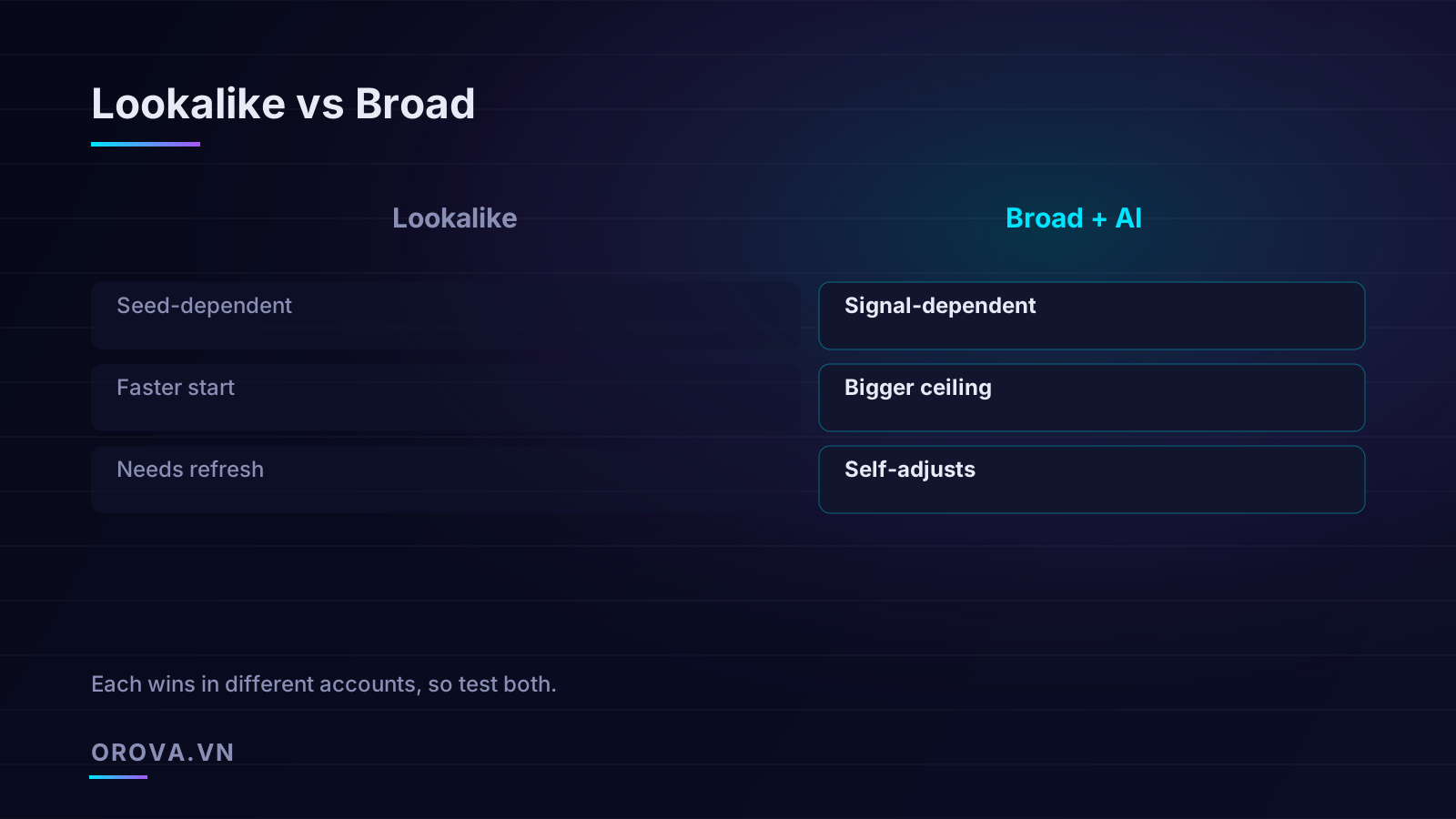
When broad plus Advantage+ wins
- High-volume e-commerce with strong signal. If you're spending five figures a day, selling a product with broad appeal, and your Conversions API is firing clean purchase events, broad almost always matches or beats lookalikes — and it does it with a fraction of the maintenance. The system has all the signal it needs and a static seed just constrains it.
- Mature accounts with rich pixel history. Years of conversion data is itself a kind of seed — one that updates every day. A separate lookalike is often just a noisier, frozen copy of what the pixel already knows.
- Products with a large, diverse buyer base. Consumer staples, fashion, anything with mass appeal: the seed adds little because there's no hidden pattern to encode. Broad finds your buyers fast because they're everywhere.
- Accounts where creative is the real lever. When your conversion rate swings more on the ad than on the audience — which is increasingly the norm — broad plus strong creative lets the algorithm match creative to person across the whole population, instead of fishing in the seed's pond.
The uncomfortable truth is that for a large, healthy e-commerce account in 2026, the lookalike is often a comfort blanket. It doesn't hurt much, but it doesn't help much either, and it costs you maintenance time. For a niche, low-volume, or cold account, it's still a real weapon. Most accounts are somewhere in between, which is why you test instead of believe.
Building a seed that's actually worth a lookalike
Here's the part most "are lookalikes dead?" articles skip: the quality of a lookalike is almost entirely determined by the quality of the seed, and most seeds are quietly terrible. People build a lookalike from "all website visitors in the last 180 days," get a mediocre result, and conclude lookalikes don't work. They didn't test lookalikes. They tested a bad seed. The audience is only as good as the list you train it on.
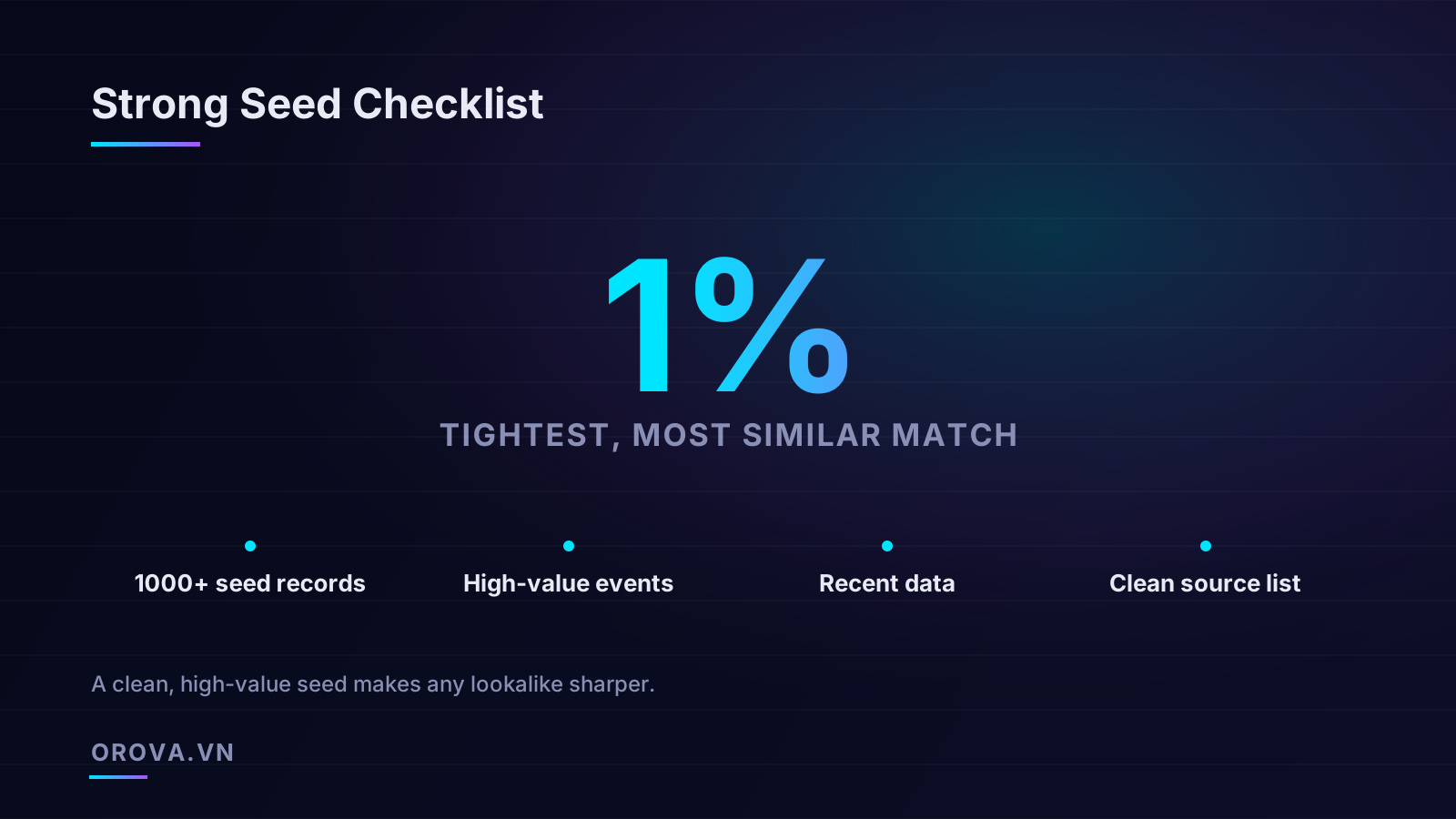
The strong-seed checklist
A seed worth building a lookalike from clears four bars. Miss any of them and you're degrading the prior you're trying to give the algorithm.
- Size: 1,000 records minimum, 5,000+ ideal. Meta technically accepts 100, but a seed under 1,000 is statistically thin — the lookalike inherits the seed's random noise as if it were signal. More records means the model can separate "what my customers have in common" from "coincidence." This is the single most common reason lookalikes underperform.
- High-value events, not vanity events. A lookalike of "added to cart" finds people who add to cart and abandon. A lookalike of "purchased and didn't refund" finds buyers. A lookalike of "purchased twice" finds loyal buyers. Always seed from the most valuable behavior you have enough volume to support. The event you choose is the customer you'll get more of.
- Recent data. A seed built from buyers two years ago encodes a market that may no longer exist — old prices, old products, old buying intent. Refresh from a rolling recent window (say, the last 90–180 days of high-value events) so the prior reflects who buys now, not who bought then.
- A clean source list. Deduplicated, properly formatted, with as many match keys as you can provide (email, phone, name, location). A list with a 30% match rate is effectively a third the size you think it is. Hash it correctly, include every field Meta can use, and strip the junk before you upload.
Value-based lookalikes: the underused upgrade
If you can attach a value to each record — lifetime value, first-order value, total spend — use a value-based lookalike. Instead of treating every seed customer as equally important, Meta weights the model toward your highest-value customers, so the lookalike skews toward people who resemble your best buyers, not just any buyer. In accounts with a wide spread between average and top customers (which is most of them), this consistently outperforms a flat lookalike. It's the closest thing to optimizing toward LTV that the targeting layer offers, and almost nobody uses it.
Percentage sizing: 1%, 5%, 10% and the lift-versus-scale trade
The percentage sets how tightly the lookalike hugs the seed. A 1% lookalike of a country is the ~1% of the population most similar to your seed — the tightest, most similar match. A 10% lookalike is ten times bigger and correspondingly looser, shading toward broad.
The trade-off is mechanical and worth internalizing:
- 1% — highest similarity, smallest reach. Best precision, but it caps your scale and saturates fastest. In a small market, 1% might be only a few hundred thousand people, which a real budget burns through in days. Start here when precision matters more than scale.
- 3–5% — the practical middle. Enough similarity to keep quality up, enough reach to actually spend. For most accounts that still run lookalikes, this is the workhorse range.
- 10% — barely a lookalike. So loose it behaves almost like broad with a faint lean. If you're considering 10%, you should probably just run broad with your customer list as an Advantage+ signal and skip the maintenance.
A common mistake is stacking 1% / 1–3% / 3–5% as separate ad sets and letting them fight. They overlap heavily, cannibalize each other in the auction, and fragment your conversion volume across more ad sets than your budget can feed out of the learning phase. If you test percentages, test them as separate experiments over time, not as parallel ad sets bidding against your own account.
Tighter isn't automatically better. A 1% lookalike that saturates in three days and then spends into the same exhausted pool is worse than a 5% that keeps finding fresh, qualified people. Match the percentage to your budget and market size, not to a rule of thumb.
How to actually test lookalike vs broad without fooling yourself
This is where most teams go wrong. They run a lookalike, run broad, eyeball the cost per acquisition after a week, and declare a winner. That's not a test — it's a coin flip dressed up as analysis. Audience tests on Meta are unusually easy to misread because of overlap, learning-phase noise, and attribution windows that shift results for days after the spend.
The conditions for a test you can trust
- One variable. Same creative, same budget, same optimization event, same placements. The only difference is the audience. If you change the creative too, you've learned nothing about the audience.
- Enough conversions to be real. Aim for at least 50 conversions per arm before you compare, ideally more. Below that, the difference you're seeing is noise. A 30% CPA gap on 12 conversions is meaningless.
- Long enough to clear the learning phase plus stabilize. The first week is contaminated by exploration. Give each arm enough time and volume to exit learning, then measure the stable period — usually a minimum of two weeks for most budgets.
- Account for audience overlap. A lookalike and broad targeting in the same country overlap massively. If they run simultaneously they bid against each other and corrupt both results. Use Meta's A/B test tool, which splits the audience so the same person can't be in both arms.
- Measure on a holistic metric. Don't just compare CPA — compare CPA at equal scale, and watch incremental volume. A lookalike with slightly lower CPA that can only spend half your budget is often worse for the business than broad with slightly higher CPA that scales cleanly.
Run that disciplined test and you'll get an answer you can act on. Skip it and you'll keep relitigating "lookalikes vs broad" forever, swayed by whichever one happened to win the last noisy week. The reason this matters so much is that the right answer genuinely differs by account, season, and product — so you have to keep re-testing as your data and the platform evolve.
Why this gets harder across multiple platforms
Everything above is just Meta. The moment you're also running Google and TikTok, the audience question multiplies: Google's Customer Match and similar segments behave differently, TikTok's lookalikes have their own seed and sizing quirks, and the "broad vs seeded" trade-off lands in a different place on each platform because each has a different signal density and exploration speed. Trying to keep a consistent, well-tested audience strategy across three platforms by hand — refreshing seeds, running clean A/B tests, reading results without fooling yourself — is more work than most teams have hours for. This is a big part of why a unified, cross-platform approach run by one brain beats juggling three separate consoles with three separate mental models.
How an AI agent runs structured audience tests
The reason audience testing stays sloppy in most accounts isn't ignorance — people know they should run clean A/B tests. It's that doing it properly is tedious, easy to get wrong, and never gets prioritized over the next campaign launch. Seeds go stale because refreshing them is a chore. Tests get cut short because someone got impatient. Results get misread because nobody waited for attribution to settle. The discipline that good audience strategy requires is exactly the discipline humans are worst at sustaining week after week.
That's the gap an AI agent fills, not by being smarter about marketing strategy than you, but by being relentless about the parts you keep skipping. A well-built agent does a few things consistently that human teams do sporadically:
- Keeps seeds fresh automatically. Instead of a quarterly "we should rebuild the lookalike" that never happens, the agent refreshes high-value seed audiences on a rolling window so the prior never goes stale.
- Runs proper, non-overlapping tests. It structures lookalike-vs-broad and percentage-sizing experiments as real split tests, with one variable, adequate conversion thresholds, and enough runtime — then waits for statistical confidence instead of calling it early.
- Reads results correctly. It accounts for the learning phase, attribution settling, and overlap, so the "winner" it reports is a winner you can actually trust, with the audit trail to back it.
- Acts on the result. When a test resolves, it doesn't just report — it shifts budget toward the winner, pauses the loser, and proposes the next experiment, keeping the optimization loop turning continuously rather than in quarterly bursts.
The strategic decisions — what counts as a high-value customer, how aggressive to be, what the brand can and can't do — stay with you. The agent handles the relentless execution that turns a good audience strategy from a slide deck into a live, continuously-tested system. That's the realistic division of labor: humans decide what good looks like, the agent makes sure it actually happens every single day.
The verdict for 2026
Lookalikes aren't dead and they aren't a relic — they're a tool that used to do everything and now does one thing well: giving the algorithm a strong, high-value prior in accounts where the live signal is too thin to find your buyers on its own. If you're a large, mature, high-volume advertiser with clean signal, broad plus Advantage+ probably matches or beats your lookalike with far less work, and you should test your way to retiring the seed. If you're niche, low-volume, cold, or optimizing toward a downstream value event you can't target directly, a clean 1% value-based lookalike still earns its keep.
The only wrong answer is picking on principle. Build a strong seed, size it to your market, run a disciplined test, and let the data decide — then re-test next quarter, because both your account and the platform will have moved. The advertisers who win at audiences in 2026 aren't the ones with the strongest opinion about lookalikes. They're the ones with the most disciplined testing loop.
If keeping that testing loop running across Google, Meta and TikTok sounds like more than your team can sustain by hand, that's exactly what Orova Ads is built for. It's an AI agent that reads your ad data every day, recommends audience tests and optimizations, and executes them — budget shifts, bid changes, turning campaigns on and off, swapping audiences — with your approval on every move and a full audit log of everything it does. You set the strategy; it runs the disciplined, relentless testing that actually makes lookalike-versus-broad a solved question in your account instead of a recurring argument.
Let an AI Agent handle your SEO
Orova plans, writes, optimizes, and tracks rankings on its own — you just read the results.
Try it free