
Audience Overlap on Meta: The Silent Cause of Self-Competition

A retailer we worked with had eleven active ad sets in a single prospecting campaign, each one carefully named for a different interest: "Yoga enthusiasts," "Activewear shoppers," "Fitness influencers' followers," "Wellness lifestyle," and so on. On paper it looked like disciplined segmentation. In practice, when we ran Meta's audience overlap tool, seven of those eleven ad sets shared more than 40% of their reachable users with at least one sibling. The brand was paying to win the same impression twice, sometimes three times, and the auction was happy to take the money. After consolidating down to three ad sets, their average CPM dropped 22% and their cost per purchase fell by nearly a third, with no change to creative or landing page. Nothing about their product got better. They simply stopped bidding against themselves.
This is one of the most common and least diagnosed problems in Meta advertising. It hides behind reasonable-looking account structure, it gets worse as accounts grow, and it quietly inflates costs in a way that no single report flags for you. The term for it is audience overlap, and understanding it is the difference between a campaign that scales efficiently and one that fights itself for every conversion.
What audience overlap actually is
Audience overlap happens when two or more of your ad sets are eligible to show ads to the same people. Meta does not silo your ad sets into mutually exclusive buckets. Each ad set defines a target audience, and if those definitions describe populations that intersect, the same user can be a candidate for multiple ad sets at once.
Here is where it turns into a real cost. Meta runs a separate auction for every available impression, and each of your ad sets enters that auction independently. When a user who qualifies for three of your ad sets loads their feed, all three of your ad sets can compete for that single impression slot. Meta's ad delivery system includes deduplication so that, in most cases, only one of your ad sets wins and you are not literally charged three times for one impression. But the damage is more subtle than double-billing.
When your own ad sets compete in the same auction, they push up the price you pay. The auction is a second-price-style system influenced by total value (bid plus estimated action rates plus ad quality). When two of your ad sets are both strong contenders, they raise the bar that the winning ad set must clear. You end up paying more to beat yourself than you would have paid to beat an unrelated competitor. Meta's own documentation describes this as ad sets that "compete against each other," and it is the mechanism behind a lot of unexplained CPM inflation.
Why it is so easy to create accidentally
Overlap rarely comes from carelessness. It usually comes from doing things that feel correct:
- Interest stacking and splitting. You break "fitness" into "yoga," "running," "CrossFit," and "Pilates" to test which performs best. But a huge share of people interested in yoga are also flagged as interested in running. The interests are not exclusive categories; they are overlapping tags on the same people.
- Lookalike audiences at multiple percentages. A 1% lookalike is, by definition, a subset of a 2% lookalike, which is a subset of a 3%. If you run all three as separate ad sets, the smaller ones are fully contained inside the larger ones. That is 100% overlap by construction.
- Broad targeting alongside specific targeting. The moment you add a broad or Advantage+ audience to an account that also has tightly targeted interest ad sets, the broad audience swallows everyone the specific ones were chasing.
- Retargeting windows that nest. "Visited in last 7 days" lives entirely inside "visited in last 30 days." Running both as separate ad sets without exclusions guarantees overlap.
- Geographic and demographic re-splitting. Splitting one audience into "18-24," "25-34," and "35-44" is clean. Splitting by interest and by age at the same time across many ad sets multiplies the surface area where collisions occur.
None of these is wrong in isolation. The problem is the cumulative structure. Accounts accrete ad sets over months. A test launched in March never gets paused. A seasonal campaign duplicates the evergreen one. By the time anyone audits the account, the prospecting layer is a tangle of populations that mostly describe the same few hundred thousand people.
The signs you are competing against yourself
The overlap tool gives you a definitive answer, but you can often smell the problem before you confirm it. Watch for these patterns:
CPMs that rise as you add ad sets
If you launch a new ad set targeting "wellness" and your existing "fitness" ad set's CPM ticks up in the following days, that is a tell. You added a competitor to your own auction. Healthy account growth should not make your existing ad sets more expensive. When it does, suspect overlap.
Frequency climbing faster than reach
When multiple ad sets chase the same people, those people see your ads more often while your total unique reach barely grows. You will see frequency creeping up — say, from 2.1 to 3.4 over a week — without a corresponding jump in unique users reached. The budget is being spent showing the same faces more ads, not finding new ones.
Ad sets stuck in the learning phase
Meta needs roughly 50 optimization events per ad set per week to exit the learning phase and deliver stably. When your budget is fragmented across many overlapping ad sets, each one gets a thin slice of conversions and never accumulates enough signal. You end up with five ad sets perpetually "learning" instead of two that are optimized. Overlap is a direct cause of chronic learning-phase limitation because it splits both budget and the available audience.
One ad set cannibalizing another's delivery
You will sometimes see one ad set suddenly spend almost nothing while a sibling spends everything, with no obvious reason. Meta's delivery system decided the sibling had a marginally better expected value for the shared audience and routed spend there. Your "test" never got a fair read because it was starved by an overlapping ad set, not because the audience was bad.
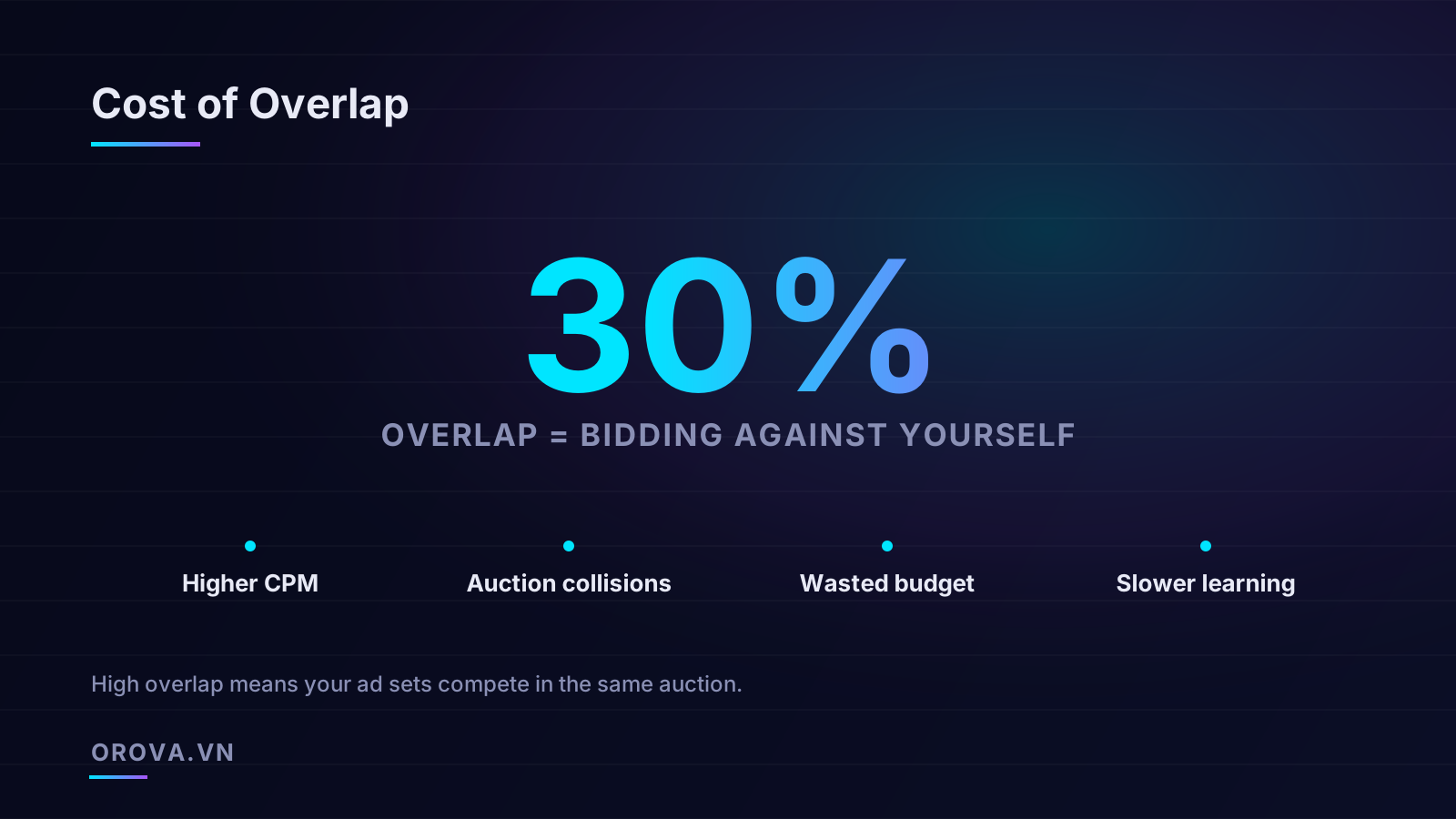
If two of your ad sets share more than 30% of their audience, treat them as one audience that you accidentally split in two. The auction certainly does.
How to detect overlap with Meta's audience overlap tool
Meta provides a built-in tool that measures how much any two saved or custom audiences intersect. It is in Ads Manager under the Audiences section. The workflow is straightforward, but most advertisers never open it.
- Go to the Audiences tab in Ads Manager (you can reach it from the main menu).
- Select two or more audiences by ticking their checkboxes. You can compare up to five at once.
- Click Actions and choose Show Audience Overlap.
- Read the percentage. The tool shows, for each pair, what share of the smaller audience is contained within the larger one.
How to read the number correctly
The overlap percentage is calculated relative to the selected audience, which trips people up. If audience A has 100,000 people and audience B has 1,000,000 people, and all of A is inside B, the tool will report 100% overlap from A's perspective and 10% from B's. Always think about which direction matters for your spend. If your small, high-intent retargeting audience is fully contained in a broad prospecting audience, the broad one will eat the small one's users in delivery — even though the broad audience only "overlaps" 10% by its own measure.
Thresholds worth acting on
- Under 20%: Usually fine. Some overlap is unavoidable and not worth chasing. The auction efficiency loss is marginal.
- 20% to 30%: Watch it. If both ad sets are spending meaningfully, the collision cost is starting to matter. Consider exclusions.
- Over 30%: Act. At this level you are demonstrably bidding against yourself for a third or more of the population. Consolidate or exclude.
- Over 50%: These are effectively the same audience. There is almost never a good reason to run them as separate ad sets in the same campaign.
One caveat: the overlap tool only compares defined audiences (saved audiences, custom audiences, lookalikes). It cannot directly show overlap between two ad sets built from raw interest stacks unless you save those targeting definitions as saved audiences first. So the practical first step in an audit is often to recreate your live ad set targeting as saved audiences purely so you can run them through the tool. It is tedious, which is exactly why this problem stays hidden — the diagnosis requires manual setup that nobody has time for.
The metrics that corroborate the overlap number
The overlap tool tells you the structural truth, but you should triangulate it against delivery metrics so you can size the actual cost. Pull a custom report with these columns at the ad set level and look at them side by side: CPM, frequency, unique reach, cost per result, and the percentage of budget each ad set actually spent versus its daily cap. Three patterns confirm that overlap is doing real damage rather than sitting harmlessly in the background.
First, look for ad sets whose cost per result rose without any change to creative or bid strategy. If you did not touch an ad set and its results got more expensive after you launched a neighbor, the neighbor is the variable. Second, check whether your account-level unique reach has plateaued while spend kept climbing. When you are spending more but reaching the same number of distinct people, the extra money is buying frequency against an overlapping pool, not incremental audience. Third, watch for ad sets that chronically underspend their daily budget. An ad set that consistently spends 40% of its cap while a sibling maxes out is usually losing the internal auction for the shared population — Meta keeps routing the impression to the sibling it judges marginally better, and your "test" never gets a fair sample. Each of these is circumstantial on its own, but together with a 30%+ overlap reading they form a clear case.
The consolidation strategy: fewer, broader, cleaner
Once you have found the overlap, the fix is consolidation. The instinct of many advertisers is to keep all their ad sets and just add a bunch of audience exclusions to carve them apart. Sometimes that is right. More often, the cleaner and higher-performing move is to merge.
Merge overlapping prospecting ad sets into one
If three interest-based ad sets share 40-60% overlap, the strongest play is usually to combine their interests into a single ad set with a single, larger budget. This does several things at once:
- It eliminates the internal auction competition entirely — there is only one ad set bidding now.
- It pools the conversion signal so the surviving ad set exits the learning phase faster.
- It gives Meta's delivery system a larger pool to find the best-performing pockets, which is what the algorithm is genuinely good at. The modern Meta delivery system performs better with broad, well-fed audiences than with hand-carved narrow ones, and consolidation leans into that strength.
You lose the ability to read performance interest-by-interest, but in most cases that read was illusory anyway because the overlap meant you were never measuring clean populations to begin with.
Use exclusions where segments must stay separate
Some separations are strategic and should be preserved with exclusions rather than merged:
- Prospecting vs. retargeting. You almost always want these on different budgets, messages, and bid strategies. Exclude your website visitors and customer lists from prospecting so the two layers do not collide. This is the single most important exclusion in any account.
- Existing customers vs. new acquisition. If you do not want to pay to re-acquire people who already bought, exclude your customer list from prospecting campaigns.
- Nested retargeting windows. If you run a 7-day and a 30-day retargeting ad set with different messaging, exclude the 7-day audience from the 30-day one so each window addresses a distinct group.
Stop running lookalike percentage ladders as separate ad sets
Running 1%, 2%, and 3% lookalikes as three ad sets is one of the most common self-inflicted overlap wounds because the smaller percentages are entirely contained in the larger ones. Either pick one tier and commit, or, if you want a wider net, run a single 0-3% or 1-5% lookalike as one audience and let delivery sort it out. Stacking nested lookalikes as separate ad sets is pure self-competition.
A practical consolidation workflow
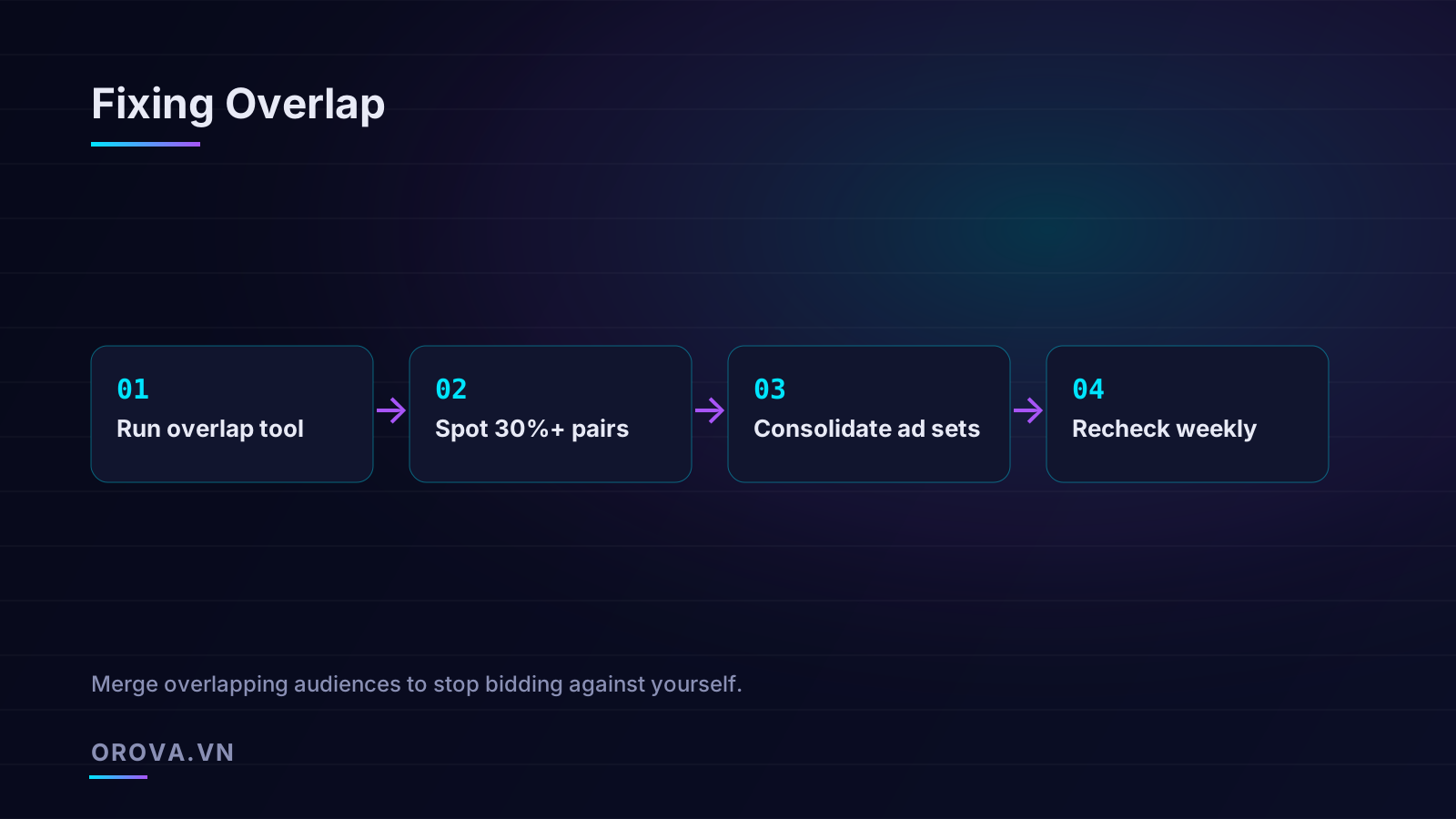
Here is a sequence you can run on any account this week. It moves from diagnosis to action to maintenance.
- Inventory your active ad sets. List every ad set that is currently spending, grouped by campaign and by layer (prospecting vs. retargeting). Ignore paused ones for now.
- Save targeting as comparable audiences. For each prospecting ad set, recreate its targeting as a saved audience so the overlap tool can read it. For custom and lookalike audiences, they are already comparable.
- Run the overlap tool in pairs. Compare audiences within the same campaign and layer. Note every pair above 30%.
- Decide merge vs. exclude for each flagged pair. Same layer and same intent: merge. Different layer or different intent that must stay separate: exclude. When in doubt at high overlap, merge — fewer ad sets almost always wins on Meta today.
- Rebuild with consolidated structure. Create the merged ad set with a combined budget roughly equal to the sum of the budgets it replaces. Add exclusions where you decided to keep things separate. Pause the redundant ad sets rather than deleting them immediately, so you can revert if something goes sideways.
- Let it relearn. Expect a few days of instability as the consolidated ad set re-enters the learning phase. Do not panic and revert on day two. Give it at least 50 conversions or a full week before judging.
- Recheck weekly. Overlap creeps back as you add new tests. Make the overlap check a recurring habit, not a one-time cleanup.
What good results look like
When consolidation works, you will typically see lower CPMs (because the internal auction competition is gone), faster exit from the learning phase (because the surviving ad sets are better fed), steadier delivery (because Meta is not constantly re-deciding which of your ad sets deserves the shared audience), and often a lower cost per result even though nothing about your offer changed. The retailer in the opening example saw those exact movements. The wins come from removing waste, not from adding anything.
Common mistakes during consolidation
Consolidation is simple in principle and easy to fumble in execution. A few traps come up repeatedly:
- Cutting the combined budget. When you merge three ad sets into one, give the survivor a budget close to the sum of what the originals spent, not the budget of a single one. Starving the consolidated ad set defeats the point — you wanted to pool the conversion signal, and a tiny budget cannot generate enough events to exit the learning phase.
- Reverting too soon. The consolidated ad set re-enters the learning phase and will look volatile for the first few days. Advertisers panic on day two, switch everything back, and conclude "consolidation doesn't work." It does; you just judged it before it stabilized. Hold for a week or 50 conversions.
- Forgetting the prospecting-to-retargeting exclusion. While you are restructuring, it is easy to lose the most important exclusion of all. Re-add it on every prospecting ad set: exclude website visitors and customer lists so you stop paying prospecting prices to reach warm audiences.
- Deleting instead of pausing. Pause the redundant ad sets first. If the consolidation underperforms for a legitimate reason, you want the ability to revert quickly with the original structure intact rather than rebuilding it from memory.
- Consolidating across genuinely different intents. Merging two prospecting interest stacks is good. Merging a cold prospecting audience with a high-intent cart-abandoner audience is bad — they need different messages and bid logic. Consolidate within a layer, not across layers.
It is also worth saying what consolidation will not fix. If your creative is weak, merging ad sets will not save you. If your offer is not competitive, a cleaner auction just means you lose more efficiently. Overlap cleanup is a multiplier on a sound foundation, not a substitute for one. This is part of why thinking about your account holistically — across platforms and layers rather than ad set by ad set — pays off. The same discipline of consolidating instead of fragmenting applies whether you run one platform or several, which is exactly the philosophy behind treating cross-platform ad management as one brain rather than a pile of disconnected campaigns.
Why overlap is a perfect job for an AI agent
Everything above is doable by hand. The reason most accounts stay tangled is not ignorance — it is that the work is tedious, recurring, and easy to deprioritize against more visible tasks. You have to recreate targeting as saved audiences, run pairwise comparisons, interpret asymmetric percentages, decide merge versus exclude, rebuild structure, and then do it all again next week because new tests reintroduce overlap. It is precisely the kind of high-frequency, pattern-matching, low-glory work that humans skip and software does not mind.
What an AI layer can do that a person realistically will not
- Continuous detection. An agent can read your account structure every day and compute overlap across all ad set pairs, not just the handful you remembered to check. It surfaces the 30%+ collisions before they cost you a full billing cycle.
- Asymmetry-aware reasoning. Because overlap percentages are directional, an agent can flag the dangerous case — a small high-intent audience fully nested inside a broad one — that a quick human glance at a single number misses.
- Spend-weighted prioritization. Not all overlap matters equally. Two overlapping ad sets each spending $5 a day are noise. Two overlapping ad sets spending $2,000 a day are an emergency. An agent ranks the collisions by the actual money at stake so you fix what matters first.
- Concrete consolidation proposals. Rather than just reporting "you have overlap," a well-built agent proposes the specific merge — which ad sets to combine, what the combined budget should be, which exclusions to add — and explains the expected effect.
- Closing the loop. After a change, it rechecks the following week to confirm the overlap is gone and CPMs moved in the right direction, so the cleanup actually sticks instead of quietly reverting.
The critical design point is that none of this should happen blindly. Audience structure is strategic, and a merge that looks correct by the numbers might break a deliberate separation you set up for a campaign-specific reason. The right model is human-in-the-loop: the agent does the relentless monitoring and the math, proposes the consolidation, and waits for your approval before it touches anything — with a full record of what it changed and why. You keep the judgment; the software handles the vigilance.
Putting it together
Audience overlap is the silent tax on Meta accounts that grow. It is not caused by bad advertisers; it is caused by reasonable decisions accumulating without anyone stepping back to check whether the populations they describe are actually distinct. The cure is unglamorous: open the overlap tool, find the pairs above 30%, consolidate or exclude, and recheck on a schedule. Do that consistently and you will spend less to reach the same people, exit the learning phase faster, and stop handing the auction free money to watch your own ad sets fight.
If you would rather not run that audit by hand every week, Orova Ads is an AI agent that manages paid campaigns across Google, Meta, and TikTok for you. It reads your account data every day, flags overlapping and self-competing ad sets, and proposes consolidations — along with budget, bid, on/off, and audience changes — then executes the ones you approve, with human-in-the-loop sign-off and a full audit log of every move. It is the difference between knowing overlap is a problem and actually keeping it out of your account. Start at orova.vn/ads.
Let an AI Agent handle your SEO
Orova plans, writes, optimizes, and tracks rankings on its own — you just read the results.
Try it free