
Meta Dynamic Creative Explained: When to Let It Assemble Ads
A media buyer I worked with once spent three weeks building forty separate ad variations by hand. Each one was a slightly different combination of one of four images, one of five headlines, and one of two body texts. She duplicated ad sets, renamed everything, and waited for the data. By the time she had a statistically clean read on which combination performed best, the promotion was over and the winning creative was stale. Meta's dynamic creative feature was built to kill exactly that workflow. Instead of hand-assembling forty ads, you upload the raw ingredients once and let the delivery system mix and match them in real time, serving each person the combination most likely to make them click, install, or buy.
That sounds like magic, and the marketing around it leans into that impression. The reality is more grounded and more useful: dynamic creative is a structured experiment that runs continuously inside a single ad. It is not a replacement for creative judgment, and it does not invent good ads out of bad inputs. It is an amplifier. Feed it variety and clear intent, and it will find combinations you would never have tested manually. Feed it four near-identical images and three headlines that all say the same thing, and it will hand you back exactly the mediocre performance you put in. This article walks through how the system actually assembles ads, what assets are worth varying, where the reporting falls short, and how an automated optimization layer reads the messy combination-level data to keep winners fresh and retire losers before they drag your account down.
What Dynamic Creative Actually Does Under the Hood
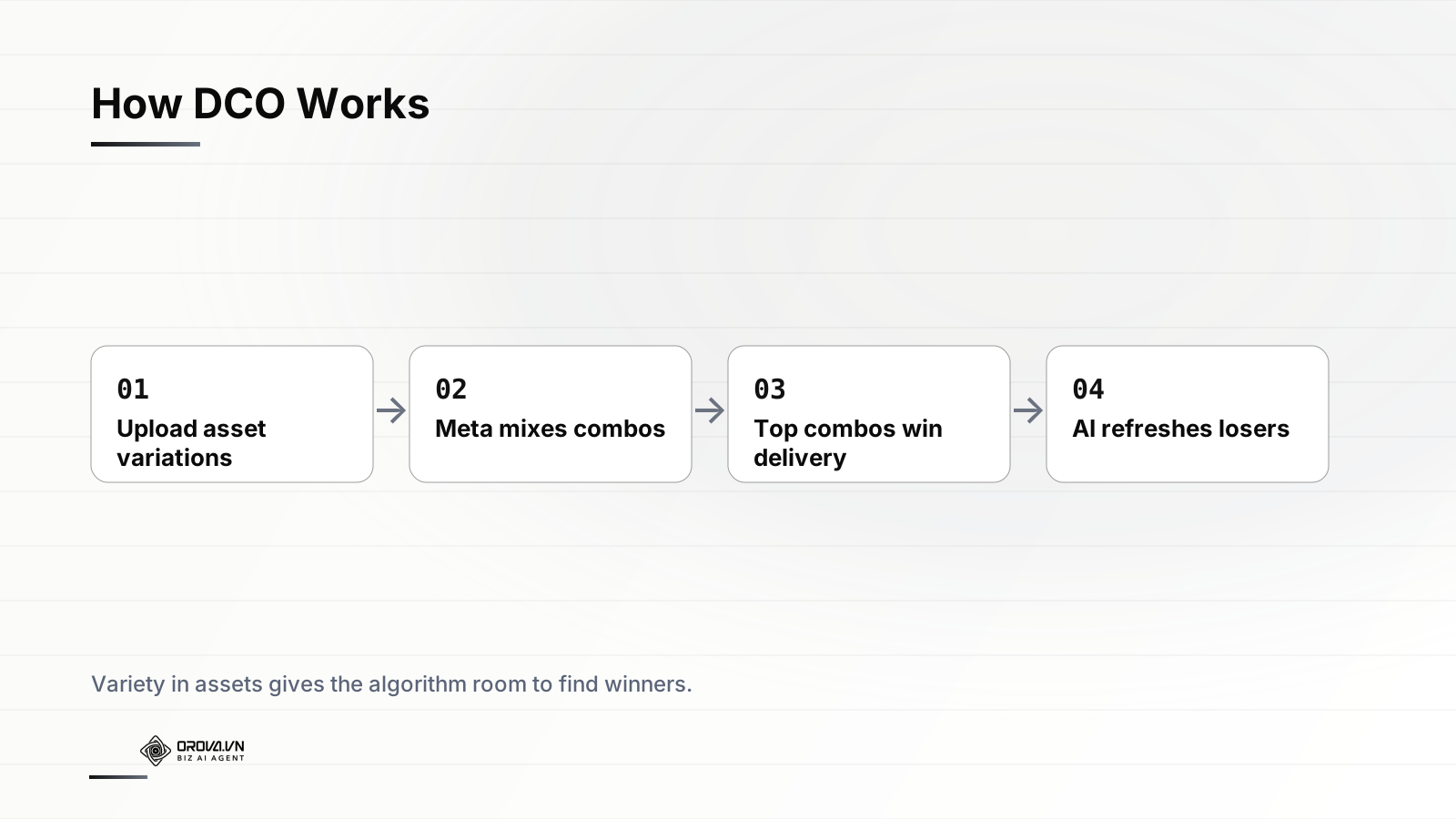
When you turn on dynamic creative at the ad set level, you stop uploading finished ads and start uploading components. You provide up to ten images or videos, up to five primary text options, up to five headlines, up to five descriptions, and a small set of call-to-action buttons. Meta then treats these as a pool of interchangeable parts. For every impression opportunity, the delivery system constructs a candidate ad on the fly by selecting one asset from each slot, and it chooses the combination it predicts will perform best for that specific person in that specific moment.
The selection is not random and it is not a flat round-robin. Early in the ad's life, the system explores: it serves a wide spread of combinations to gather signal on how each asset and each pairing performs across different audience segments. As data accumulates, it shifts toward exploitation, concentrating delivery on the combinations that are winning. This is the same explore-exploit logic that drives most modern recommendation systems. The practical consequence is that the first few days of a dynamic creative ad look noisy and inconclusive on purpose. The system is spending your budget to learn, and if you panic and turn things off after 24 hours you are paying for the education without collecting the diploma.
Combinations multiply fast
The math behind dynamic creative is why it can outperform manual testing so dramatically. With ten images, five primary texts, five headlines, and five descriptions, the number of possible distinct ads is ten times five times five times five, which is 1,250 combinations. No human team is going to build, name, and monitor 1,250 ads. But the delivery system does not need to test all of them exhaustively. It uses what it learns about individual assets to estimate how unseen combinations will perform, so it can prune obviously weak pairings early and pour budget into the promising regions of that 1,250-cell grid.
This is also why variety inside each slot matters more than raw count. If your ten images are ten crops of the same product on the same white background, the system has ten options but effectively one idea. It cannot discover that a lifestyle shot beats a studio shot, because you never gave it a lifestyle shot. The combinatorial power only translates into real lift when the components are genuinely different from one another.
Where dynamic creative fits in the campaign structure
Dynamic creative is an ad set setting, not a campaign type. You can run it inside almost any objective, and it coexists with the broader move toward consolidated, AI-driven campaign structures. The trend across the platform has been to give the delivery system fewer, larger ad sets with more room to optimize, and dynamic creative is the creative-layer expression of that same philosophy. Rather than splitting a small budget across many tightly controlled ads, you give one ad set a rich asset pool and a meaningful budget, then let the system do the granular allocation that you used to do by hand.
It is worth distinguishing plain dynamic creative from the more aggressive automated formats Meta has layered on top of it over the years, where the system will also generate variations, crop images differently per placement, brighten photos, or suggest text. Those generative enhancements sit on the same foundation. Understanding the core assemble-and-allocate mechanic is what lets you decide which of the automated bells and whistles to keep on and which to switch off.
What to Vary, and How Much
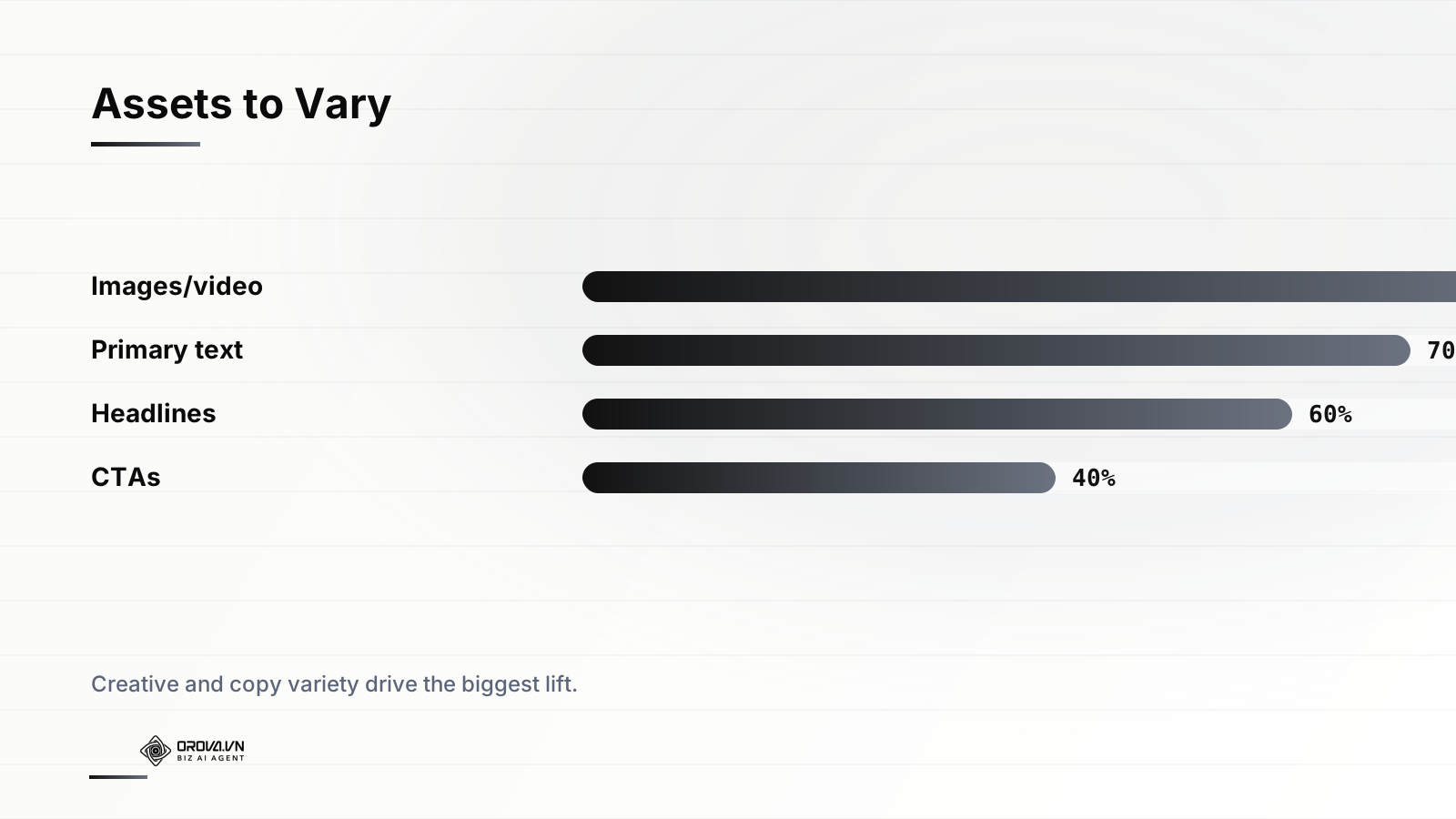
Not all assets are equal in their impact on performance. Years of testing across accounts consistently show that the visual layer — the image or video — carries the most weight, followed by the primary text, then the headline, and finally the call-to-action button. That ordering should govern where you invest your production effort. Spending an afternoon writing five clever button label variations while shipping one bland video is investing in the cheapest lever and ignoring the most powerful one.
Lead with the visual
The image or video is the first thing a thumb-stopping a feed encounters, and it does the heavy lifting on whether anyone stops at all. When you assemble your asset pool, the visuals should represent distinct creative concepts, not minor tweaks. A good starting set might include a clean product shot, a person actually using the product, a bold text-overlay graphic that states the core offer, and a short user-style video that feels native to the feed. Each of those is a different hypothesis about what will resonate. The system can only test hypotheses you give it.
Video deserves special attention because the same footage can be cut into multiple distinct openings. The first three seconds determine the vast majority of watch-through, so a fifteen-second clip that opens on the problem, the product, and a customer testimonial are effectively three different ads. Providing those as separate video assets gives the algorithm three real options rather than one.
Then the primary text
Primary text — the body copy above the image — is the second-strongest lever, and it is where you can vary angle rather than just wording. One option might lead with a pain point, another with a specific number or proof point, another with social proof, and another with a direct, no-nonsense offer. Resist the urge to write five rephrasings of the same sentence. The system will happily test "Save time on your commute" against "Cut your commute time," but the lift from that comparison is trivial. The lift from testing a fear-of-missing-out angle against a rational savings angle can be large, because those copy directions appeal to different buying psychologies and pair differently with different images.
Headlines and CTAs as fine-tuning
Headlines and call-to-action buttons are real levers but smaller ones, best treated as fine-tuning once the visual and body angles are working. For headlines, vary the framing: a benefit headline, an offer headline, a curiosity headline, a price-anchored headline. For CTAs, the differences are usually modest but occasionally decisive — "Shop Now" versus "Learn More" can meaningfully change who clicks, because one filters for purchase intent and the other invites the merely curious. Test them, but do not expect a button to rescue a weak campaign.
The relative weight of these levers is summarized in the chart below. It is a useful prioritization map: when your production time is limited, push it toward the top of the list.
How many of each is enough
More options give the system more room, but there is a practical ceiling set by your budget. Every combination needs enough impressions to generate a reliable read, and budget is finite. A reasonable default for a healthy mid-sized ad set is four to six distinct visuals, three to five primary texts, and three headlines. That gives the system a rich grid without spreading the budget so thin that nothing reaches significance. If your daily spend is small, dial the counts down rather than starving every combination of the impressions it needs to prove itself. A pool the algorithm cannot afford to test is just clutter.
- Distinct concepts over volume. Four genuinely different images beat ten variations of one.
- Match pool size to budget. If each combination cannot earn a few hundred impressions, you have too many assets.
- Cover the funnel emotions. Include copy that appeals to rational buyers and copy that appeals to impulse buyers.
- Refresh on a schedule. Even winning combinations decay; plan to rotate in new assets before performance dips.
The Reporting Problem Nobody Warns You About
Here is the catch that frustrates everyone the first time they run dynamic creative seriously: the reporting is incomplete by design. Meta's interface lets you break down a dynamic creative ad by individual asset — you can see how each image performed, how each headline performed, and so on, aggregated across every combination that asset appeared in. What it does not reliably give you is clean, complete performance for each specific combination of assets together.
That gap matters because creative performance is interactive, not additive. An image that looks mediocre in the asset-level breakdown might be a quiet star when paired with one particular headline, and a top-performing headline overall might owe its numbers entirely to one image it happened to ride alongside. The whole premise of dynamic creative is that combinations matter, yet the standard reporting flattens combinations into per-asset averages. You are told which ingredients are good on average but not which recipes are great.
Why the asset-level view misleads
Consider a concrete case. Image A has a 2.1 percent click-through rate in the breakdown and Image B has 1.6 percent, so you conclude A is the winner and you cut B. But B's average was dragged down because the system kept pairing it with a weak headline during the exploration phase, while in the handful of impressions where B ran with your strongest headline it pulled a 3.4 percent click-through rate. By cutting B on its average, you threw away your single best combination. This is not a hypothetical; it is the routine failure mode of judging dynamic creative by asset-level reports alone.
The breakdown view also gets noisier as your pool grows, because each asset's stats are averaged over an unknown and uneven mix of partners. Two assets can have identical aggregate numbers while behaving completely differently underneath. Without combination-level visibility, you cannot tell the difference, and you end up making rotation decisions on a blurred picture.
Working around the gap
There are partial workarounds. You can keep your asset pools small enough that the per-asset view stays interpretable, accepting less combinatorial power in exchange for clearer reads. You can run periodic confirmation tests, taking the combinations the system seems to favor and rebuilding them as standalone ads to measure them cleanly. And you can lean on the platform's API, which exposes more granular delivery data than the dashboard surfaces, to reconstruct combination-level performance yourself. Each of these costs time and analytical effort, which is precisely why most accounts never do them and instead make rotation decisions on incomplete information.
The asset-level breakdown tells you which ingredients are good on average. It rarely tells you which recipes are great. The difference between those two questions is where most of the wasted spend hides.
Creative Fatigue: The Reason This Is Never Finished
Even a perfectly assembled dynamic creative ad has a shelf life. The same audience sees the same winning combination repeatedly, response decays, frequency climbs, and your cost per result drifts upward. This is creative fatigue, and dynamic creative does not exempt you from it — it just changes how you fight it. We have covered the mechanics of how ad fatigue and frequency burnout erode performance in detail elsewhere; the short version is that audiences habituate, and the only durable defense is a steady supply of fresh creative.
The advantage of the dynamic format here is that you do not have to rebuild whole ads to fight fatigue. You can swap individual assets in and out of the existing pool. When the system's top image starts losing steam, you retire that one asset and introduce two new visual concepts, and the algorithm immediately starts testing them against the still-strong copy. The infrastructure stays in place; only the tired ingredient gets replaced. This makes the dynamic format genuinely well suited to a continuous-refresh discipline, provided someone is actually watching for the early signs of decay and acting on them.
What fatigue looks like in the data
Fatigue rarely announces itself with a sudden crash. It shows up as a slow, compounding drift: frequency creeping past three and then four, click-through rate sliding a tenth of a point each week, cost per acquisition inching up while everything else holds steady. By the time these trends are obvious in a monthly report, you have already burned weeks of inefficient spend. The whole game is catching the inflection early, when the curve first bends, and refreshing before the audience tunes you out entirely.
Why this becomes an operations problem
None of the individual actions here are hard. Spotting a frequency trend, identifying which asset has gone stale, sourcing a replacement, and slotting it into the pool are all routine. The difficulty is doing this consistently across dozens of ad sets, every day, without the combination-level blind spots leading you to cut the wrong asset. That is a monitoring and decision-cadence problem more than a creative one, and it is exactly the kind of repetitive, data-intensive work that humans do inconsistently and machines do tirelessly.
- Watch the leading indicators. Frequency and click-through trend turn before cost per result does.
- Diagnose at the combination level, not the asset level. Average performance hides interaction effects.
- Refresh the tired ingredient, not the whole ad. Keep the structure, rotate the asset.
- Maintain a creative backlog. You cannot refresh on schedule if you have nothing ready to ship.
Common mistakes that quietly waste budget
A few errors come up again and again in accounts that adopt dynamic creative without fully understanding it. The first is impatience: turning the ad off before the exploration phase has finished, which means paying for the system to learn and then walking away before it can apply the lesson. Give a new dynamic creative ad at least a week, and judge it on trends rather than the first day's numbers.
The second is fake variety. Uploading ten assets that are really one idea in ten outfits gives the algorithm nothing to discover, and the resulting "optimization" is just the system shuffling between equally average options. The third is over-segmentation of the audience. Dynamic creative shines when it has a broad audience to learn across, because variety in people is what lets it match different combinations to different segments. Pairing rich creative variety with a tightly restricted audience wastes half the mechanism. The fourth, already discussed, is trusting the asset-level breakdown as gospel and cutting assets on blended averages that hide their best pairings.
Finally, many accounts set dynamic creative live and then forget it. The format is built for continuous refresh, and an ad set you have not touched in two months is almost certainly fatigued, serving a tired winning combination to an audience that stopped responding weeks ago. The format does not maintain itself; it just makes maintenance cheaper for whoever shows up to do it.
How an AI Optimization Layer Reads Dynamic Creative
This is where automated optimization earns its keep, because the weaknesses of dynamic creative — noisy early data, incomplete combination reporting, gradual fatigue across many ad sets — are precisely the problems that reward constant, patient, quantitative attention. An AI agent watching your account does not get bored on day three, does not forget to check the frequency trend on a Friday, and does not eyeball an asset-level average and jump to a conclusion.
Reading combinations the dashboard hides
An automation layer pulling data through the API can reconstruct more of the combination-level picture than the standard interface shows. Instead of judging an image by its blended average, it can look at how that image performs against each headline it has been paired with, separate genuine interaction effects from exploration noise, and flag the combinations that are quietly outperforming. That turns the reporting gap from a permanent blind spot into a solvable analysis problem — one that simply requires more computation than a human is willing to do by hand every morning.
Acting on fatigue before it costs you
The same layer watches the leading indicators across every ad set at once. When frequency climbs and click-through bends downward on a specific combination, it can identify which asset is dragging, recommend retiring it, and propose introducing fresh variations into the pool — all before the cost per result has visibly moved. Because the actions are small and surgical, swapping one asset rather than rebuilding a campaign, they are low-risk and easy to keep under human control. The point is not to remove the marketer from the loop. It is to make sure the loop runs every day instead of whenever someone remembers to log in.
Keeping a human on the decisions
The healthiest version of this is not full autopilot. It is a system that does the relentless reading and proposes the moves, while a person retains approval over anything that changes spend or kills a creative. You get the machine's consistency and the human's judgment, with a record of every change so you can see exactly what was adjusted and why. For dynamic creative specifically — where the data is genuinely ambiguous and the cost of cutting the wrong asset is real — that combination of tireless analysis and accountable human approval is the right balance.
Dynamic creative rewards variety, punishes laziness, and never truly finishes. If you want a system that reads your combination data daily, catches fatigue before it bleeds budget, and proposes the exact asset swaps to keep your best ads winning, Orova Ads is an AI agent that does this across Google, Meta, and TikTok — recommending and executing budget, bid, audience, and on-off changes with your approval and a full audit log of every move.
Read next: Dynamic & Responsive Ad Creative: How AI Assembles Ads
Orova Ads optimises campaigns for you
Connect Google, Meta and TikTok in one place. AI reads the numbers, proposes changes and executes under the rules you set.
Explore Orova Ads