
How to Set an Ads Budget That Matches Growth Goals
Your ads budget should not be a number you pick. It should be a number you derive: revenue goal ÷ average order or deal value gives the customers you need, multiplied by what one customer actually costs to acquire, and that product is the budget. Everything else in this article is about getting those three inputs honest.
Ask ten marketers how they set their ads budget and you will hear ten versions of the same answer: "We spend what we spent last year, plus a bit more." Or worse: "Finance gave us a number and we make it work." Both share a fatal flaw. The budget is treated as an input you guess at, when it should be an output you calculate. What you spend on ads is the last thing to decide, not the first.
Here is how the guessing game goes wrong. A B2B software company set a monthly ads budget of $40,000 because that was roughly 10% of revenue and "10% felt right". Their average customer was worth $9,600 in lifetime value, and their cost to acquire one through paid channels was around $1,800. At $40,000 a month they could afford about 22 new customers. Their actual growth target required 38 a month. The budget was not slightly off — it was sized for a company growing at half the rate the board had signed off on. Nobody noticed until Q3, when the pipeline came up short and everyone blamed the ads for underperforming. The ads were performing fine. The budget had never been connected to the goal.
This article walks through the opposite discipline: working backward from the revenue you actually want to an ads budget that can fund it, then using payback period as a cash-flow guardrail so you do not drain the bank account chasing the number. The maths is not complicated. Doing it honestly is the hard part.
Why a gut-feel ads budget fails in both directions
A budget set by instinct fails in two opposite and equally expensive ways, and most teams cycle between them.
The first failure is starving growth. You set a conservative number because it feels responsible, and you cap spend even when every signal says the channel is profitable. If a campaign returns three dollars for every dollar in, and you stop feeding it at the budget ceiling, you are voluntarily leaving money on the table. The budget becomes the thing limiting your growth rather than your market, your creative, or your offer. Teams in this trap often congratulate themselves on "efficiency" while quietly losing the category to a competitor who did the math and kept spending into a winning channel.
The second failure is overspending into a hole. You see growth slowing, panic, and pour money in to hit a top-line number. The extra spend buys customers at a cost above what they are worth, or above what your cash position can survive while you wait to recover it. Revenue looks fine on the dashboard for a quarter, and then the unit economics catch up with you. This is how venture-funded companies post impressive growth charts and run out of money at the same time.
Both failures come from the same root: nobody connected the spend to a goal and to the economics that make the goal affordable. A gut-feel budget has no error-correction mechanism because it has no reference point. When you derive the budget from your goal, every part of the chain becomes testable. If the customers do not arrive, you know exactly which assumption broke.
Working backward: the four-step chain
The core method is a chain of four steps. You start with the revenue you want and end with the spend required to fund it. Each link is a simple division or multiplication, but the order matters: you reason from the goal down to the budget, never the other way around.
Step 1: Set a revenue goal that is yours, not a vibe
Begin with the specific revenue number you are accountable for in the period. Not a range, not "grow nicely," but a figure: "$2.4 million in new revenue this year," or "$200,000 in net-new monthly recurring revenue by December." Be honest about whether this number is yours to influence through paid acquisition. If half your revenue comes from renewals and referrals, only the new-business portion belongs in this calculation. Carve out the slice that paid media is actually responsible for, because that is the slice your budget has to fund.
One discipline that separates serious planning from wishful thinking: state the goal as new revenue from paid channels specifically. A team that conflates total revenue growth with paid-channel revenue will always over-size the budget, because they expect ads to pay for growth that organic, sales, and word of mouth were going to deliver anyway.
Step 2: Derive the customers you need
Translate the revenue goal into a customer count. Divide the new revenue you need by the value of a single customer. The version of "customer value" you use depends on your model and your honesty.
- First-order revenue (the value of the initial purchase) is the conservative choice and the right one if your cash is tight or your retention is unproven.
- Lifetime value (the total margin a customer delivers over their relationship with you) lets you justify a larger budget, but only if you can actually wait for that value to materialize and you trust your retention data.
Suppose your goal is $2.4 million in new annual revenue and your average customer delivers $8,000 in first-year revenue. You need 300 new customers in the year, or 25 a month. That number, 25 customers a month, is now your operational target. Everything downstream serves it.
Step 3: Apply your real cost to acquire a customer
Now multiply the customers you need by what it costs to acquire one. Customer acquisition cost, or CAC, is the total you spend to win a single customer through paid channels. The word "real" is doing heavy lifting here. Your blended CAC across all channels is not the same as your paid CAC, and the paid CAC you achieved last quarter at low volume is not the CAC you will see when you double spend.
Use the CAC you have actually observed in the channel and at roughly the volume you are planning. If your historical paid CAC is $1,500 and you need 25 customers a month, the arithmetic says you need $37,500 a month in spend to deliver the customers your revenue goal requires. That is your derived budget. It is an output of the goal, not a guess that preceded it.
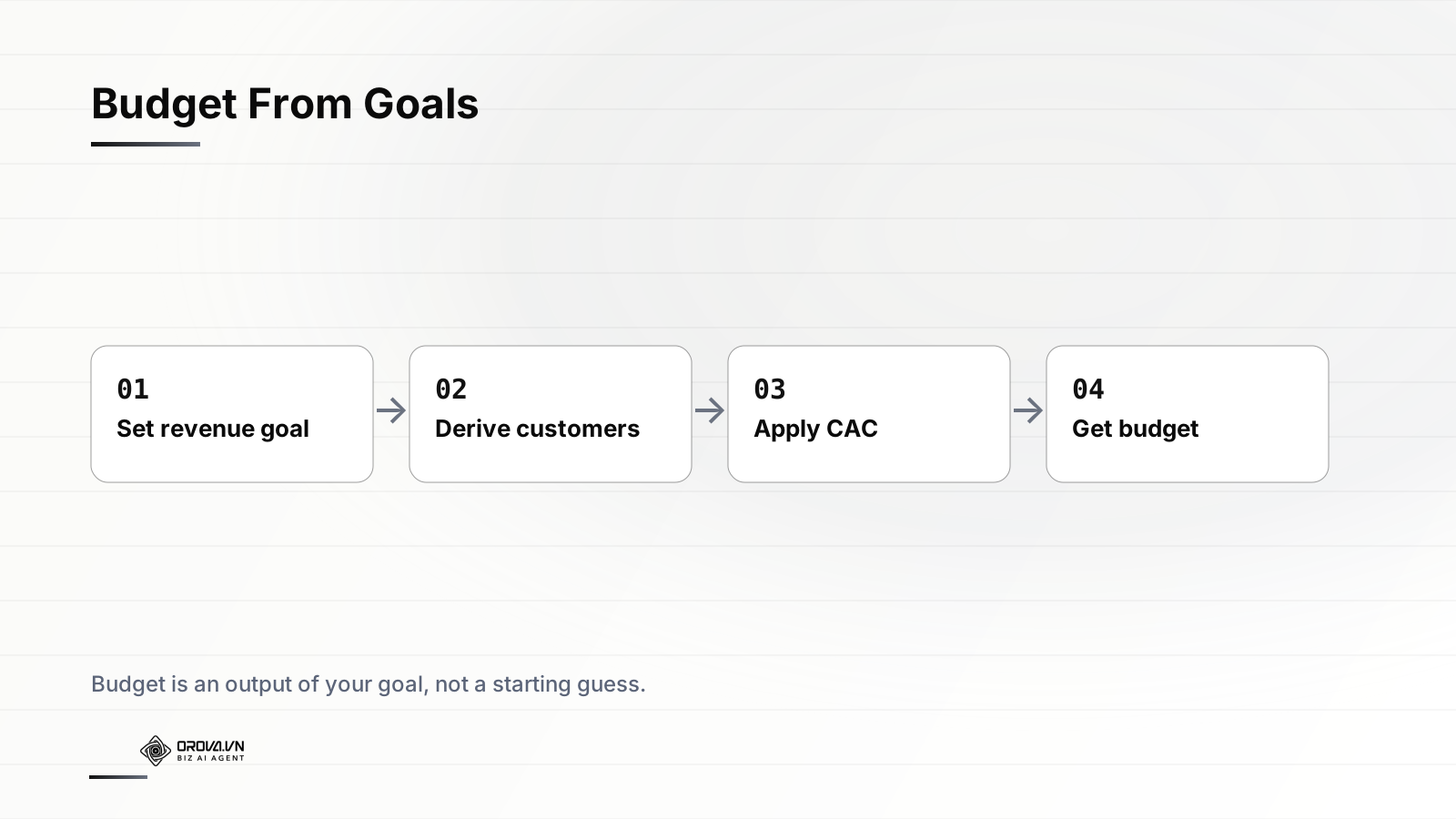
Step 4: Get the budget, then pressure-test it
The output of step three is a candidate budget. Before you commit to it, run it through two pressure tests.
First, check it against capacity. Can your funnel actually convert the traffic that $37,500 will buy? Can sales handle 25 new conversations a month? Can fulfillment onboard 25 new customers without the experience collapsing? A budget that buys more leads than your business can serve does not produce more revenue; it produces a backlog and a refund queue.
Second, check it against marginal CAC. The CAC on your first $20,000 of spend is almost never the CAC on your next $20,000. As you scale, you exhaust your best audiences and your cost per acquisition rises. If you derived a budget assuming flat CAC across all volume, you will fall short of the customer count, because the later dollars are less efficient than the early ones. Plan for marginal CAC to climb, and treat your derived budget as the floor of a range rather than a precise point.
Payback period: the cash constraint that overrides the math
The four-step chain tells you what you should spend to hit your goal. Payback period tells you what you can afford to spend without running out of money. These are different questions, and ignoring the second is how profitable companies go broke.
Payback period is the time it takes for a customer to repay the cost of acquiring them. If you spend $1,500 to acquire a customer who pays you $300 a month in gross margin, your payback is five months. For those five months, that customer is a hole in your bank account. Until they cross the payback line, you have spent money you have not yet recovered.
Here is why this constrains your budget independently of profitability. Imagine a subscription business where every customer is wildly profitable over two years but takes eleven months to pay back acquisition cost. If you scale spend aggressively, you are funding eleven months of acquisition cost for every cohort before the first cohort starts repaying. The faster you grow, the deeper the cash hole gets before it reverses. You can be growing, profitable on paper, and insolvent in the same quarter. This is the precise trap that catches teams who optimize for growth charts and forget that cash is a separate, harder constraint than profit.
Profit tells you whether a customer is worth acquiring. Payback tells you whether you can afford to acquire them at the speed you want. A budget plan that respects only the first will eventually be corrected by your bank balance.
Setting a payback ceiling
The practical move is to set a maximum acceptable payback period given your cash position, then let it cap your spend velocity. A well-funded company might tolerate twelve-month payback because they can finance the gap. A bootstrapped company living on monthly cash flow might need payback under three months, which forces a smaller, slower budget even when the longer-term economics would justify spending more.
This is the uncomfortable truth that pure goal-backward math hides: sometimes the budget your goal requires is larger than the budget your cash can survive. When that happens, you do not ignore the cash constraint and hope. You either find financing to bridge the payback gap, lower the growth goal to match what cash allows, or improve the economics (raise prices, lift retention, shorten payback) until the required budget becomes affordable. What you must not do is spend the goal-derived number while quietly hoping the cash works out. It will not.
A worked example, end to end
Let us run the whole thing for a hypothetical company so the chain is concrete.
- Revenue goal: $1.2 million in net-new annual recurring revenue from paid channels.
- Customer value: average new customer pays $400 a month, so $4,800 in first-year revenue.
- Customers needed: $1,200,000 divided by $4,800 equals 250 new customers, or roughly 21 a month.
- CAC: observed paid CAC of $1,200 at current volume.
- Derived budget: 21 customers times $1,200 equals about $25,000 a month.
So far the math is clean: spend $25,000 a month to land 21 customers and hit the revenue goal. Now apply the constraints.
Marginal CAC: at current volume CAC is $1,200, but the team estimates that doubling spend pushes marginal CAC to $1,600 as they exhaust their best audiences. To actually deliver 21 customers, the realistic budget is closer to $28,000–$30,000, not $25,000. The naive number would have left them four or five customers short every month.
Payback: gross margin is 80%, so each customer returns $320 a month in margin. At $1,200 CAC, payback is just under four months. The company has six months of runway and modest monthly cash flow. Four-month payback against a six-month cash buffer is survivable but tight, especially because every new cohort adds another four-month hole before it repays. The finance lead sets a rule: ramp to the full budget over a quarter rather than overnight, so the cash holes from successive cohorts stagger instead of stacking.
The final plan is not "spend $25,000." It is "ramp from $18,000 to $30,000 over the quarter, expect marginal CAC to rise to $1,600, hold a four-month payback ceiling, and revisit if cash flow tightens." That is a budget connected to a goal, stress-tested against economics, and bounded by cash. It is the kind of plan that survives contact with a real quarter.
Translating a derived budget into daily reality
A monthly budget is a planning artifact. Ad platforms spend money by the hour and the day, and a budget that is correct on a spreadsheet can still be wasted by sloppy execution. Two execution problems quietly undo good budget math.
Pacing
The first is pacing. If your plan is $30,000 a month and the platform front-loads spend in the first ten days, you can burn 60% of the budget before you have learned which campaigns are working, then crawl through the back half of the month starved for data. Conversely, an over-cautious daily cap can leave thousands unspent at month end, which means you missed customers your goal required. Smooth, deliberate pacing toward the derived number is what keeps the monthly math honest. We go deeper on this in our guide to budget pacing on autopilot, which covers how to keep daily spend tracking toward the monthly target without manual babysitting.
Allocation across channels
The second is allocation. Your derived budget is a total, but it has to be split across Google, Meta, TikTok, and whatever else you run, and the split should follow marginal CAC, not habit. The dollar that buys your cheapest next customer should be funded before the dollar that buys an expensive one, regardless of which platform it lives on. In practice this means continuously shifting budget toward the channels and campaigns with the best marginal economics, and pulling it from the ones whose CAC has crept above your ceiling. Done by hand, this is a weekly chore that most teams skip. Done well, it is the difference between hitting your customer target at the budget you planned and missing it while spending the same money.
Revisiting the budget as the inputs move
A derived budget is not a one-time calculation you file away. Every input in the chain drifts, and when it does, the budget that flows from it changes too. Treat the chain as a living model you re-run on a regular cadence, not a number you set in January and defend until December.
- When CAC rises, either your budget must grow to hit the same customer count, or your customer count and revenue goal must come down. Pretending CAC is still last year's number is the single most common way budgets quietly detach from reality.
- When customer value improves (you raise prices, lift retention, or upsell more), you can afford a higher CAC, which means you can spend more to win the same customer and still hit your payback ceiling. Better economics unlock a bigger budget, not just fatter margins.
- When conversion rates change downstream, the leads your budget buys turn into more or fewer customers, and the whole chain shifts. A landing page improvement that lifts conversion 20% is, in budget terms, a 20% CAC reduction.
- When cash position changes, your payback ceiling moves, and with it the maximum velocity you can spend at. A new funding round or a strong cash quarter can justify scaling faster; a tight month should pull spend back even if the long-term economics still look great.
The teams who do this well review the full chain monthly: actual CAC versus assumed, actual customer value versus assumed, actual payback versus the ceiling. When an assumption breaks, they adjust the budget deliberately instead of discovering the gap in a quarterly miss. The review takes an hour. The miss it prevents costs a quarter.
Common mistakes that break the chain
Even teams that adopt the goal-backward method tend to trip over the same handful of errors. Watch for these.
- Using blended CAC to justify paid spend. Blended CAC includes customers who came from organic, referral, and direct, who would have arrived without any ad spend. Sizing a paid budget on blended CAC makes paid look cheaper than it is and leads to over-spending. Use paid-channel CAC for paid-budget decisions.
- Assuming flat CAC at scale. The CAC at $10,000 a month is not the CAC at $50,000 a month. Build rising marginal CAC into the plan or you will consistently come up short on customers.
- Counting lifetime value you cannot wait for. LTV justifies a bigger budget, but only if your cash can survive the payback gap. Optimistic LTV plus thin cash is the classic recipe for growing into insolvency.
- Ignoring funnel capacity. Buying more leads than sales and onboarding can serve does not create revenue. It creates a backlog, a worse customer experience, and refunds. The budget should never outrun the funnel's ability to convert and serve.
- Setting the budget once. A budget that never gets revisited drifts from reality within a quarter as CAC, conversion, and cash all move. Re-run the chain on a schedule.
Putting it into practice
The method is straightforward enough to write on a whiteboard: start from the revenue you want, divide by what a customer is worth to get the customers you need, multiply by what a customer costs to get the budget, then bound it all with a payback ceiling your cash can survive. The reason most teams do not do it is not difficulty. It is that working backward from the goal forces uncomfortable honesty. It exposes when the goal is unaffordable, when CAC has crept up, when the cash position cannot support the growth rate the board expects. A gut-feel budget lets you avoid those conversations until the quarter forces them on you. A derived budget makes you have them in advance, when you can still do something about them.
Do the math once, properly, and you will never again wonder whether your budget is too big or too small. You will know, because the budget will be the answer to a question you actually asked: what does it cost to fund the growth I have committed to, and can my cash survive the wait?
If you would rather not babysit pacing, marginal CAC, and channel allocation by hand every week, Orova Ads is an AI agent that manages paid spend across Google, Meta, and TikTok for you. It reads your account data daily, paces toward the budget you derived from your goals, recommends and executes optimizations across budget, bids, on/off, and audiences, and flags overspend before it happens, all with human-in-the-loop approval and a full audit log so you stay in control. See how it keeps your spend tied to your growth goals at orova.vn.
Related reading: ROAS Formula & Conversion Lag: Why Today's ROAS Is Wrong
Orova Ads optimises campaigns for you
Connect Google, Meta and TikTok in one place. AI reads the numbers, proposes changes and executes under the rules you set.
Explore Orova Ads