
Ad Campaign: How to Structure One That Covers the Funnel
You are probably running more than one ad campaign right now, and each one looks fine on its own. The awareness video is getting views, the retargeting campaign is getting clicks, the conversion campaign is getting some sales. But if you add it all up, you are spending real money every month on people who never move from "saw the ad" to "bought the thing" — because nothing in your setup is actually pushing them there.
The usual fix is to just add more campaigns or switch to whatever objective is trending this month, hoping something sticks. That does not work because the problem was never the number of campaigns — it is that they are not talking to each other. Your awareness campaign builds a big audience, but your conversion campaign ignores that audience and goes hunting for cold strangers instead. So you pay once to get attention, then pay again in full to try to win it back. That disconnect is not just a strategy problem — it is a budget leak: roughly a quarter of programmatic ad spend is wasted on inefficient buying and invalid impressions, according to the ANA Programmatic Transparency Study, and a funnel where campaigns do not hand off audiences to each other is exactly the kind of setup that produces waste like that.
This article shows you how to connect those pieces into one working ad campaign structure, so the audience you already paid to reach becomes the audience your sales campaigns can actually sell to. By the end, you will know how to line up each stage of your funnel with the right goal, how to pass warm audiences from one campaign to the next instead of starting cold every time, and how to judge each stage by the right result instead of expecting every single campaign to directly produce sales.
What an Ad Campaign Is, and How It Is Built
An ad campaign is a set of ads sharing one goal and one budget. Every major platform uses the same three-level structure, and knowing it makes the settings obvious.
Campaign — where you choose the objective. Sales, leads, traffic, awareness. This single choice decides which people the platform shows you to, so getting it wrong wastes everything below. Ad set (or ad group) — where the money and the audience live. Budget, targeting, placements, schedule. Ad — the creative itself: image or video, headline, text, link.
A common mistake: one campaign trying to do everything. Someone who has never heard of you and someone who abandoned a cart yesterday need different messages and different budgets. Splitting them costs nothing and usually improves both.
How many: most small businesses need three campaigns, not thirty — one to reach new people, one to bring back visitors, one for existing customers.
The rest of this article builds that three-part structure out properly, with what to say and spend at each stage.
Why "full-funnel" is an architecture problem, not a campaign list
The phrase "full-funnel" gets thrown around as if it means "we run top, middle, and bottom campaigns." That is necessary but not sufficient. Plenty of accounts have all three and still leak badly. The reason is that having campaigns at every stage tells you nothing about whether they connect.
Think of the funnel as a plumbing diagram rather than a list of buckets. Water enters at the top — strangers who have never encountered you. Each stage is a valve and a holding tank. The awareness stage fills a tank of people who now recognize you. The consideration stage draws from that tank, qualifies the people who lean in, and fills a second, smaller, warmer tank. The conversion stage draws from that second tank and turns intent into revenue. The connections between tanks — the pipes — are your audience definitions, your retargeting windows, and your exclusion rules. If the pipes are missing, each tank fills from the cold municipal supply, which is the most expensive water you can buy.
This framing matters because it reorders your priorities. Once you see the funnel as plumbing, the first question stops being "what should my conversion ROAS be?" and becomes "is my conversion campaign actually drinking from the warm tank, or is it back on the cold supply?" In most underperforming accounts, the answer is the cold supply, and no amount of bid tuning on the conversion campaign will fix that, because the problem is upstream.
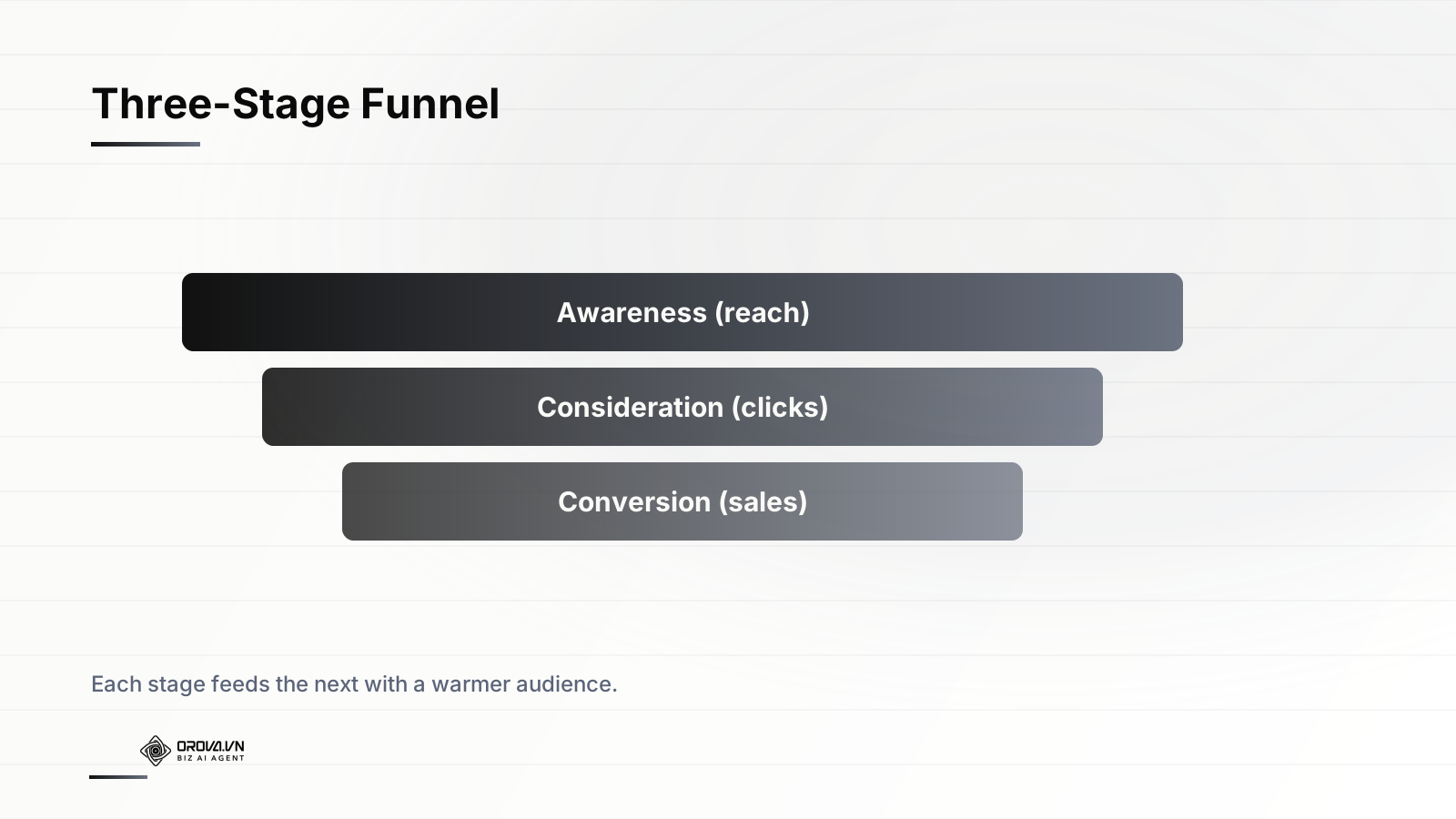
The three stages and the job each one actually does
Stage definitions get fuzzy, so let me be concrete about what each stage is responsible for and, just as importantly, what it is not responsible for.
- Top of funnel (TOFU) — Awareness. Its job is to put your brand in front of the right strangers as efficiently as possible and to make a measurable number of them engage enough to become a known audience. Its job is not to drive sales. If you judge a TOFU campaign by last-click ROAS, you will kill it, and then you will wonder why your remarketing pools are empty three weeks later.
- Middle of funnel (MOFU) — Consideration. Its job is to take the audience TOFU created and move it from "I have heard of this" to "I am evaluating this." That means clicks to a comparison page, video views past 50%, add-to-carts, lead form opens, content downloads — intent signals short of purchase. MOFU qualifies. It separates the curious from the merely reached.
- Bottom of funnel (BOFU) — Conversion. Its job is to close people who have already shown intent. This is where ROAS and cost per acquisition belong. BOFU should be your cheapest, most efficient stage on a per-conversion basis precisely because the two stages above it did the expensive work of warming the audience.
The single most common mistake I see is asking one stage to do another's job. Brands run BOFU-style conversion campaigns against cold audiences because conversion campaigns "have better ROAS in the reports." They do — on the small slice of cold traffic that was going to buy anyway. But they cannot scale, because there is no warm pool feeding them. The reported ROAS looks great until you try to spend more, at which point it collapses, because you have run out of the people who were already in-market and you are now paying conversion-campaign prices to reach total strangers.
Mapping objectives to stages
Once you accept that each stage has a distinct job, the platform objective you choose for it follows naturally. The objective is the instruction you give the ad platform's optimization engine, and it should match the job, not the revenue you wish you were getting.
Top of funnel objectives
For awareness, choose reach, brand awareness, or video views, depending on your creative. The goal is broad, efficient exposure to a defined cold audience — interest stacks, broad demographics, or a large lookalike off your customer list. The metric you optimize toward is cost per thousand impressions (CPM) and, critically, the rate at which exposed users become engagers. A TOFU campaign that reaches two million people but generates zero video completions and zero engagement has filled no tank. It has burned money on impressions that left no trace.
This is the stage where practitioners get nervous, because awareness spend does not show up as revenue in the same reporting window. Resist the urge to bolt a purchase objective onto your awareness campaign to "make it pay for itself." When you do that, the algorithm narrows your reach to the tiny pool most likely to convert immediately, which defeats the entire purpose of the stage. The whole reason TOFU exists is to reach people who will not buy today.
Middle of funnel objectives
For consideration, choose traffic, engagement, or — better — a custom conversion event that represents qualification: viewed a product page for more than thirty seconds, watched 75% of a demo, added to cart, started a quiz. The audience for this stage is the engaged segment your TOFU campaigns produced: video viewers, page engagers, profile visitors, ad clickers. You are no longer targeting strangers; you are targeting people who raised a hand, however slightly.
The objective here optimizes for click-through rate and cost per qualified click or cost per intent event. A good MOFU stage takes a large, lukewarm pool and concentrates it into a smaller, hot pool while filtering out the people who were never serious. This is the stage where your differentiation messaging lives — comparisons, social proof, objection handling, the "why us and not them" content.
Bottom of funnel objectives
For conversion, choose the purchase, lead, or sign-up objective and point it at the warm pools the funnel built: cart abandoners, recent product-page visitors, MOFU engagers, past customers for repeat purchases. This is the only stage where you should be optimizing directly toward revenue events, and it is the only stage where ROAS and CPA are the headline metrics.
Because the audience is pre-qualified, BOFU campaigns can afford aggressive bidding and direct-response creative — discount codes, urgency, free shipping thresholds, "complete your order." The efficiency here is borrowed from the work upstream. If your BOFU ROAS is strong and your pools are large, that is the signal your funnel is wired correctly. If your BOFU ROAS is strong but the pools are tiny and never grow, you have a great closer and an empty pipeline.
Designing the audience handoffs
The handoffs are where full-funnel structures live or die, and they are the part most accounts neglect. A handoff is the rule that takes the output of one stage and makes it the input of the next. In practice it is built from two things: custom audiences that capture each stage's engagers, and exclusion rules that prevent stages from cannibalizing each other.
Building the source audiences
Every stage needs to emit a trackable audience that the next stage can target. Set these up before you spend a dollar, because they take time to populate and you cannot retroactively capture engagement you failed to track.
- From TOFU: video viewers (25%, 50%, 75%, 95% thresholds), post engagers, page or profile visitors, and ad clickers over a rolling 30 to 90 day window depending on your sales cycle.
- From MOFU: website visitors who hit key pages, product viewers, content downloaders, lead-form openers who did not submit, and add-to-cart users.
- From BOFU: purchasers and converters, which become both an exclusion list for acquisition and a seed list for retention and lookalike expansion.
The warmer the source audience, the smaller and more responsive it is. A 95% video-view audience is far smaller than a 25% one, but the people in it are worth more per head. Tier your remarketing windows accordingly: target recent, deep engagers with your most aggressive offers, and use longer windows with softer reminders for the broader pool.
Exclusions: the rule everyone forgets
Exclusions are what make the funnel a funnel rather than three overlapping puddles. The principle is simple: each stage should exclude the audiences that belong to the stages below it, so you are never paying awareness prices to reach people who are already deep in consideration, and never paying to convince someone to "consider" a product they bought last week.
- TOFU should exclude all known engagers, MOFU audiences, and customers. It exists to find new people; spending it on warm audiences is waste.
- MOFU should exclude recent purchasers and, usually, your hottest BOFU retargeting pool, so you are not running consideration content at someone who is one click from buying.
- BOFU should exclude recent purchasers (unless the product is consumable or subscription) to avoid paying to "convert" people who already converted.
Without these exclusions, your stages compete in the auction for the same people. You end up bidding against yourself, inflating your own CPMs, and double-counting conversions across campaigns. I have seen accounts cut wasted spend by 15 to 25% just by installing a clean exclusion hierarchy — no new creative, no new budget, just plumbing.
Measuring each stage by its own KPI
If you take one operational habit from this article, make it this: stop judging your entire funnel by a single metric. The reason full-funnel structures get dismantled is almost always a measurement error. Someone opens the dashboard, sorts by last-click ROAS, sees that the awareness campaign has a ROAS of 0.3, and pauses it. Two weeks later, conversion volume drops, because the pool feeding BOFU stopped refilling. Nobody connects the two events, because the dashboard does not show that relationship.
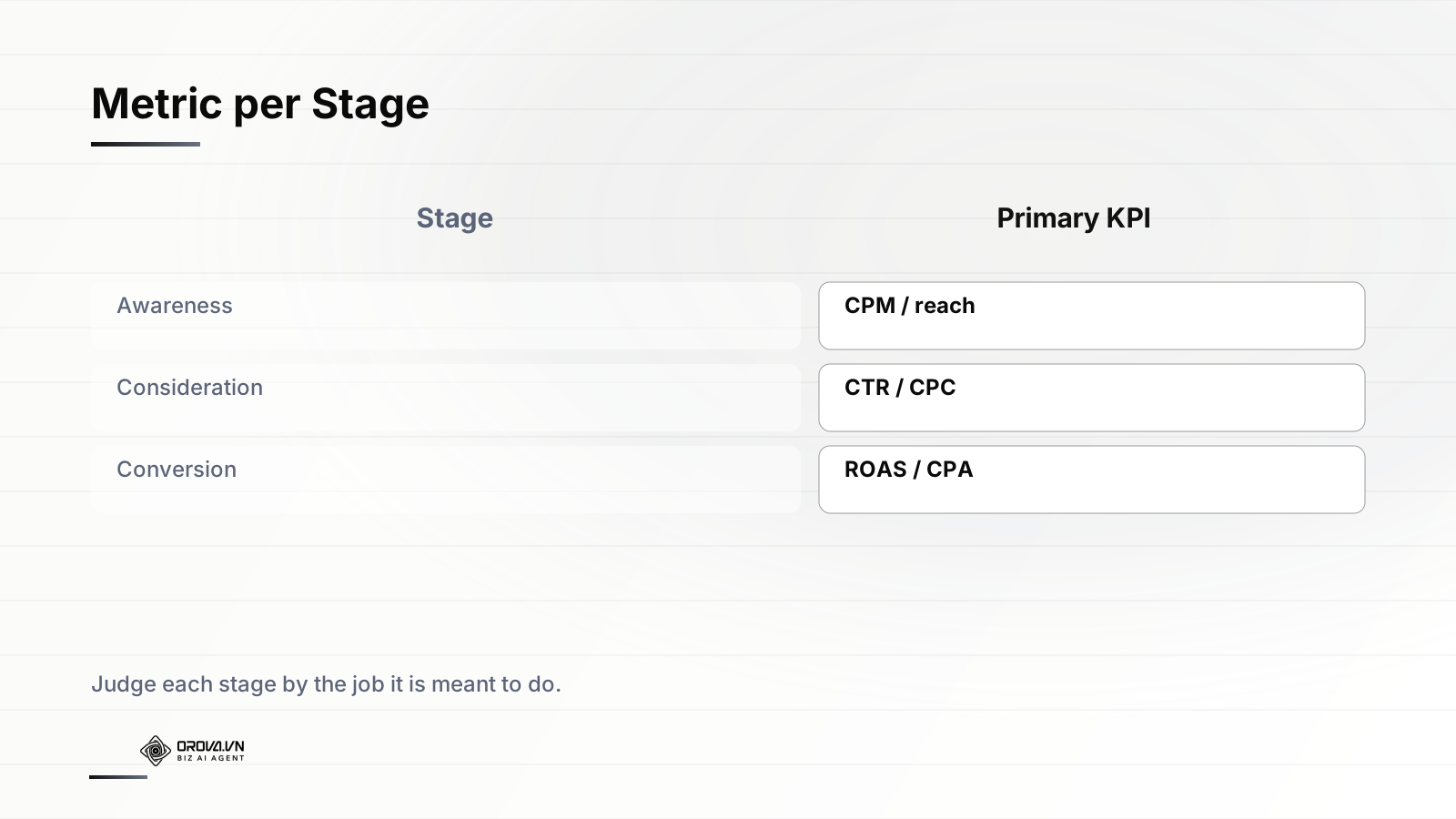
Each stage has a different job, so each stage gets a different scorecard.
Awareness KPIs
- CPM and reach — are you buying attention efficiently?
- Engagement rate and audience growth — how fast are your remarketing pools filling? This is the real output metric of TOFU. A healthy awareness stage shows your warm audiences growing week over week.
- Frequency — are you over-exposing the same people instead of reaching new ones?
Consideration KPIs
- Click-through rate and cost per click — is the warm audience actually leaning in?
- Cost per intent event (add-to-cart, lead-form open, deep page view) — the true measure of qualification.
- Pool conversion rate — what share of TOFU engagers progress to MOFU intent? This number tells you whether your consideration messaging is doing its job.
Conversion KPIs
- ROAS and CPA — the headline efficiency numbers, which belong here and only here.
- Pool depletion rate — how fast are you burning through the warm audience? If BOFU is converting faster than MOFU and TOFU can refill the pools, you will hit a ceiling.
The connective tissue across all of this is incrementality and assisted-conversion reporting. Last-click attribution systematically undervalues TOFU and MOFU because it credits the final touch with the whole sale. Use a multi-touch or data-driven attribution model, look at view-through and assisted conversions, and run the occasional geo holdout or lift test to see what your upper funnel is genuinely contributing. The funnel only makes sense when you can see how the stages assist each other; judged in isolation by last click, the top of your funnel will always look like a waste, and you will keep dismantling the thing that makes the bottom work.
The fastest way to ruin a working funnel is to evaluate every stage by the metric that only belongs to the last one. Awareness will always lose a ROAS contest. That does not mean it lost money.
Keeping the funnel balanced as audiences move down
A full-funnel structure is not a static thing you build once. It is a flow system, and the flow rate changes constantly. Audiences move down. Pools fill and drain. The right budget split between stages in week one is the wrong split in week six, because by then your warm pools are large and your bottleneck has moved.
Reading the bottleneck
At any given moment, one stage is the constraint on the whole system. Your job is to find it and feed it.
- If your BOFU pools are draining faster than they refill — high conversion efficiency but flattening volume — your constraint is upstream. Shift budget into TOFU and MOFU to widen the top.
- If your warm pools are large but conversions are not keeping pace — engaged audiences sitting idle — your constraint is BOFU capacity or BOFU creative. Shift budget down and refresh your closing offers.
- If your TOFU frequency is climbing and reach is stalling, you have saturated your cold audience. Expand targeting or refresh creative before pouring in more budget.
This is exactly the kind of rebalancing that punishes a once-a-month manual review. By the time you notice in the monthly report that BOFU pools have run dry, you have already lost two or three weeks of compounding. The funnel rewards frequent, small adjustments far more than occasional large ones — the same discipline that separates accounts that scale cleanly from those that lurch from one fire drill to the next. When you do find a stage that is firing on all cylinders and ready to take more budget, the way you push that budget matters as much as the decision to push it; pour it in too fast and you can knock the campaign back into the learning phase, which is why scaling winners without breaking the learning phase deserves its own deliberate playbook rather than a reactive "spend more" reflex.
Why this is hard to do by hand
Balancing a funnel correctly means watching, every day, the fill and drain rates of multiple audience pools, the frequency curves on your cold audiences, the cost-per-intent on consideration, and the pool-depletion rate at the bottom — and then making proportional budget moves across stages without overcorrecting. Doing this well across Google, Meta, and TikTok simultaneously, where the pools and signals live in three different interfaces, is genuinely beyond what most teams can sustain manually. It is not that marketers cannot do the math; it is that the math needs doing every single day, per stage, per platform, and nobody has that many hours.
The order of operations for building one
If you are starting from scratch or rebuilding a messy account, do it in this sequence:
- Define your three stages and write down the single job and primary KPI for each before you touch a campaign.
- Set up every source audience and the tracking behind it. You cannot retarget engagement you never captured.
- Build the exclusion hierarchy so stages do not cannibalize each other.
- Match each stage's objective to its job — reach for TOFU, intent for MOFU, conversion for BOFU.
- Launch TOFU and MOFU first and let the warm pools populate for a sales-cycle's length before you expect BOFU to scale.
- Instrument multi-touch attribution so you can see the assists, then rebalance budget weekly against the bottleneck.
Skip the early steps and you get the same broken account everyone else has: three stages that do not connect, a top of funnel that looks like waste under last-click, and a bottom of funnel that converts beautifully right up until you try to grow it. Get the wiring right and the opposite happens — the reach you bought becomes the intent you qualify becomes the revenue you close, and each month's spend leaves behind warm audiences that make next month cheaper.
The payoff of a connected funnel
A correctly wired full-funnel structure does something no single high-performing campaign can: it compounds. The audience you reach today is the conversion pool you draw from next month. The intent signals you qualify this week lower your acquisition cost the week after. Because each stage feeds the next a warmer audience, your blended cost per acquisition trends down over time even as you scale spend up — the exact opposite of what happens when you push budget into disconnected conversion campaigns and watch efficiency collapse the moment you exceed the in-market crowd.
None of this requires exotic tactics. It requires discipline about jobs, honesty about measurement, and constant small adjustments to keep the flow balanced. The architecture is simple. The maintenance is relentless. That gap — between a structure that is easy to design and a structure that demands daily attention to stay healthy — is precisely where most funnels quietly degrade.
If you want a full-funnel structure that actually stays balanced without living in three ad managers all day, Orova Ads is built for exactly this. It is an AI agent that manages your paid campaigns across Google, Meta, and TikTok — reading your data daily, watching how pools fill and drain across every stage, and recommending the budget shifts, bid changes, on/off calls, and audience moves that keep the funnel flowing. It executes those optimizations with human-in-the-loop approval and a full audit log, so you stay in control while the agent does the relentless daily maintenance a connected funnel demands. See how it works at orova.vn.
Let the Handoffs Run Themselves
Everything described above — mapping stages, building the audience handoffs, checking each stage against its own goal, rebalancing when one stage gets too big or too small — is doable by hand. It is also the kind of work that quietly eats a few hours every week, because audiences drift, budgets need rechecking, and nobody notices a broken handoff until the money is already spent.
Orova Ads is built to take that ongoing maintenance off your plate, keeping the audience handoffs between your campaigns connected and adjusting as people move through the funnel, so you are not the one manually stitching it together every week. If that sounds like the part of this you would rather not do yourself, it is worth a look.
Orova Ads optimises campaigns for you
Connect Google, Meta and TikTok in one place. AI reads the numbers, proposes changes and executes under the rules you set.
Explore Orova Ads